
Translated material
“You must know the heroes of the Northern Military District - learn their names, know their exploits, and then you will pass the Unified State Exam. And if you don’t learn, you won’t pass.”
This is how history is taught in schools in Russia now.
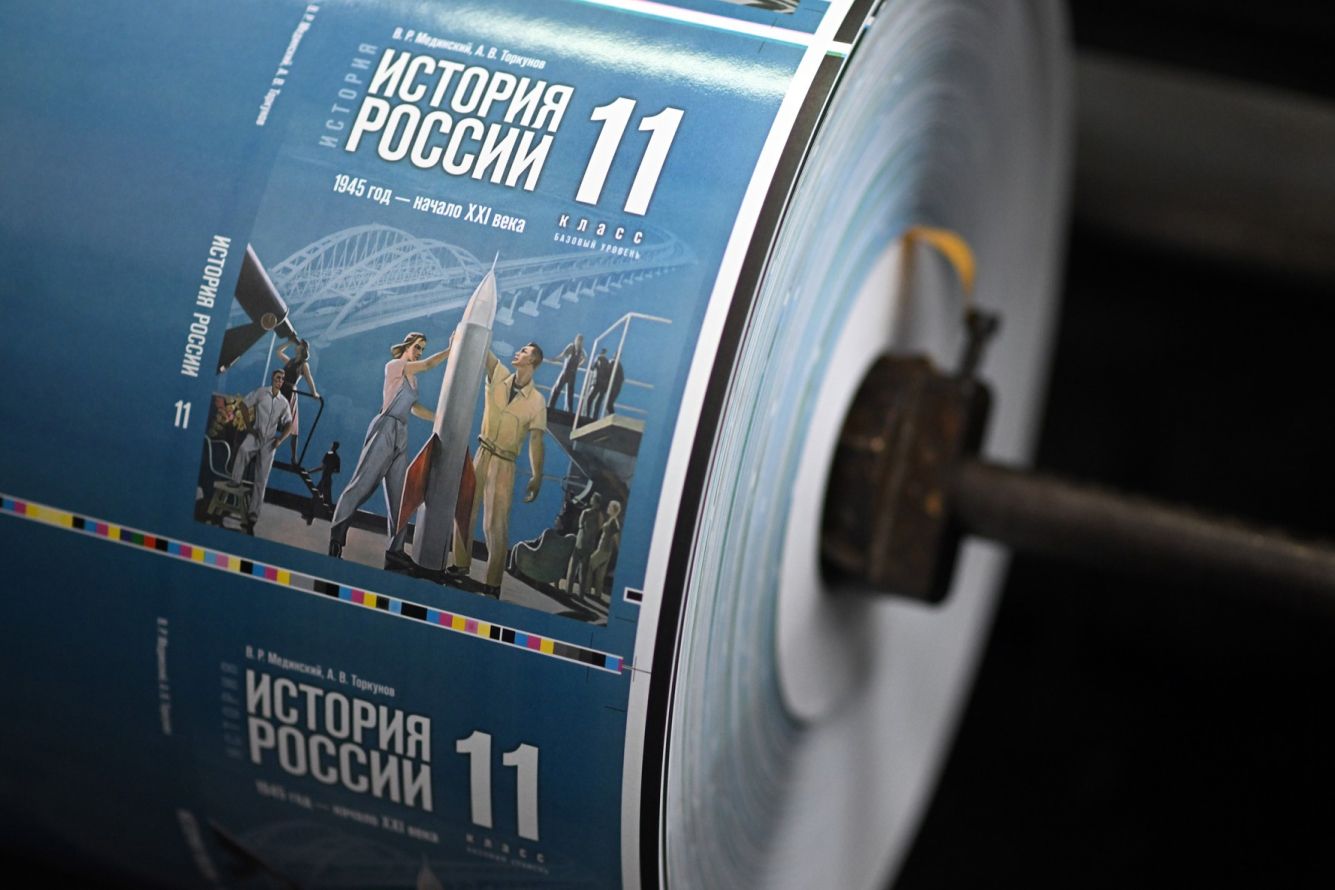
In Russia, since 2023, history in schools in grades 10-11 is taught using a single textbook, the main author of which was Putin’s assistant Vladimir Medinsky. The creators of the textbook did not hide the fact that their main goal was “instilling patriotism.” From September 2026, all schools, starting from the fifth grade, will switch to a single line of textbooks from the same authors. Kommersant interviewed Vladislav Kononov, the executive secretary of this project, an assistant at the Russian Presidential Administration’s Department for State Policy in the Humanitarian Sphere. That's what he said.
On the task of a single textbook
A single textbook provides the necessary basis for general civic identity. We do not have another story, just as each of us does not and cannot have other parents. You can think and ask questions. But if you begin to despise the history of your own country, you have no future as a citizen.
About errors in the textbook
Our textbook has passed many examinations, it was checked by three historical institutes of the Russian Academy of Sciences, and the Ministry of Education organized its own examinations. Now testing is actually underway on a national scale - we are collecting feedback, and this is a normal process. Textbooks are constantly being polished and improved - this has always been the case and this happens with all subjects.
There are not many comments from teachers. The document where I collect comments on the ninth grade textbook is only 15 pages long. This process is endless in a good sense, because there will always be comments of the second order, third, fourth. But I say with all responsibility: there are no factual errors in the textbooks.
About textbook criticism
Textbooks for grades 10–11 sincerely and vehemently criticized only “foreign agents.” Nice to read and listen. For once, they immediately realized that mass speculation on historical topics was coming to an end. I do not agree that those inside Russia were simply afraid to criticize.
About Stalin
Repression cannot be justified under any circumstances. But we must try to understand why these actions were taken, what caused them, and what consequences they led to. There is no “exaltation” of Stalin in the textbook, as some “foreign agents” wrote. It’s just that for the first time in a 10th grade textbook there is a biography of Stalin, his role in history - and in the nineties it turned out that in the Great Patriotic War the Soviet people won without a supreme commander in chief. They hid him bashfully. But we didn't.
We are for an objective and balanced attitude to history, including such controversial personalities as Stalin. Beria is not listed among the marshals of Victory because he has not been rehabilitated. But no one tried Stalin during his lifetime.
Podcast “What Happened” - about a single textbook
About Prince Vladimir
The fact that the textbook does not say that Vladimir killed his brother is not a gloss on history. You always need to remember the level of perception. If in the sixth grade we talk about Prince Vladimir as a fratricide, then this is what the children will remember, and not at all the fact that he baptized Rus'.
The main thing that Prince Vladimir did was not connected with the negative aspects of his biography. If he had not chosen Orthodoxy, there would have been no ancient Russian state. I would like to tell everything about everyone, but what can you do if the space in the textbook is limited. We have no desire to create some kind of myth about Vladimir.
About Gorbachev
The textbook does not make Mikhail Gorbachev the culprit of the collapse of the USSR; this is a very simplified retelling. We invite students to evaluate Gorbachev’s personality for themselves. But there is a clear criterion for assessing a statesman - what he came with at the beginning of his reign and what he left with. If Gorbachev became the head of the Soviet empire, and then the empire disappeared, rate it yourself.
About the Decembrists
The classical liberal, and after it the Soviet, approach was to idealize the Decembrists. Subsequently, this assessment changed to the exact opposite: rebels, conspirators, terrorists who encroached on the foundations of the state. There is no consensus and unambiguous assessment in historical science today. We allow for diversity of opinions.
About other textbooks
Why don't we have an alternative multiplication table? <…> Parents can have any point of view, no one forbids them to have it. They can talk about this topic with their child.
What a student should know
You must know the heroes of the SVO - please learn their names from the textbook, know their exploits and then you will pass the Unified State Exam. And if you don’t learn, you won’t pass.