
Translated material
Undemanding persons
The number of personal bankruptcies in Russia has increased 2.2 times since 2022. We studied what property Russians lose due to debts
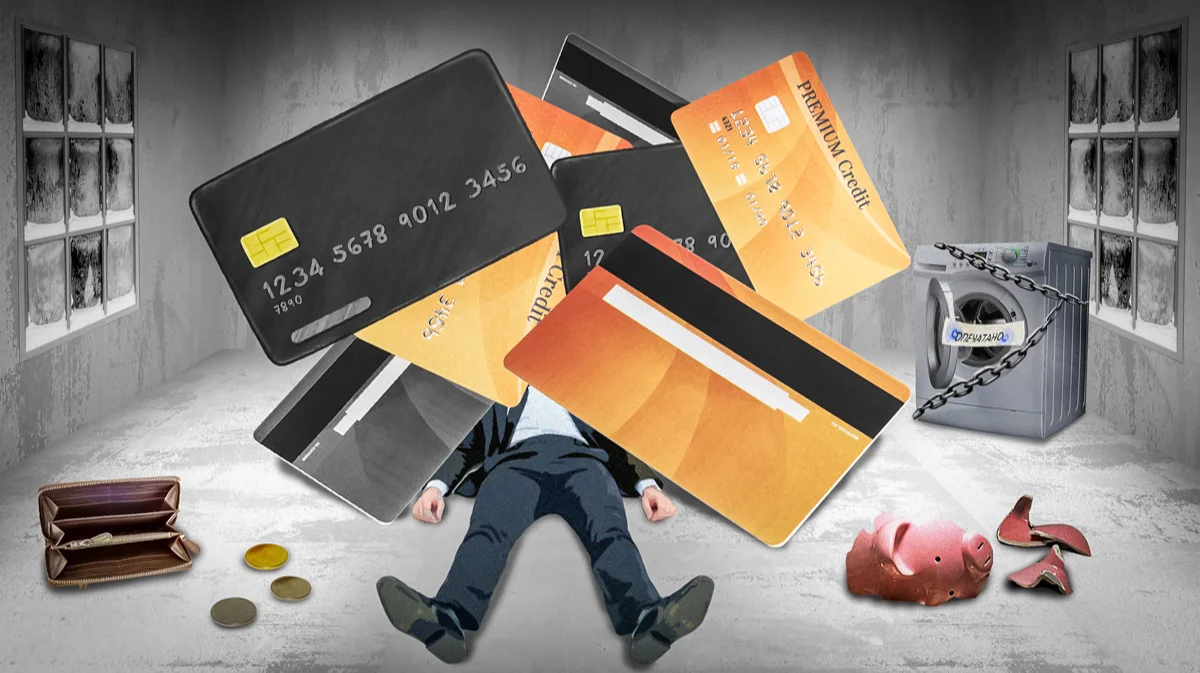
Illustration: “New Newspaper Europe”
The number of Russian bankruptcies in 2025 exceeded half a million for the first time. And the growth doesn't seem to be stopping. “New Europe” has collected all advertisements for the sale of property from debtors. We tell you what is taken from bankrupts and put under the hammer.
52-year-old Andrei Chalkevich from Rostov took out several loans from banks back in 2012 and 2018, but by the fall of 2024 he lost the ability to pay the loans. By the time they went to court, most of the debts, worth 1.6 million rubles, had already been transferred to collectors.
The court appointed an arbitration manager - essentially, this is a representative of creditors who must find property for sale and repay debts as much as possible. And the manager found Andrey’s garden plot of six acres in Azov and household appliances. A washing machine, an old Samsung phone, a TV, even a non-working refrigerator went under the hammer. In total, about 200 thousand rubles were gained from the sale of property, 160 thousand of which were returned to creditors. Andrey was declared bankrupt.
The personal bankruptcy procedure for citizens in Russia was introduced in 2015. It gives people a chance to start a “new financial life,” the Ministry of Economic Development says. “If collection is impossible or economically unfeasible, it is wiser to give the person the opportunity to start over from scratch. People freed from debt return to economic circulation,” explained First Deputy Minister of Economic Development Maxim Kolesnikov.
The sharpest jump in the number of bankruptcies occurred during the Covid years. In 2020, the number of such solutions increased by 75%, and in 2021 by another 63%. Growth has slowed in recent years, but has not yet stopped. The number of bankruptcies grows by a third every year - by 30%.
In just 2.5 years, from the beginning of 2023 to July 2025, Russians wrote off debts of at least 2.1 trillion rubles. This is significant: the entire portfolio of loans to individuals in Russian banks amounts to 39 trillion rubles. That is, about 2% of the portfolio is written off per year.
Nevertheless, this is not yet a risk for the financial system, assessed the economist, who requested anonymity.
— Banks factor in non-repayment in unsecured lending. In theory, it pays off at the expense of those who pay regularly,” the expert said.
In 2025, over 50 thousand people became bankrupt every month, and they wrote off 67 billion debts. Residents of territories occupied by Russia, including the Lugansk and Donetsk People's Republics, Kherson and Zaporozhye regions, are also going through bankruptcy proceedings. In total, almost 700 people went bankrupt last year.
Over the course of ten years, more than 2.2 million people went through bankruptcy proceedings. According to the letter of the law, bankruptcy can be filed once every five years. But if we assume that the absolute majority went through the procedure only once, it turns out that almost 2% of citizens in Russia have already gone bankrupt.
If we compare the number of decisions on financial insolvency—bankruptcies and debt restructurings—with large European countries and the United States, it turns out that debt relief in Russia is significantly more frequent: 3.6 times more often than in Germany, and 2.9 times more often than in the United States. The cost and procedures themselves differ in different countries, but the difference is still significant.
What's up for auction
Muscovite Sergei Khodas took out a mortgage for three rubles in a Brezhnevka apartment in Orekhovo-Borisovo, next to the Moscow Ring Road, back in 2018. But business lost momentum. Sergei took out more loans and by 2022 he owed about another 2 million rubles to five banks and a legal entity. Sergei filed for bankruptcy. The arbitration manager predictably put his family’s apartment up for auction.
Sergei’s wife tried to challenge the sale: half of the apartment belongs to her, and this is her only home; in fact, she and her husband separated, she pointed out. But the court refused: bail is bail. As a result, the apartment was put up for auction three times. And it was only by miracle that she did not find buyers until Sergei’s wife paid off the mortgage for her husband. The apartment was excluded from the property for sale. The bankruptcy process of Sergei himself is still ongoing.
We have collected all the lots for the sale of things belonging to bankrupt debtors from the Unified Federal Register of Bankruptcy Information and the aggregator “Torgi-Rossii.rf”.
Over the nine months of 2025, almost 72 thousand unique lots belonging to approximately 50 thousand people were put up for sale on these sites. These lots included everything from old non-working mobile phones to luxurious palaces of billionaires.
What we thought
We have collected all archival lots exhibited as part of the bankruptcy of individuals for January 1 - October 8, 2025, as well as all active lots as of October 8, 2025 from the aggregator site “ Russian Auctions ”. Then we followed the links to the official bankruptcy register of the EFRSB and collected additional information about the lots there.
Our sample also included individual entrepreneurs (IP), who are liable for their debts with their property and go bankrupt according to the same rules as an individual.
On the charts and in the text we indicate the number of unique lots. That is, if the same apartment was put up for auction three times, it will still be considered one lot.
Most often, the cars of bankrupt people go under the hammer. We found almost 25 thousand such lots. This is followed by land plots and housing, 23 and 13 thousand lots, respectively.
The sale of mortgaged housing within the framework of bankruptcy, as in the case of Sergei Khodas, is still very rare. However, this does not mean that there are no problems in the mortgage market. According to the Central Bank, 1.2–1.5% of loans issued in the second half of 2023, at the peak of the credit boom, are more than 90 days overdue on payments. However, mortgage defaults rarely lead to buyer bankruptcy and were therefore not included in our study. As a rule, the bank or debtor simply sells the mortgaged home and returns the loan money.
What cannot be taken away
The only housing, even if it is taken out on a mortgage , if the debtor continues to pay regularly on this loan.
Furniture, clothing and personal belongings used “to ensure a real opportunity to meet everyday household needs for food, rest, treatment, hygiene” (if they are not luxury items). This point seems to be interpreted differently by different arbitration managers. Some even have their household appliances taken away, while others find nothing.
Equipment necessary for the work, if its cost does not exceed 10 thousand rubles.
A car, if it is required for the movement of a disabled person (the debtor himself or a member of his family) or if it is of low cost, but ensures “an adequate standard of living for the debtor and his dependents,” for example, in the absence of public transport in the person’s place of residence.
Pets not used for commercial purposes.
As part of bankruptcy proceedings, debtors' second homes, for example those received as an inheritance, are often sold. Or apartments, against which entrepreneurs took out loans for business development. In addition, the real estate of bankers and entrepreneurs who went abroad is being auctioned off for debts.
In October last year, the property of ex-banker and co-founder of Promsvyazbank Dmitry Ananyev was sold at auction. The house has an area of almost 500 sq. m in the village of Gorki-2 near Moscow and a vacant plot of 474 acres there went for 1.8 billion rubles, with a starting price of 2.3 billion. These are the most expensive lots of 2025.
In addition, last year the house of the former president of the Onexim Development company Oleg Baibakov, the house and business of the co-owner of the bookmaker Rosbet Alexander Mironov, the property of socialite Marianna Belchanskaya - from Gucci ankle boots to a painting by Mikhail Shemyakin, as well as furniture and paintings of the ex-co-owner of the Baltic Bank Oleg Shigaev were sold at auction. Last year, his bankruptcy procedure, which had been going on for ten years, ended. Only 4% of the debt was returned to creditors.
Most often, according to official data, residents of the Krasnodar Territory went bankrupt in 2025 (33.5 thousand people, 2.7 thousand lots offered).
However, most of the lots were put up for auction by managers from the wealthier Moscow region (31 thousand bankrupts, 5.3 thousand lots) and Moscow (29 thousand people, 3.3 thousand lots).
However, if you compare the number of bankruptcies with the population, it turns out that residents of some of the poorest regions write off their debts first. These are Altai, North Ossetia (Alania), Adygea. In 2025, seven to eight people out of every thousand residents of these regions will go bankrupt. For comparison, Muscovites file for bankruptcy four times less often: in 2025, two people out of every thousand went bankrupt. There are even fewer bankrupt people among residents of the Nenets Autonomous Okrug and Sevastopol.
The property of bankrupts is most rarely put up for sale in Chechnya, Kabardino-Balkaria, Ingushetia, and Dagestan. These are also some of the poorest regions in Russia. But most often bankrupts from the Nenets Autonomous Okrug and Leningrad Region part with their property.
How the price goes down
In order to sell property found in bankruptcy, the bankruptcy manager first evaluates it and then puts it up for auction. In theory, property can be sold either more or less than the starting price. But in practice, only 23% of lots are sold at the starting price or higher. On average, property is sold for about a third less than the original price.
In the first half of 2025, the latest period for which official data is available, the courts received claims from creditors for 400 billion rubles. At the same time, 26.6 billion was collected from debtors. This is only 6.6% of the debt.
Even if the debtor has something to put up for auction, in most cases buyers are still not found. According to our calculations, only 41% of the lots whose auctions took place in January - September 2025 were purchased. All the rest will either remain with the owners or be put up for sale again. Anyone can buy bankrupt property. To do this, you only need to issue an electronic signature and register on the trading platform where the trading takes place.
Wartime microloans
Synaru Shirinova from the village of Ust-Kan in the Altai Republic was on maternity leave with her third child when her husband was left without work. By that time, several loans had been issued for the family, and the spouses were unable to pay them. By August 2024, when Arif and Synaru Shirinov filed for bankruptcy, their debt to two banks and six microcredit organizations had grown to almost a million rubles. Some of the debts have already been resold to collectors.
The process lasted more than a year. The arbitration manager tried to sell the Shirinovs’ washing machine at auction, but no one bought it. As a result, in November 2025, the court completed the bankruptcy procedure of the spouses. All the family's debts were simply written off.
The case of the Shirinov family is typical. In 73% of cases, according to official statistics, arbitration managers do not return a single ruble to creditors. That is, people do not have any valuables or real estate, except for their only home. In addition, this figure (73%) shows that it is mainly those who take out unsecured loans who go bankrupt.
According to the Central Bank, the average Russian who took out a consumer loan in April - June 2025 has more than three loans (this does not count loans from microfinance organizations), and his debt is 1.2 million rubles.
MFOs make a significant contribution to the level of debt among Russians. According to the Central Bank, the portfolio of microfinance organizations has been actively growing since at least 2018. But in the last two years this growth has accelerated noticeably. From the second half of 2023, the key rate, on which loan rates depend, increased sharply, and banks began to tighten requirements for borrowers and increasingly refuse them.
As a result, people went to get loans from microfinance organizations. In the first half of 2025, they issued loans worth a trillion rubles - 2.2 times more than in the first half of 2023. In just two years, from June 2023 to June 2025, the number of Russians with three or more loans from microfinance organizations increased 2.5 times - from 600 thousand to 1.6 million people.
Only a third of clients of microfinance organizations make payments on schedule or repay loans and do not take out new ones. Everyone else falls into a “debt spiral,” that is, they take out new loans to pay off old ones. Often at 250% or more per annum. Eventually paying off debts becomes unsustainable. At the beginning of 2025, a third of the MFO portfolio, that is, about 250 billion rubles, consisted of loans overdue for more than 90 days.
However, banks are not lagging behind microfinance organizations. Since the beginning of the war, they have been increasingly distributing credit cards. Over three years, from June 2022 to June 2025, the number of Russians with credit card debt increased from 19.9 to 28.6 million.
The trend in recent years has been student credit cards. For example, in 2024, 11–12% of all credit cards were received by young people aged 18–19 years. In 2025, this percentage dropped to 5. Bankruptcy also became younger. Borrowers under the age of 30 are increasingly going through the procedure, specialized lawyers talk about this. The share of bankrupts under the age of 25 has increased several times over the past two years.
“A significant part of citizens go into bankruptcy after a long period of delays, when property is sold, pledges are foreclosed, “excess” assets are sold to pay off debts to the most aggressive creditors or for current consumption,” a lawyer who wished to remain anonymous explained to Novaya Gazeta Europe.
In addition, the consumption model today is largely of a rental-subscription nature: expensive equipment, electronics, cars and even furniture are often purchased on credit, leasing or rent, formally remaining the property of credit institutions or lessors. After the seizure of such items, the debtor has almost no real assets left, the expert adds.
If some property is still not sold, then the debtors can “redistribute” it within the family in advance. Transfer equipment or valuables to relatives for storage or initially register cars and apartments purchased with gray income to nominees.
“Challenging such transactions is possible, but requires separate active work by the manager and the presence of economic sense: the value of the asset and the prospects for collection must cover the costs of disputes,” says the interlocutor.
Managers will definitely not look for an inexpensive telephone or microwave among their friends.
Again, the arbitration manager can come to the debtor’s house and describe the property, but this requires court permission. And in practice, it is not always even requested.
“A lot depends on the manager’s thoroughness, but not everything,” explains the expert. — Even with a highly qualified and active position of the manager, the economic result depends on three factors: the scale of actually preserved assets, the possibility of challenging transactions (presence of evidence of affiliation, reduced prices, etc.) and the willingness of creditors to finance complex legal disputes.
Life after bankruptcy
“The court ruled to write off all my debts. I'm officially free! … [What remains] is to increase your credit rating by taking out small loans. I’ll buy tablets for myself and my youngest son in installments. So, I’m thinking, do I need a multicooker on credit or should I buy something else..." - this is a post by Maria Karikova, who went bankrupt in 2021. She is also a lawyer who makes money from bankruptcy consultations.
By law , within five years after bankruptcy, a citizen, when submitting an application to a bank or microfinance organization for a loan, must report his status. In addition, information about bankruptcy appears in your credit history. There is no direct ban on obtaining new loans.
Back in 2020–2022, loans were again issued to bankrupts with relative ease.
“I took out my first loan three months after completing the bankruptcy procedure,” Irina, who asked for anonymity, shares her experience. — It was a small loan for a phone of 80 thousand. About a month and a half later, the same bank offered me a credit card - I took it, spent small amounts and paid it back again, thereby building up a rating. And eight months after the bankruptcy, a car loan was taken out for a new car.
But since 2023, bank policies and Central Bank regulations have become significantly stricter. According to the United Credit Bureau, it is now almost impossible to get a new loan within the first year after bankruptcy. Then banks approve no more than 3% of applications from such clients, and, as a rule, under strict conditions: the loan period is reduced by two to three times and increased rates. The chance of approval for a car loan is estimated at less than 0.4%, and the proportion of approved mortgage applications does not exceed 3%.