
Translated material
Federal salary, regional expenses. Why have governors become more expensive?
Since 2026, the Kremlin has actually transferred governors to federal salaries: now their salaries are paid directly from the federal budget and are equal to the income of deputy prime ministers. But the promised relief for the regions did not materialize. In many regions, spending on governors not only remained the same, but also increased.
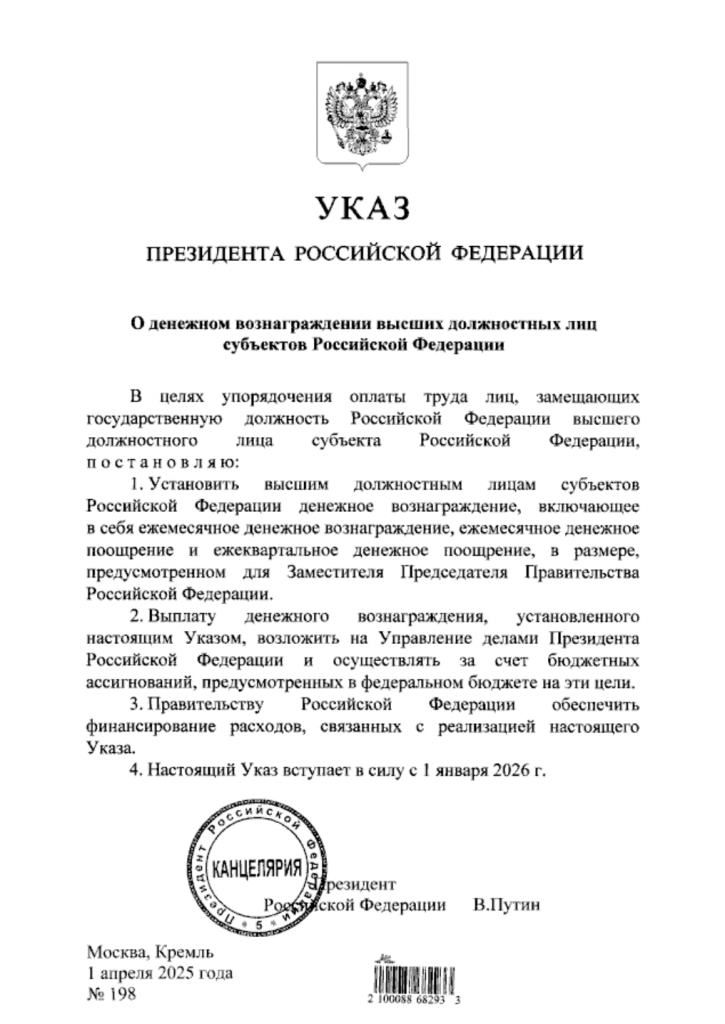
On April 1, 2025, Vladimir Putin signed a decree “On monetary remuneration of senior officials of the constituent entities of the Russian Federation.” The document establishes that governors receive monthly remuneration, monthly incentives and quarterly incentives - in the amount provided for deputy prime ministers of the Russian government. Now they must be paid not by the regional budget, but directly by the federal center - through the Presidential Administration.
For 2026, the federal budget allocated 807.1 million rubles for this. If we divide the amount by the 89 federal subjects listed in the Constitution, we get about 9.1 million rubles per year per governor, or approximately 755 thousand rubles per month. This includes taxes.
The Kremlin did not just take governors under its financial wing, easing the burden on regional budgets. He officially placed them on a par with the highest federal bureaucracy. In this logic, the governor is no longer a regional leader, but a manager built into the Moscow “vertical of power.”
Governors on two budgets
It would seem that if the salaries of regional heads are now paid by the federal budget, the expenses of the subjects should have been reduced. But in most cases this did not happen. Regional budgets have not relieved the governor of the burden. On the contrary, they often continue to pay for “additional guarantees,” bonuses, allowances, vacation pay, coefficients, financial assistance and other bonuses. In other words, the governors were simply forced to rely on two sources of funding at once - federal and regional.
This is especially clearly visible in the Vologda region. In 2025, they allocated 8.1 million rubles for the maintenance of the governor, and in 2026 - already 13.6 million. An increase of almost one and a half times - despite the fact that the bulk of the money for the governor should come from the federal budget. It is impossible to check exactly how this money is spent, because since October 2025, the regional Ministry of Finance has stopped publishing data on budget execution. Against the backdrop of the problematic state of regional finances, such secrecy does not look like an accident, but a convenient form of disguise.
In the Murmansk region, expenses for the head of the region doubled from 5.9 million rubles in 2025 to 12.6 million in 2026. And by February 1, 2.5 million rubles had been spent on the governor. And the median salary in the region, according to HH.ru estimates, is 81.4 thousand rubles. That is, despite the federal salary, the region continues to actively spend money on its own governor. In July 2025, local legislation was rewritten under a presidential decree, but the result was not a reduction in spending, but an increase in it.
In the Leningrad region, 12.3 million rubles are allocated for the governor in 2026, compared to 9.9 million a year earlier. Formally, only 68 thousand rubles were spent in the first month of the year. However, since the money is provided for in the budget, it will definitely be spent before the end of the year.
In Komi, expenses increased from 12.4 million to 15.4 million rubles. Moreover, in December 2025, the republican authorities specifically made changes to the legislation, retaining the opportunity to bonus the head of the region at the expense of the republican budget - in the amount of nine monthly salaries of the head of the Komi government. That is, as soon as Moscow hired the governor on federal pay, the region immediately insured him with local bonuses.
They acted even more frankly in the Nenets Autonomous Okrug. There, in 2026, 10.2 million rubles were allocated for the governor, compared to 8.7 million a year earlier. And in February 2026, the district administration assigned additional payments to the governor in addition to the presidential decree: vacation pay in the amount of two monthly salaries, an allowance for state secrets, a regional coefficient of 1.8 and a northern allowance for length of service. Moreover, all these payments are now calculated from federal remuneration, that is, from a salary equal to the level of the deputy chairman of the Russian government. It turns out that as soon as the center took over the salary, local authorities made it the starting point for paying bonuses from the regional budget.
In St. Petersburg, the law on the governor was also rewritten to suit the new reality. Now it directly states that the remuneration of the city head is paid in the amount and manner established by presidential decree. According to the document, the head of St. Petersburg can count on monthly remuneration and incentives, as well as quarterly incentives - in the manner established by the President of Russia. But at the same time, this law retains the rule on “other payments” provided for by federal and St. Petersburg acts. The amounts of such incentives are not specified.
In the Arkhangelsk region, expenses decreased slightly - from 7.8 million to 7.4 million rubles - but the governor’s own regulation of salary levels has not gone away. The current regional law still states that the governor’s monetary remuneration is 50% of the federal minister’s remuneration, and monetary incentives are 4.5 of such remuneration. That is, even after the presidential decree, the region continues to live according to its own formula for maintaining the head of the region.
Visibility of savings
There are also rare exceptions. In the Kaliningrad region, budget expenditures for 2026 decreased to 1.1 million rubles after 6.5 million in 2025. In Karelia and the Novgorod region, separate budget expenditures for the governor have completely disappeared.
But here, too, there is no need to talk about complete transparency. In Karelia, the decree on the salary of the head of the republic continues to be in force, and in the Kaliningrad region, the regional law retains an extensive system of salaries, allowances and incentives. According to them, it turns out that the governor must receive an additional minimum of 318 thousand rubles per month from the local treasury. This is approximately six times higher than the median salary in Kaliningrad.
A separate story is the Pskov region, where the budgets for 2025 and 2026 indicate the same amount - 34.6 million rubles, but immediately for both the governor and his deputies. In the region, previously, the governor’s salary was tied to the salary of the federal minister, but was paid from the regional budget. Now, in accordance with the presidential decree, the payment is equal to the salary of a deputy minister and is paid from the federal budget; it is unclear whether the payment remains from the regional budget.
"Vertical" governors
The actions of regional authorities look cynical against the backdrop of talk about budget discipline, deficits and the need to “tighten their belts.” After all, the budget deficit of regional budgets in 2025 reached a record 1.5 trillion rubles.
After amendments to the Constitution of 2020, a “unified system of public power” appeared in Russia. Now it has also received a monetary value, when the governor is financially obliged to the federal center, and not to the region, which he is supposed to serve.
At the same time, the new model does not take into account either the real income of the population in the regions, or the quality of management, or the effectiveness of governors, or the state of regional budgets. The heads of poor and rich regions find themselves in the same federal tariff schedule and receive the same amount - regardless of the state of the economy and standard of living.
That is why transferring governors to federal pay makes them even more disconnected from the land. The less the head of a region depends on his own region, even in matters of salary, the less reason he has to perceive local residents as a source of his legitimacy. His real employer is not the voter, but the Kremlin. Governors in Russia have finally turned into governors who live with an eye on their superiors.
Alexander Shurshev, Maxim Privin