
Translated material
“Watch the angle of attack of the UAV”
In the Belgorod region, due to blockages, push notifications about drones do not work, it is difficult to make an appointment with a doctor, and school is paralyzed. Similar problems in other regions
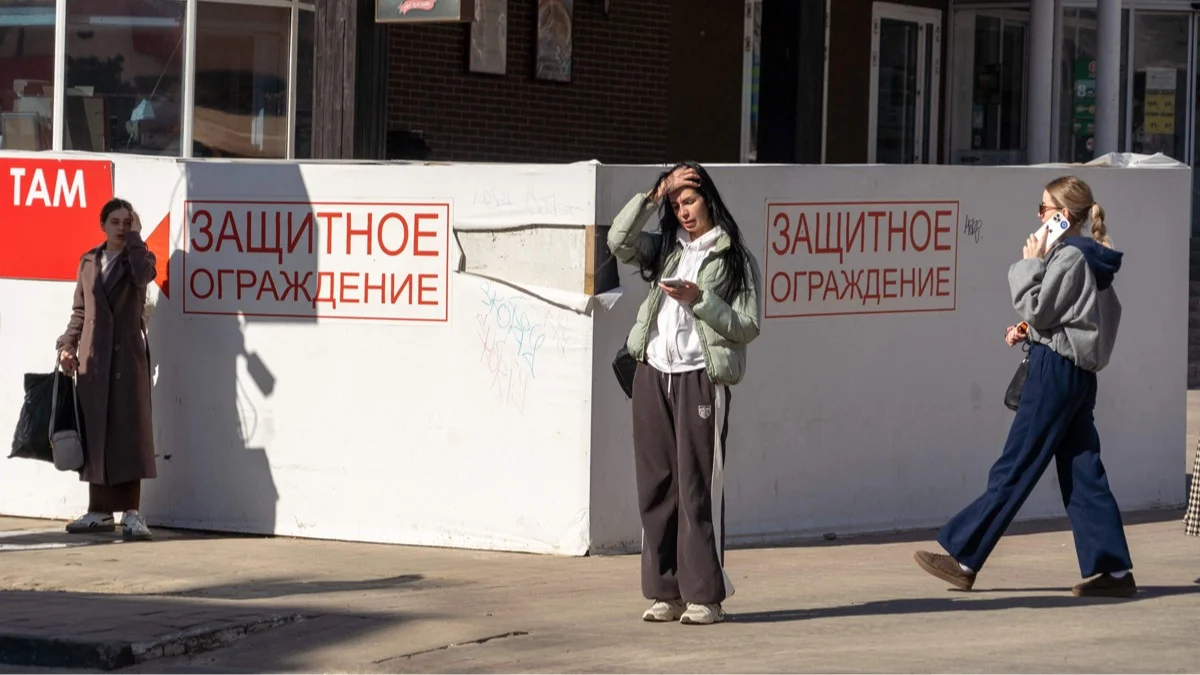
Passers-by near a concrete shelter on Belgorod street, March 12, 2026. Photo: Andrey Borodulin / AFP / Scanpix / LETA
Internet blocking became the main topic that residents of the Belgorod region raised on the last “direct line” of Governor Vyacheslav Gladkov. Due to the restrictions that have been in effect in the border region for the past week, all the services familiar to city residents are not working: from banking applications and parking to the “Virtual School”. Also, Belgorod residents do not receive notifications about missile danger via Max. “New-Europe” tells what else residents of the Belgorod region are facing due to network outages.
Push notifications
Belgorod resident Lyubov, during a broadcast on March 23, asked Gladkov why Belgorod residents need the Max messenger if the sound does not work when installing a channel with missile warnings.
“Push notifications via MAX are impossible because the software is released to foreign manufacturers. This contradicts the entire approach of the “White List” (a list of sites that operate even with existing blocking) ,” the governor said in response.
Gladkov recognized Internet blocking as “one of the most difficult problems that now worries the entire border region.” The governor also explained that the entire alert system is built on push notifications that are received in case of danger, and emphasized that for Belgorod residents “this is vitally important.” Despite this, he noted that he does not know when he will be able to resolve this “extremely difficult” issue.
Until the problem is resolved, Gladkov proposed switching to a “new algorithm of actions”: when a sound siren sounds on the streets about UAV attacks, Belgorod residents should go to the notification channels in Max, and also independently “monitor the angle of attack of the unmanned aerial vehicle.” The governor clarified that this is “certainly inconvenient” and added that officials are “trying to resolve the issue.”
Doctor's appointments
During the broadcast on March 23, residents of the Belgorod region asked Gladkov a question about the operation of the doctor appointment service. Olga Bozhenko noted that you can sign up through State Services, but you can cancel your appointment or view test results only on the electronic registration website, which has not been working for several days. Also, by calling 122 (the number for calling immediate medical assistance), the robot drops calls on its own, the woman wrote.
According to Gladkov, now the Ministry of Digital Development of the region is trying to add the “Electronic Registry” to the “White List”.
He explained that “there is such a possibility, but, of course, it takes a certain amount of time.” The authorities did not provide any more precise data on the timing of inclusion of the application in the “white lists”.
Diabetes mellitus
Due to regular internet outages in the region, parents have no way to monitor the blood sugar levels of their children with diabetes while they are at school. Concerned parents reported this during Gladkov’s broadcast. Previously, residents of Saratov had already encountered such a problem in November 2025. For example, glucose levels in children with type 1 diabetes can be monitored using continuous glucose monitoring (CGM) sensors, which alert patients when their sugar levels are high or low. When the Internet goes out, the data in them is not updated.
Read also:
Parents of children with diabetes collected signatures to get glucose monitoring apps whitelisted.
“The difficulty in adding this application to the White List is that the software belongs to a foreign company. By definition, it is impossible to include such products in the White List,” Gladkov explained.
According to him, the latest bid for the supply of a blood sugar monitor was won by a Russian-made company, so “the issue will be resolved.”
Study and teaching
Fourth-year medical college student Maxim Inyakov complained to the governor that due to internet outages, he could not prepare to take his accreditation and thesis. According to him, all the tests are on the Internet, without it he cannot study. The student also noted that he lives in a village and there is no Wi-Fi in his house.
“How do we learn? Or maybe all the regional deputies will pass the accreditation for us and write a diploma? What about mobile internet? When would you please turn it on?” - he asked.
They also complained to the governor that the application for online learning in the region “Virtual School” is not included in the “White List”. Gladkov said that adding it “takes time.” Ekaterina Soserdotskaya also noted that other important sites and applications for education do not work: Uchi.ru and Algorithmika. The woman also emphasized that she could no longer use the child’s electronic watch to track how he got to school and back.
“You can’t transfer money from Sberbank, you can’t read educational materials, you can’t solve tests, messages don’t arrive in Max unless you go into the application yourself - and then you curse.
We have paid for online classes with a tutor until the end of April, what should we do now? What a mockery of people,” Seserdotskaya said.
At the same time, not only students, but also teachers suffer from the lack of Internet. Teacher Nadezhda Vladimirova said that to work she “needs to register for the Olympics, do work in a virtual school, give grades, prepare for lessons and communicate with children and parents.”
“I DO NOT have a Wi-Fi hotspot at home. I CAN'T do my job. What indicators can we talk about? What about advanced education, when teachers simply simply have no connection with the outside world to perform the most basic tasks.
Bring back the Internet! Stop mocking ordinary people,” she urged.
Parking
Also, due to lack of communication, citizens cannot pay for parking in Belgorod. Residents in the comments on Gladkov’s page note that it is possible to pay through parking meters, but they are not installed everywhere and funds cannot be used from a parking account.
“A parking meter is good when it’s somewhere nearby, but it’s not always nearby and on this street. Postpayment is also good, but provided that people have home Internet. I have funds in my parking account in the city parking app that are actually impossible to use here and now,” explains the Belgorod resident in the comments.