
Translated material
Hole punch for memory
Why the Gulag History Museum will be turned into a Museum of Memory of the Victims of the Genocide of the Soviet People and why do the authorities need the concept of “genocide”

Photo: Sergey Fadeichev / TASS
The closure of the Gulag History Museum in Moscow marks a new round of re-Stalinization in “a single country”, the transition of this process to a qualitatively different level. This is a new stage in the amputation of the historical memory of Russians, from which the memory of the criminal past is cut out, and the memory of terror is turned into a heroic narrative. The operation to create artificial national amnesia, which the authorities have been working on for so many years, seems to be entering its final stage.
...We should start with the question of how the Gulag History Museum differed from Memorial*. Although these differences lie on the surface, they need to be mentioned. The Gulag History Museum was originally created as a state project. It arose in the first year of Putin’s rule on the initiative of Anton Antonov-Ovseenko, who spent more than 10 years in a camp as the son of an enemy of the people, Vladimir Antonov-Ovseenko, who was executed. Until 2024 (before closing due to violations of fire safety regulations), this museum enjoyed significant support from the authorities. In 2014, he moved to a large building rebuilt for him by Moscow Mayor Sergei Sobyanin.
The concept of the museum, dedicated to the chronicle of mass repressions in Soviet Russia from 1918 to 1956, was formed as a purely historical one: yes, there were repressions, and the memory of them must be preserved, but they have nothing to do with the present and future of Russia. The museum had no obvious connection with human rights detail.
On the contrary, “International Memorial”**, which arose in 1988-1989, also as a public, but not only historical, but also human rights organization, set as its task not just perpetuating the memory of repression, but also the fight against attempts to rehabilitate state terror and violation of the rights of citizens.
Preparations for the SVO were preceded by a period of purges of the opposition and human rights organizations. The closure of Memorial in Moscow, which was preceded by the destruction of its branches, became part of the purge.
Among these branches, a special place was occupied by the Perm-36 museum-reserve, transformed from a center for the memory of victims of repression and the protection of human rights into a place for the memory of the “hard work” of prison guards. Although, most likely, the closure of Memorial has been in the plans of the authorities since the mid-2000s.
A complete refusal to criticize Stalinism is the true meaning of this event.
A dangerous concept for an unprecedented community
Of course, what is even more significant is what the authorities are going to do with this museum. The new Museum of Memory “will be dedicated to the memory of the victims of the genocide of the Soviet people. The exhibition will cover all stages of Nazi war crimes during the Great Patriotic War.”
As you know, before Putin’s statement in July 2020 that “the crimes of the Nazis and their henchmen - genocide against the peoples of the Soviet Union - have no statute of limitations” and that this concept should be enshrined “in our legislation and in the system of international law,” such a concept did not exist, and it did not have any legal definition.
Following the recognition of the siege of Leningrad and massacres during the war as genocide, the law “On perpetuating the memory of the victims of the genocide of the Soviet people” was adopted in April 2025. And the law was immediately applied: by the end of last year, Russian courts had made at least 34 decisions on it. As they say, word and deed.
Now State Duma deputies are preparing to quickly introduce criminal penalties for denying such genocide. The bill, adopted by active people's representatives in the first reading, states that “for the destruction or damage of graves and memorial objects perpetuating the memory of victims of the genocide, a fine of up to five million rubles or imprisonment or forced labor for up to five years will be provided.”
Of course, this operation has, as always, a financial dimension. We were encouraged that “a national operator will begin work to perpetuate the memory of the victims of the genocide, which will be a non-profit organization chosen by the Government of the Russian Federation.”
And the country’s chief historian, Vladimir Medinsky, was preoccupied with the creation of the Gatchina memorial “In memory of the civilians of the USSR - victims of the Nazi genocide during the Great Patriotic War,” which was opened in 2024.
But the legislator will have a hard time defining the genocide of the Soviet people. They, of course, will manage in the end - as the famous cartoon says, “they didn’t take it like that.” No one will deny that the Nazis committed atrocities in the occupied territories of the USSR, but the fact is that the concept of genocide of the Soviet people raises all sorts of unnecessary questions.
Here, for example, is the number of losses announced by Putin, who said that “the Soviet Union gave 27 million lives, put them on the altar of the Fatherland and on the altar of Victory.” Does it include those killed in Stalin's camps from 1941 to 1945? The number of prisoners during this period was 6,174,805. And those who were shot in the back by SMERSH after the order “Not a step back” and about whom there is no information? How many of them were there, unaccounted for, if we know that during the war years the military counterintelligence agencies (Special Departments and SMERSH), according to rough estimates, arrested and convicted about 650,000–700,000 people? (...)
According to the candid admission of Kremlin memory policy engineer Vladimir Medinsky, a historian widely known for his crystal “scientific honesty,” the figure of 26.6 million “is calculated mathematically as the total population decline minus the so-called natural mortality rate. Mathematically, we calculate, based on the 1940 level, how many citizens would have died of old age, and subtract it from the total population decline.” That is, all the losses listed above do not fall into it. So what does this figure consist of? For conscientious historians, it is no secret how and at what stages - first by Stalin, then by Khrushchev - the loss figure was falsified, which probably actually amounted (without taking into account those categories mentioned above) to “approximately 16 million actual victims of the war.”
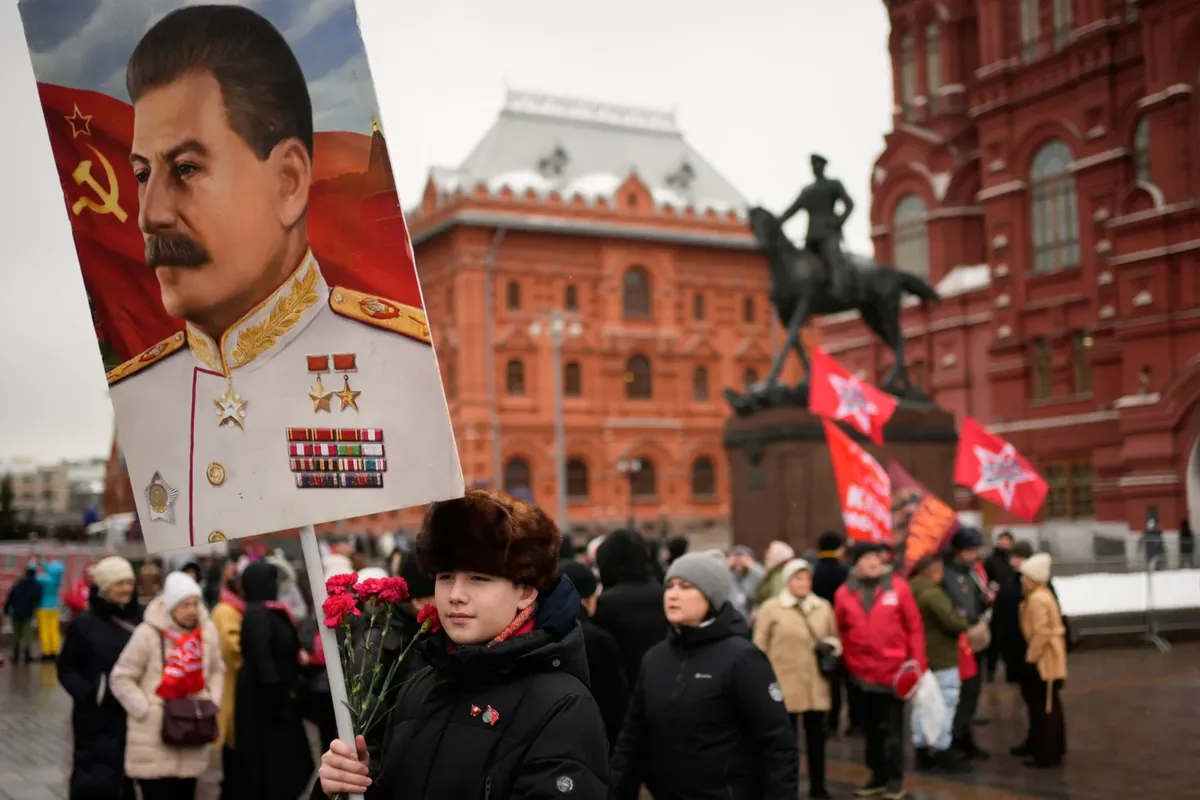
But why then does Stalinism not fall under the concept of “genocide of the Soviet people”? Historians estimate the total number of victims of repression among the “Soviet people” at 10 million dead.
And if we apply the broad concept of genocide, which deputies and prosecutors insist on today, then it includes not only the physical extermination of people. According to the calculations of historian Nikolai Koposov, “the total number of victims of terror during the years of Soviet power can <...> be approximately estimated at 50–55 million people. The vast majority of them occur, naturally, in the period before 1953.” In other words, “one in five adults has been a victim” of terror. This figure includes not only 10 million killed, but also innocent people who served time in Soviet camps, deported people, deported peoples, dispossessed people, and many other categories of victims, expelled from work, and deprived of their rights.
It turns out that this is also genocide? For in order to destroy, imprison, exile and dispossess so many people, the regime needed popular support.
Genocide of the Soviet people and Holocaust denial
So, what is the undoubted benefit of this concept for the Kremlin? There are different hypotheses about this, often complementing each other.
According to historian Konstantin Pakhalyuk***, it was to fight back “to the repeated accusations that the USSR was responsible for the start of the Second World War and to serve as a justification that the Soviet people are not only the main winner of Nazism, but also the main victim, which means they cannot bear responsibility...”.
This is an important argument.
The question of the role that the USSR played with the Molotov-Ribbentrop Pact, the partition of Poland, the seizure of the territories of Finland, Western Belarus and Ukraine, the Baltic states and Bessarabia, and also, possibly, the preparation of a strike on Germany, which forced the abandonment of the fortified old border and moved to a new, unfortified one, and, probably, led to unprecedented losses in the first year of the war, remains sharply debated in historiography. But he is far from the only one.
The concept of “genocide of the Soviet people” contrasts the incompletely understood community “Soviet people” as the main victim of Nazi crimes with the uniqueness of the genocide against the Jewish people. As Konstantin Pakhalyuk correctly noted, “in fact, the Germans did not kill Russians, Ukrainians and Belarusians precisely as Russians, Ukrainians or Belarusians. They were killed as partisans, as soldiers, as prisoners of war. But Jews, Gypsies and people with disabilities, especially those with mental disabilities, were killed precisely because of their origin or certain biological characteristics.” That is, the “Soviet people” do not fall under the narrow concept of genocide adopted by the 1948 UN Convention. But a “scientific work” has already arrived, entirely devoted to how the “genocide of the Soviet people” can be included in the broad concept of genocide.
So,
It is very important for the authorities to present the “Soviet people” as the only and main victim of World War II. But why? From the point of view of normal logic, this is impossible to understand.
Here's how Viktor Vakhshtain*** talks about it:
“There’s simply no logic there. <…> When Soviet citizens now find themselves victims of genocide, they will have to somehow combine two very different mythologies. There is also a mythology associated with a great feat, which a huge number of people believe in, because it has been installed for generations. But now it is proposed to integrate the mythology of the victims here. How will these two narratives live with each other? I don’t think that there is any clear historical policy behind this; rather, there is a general trend behind this of what is called the transformation of the concept of genocide into a weapon of political struggle.”
Unlike Vakhshtain, I believe that the answer must be sought in the Kremlin’s memory policy, namely, in the policy of re-Stalinization. To date, its result has been the closure of the Museum of Memory and the transformation of the concept of “genocide of the Soviet people” into another weapon of Russian propaganda.
Re-Stalinization of the entire country
To avoid any illusions that re-Stalinization is a recent phenomenon, let me remind you that Putin’s very first events were dedicated to it. On February 22, 2000, Putin, now acting president, visited the war memorial on Mamayev Kurgan in Volgograd and met with war veterans there, prompting local attempts to rename the city Stalingrad.
On December 30, 2000, by decree of Putin, the national anthem of the Russian Federation began to be performed to the music of the Soviet anthem with the translated text by Sergei Mikhalkov, who wrote the words of both the original Stalinist anthem and its de-Stalinized version. The most significant of these events, however, was the grand Victory Day parade on May 9, 2000, which revived Soviet militarism and made clear that Russia's memory policy had changed course.
To list all the re-Stalinization events since 2000, it would take not a newspaper article, but a thick monograph. Suffice it to say that of the 110 monuments to Stalin in Russia, 90% appeared under Putin. Moreover, after 2014 they began to be installed twice as often. The celebration of the memory of the executioners was steady and multifaceted - from the final closure of archives and the appearance of textbooks by Filippov and Medinsky to endless films about the war, made with taxpayers’ money and glorifying the “Marshal of Victory”. And of the 441 “Last Address” signs installed in St. Petersburg, at least 101 were removed by order of local authorities.
But everything that came before pales in comparison to the achievements of the re-Stalinization of the last two years. On this front, an undoubted breakthrough was the changes in the Concept of State Policy for Perpetuating the Memory of Victims of Political Repression in 2024, which replaced the first edition of the concept approved in 2015 by Dmitry Medvedev.
According to Boris Vishnevsky***, the author who brilliantly compared the two editions of the concept, “[in] the current edition the wording is so streamlined that it remains unknown who exactly carried out the repressions, who is responsible for them, what exactly they consisted of, who and how many were affected, and who and how many were rehabilitated. <...> But there was room for discussions about “national interests”, “strengthening traditional spiritual and moral values” and protecting society from “destructive information and psychological influence. <…> And of course, about the Baltic and Ukrainian Nazis, traitors to the Motherland and participants in underground nationalist formations.”
The new concept immediately began to be actively used by law enforcement agencies. Thus the process of de-rehabilitation was launched. Since mid-2022, zealous prosecutors have managed to overturn over 4,000 exoneration decisions.
According to a special BBC investigative report, in the narrative created by the de-rehabilitation company, “some repressions are presented as “blows against the people,” while others are presented as necessary state actions, fair punishments for “traitors” and “collaborators.” This interpretation is consistent with military rhetoric and the current campaign against “traitors to the Motherland,” saboteurs and internal enemies.”
The basis of re-Stalinization was and remains the myth of the “Great Patriotic War”. By myth I do not mean that there was no war or that the people did not suffer. But this suffering and memory were instrumentalized first by Stalinist and then by post-Soviet propaganda. The Stalinist war myth, which I call the barrage, was intended to block the memory of the camps and replace memories of suffering with collective memories of the patriotic struggle against the Nazis, transforming the traumatic experience of terror into a feeling of participation in a heroic deed.
The central place in the Stalinist war myth was always occupied by Stalin, the commander-in-chief of the victorious Soviet army. The glorification of the “Marshal of Victory” could not but turn out and turned into the rehabilitation of Stalinism.
The significance of the war myth for the authorities is determined by the role it played in consolidating first Soviet and then post-Soviet society around the regime.
Khrushchev's main goal was not to overthrow Stalinism, but to reform the Soviet system in his own interests and in the interests of his allies - maintaining power without fear of persecution and execution. Placing responsibility for “violations of socialist legality” on Stalin’s “cult of personality” shifted the blame from the doctrine of communism, the totalitarian nature of the Soviet regime, as well as the Communist Party of the USSR and the NKVD to the personality of Stalin. It also freed the Soviet population from any sense of historical responsibility for their collaboration with the criminal regime.
Khrushchev's speech laid the foundation for the subsequent rehabilitation of Stalin. Khrushchev's position towards Stalin was inconsistent, and he himself was both one of Stalin's jesters and one of the Stalinist executioners.
Khrushchev was not against terror as a tool: he used it in the 1930s and during the Budapest uprising of 1956. In his secret speech, he praised Lenin for his use of terror.
Khrushchev's report turned Stalin into a controversial symbol in Russian politics and created a new political language of de- and re-Stalinization that coincided with the relative rise and fall of KGB power. It was this language of latent re-Stalinization under the banner of the Great Victory in the Great Patriotic War that conveyed to the Soviet subjects under Brezhnev, mainly to the newly created KGB, the idea that their time had returned.
The return to the policy of re-Stalinization after a brief period of de-Stalinization under Gorbachev and Yeltsin, despite all the revelations of the era of perestroika and glasnost, can be partly explained both by Khrushchev’s ambiguous and inconsistent report and by Yeltsin’s inability to force parliament to pass a law on the criminal role of the CPSU and to ban it.
Of course, Putin is not Lenin. When he came to power, his team had no ideology. But there was an urgent need to justify its legitimacy. The myth of the Great Victory was intended to compensate for the lack of a clear program, since at that time it was still impossible to openly proclaim the restoration of the empire as its goal. Thus, the Stalinist myth about the Great Patriotic War found itself at the forefront of the search for a new Russian ideology. Although the people of St. Petersburg, despite a long search, did not find a new ideology, it was more than replaced by the politics of memory. And for Putin, re-Stalinization was a way to make it clear that the KGB/FSB was back in power.
Re-Stalinization with canonization
The new, Orthodox post-Soviet aspect of re-Stalinization is directly related to the “genocide of the Soviet people” - the struggle for the canonization of Stalin. Apparently, the annexation of Crimea and the “return of our shrines” served as the impetus for this movement.
The loudest speaker on this topic was the head of the Russian ultra-right, Alexander Prokhanov, who simply proposed to canonize Joseph Stalin. In 2015, Prokhanov brought an icon depicting the Generalissimo to a closed airfield and promised to soon get two more. As Novaya Gazeta reported, he “expressed the hope that the Engels bomber, “flying over America, will show the military power of Russia, as if saying:“ Don’t be a fool, America!
Although the Russian Orthodox Church has not yet come out for the canonization of the “leader of peoples,” the words of the peace-loving Orthodox writer resonated with the head of the Russian Orthodox Church, who in the same 2015 also praised the mass murderer Stalin, saying that “the successes of this or that state leader, who stood at the origins of this kind of revival, the modernization of the country, cannot be questioned, even if this leader is marked by atrocities. You need to be able to distinguish between spirits.”
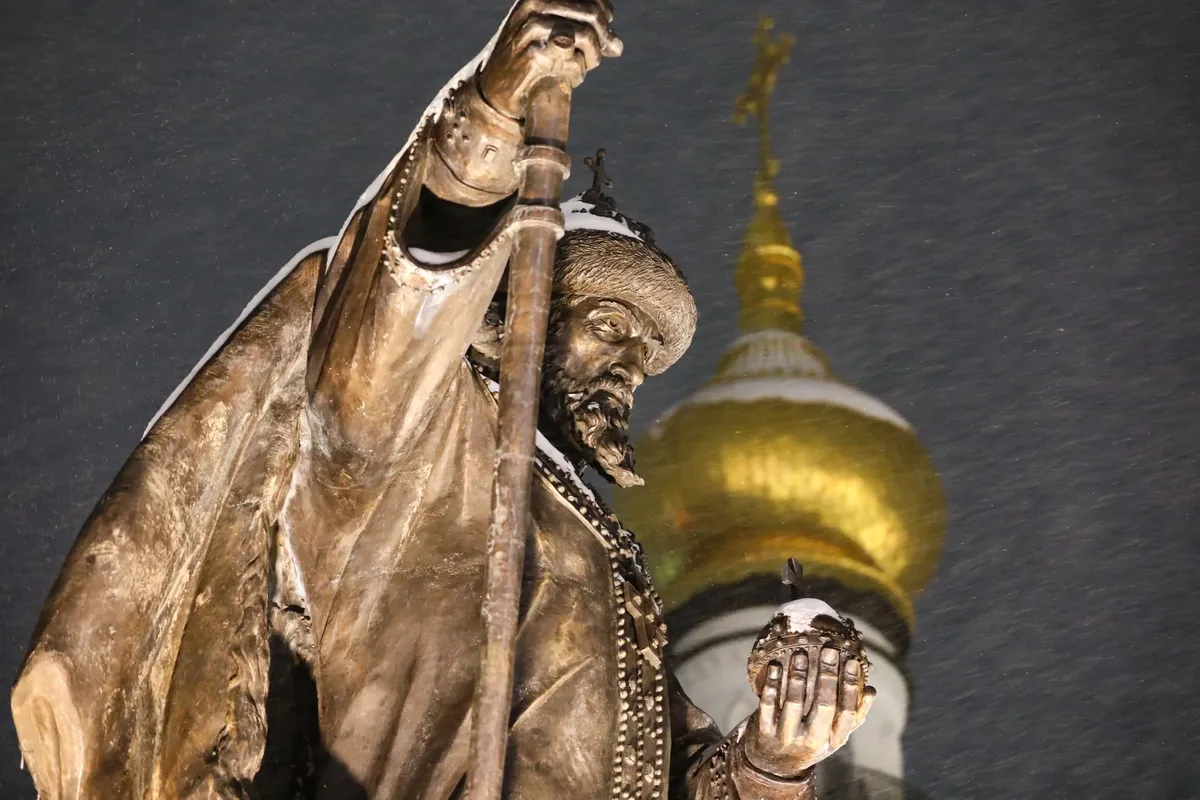
Since then, the leader of the Russian Orthodox Christians has more than once spoken cordially and with understanding about the man, under whose strict leadership churches were blown up and thousands of priests were killed and tortured. Thus, in March 2023, on a trip to Donbass, Patriarch Kirill called Donbass Russian land and quoted Joseph Stalin. In September of the same year, Kirill again spoke positively about the Secretary General: “This turning point in the relationship between church and state occurred during the war, when I.V. Stalin eventually realized the enormous spiritual and patriotic role of the Russian Orthodox Church."
Another driving force behind the canonization of the Secretary General is the Communist Party of the Russian Federation, a party for which lobbying Stalin is its main business. As the reader understands, the idea of canonization goes well with the ardent materialism and atheism of Marxist ideology. It is difficult to resist mentioning one of the episodes of this communist struggle. As Novye Izvestia reported, “in 2023, on the territory of the Mikron plant in the Pskov region, one of the priests of the Velikiye Luki diocese consecrated a monument to the Secretary General. Before this, video footage of the consecration of the monument to Stalin in Velikiye Luki was distributed on Telegram channels. Since the diocese began an internal check on the facts, the “Communists of Russia” turned to Patriarch Kirill with a request to stop checking the fact of the consecration of the monument to Stalin and canonize the Secretary General.”
Tsarebozhie, Stalin and Grozny
Typically, the story of Stalin’s canonization begins in 2008, when an icon depicting the Generalissimo and the Blessed Matrona of Moscow was exhibited for veneration in the church in the city of Strelna, Leningrad Region. But it seems to me that the movement for the canonization of Stalin is directly connected with the influential sect of Tsarebozhiy, founded by Ivan Snychev, Metropolitan of St. Petersburg and Ladoga. The main dogma of Tsarebozhiy is the sacralization of Russian tsars, who are considered not just messengers, but true incarnations of God. Tsarebozhie rejects the principle of harmony between the Russian secular state and the Orthodox Church, giving the Russian Orthodox Tsar - the katechon - absolute dominance over the church. Some followers of the sect consider it necessary to canonize all the rulers of Russia. Maybe because this is a “particularly difficult area of work”?
The Orthodox followers of this sect predict another murderer, also a favorite of the Kremlin’s memory policy, Ivan the Terrible, to become a saint.
Here is an example of the combination of these two favorite heroes in the minds of Russian Orthodox nationalists: “Grozny defeated the European Reich, won an informational and military victory in the “Battle of Stalingrad of the Middle Ages,” which was won in Pskov” (1581–1582).
As in the case of Grozny, the spontaneous canonization of Stalin is already underway. According to researchers, it is based on the non-canonical creativity of the Orthodox. “So, in the so-called popular among adherents. “The troparion to Joseph the Great” Stalin is glorified as a hidden (i.e., secret) ascetic of the faith, “the shield and protection of our people,” “convicted by God in the royal image,” and finally, as a martyr, “accepting a martyr’s death from the Jews.”
It is significant that the worship of Stalin among Orthodox monarchists has a clear anti-Semitic component “with the mythologeme of the “third” or “Jewish” yoke, included in the corpus of apocryphal prophecies of the monk Abel (Abel the Seer of Secrets), which arose in emigrant circles in the 20-30s. XX century."
As researchers rightly note, this is directly related to the anti-Semitism of Stalin himself, which is expressed in the mythologization of the famous “Doctors’ Plot,” in which “both medical phobias characteristic of archaic culture and obvious anti-Semitic loci characteristic of the Stalinist myth as such were clearly manifested.” Of course, the movement for the canonization of Stalin creates additional important support for both re-Stalinization and the religious justification of terror.
It is no secret that the growing popularity of Ivan IV and Stalin correlates with growing approval of their domestic policies. For many Russian ultra-rightists, the idea of introducing a new oprichnina, the prototype of which is not only Ivan’s oprichnina, but also Stalinism, is inextricably linked with the reconstruction of class society and the restoration of the Russian Empire.
If in the early 2000s the main goal of Putinism was to suppress the memory of repression and normalize it, then modern post-Soviet artificial memory presented state terror as the best way to govern the country and made it the real source of the emerging imperial identity.
Attempts, first by the Soviet leadership led by Stalin, and then by the post-Soviet leadership, to portray the USSR and the Soviet people as both the main victim and the main winner of fascism were not meaningless. They allowed Stalinist propaganda starting in the 1930s. turn anyone who tried to criticize Soviet policy into a fascist.
Let's summarize. The concept of “genocide of the Soviet people” makes it possible to present the “Soviet people” and their post-Soviet successors as a people-messiah - both a winner and a victim. Russia, the messianic myth claims, has sacrificed itself for humanity throughout history: in the 13th century, it shielded Europe from the Tatar invasion, then rid the world of Napoleon, and finally saved civilization by defeating fascism.
The central idea of the concept of “genocide of the Soviet people” is that the messianic sacrifice of ancestors gives descendants the exclusive right to decide what the world political order will be like. The concept of “genocide of the Soviet people,” supported by the Orthodox round of re-Stalinization, gives a free hand for any policy, and above all for attempts to restore the empire.
* The Russian authorities included “foreign agents” in the register, and the foreign organization was declared undesirable and banned on the territory of the country
**Included in the register of “foreign agents”, declared an undesirable organization and banned in Russia
*** The Ministry of Justice of the Russian Federation included in the register of “foreign agents”
This material was published in the seventeenth issue of Novaya Gazeta. Magazine". You can buy it in the online store of our partners.