
Translated material
Senor Nobody against military dictatorship
The Brazilian "Secret Agent" on Russian screens is a political detective story about the absurdity and paranoia of everyday life under authoritarianism

Photo: CinemaSco´pio / MK Production / One Two Films / Lemming / Festival de Cannes
On March 26, a political detective story from Brazil, “Secret Agent,” is released, about a young father who is trying to emigrate from his native dictatorship with his child. The film by Kleber Mendonça Filho competed in the Oscar race in four categories (although it did not win anything), and at the Cannes Film Festival, the director and leading actor Wagner Moura received prizes in the corresponding categories. Film critic Katya Stepnaya talks about the author's hybrid of thriller, political satire and surreal historical reconstruction, where a bitten leg is running around Brazil among dictators and double agents.
People go to work, argue about football, wait for the carnival, watch TV, complain about the heat, but behind everyday life another reality emerges - paranoid and absolutely abnormal. This is exactly how the new film by Brazilian Kleber Mendonça Filho, the author of “Bacurau” and “Aquarius”, is structured - one of the main voices of modern Latin American cinema. “Secret Agent” begins as a spy story, slowly unfolds into a political thriller, and by the end turns into a strange chronicle of life in a country where the state, urban legends, everyday repression and fear of mistakes cannot be separated from each other.
Brazil in the late 1970s is a military dictatorship. Half the country is under surveillance, the other half is watching closely. An engineer named Marcelo returns to his hometown to his family and little son in order to take the child out into the free world. The sad brunette tries not to attract attention to himself: the success of the escape depends on the support of the underground opposition and the speed of reaction to alarming news. In the past, the hero seems to have gotten in touch with the authorities to his misfortune, and perhaps it was Marcelo who was the secret agent infiltrated into the underground to expose the Brazilian resistance, and the return to the child is simply a legend. Maybe he himself is to blame for the early death of his wife.
The plot space is filled by nomenclature officers, spies of varying degrees of disgust, and revolutionaries of the 60s who hid from informants. And the season's two biggest stories are making national headlines: the box office success of Steven Spielberg's Jaws and a bitten leg found inside a real shark off the Brazilian coast. Cinema, reality, double play, fictional biography and the real history of Brazil in the seventies merge into a sticky dream.
The director subverts expectations of the genre, as he has done in his past films. A spy thriller is usually built on a frantic rhythm: chases, revelations, secret operations - in general, battle after battle. There is too little action in “Secret Agent”: the camera films in detail the life of a provincial town, passengers in transport, everyday conversations, television programs, every now and then distracting from the main intrigue.
The two main constants of life under a dictatorship are absurdity and permanent anxiety.
The film reveals the historical context of life in Latin America in the 20th century. The Brazilian military dictatorship existed for more than 20 years, from 1964 to 1985. It was an era of censorship, political arrests and secret services monitoring journalists, intellectuals, bohemians and students. Despite a vibrant underground culture and alternative youth inspired by leftist ideas, a right-wing government came to power. Nepotism and corruption have led to the fact that a huge multinational country, with a rich culture and economy, has been placed at the service of the military-industrial complex. Mendonça Filho does not make a historical film in the usual sense: he does not show generals, does not reconstruct unrest and does not illustrate significant events. After all, the dictatorship has not been defeated, and the military appetites of elites around the world have not yet been satisfied.
It's the atmosphere that makes The Secret Agent one of the most disturbing films of recent years - in this it rhymes with Seerat and A Mere Chance , which deal with disenfranchisement and existential horror in other parts of the world. “It doesn’t seem to me that today you can be a serious artist and just live, ignoring what is happening,” the director said in an interview with The Guardian. The director is interested not only in limitations, but also in the human ability to adapt to any reality, even the most absurd.
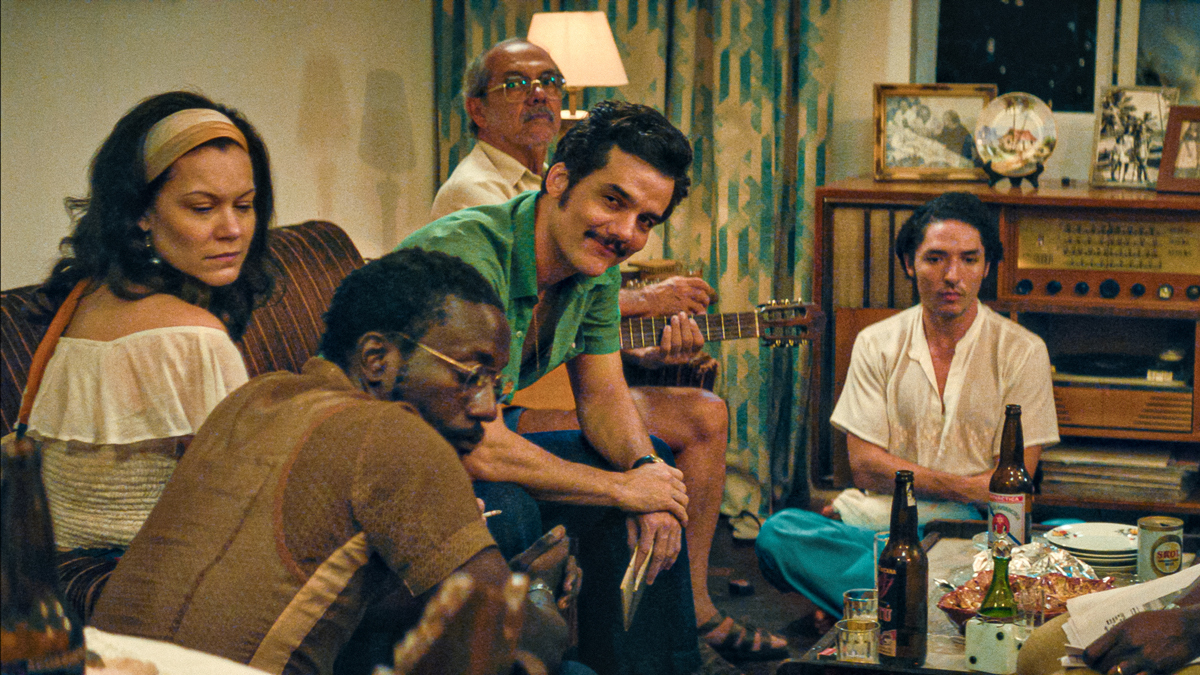
The more silence, the more suspicion. This is what turns the protagonist’s preparation for escape into a paranoid labyrinth. At some point, the "secret agent" begins to look like a representative of the "political magic realism" genre. Characters discuss strange rumors, a leg bitten off by a shark rushes through city parks, memories and testimonies of unreliable narrators are twisted into a ball. The city looks familiar and at the same time distorted, behind each real person there is another identity, appearances, passwords, a half-erased biography, a family or professional secret.
Wagner Moura plays Marcelo with pauses and tension. His hero constantly controls himself and tries to understand whether he is really being followed or is it just a habit of life in a society where suspicion has become the norm.
A rare type of political film hero: not a fighter against the system or a whistleblower, but a person who continues to pay for one single attempt to do something in the distant past.
Secret Agent is ultimately a film about the mechanics of fear and thwarted democracy. About the arms race. About decisions that are made in closed offices by a narrow group of people. About officials who want to get their hands on any achievement. About horizontal resistance that needs to be fluid and translucent in order to survive. About populism and pop culture sensations that distract people from their boring and poor lives. About the majority of conformists who are satisfied with any job - even spying on their neighbors.
Slow, almost hypnotic, at times funny, the film leaves a bitter aftertaste: what is happening looks not like a historical reconstruction, but like an eternal model of freedom taken away. Of course, you can console yourself with the fact that this is an abstract thriller. But the best political thrillers are often almost documentaries.