
Translated material
Dust and noise
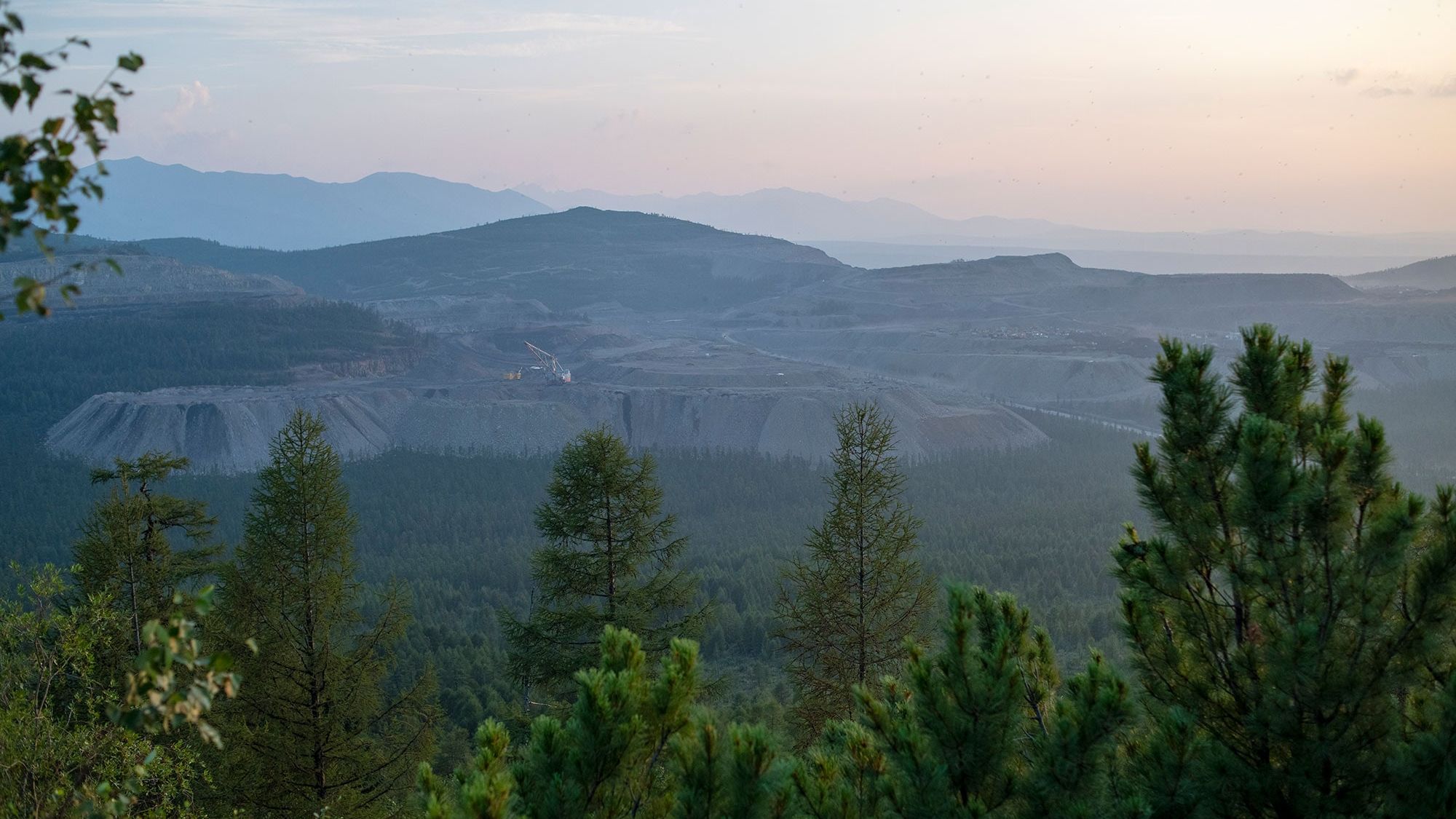
How does Elgin coal threaten the environment?
The Elga coal deposit in the Republic of Sakha (Yakutia) is one of the largest reserves of high-quality coking coal in the world. In 2020, the assets of the Elga coal complex were sold to A-Property, a company owned by billionaire Albert Avdolyan. Since then , coal production at the Elga deposit has increased fivefold , reaching 36 million tons in 2025. Last year, the Pacific Railway was also launched , connecting the field with the Port Elga coal terminal. This allowed us to increase exports. In the future, production may increase to 45 million tons per year.
The Elga Coal Complex (ECC) is positioned as the largest private infrastructure megaproject in Russia in recent decades. However, its implementation is accompanied by serious environmental risks.
This is a short version of a report prepared by the NGO Arctida. The full version with details, data and a detailed description of the methodology can be downloaded below.
Dust and noiseHow did we conduct the research?
An island of dust the size of Samara: how the Elga complex pollutes the environment
Open-pit mining at the Elga deposit is accompanied by the cutting off of mountain peaks, the transformation of watersheds and the formation of large waste rock dumps in river valleys. This destroys soil and vegetation cover, disrupts the water regime, and deteriorates the quality of water and air.
The main air pollution in the area of the coal complex is associated with dust and gases that arise during drilling, explosions, mining and transportation of rock mass, as well as due to the blowing of small particles from the surface of quarries and dumps. At the same time, the results of the analysis carried out by Arctida indicate that the actual zone of dust pollution from the mining of Elgin coal is many times greater than the size stated in the project documentation.
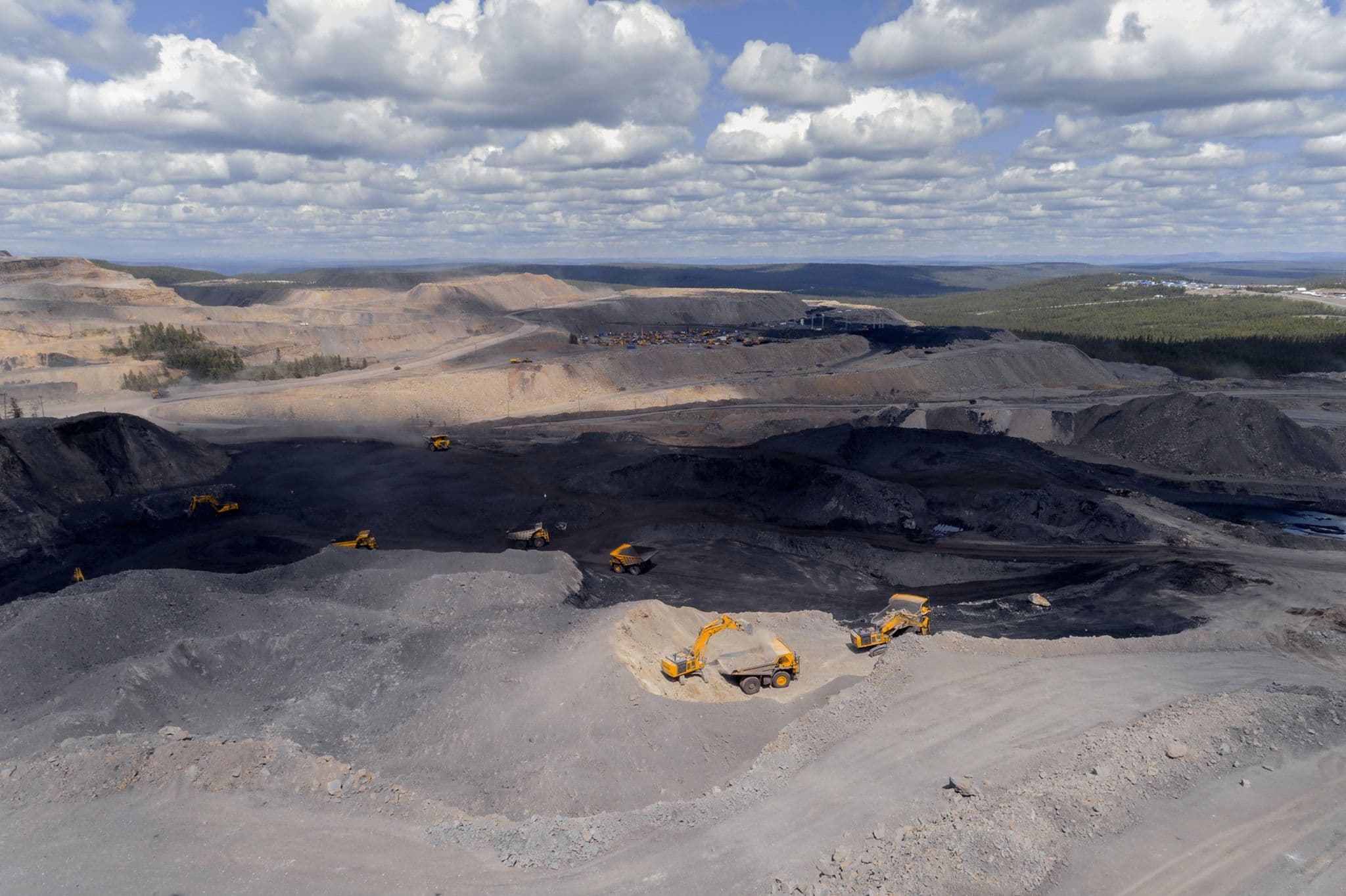
Satellite analysis shows that the area of visible pollution in the area of the coal complex is about 50 thousand hectares (almost the same area as Samara and eight times the area of Manhattan). Moreover, about 80% of the contaminated territory is located outside the boundaries of the EUC and the sanitary protection zone.
According to Arctida, the area of pollution increased almost ninefold from 2019 to 2025. The sharp increase began after 2020, when the Elginskoye field was transferred to A-Property, and coincides with an increase in production volumes.
Protected natural areas are also under threat. Since 2021, the area of contaminated snow cover within the Bolshoye Tokko reserve has increased almost tenfold - from 109 hectares to more than 10.5 thousand hectares. In the last two seasons, pollution covered a significant part of the lake’s water area and the basins of the rivers flowing into it.
Taking into account the planned increase in production, we can expect a further expansion of the impact zone, including full coverage of the waters of the unique Big Tokko Lake.
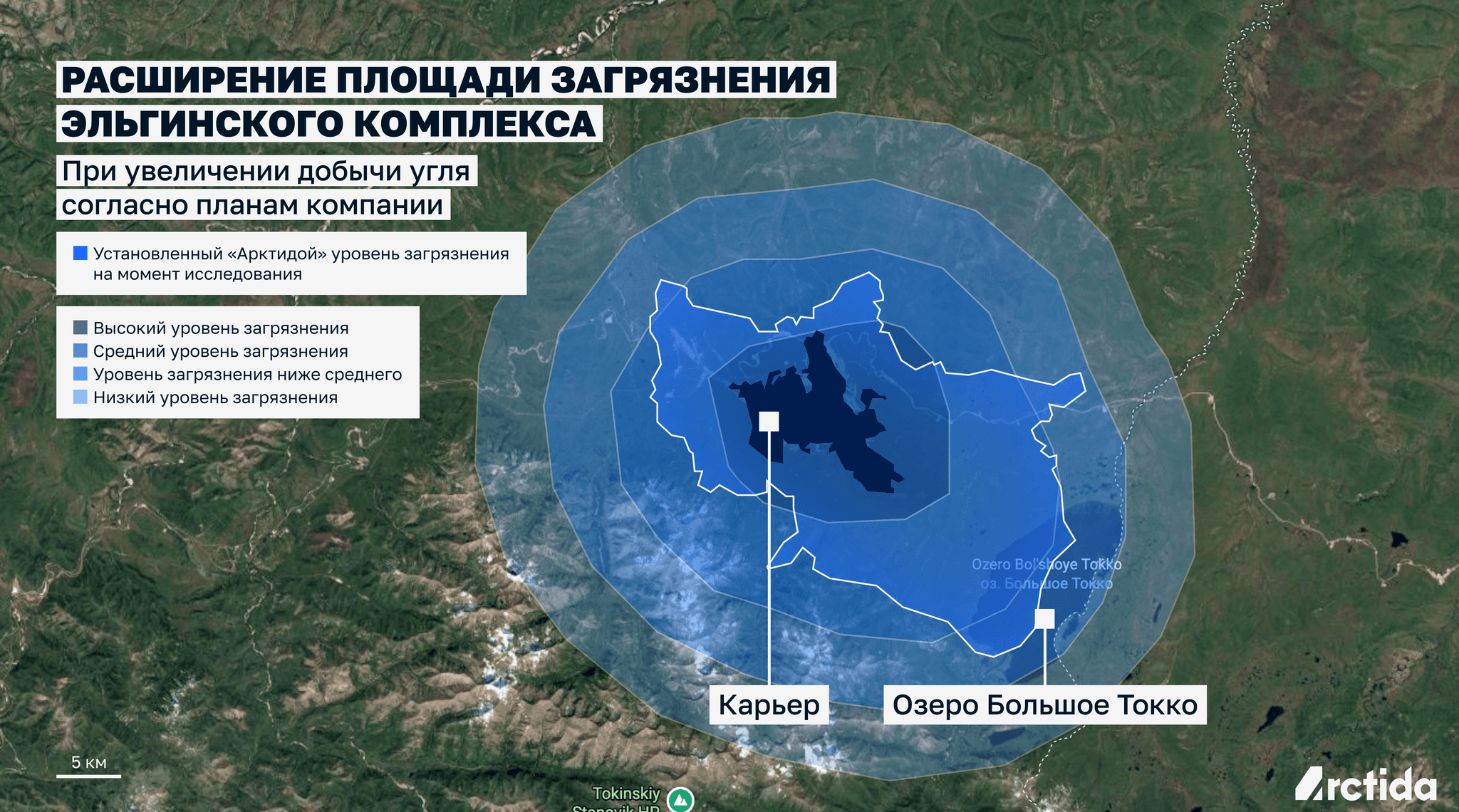
The failed national park: how the territory ended up without protection
The creation of a specially protected natural area (SPNA) was considered by the scientific and environmental community as a key measure to reduce the impact of the Elga coal complex on local ecosystems. Already in 2016, it was proposed to create a state reserve uniting the Bolshoye Tokko reserve and adjacent territories.
But the process dragged on. Only in April 2022, a competition was announced to develop a justification, the winner of which was the Federal State Budgetary Institution Federal Research Center "Yakut Scientific Center SB RAS". The project provided for a park with an area of 400.7 thousand hectares with the inclusion of additional valuable areas. However, already in September the Ministry of Natural Resources proposed an option with an area of 288.5 thousand hectares. As a result, the areas most vulnerable to coal mining were excluded from the project, despite the increase in anthropogenic pressure.
By January 2025, the process of creating the park had stopped . The new national project “ Ecological Well-Being ”, launched in 2025, does not provide for the creation of new protected areas.
First construction - then permission: construction of a coal terminal bypassing procedures
Arctida's investigation showed that the construction of the Port Elga coal terminal began long before the approval of the project documentation.
According to Sentinel-2 satellite images, work has been recorded since at least May 2022. The progress of construction is confirmed publicly. At the end of July 2022, the facility was visited by the Governor of the Khabarovsk Territory, Mikhail Degtyarev, who confirmed that active construction of a new port was already underway. He subsequently actively supported the project, insisting that it complied with environmental requirements and regularly publishing videos from the construction site on his social networks.
At the same time, the positive conclusion of the state environmental assessment was approved only on June 23, 2023, that is, more than a year after the start of construction. By this time, a number of key transport infrastructure facilities had already been built.
Noise disturbing whales: environmental risks when transporting coal
Arctida has established that the implementation of the Elga coal complex project threatens the rarest species of whales of the Northern Pacific, in particular the Sea of Okhotsk population of the bowhead whale, which is included in the Russian Red Book.
A study of the routes of bulk carriers exporting coal from the port of Elga shows that the shipping corridor crosses the suspected wintering grounds of the bowhead whale in the Kashevarov Bank area. In addition to the fact that shipping in this area creates additional physical barriers critical to the whale population, during the period of icebreaker support it has also led to the emergence of long-term sources of disturbance here at the meeting points between bulk carriers and icebreakers at the edge of the ice in the supposed wintering area of the whales.
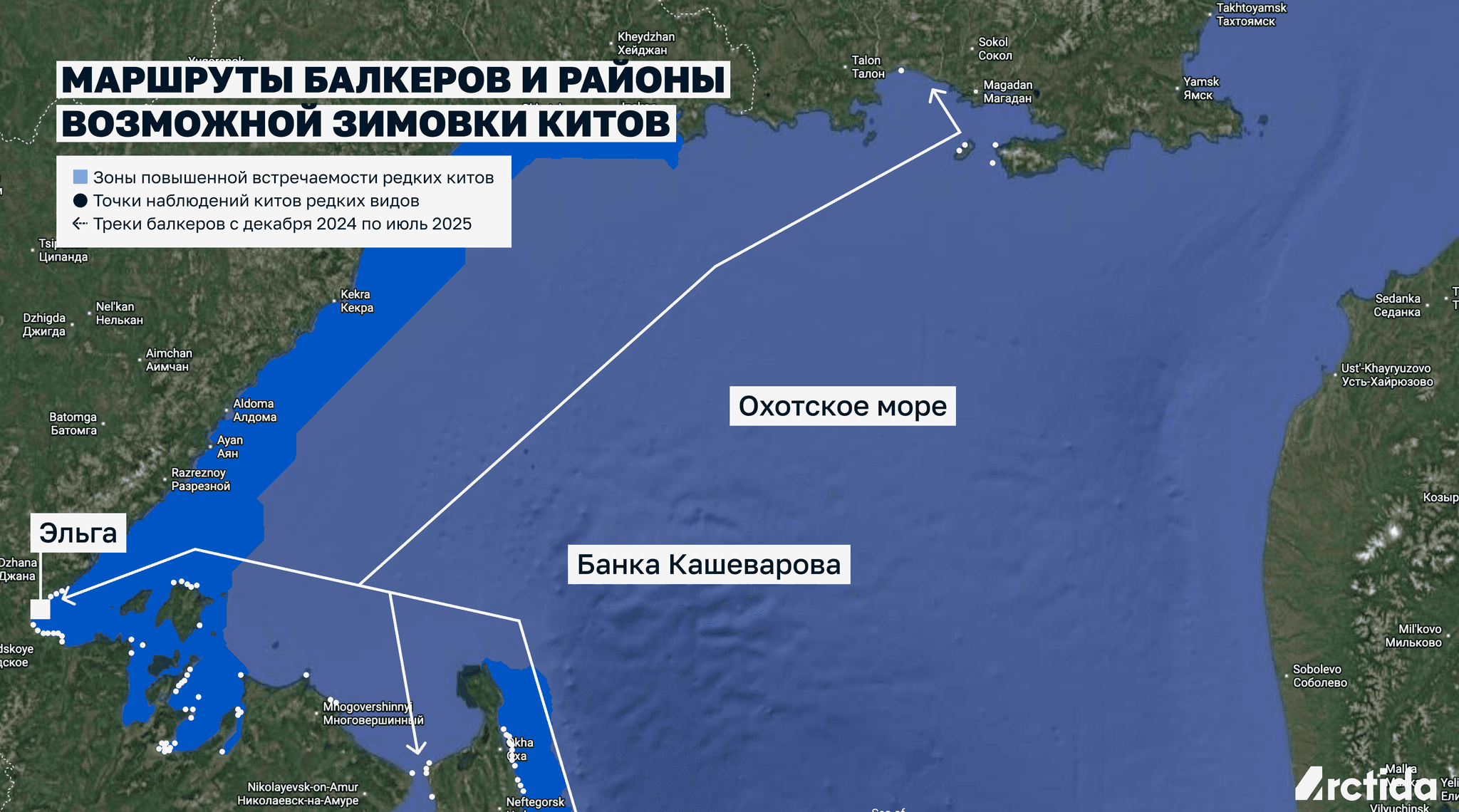
In addition, the port of Elga actually blocked the path for whales to move along the northern coast of Udskaya Bay.
According to Arctida, noise pollution in the port forces bowhead whales to go around this area at a distance of 5-10 kilometers, where, far from shallow waters, they become a target for attack by killer whales.
Working under sanctions: how coal is supplied to Korean metallurgical companies
In June 2024, the Elga management company and a number of affiliated structures for the extraction and export of coal from the Elga deposit were included in the sanctions lists of the US Department of the Treasury.
However, coal exports continued. In 2024–2025, supplies went through the ports of Elga and Vera, including to South Korea.
Elga coal was supplied to South Korean steel companies POSCO and Hyundai Steel, according to shipping analytics and industry sources. According to Arctida, since the beginning of American sanctions , 787 thousand tons of coal worth almost $100 million have been brought from the port of Vera alone to the terminals of these companies .
Despite the fact that the Republic of Korea did not impose sanctions restrictions on Elgin coal, the supply chains described indicate the risks of secondary sanctions from the United States.
Find out more
about the monitoring of infrastructure projects that Arctida does