
Translated material
Russian invention
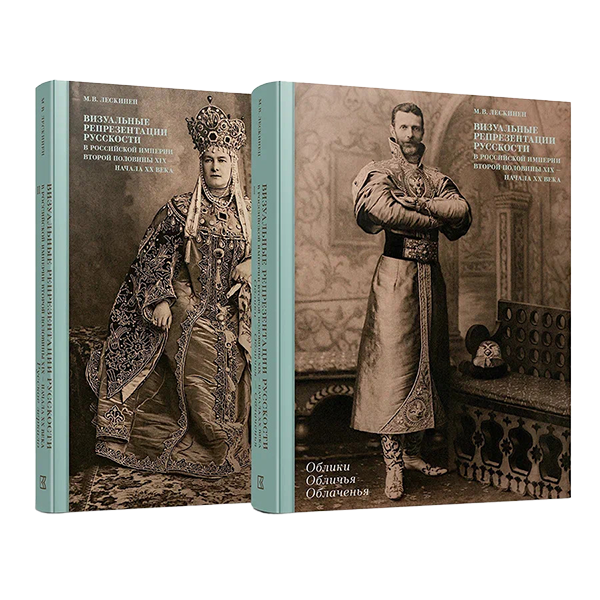
About the two-volume book “Visual representations of Russianness in the Russian Empire of the second half of the 19th - early 20th centuries”
It may seem that the history of costume is not the most exciting topic unless you are specifically interested in it. Maria Leskinen's book proves the opposite: the story of how the Russian national costume was invented in the 19th and 20th centuries inevitably turns into a discussion about the invention of the Russian nation. Details are in the review by Ivan Davydov.
All of us, since February 24, 2022, have found ourselves in the face of advancing barbarism, violence and lies. In this situation, it is extremely important to preserve at least the remnants of culture and support the values of humanism - including for the sake of the future of Russia. Therefore, the editors of Gorky will continue to talk about books, reminding our readers that there is still a place for thought and fiction in the world.
Maria Leskinen. Visual representations of Russianness in the Russian Empire of the second half of the 19th - early 20th centuries. T. 1: Images. Shapes. Vestments. Content . T. 2: Russian mirror. Content . M.: Kuchkovo pole, Muzeon, 2024
Some time ago, the business newspaper Vedomosti shared important news with readers: “Vladimir Putin is very pleased that young girls have started wearing kokoshniks. This speaks of the maturity and strength of Russian society.” When the sovereign is happy, the subjects are happy and life becomes even better. And even more fun, probably.
And a large-scale study by Maria Voittovna Leskinen, chief researcher at the Department of Eastern Slavism at the Institute of Slavic Studies of the Russian Academy of Sciences, tells how the Russian educated (but still immature, apparently not strong) society in the 19th and early 20th centuries invented the kokoshnik. As well as other elements of pseudo-folk and pseudo-Russian costume.
It may seem that the history of costume is not a particularly exciting topic: only a fanatic who is truly in love with the subject can spend a long time and passionately understanding the details of ancient outfits. But this is a special case - the book is about something completely different.
Clothes exist to cover a person, while at the same time saying a lot about him. In Leskinen’s book, the story of the invention of the Russian costume is only a background, an illustration to the story of a much more important invention.
It is the word “invention” that seems key to understanding Leskinen’s text. The premise is simple - after Peter’s reforms, the elite abandoned the traditional costume. However, by the end of the 18th century this began to be felt as a problem: along with the dress, originality was lost. The peasantry turned out to be responsible for the “visual representations of Russianness,” and the upper classes looked like just typical Europeans without clear external signs. They became nothing.
Of course, no one abandoned European clothing, despite the impulses of the Slavophiles (whom, as is known, the Moscow common people mistook for Tatars or Persians on the street because of their “original Russian” outfits). But the search for a national style was carried out, and especially actively, in places where political or commercial considerations simply forced one to demonstrate one’s own difference from others. A voluminous section of the first volume of the book is devoted, for example, to International Art and Industrial Exhibitions. Here, not only the pavilions, not only the goods in the pavilions, but also the outfits of the service personnel had to be shown to visitors, literally shouting: “Before you are Russians!” And it worked: at one of the Parisian shows of world achievements, wooden houses (“peasant” and “boyar”) were erected by Yaroslavl carpenters in bright shirts and oiled boots. The French admired not only their skillful work, but also their outfits. They came specifically to take a look. A special attraction at another exhibition - also in Paris - was a “tavern in the Russian style”, where the public flocked in droves. And it’s not only about caviar, sturgeon and Pozharsky cutlets, but also about the special dresses that the enterprising owner of the establishment sewed for his waitresses. The tea was poured by beauties in slightly frivolous outfits, but at the same time perceived as “typically Russian.”
Behind the scattering of such small stories, of which there are, of course, many in a voluminous book, hides one big story. The story about the invention of a special national costume for various needs turns into a story about the invention of the nation. Through the question “What should we look like?” educated Russians came up with a much deeper question: “Who are we?”
The first volume of the study is entirely devoted to how “Russian costumes” gradually gained their place. The quotation marks are not accidental - naturally, all this had a rather indirect relation to the authentic outfits of Russian peasants, and there was never a “Russian costume in general” “as such”: they dressed differently in different provinces, and it is also clear that peasant clothing changed over the centuries. Leskinen talks fascinatingly about how intellectuals tried to find out where real Russians live, what they look like, what kind of clothing is considered exemplary, ours. By the way, we didn’t agree on anything, but it’s all the more interesting to follow the twists and turns of the now-noisy discussions. Educated Russians then often found themselves in their own country as something like anthropologists trying to study a people who were in many ways incomprehensible and alien. And now it turns out that there’s nothing wrong with it, although it has nothing to do with the topic of the book.
Conventionally, Russian dresses appeared quite early on among court beauties (Leskinen calls it a “lady’s uniform”, since strict requirements were imposed on outfits at court, and their appearance was strictly regulated). At different times - it depended both on the political situation and on the personal views of the autocrats - elements of “Russian” were introduced into military uniforms. But the “traditional Russian costume” turned out to be truly in demand at masquerades.
There is a paradox here: Russians dressed up as Russians, dressed up as Russians, “their own” and “original” turned into a mask, and carnivals - primarily courtiers, who set the tone for everyone else - realized this spectacular metaphor. To become part of the nation, you need to wear a carnival costume. That's how it works somehow.
The second volume talks about the personifications of Russia - in monuments, political posters and advertising. From vague allegories in ancient taste to the image of a portly beauty in national costume. Or in armor - Russia fought a lot, and this warring Russia also had to be depicted. It is curious that foreign goods at the beginning of the twentieth century were also mainly advertised by beauties in kokoshniks. Apparently, Russian society has become mature and strong. It's a shame it broke later.
Leskinen does not write the history of Russia, it is focused on one special topic, but at the same time the book allows us to discern something new in the larger history. I would even venture to say that this is precisely her main interest. Here, for example, is the famous ball in the palace, for which they no longer sew pseudo-Russian costumes, but outfits that exactly replicate the clothes of the 17th century nobility, preserved in the Kremlin treasuries. The same famous masquerade of 1903 (290th anniversary of the House of Romanov), which shocked Russia so much that even a card deck appeared in which the outfits of the participants were reproduced. And this deck survived the Soviet Union, and you can still buy one at any kiosk.
Expensive entertainment, a party for the elite? Well, yes, but from it grows the fascination of the last king and his entourage with the 17th century. They are no longer inventing outfits, but an entire era in which - so they wanted to think - complete harmony reigned in the relations between the sovereign and the people. The fictional, unequal Alexei Mikhailovich becomes an exemplary ruler, whom Nicholas II strives to imitate.
By the way, the same era inspired artists and poets. Not only did the tsar invent the 17th century for himself, Bilibin and Stelletsky, and even the magnificent Goncharova did the same. Here, the exhibition “Formula of Rus' 17/20”, held a couple of years ago at the New Jerusalem Museum, can become a kind of rhyme to Leskinen’s book.
The tsar’s entourage inside their city houses decorated entire halls “under the times of Alexei Mikhailovich,” and the tsar became more and more firmly convinced that the people were unusually devoted to him, but between him and the people there was an interfering “mediastinum,” the intelligentsia and the bureaucracy, and if the mediastinum was eliminated, the golden age of Muscovy would return.
He built - in a fashionable pseudo-Russian style - the Feodorovsky town in Tsarskoye Selo, with chambers and a church. And in the chambers Yesenin and Klyuev spoke to members of the august family. In embroidered shirts and oiled boots, like Yaroslavl carpenters once did in front of Parisian onlookers. The poets demonstrated the unity of the king with the people, and the people, tormented by the Great War, were busy with something of their own and, as we now know, did not fully justify the hopes of the passion-bearing sovereign. By inventing a special version of ancient Russia, the unfortunate emperor lost the real Russia. And he died.
These unexpected entrances into the larger story are the nerve of the book. They really hold the reader. And it is also beautifully illustrated, of course. You can’t talk about such matters—in all possible senses of the word “matter”—without pictures.