
Translated material
March swing
The ruble exchange rate is jumping again - it is influenced by the war in Iran and contradictory statements by the Ministry of Finance. We explain what to expect next
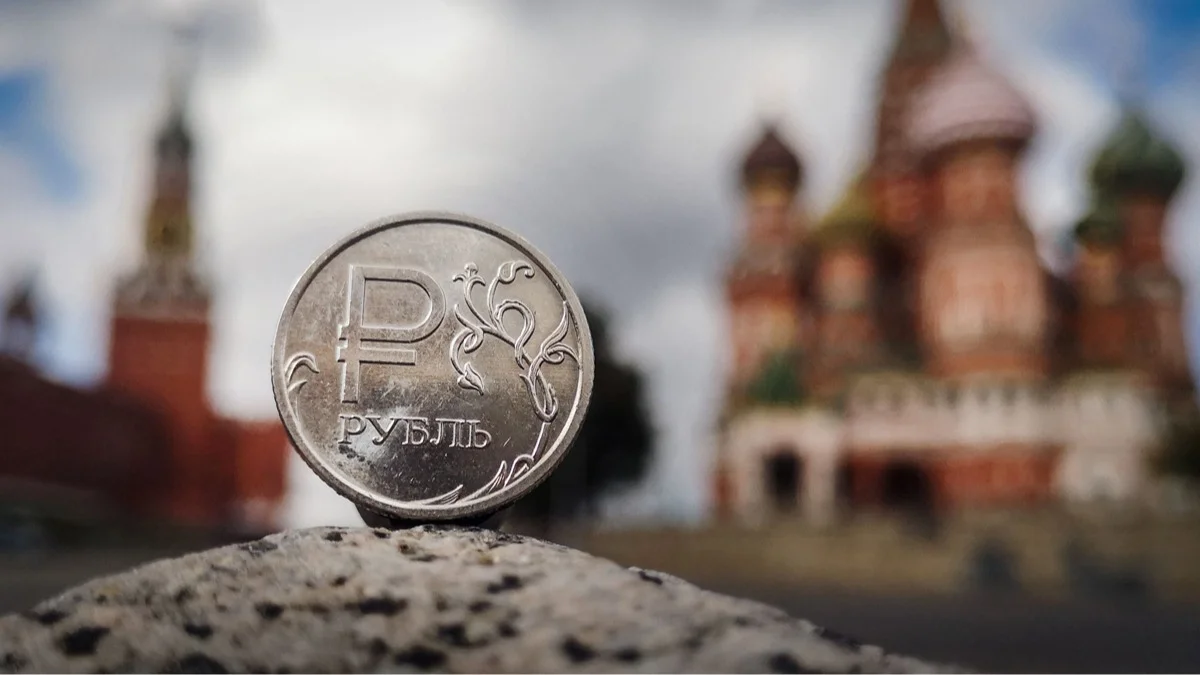
Photo: Alexander Nemenov / AFP / Scanpix / LETA
Conflicting statements by the Ministry of Finance on budget policy against the backdrop of the Gulf War and oil prices almost doubling caused sharp fluctuations in the Russian ruble: in March, it jumped by 7-10% in both directions in a matter of days - from 77 to 87 rubles per dollar and back to 81. “New-Europe” is figuring out what will happen to the exchange rate next.
The most important thing for the ruble now is the behavior of the largest players in the foreign exchange market, such as the Ministry of Finance, leading exporters of resources and importers of goods, as well as the policy of the Central Bank. Starting from mid-2025, the Central Bank has been consistently reducing the rate. And in addition, the sharp drop in Russian oil prices in the fall of 2025 and winter of 2026 led to a reduction in budget revenues. Both are factors in the weakening of the national currency.
Against this background, the Ministry of Finance made a statement that turned out to be extremely sensitive for the already nervous money market of military Russia. The financial department has proposed reducing the oil cut-off price (or changing the budget rule), above which revenues are sent to the National Welfare Fund (NWF). This meant that the Ministry of Finance was going to buy foreign currency to replenish the melting National Welfare Fund, which would push the dollar up. At the same time, the department stopped selling yuan from the Fund in March, which supported the national currency.
Thus, the Ministry of Finance admitted what seemed obvious at that time - that the oil price of $59 per barrel included in the budget law was no longer relevant for the Russian treasury (before the start of the Gulf War, raw materials from Siberia were priced at $40–45). And therefore, in order for the deficit not to grow, it’s time to move on to sequestration and reduce “non-sensitive” budget expenses by 10% (savings - from 0.6 to 2 trillion rubles, “New Europe” explained why).
These statements collapsed the ruble, the rate of which by mid-March reached almost 87 rubles per dollar on the interbank market against the dollar, falling by about 10 rubles.
But the devaluation this time turned out to be short-lived. Already on March 24, it became clear that the Ministry of Finance would not do anything about this, because, as the government expects, an unexpected gift in the form of rising oil prices would be enough to plug the growing hole in the budget.
With an increase in the average price of Urals to $85–90 per barrel, March could give the budget an additional $4.5 billion, Tatyana Mitrova, an expert at the Center for Global Energy Policy at Columbia University, calculated for New Europe.
This is approximately a tenth of the budget deficit planned for 2026 (it is expected to be 3.8 trillion rubles) at today’s exchange rate, or approximately the same amount as the treasury lost in oil and gas revenues in January and February.
As a result, the authorities announced a Solomonic decision - they will not cut budget expenditures, but they will also not touch the budget rule in 2026: until 2027, the cut-off price will remain at $59, as stated in the budget law. The financial department also stopped operations in the foreign exchange market until July 1.
After the Ministry of Finance’s words were taken back, the ruble rolled back and strengthened to 81 per dollar. “It’s unlikely that the goal of fiscal policy is to create such exchange rate volatility,” economist Dmitry Polevoy sarcastically notes in his Telegram channel.
Should we wait for strengthening?
This cannot be ruled out, but rather this forecast concerns the coming months.
Now there are two main factors in favor of the ruble. Russian oil in March costs approximately twice as much as in previous months (and foreign exchange earnings come with a time lag, that is, companies' March earnings will arrive in Russia in April and even May), and when oil companies sell more foreign currency to pay taxes, this will support the ruble. At the same time, the Ministry of Finance will not buy foreign currency from the National Welfare Fund for the next three months.
But even if the financial department returns to purchasing yuan for the fund and “creates additional demand for the currency, this will only offset the growth in its supply from exporters and will not put significant pressure on the ruble,” says Promsvyazbank analyst Denis Popov. In his opinion, the exchange rate for the middle of the year could be in the range from 80 to 85 rubles per dollar.
“The Iranian conflict has also increased prices for other Russian export goods, and this increase in export revenue is translated directly into foreign currency sales - as a result, the ruble in 2026 may be stronger than the original forecasts,” writes economist Dmitry Polevoy. Initial forecasts are, for example, the consensus of economists that the average annual exchange rate will be 84 rubles per dollar.
T-Investments chief economist Sofia Donets does not exclude the possibility that in the short term the ruble may strengthen to 70 rubles per dollar and even stronger.
Should we wait for weakening?
This is more likely a prospect for the end of 2026 or 2027, because long-term risks for the ruble have not gone away.
The main thing that the Russian authorities are now concerned about is the search for additional income, says Yaroslav Kabakov, director of strategy for the investment company Finam. Therefore, their policy is completely opportunistic and depends on events in Iran. And with the end of the Gulf War and the release of the Strait of Hormuz, the value of Urals may collapse. Then the question of where to get the money to finance the inflated expenditures of the military budget will become aggravated with renewed vigor.
An additional, although not yet manifested, risk is the Ukrainian Armed Forces’ strikes on refineries, as well as on the Russian oil export ports of Novorossiysk, Primorsk and Ust-Luga, which stopped supplies of approximately 2 million barrels of oil per day to foreign markets. This does not mean that the budget is losing right now, because Russian oil is taxed not depending on export volumes, but “at the well,” during production. Therefore, the budget will begin to lose only if oil companies are forced to stop the production of raw materials.
So far there is no such threat, although if the attacks continue and simultaneously affect several parts of the oil chain - export infrastructure, storage and refining - then the risks to production may increase, Tatiana Mitrova, an expert at the Center for Global Energy Policy at the University of Columbia, told New Europe. “It is too early to talk about the inevitability of problems in production: much will depend on the scale of the damage, the speed of repair, the possibilities of redirecting flows and, of course, on how sustainable the pace and scale of such attacks will be,” she said.
If Russian oil prices again fall to $40–$45 per barrel, as they did in the fall and winter—that is, significantly below the budgeted $59—then the authorities may have to return to discussing revising the fiscal rule again in 2026
(otherwise the National Welfare Fund will melt before our eyes) and reduce expenses. A decrease in the cut-off price means a constant weakening of the ruble, says financier Evgeny Kogan. “For example, a decrease from the current $59 per barrel to $50 will lead to a deterioration in the ruble exchange rate by 5%,” he writes in his Telegram channel. “The fundamental positive effect on the ruble at current oil prices will be temporary,” Raiffeisenbank analysts agree .
A further rate cut will also put pressure on the ruble - the Central Bank will most likely continue to do this, because it believes that it has more or less controlled inflation, and the high cost of credit money increases the risks of a recession.
According to Promsvyazbank estimates, by the end of the year the dollar exchange rate may go into the range of 85–90 rubles; macroeconomics analyst at Ingosstrakh-Investments Management Company Alexander Ivanov says that the average exchange rate over the next year may be in the region of 83–88 rubles per dollar.”
“On the horizon of three to five months, we expect to see the ruble exchange rate above 85 rubles to the dollar, even in the case of short-term strengthening,” T-Investments analysts write .
The positive trade balance and the fact that the ruble takes up more than half of foreign trade settlements reduce the likelihood of a strong weakening of the national currency, says independent investment consultant Andrei Kochetkov. “The range of 80–85 per dollar remains more promising with a slight prospect of a shift to 85–90 by the end of the year in the wake of the Central Bank of the Russian Federation rate cut,” the analyst believes.