
Translated material
Laughter culture as protest
About how, thanks to laughter, a king becomes a slave, and a slave becomes a king

Photo: Pavel Karavashkin / Kommersant
Erich Honecker comes to work, sees the sun and says:
- Good morning, sunshine!
- Good morning, dear Erich! - the sun answers.
At noon, Honecker goes to the window, sees the sun again and says:
- Good afternoon, sunshine!
— Good afternoon, dear Erich! - the sun answers.
In the evening, Honecker, leaving work, again sees the sun in the window and says:
- Good evening, sunshine!
The answer is silence. Honecker asks again:
- Good evening, sunshine! Why don't you answer?
- Go to hell, I'm already in the West! - the sun answers.
(An old joke about the General Secretary of the Socialist Unity Party of Germany, Erich Honecker, already finally immortalized in graffiti on the Berlin Wall with his kiss with Brezhnev.)
As a child, I really loved telling jokes, and since I knew few jokes, those around me got the worst of me: I could tell the same one dozens of times - sometimes even in a row, without a break.
An anecdote is a cool folklore form; it has topicality, performativity, and even literature. My closest childhood friend did not understand this genre at all. Every time I finished telling the story, he laughed and then asked: “What happened next?” And I had to come up with some kind of boring ending to the plot.
What makes the joke special is that it contains all the usual compositional elements: exposition, plot, development of action, climax, but there is never a denouement. Laughter itself is the solution.
That's how it is in the joke about the sun and Honecker. A joke, a game, is an increase in semantic layers, and the spatial “West” becomes political. The word splits into two before our eyes, and in the gap between two indistinguishable but different words, laughter is born. More precisely, in this very gap the “strange” is born, and from it laughter, fear or some other emotion can already be born. In this respect, a thriller is not very different from a comedy; they have the same mechanics. And the joke is almost indistinguishable from the horror stories that elders tell at night at a children's camp. However, laughter is stronger than fear; it’s not for nothing that JK Rowling can defeat the scary boggart by imagining him funny.
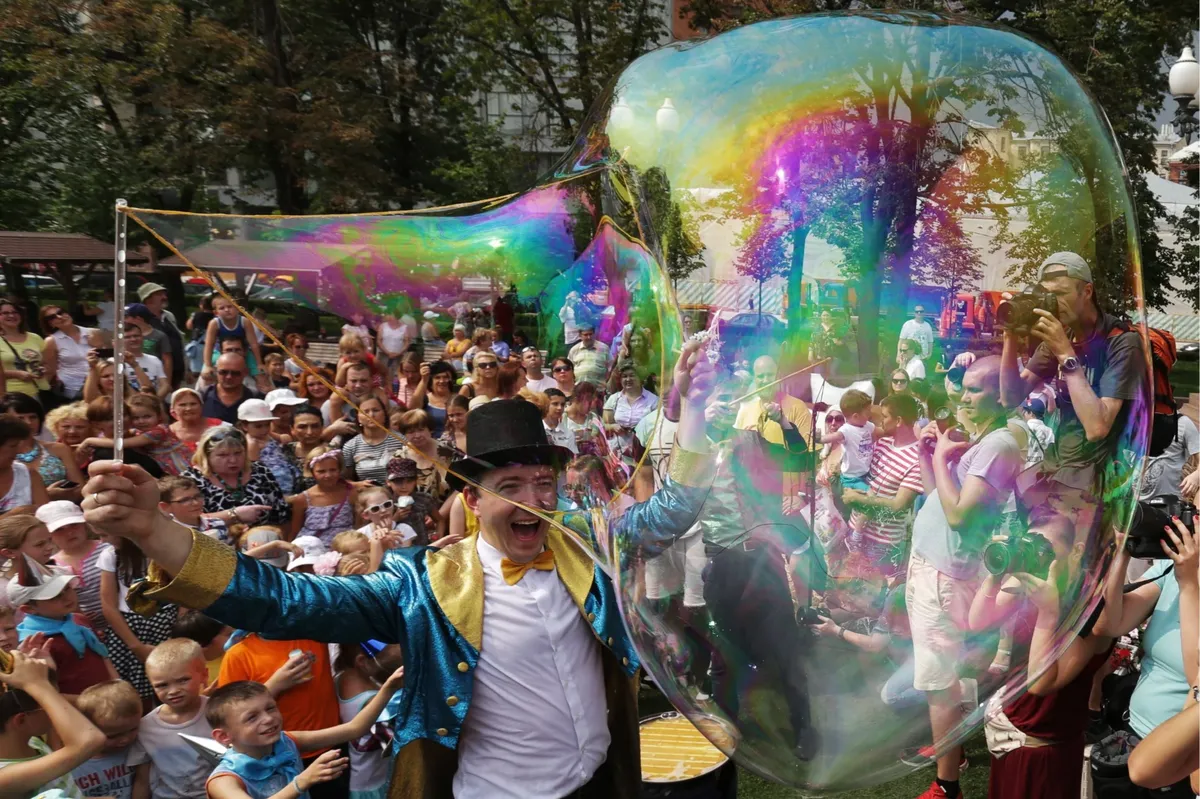
Historically in art, comedy belongs to a low genre, close to public art. Lomonosov's high style is odes, heroic poems, tragedies, oratory speeches, that is, something epic, great, historical. What is important in a joke is this gap of meaning - the less situational the joke, the larger the gap should be. The most epic, large-scale “joke” is a carnival, where one word is not simply divided into two meanings, as in the most primitive puns, which are usually avoided in literary speech. Carnival is a large-scale turning of meaning inside out. The philosopher Mikhail Mikhailovich Bakhtin, who introduced the term “carnivalization” into academic use, wrote in one of his main books, “Problems of Dostoevsky’s Poetics”:
“In the carnival, a new mode of human-human relationships is developed in a concretely sensual, experienced in a semi-real and semi-enacted form, contrasted with the omnipotent social-hierarchical relations in non-carnival life. A person’s behavior, gesture and word are freed from the power of any hierarchical position (class, rank, age, property status), which completely determined them in extra-carnival life, and therefore become eccentric, inappropriate from the point of view of the logic of ordinary extra-carnival life.”
That is, the most ossified sacralized foundations of our society are not only questioned, but for one day they are destroyed, turned over: the slave becomes a king, and the king becomes a slave. Bakhtin writes that “the leading carnival action is the clownish crowning and subsequent dethronement of the carnival king,” and elsewhere clownish priests, bishops and popes were elected. In a joke, in a carnival, in laughter there is revolution, anarchy, which is why they are so terrible for any undemocratic government.
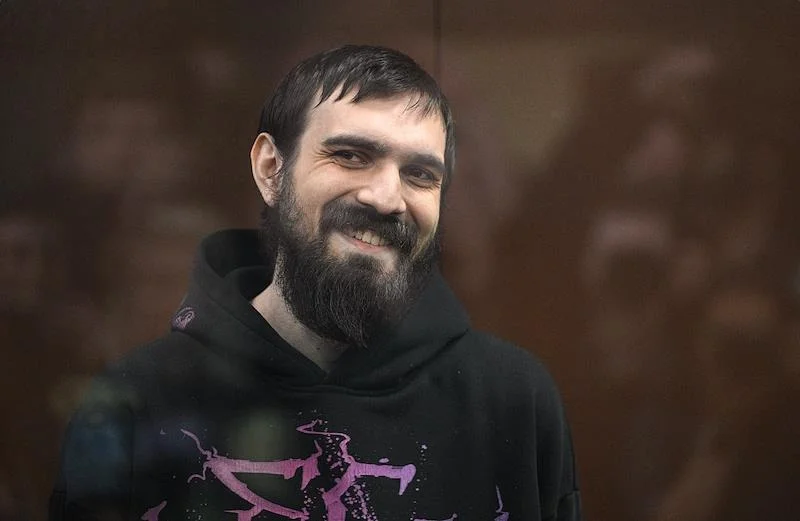
I am writing this in the days when comedian Artemy Ostanin was sentenced to 5 years and 9 months in prison in the case of insulting the feelings of believers and inciting hatred - for two jokes. And comedian Nurlan Saburov, loyal to the authorities, was banned from entering Russia for 50 years.
I am writing this during the years when comedians are imprisoned, expelled, persecuted. I am writing this in an age that began with the closure of the “Dolls” program on NTV - what was it if not a carnival. And carnivalesque is scary - scary not because we laugh at an alternative reality, where everything is upside down, but because the alternative reality laughs at us: is it all upside down for her or for us ourselves? A joke for some turns out to be a pioneer camp horror story for others.
The strangeness that lies at the heart of a joke constitutes not only literature, not only art, but human thought in general. Russian formalism began with strangeness (“estrangement” by Viktor Shklovsky is an illiterately written word “estrangement,” that is, “making a thing strange”), and from formalism, albeit condemned by the authorities of that time, grow structuralism and post-structuralism, that is, somewhat crudely, the entire humanities of the 20th century. Because presenting something as strange is an attempt to get out of ossification, that is, an attempt to comprehend. The movement of thought is strange, and the reason for it is strangeness. The Futurists and Oberiuts are strange, Mandelstam is strange, it’s strange to read Rubinstein, Prigov, and if you really look at it, Pushkin is strange, and it’s hard to imagine anyone stranger than Tolstoy.
His first monograph M.M. Bakhtin graduated in June 1929, six months after the defeat of the “Resurrection” circle, dedicated to the preservation of Christian culture, where Bakhtin himself and his brother were members. The philosopher was sent into exile in Kustanai. He still managed to publish the monograph “Problems of Dostoevsky’s Poetics,” but from 1930 to 1963, except for three minor newspaper articles, he did not publish. And he was rehabilitated only in old age. Laughter, according to Bakhtin, liberates and gives new birth. In the book “The Work of François Rabelais and the Popular Culture of the Middle Ages and the Renaissance” he writes:
“Every era of world history has been reflected in folk culture. Always, in all eras of the past, there was a square with people laughing on it.”
According to Bakhtin, there is a change in laughter: the carnival is between life and death. That’s why Maslenitsa looks so strange and cheerful, when people are already pushing winter to leave as quickly as possible, and April Fool’s Day, on the contrary, is a call for spring to disperse in full force. With laughter and carnival, people switch the frozen cold to a new life in nature, and therefore in themselves.
That is why the carnival is so important at the end of winter, as freedom from frost. And therefore, the joke became the most important part of late Soviet culture - as liberation from political unfreedom, from the nonsense of the world around us. Laughter is an explosion of anarchy that turns everything upside down. It unites, protects, destroys inequality and injustice. Therefore, the authorities feel danger in laughter. That's why it's so important to laugh.