
Translated material
There is no Easter without fire!
Police closed the Church of the Holy Sepulcher in Jerusalem. Russian propagandists predict an apocalypse without the Holy Fire
The American-Israeli operation against Iran led to the closure of Jerusalem's shrines for security reasons. Catholics are protesting, and Orthodox Christians are afraid that the Holy Fire will not descend into the Church of the Holy Sepulcher on Easter, which will mean the beginning of the end of the world...
The Patriarch was turned around
Israeli police did not allow the Latin Patriarch of Jerusalem, Cardinal Pierbattista Pizzaballa, into the Church of the Holy Sepulcher on March 29, when Catholics celebrated Palm Sunday. The hierarch and the clergy and pilgrims accompanying him headed to the main Christian church, where Catholics have served continuously since the 12th century - since the era of the Crusades. They share the temple with other faiths - each has its own altars and shrines in the basilica. The clerics obeyed the demands of the police, but the most zealous of the pilgrims entered into hand-to-hand combat with law enforcement officers.
As noted in a press release from the Latin Patriarchate of Jerusalem, “this case is a serious precedent, sensitive to the billions of people around the world whose eyes are turned to Jerusalem this week.”
The forced cessation of services at the Holy Sepulchre, representatives of the Catholic Church called an unreasonable and highly disproportionate measure that destroys the “fundamental principles of rationality, freedom of religion and respect for the status quo” of the holy places of Jerusalem.
The press release does not provide any assessment of the actions of the pilgrims, emphasizing that the patriarch and his clergy were sent to the temple “privately.”
On the same day, the Italian Foreign Ministry summoned the Israeli Ambassador, who was informed of the official position of the government: the Israeli police had caused “an insult not only to believers, but also to any community that recognizes freedom of religion.” The actions of the Israeli police were also criticized by the presidents of France, Poland, the Prime Minister of Spain, the EU Foreign Office, and even the US Ambassador to Israel Mike Huckabee, known for his belief in Trump’s special mission in the Holy Land.
Justifications were made by the Office of the Prime Minister of Israel, which recalled repeated attacks on Jerusalem by Iranian missiles over the course of a month, and debris from one of the missiles on March 16 fell a few meters from the main Christian shrine. Netanyahu later ordered that Cardinal Pizzaballa be given unhindered access to the basilica. The Israeli leadership made it clear that by Easter (Catholics celebrate it this year on April 5, and Orthodox on the 12th) they will try to find a compromise. After all, there are still people in the world who believe Trump’s promises to finish his Iranian “wonderful special operation” right around Easter.
The Church of the Holy Sepulcher was completely closed to clergy, laity and tourists on February 28, the first day of the US-Israeli operation against Iran. At the same time, access to other important shrines of the Old City was closed: Jewish (Western Wall) and Muslim (Al-Aqsa Mosque). Judging by publications on the official website of the Jerusalem Patriarchate, Orthodox Patriarch Theophilos III served either in his home church or outside of Jerusalem during March.
Fire "brace"
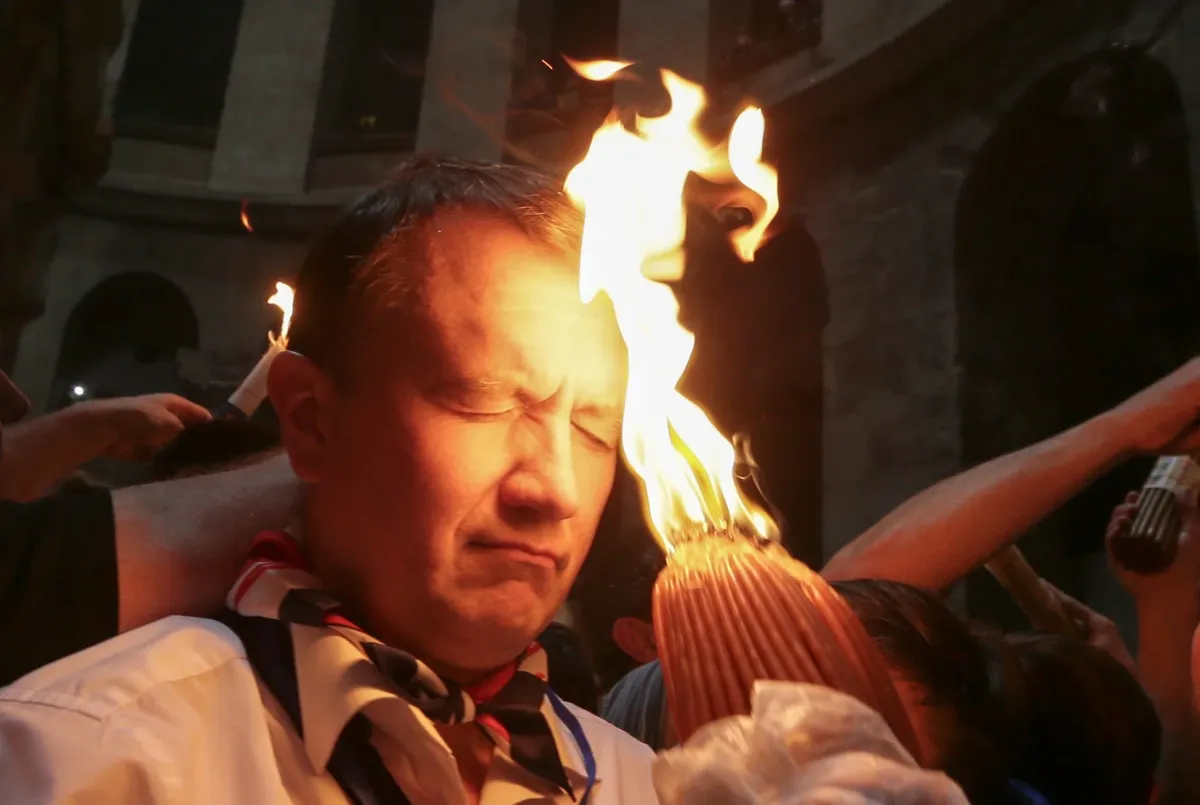
Over the past 30 years, Russian propaganda - both church and political - has made a lot of efforts to make the cult of the Holy Fire, lit on Holy Saturday on the eve of Easter at the Holy Sepulcher in Jerusalem, one of the Russian “spiritual bonds”. The mystical interpretation of this event is as follows: the Lord miraculously lights a fire on His Tomb to show the truth of the Orthodox faith (the fire descends only according to the Orthodox, “old” calendar). The Holy Fire does not burn for the first few minutes, and in the year when it does not descend, the Antichrist will reign in the world. The first written sources that the Holy Fire is not lit, but “descends from heaven,” date back to the 9th century, when Jerusalem was under the control of the Islamic caliphate.
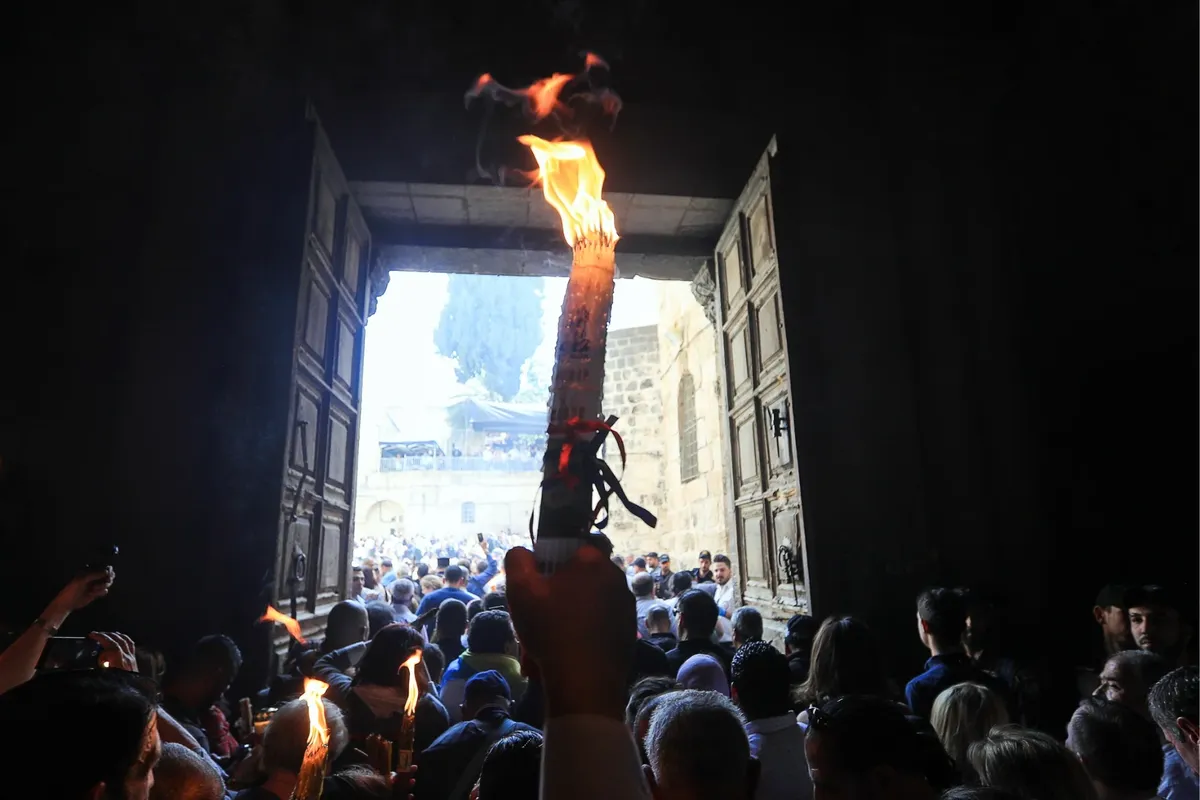
The Russian NTV channel has exclusive rights to live broadcast of the descent of the fire (the Jerusalem Patriarchate even adjusted the schedule of services to coincide with this broadcast), and the Russian St. Andrew the First-Called Foundation, headed by Vladimir Yakunin, has the right to deliver this fire on a special flight to Russia. Yakunin’s transfer of the Holy Fire to Patriarch Kirill on the pulpit of the Cathedral of Christ the Savior has become an obligatory element of the Easter service according to the Russian Orthodox Church. Quite quickly, lamps lit from the original fire are transported to churches in Moscow and by plane to various dioceses. The coronavirus year 2020 became a test for an ancient tradition: then only the Orthodox Patriarch of Jerusalem, a small group of clerics, police officers and camera operators were allowed into the temple. But the ritual itself passed without changes.
Despite the fact that the tradition of delivering fire from Jerusalem to Russian churches on Easter is quite new, a whole generation of believers has grown up for whom the “Feast of Holidays” does not occur without this broadcast.
By an annually repeated miracle, God, they believe, strengthens and renews their faith, and most importantly, sends a reliable sign that the world will last at least another year. The fact that the receipt and delivery of fire was entrusted to one of the founders of the Ozera cooperative and the head of several foundations and societies that are significant for the Kremlin (in particular, military-historical), shows how important this popular faith is for the authorities. The Holy Fire is presented as a sign of divine sanction on power, a guarantee that the current regime is “not repugnant to God,” but on the contrary, it is keeping the world from the coming of the Antichrist, which means that it must be obeyed in everything “not for fear, but for conscience.” Once hooked on such religious and mystical doping, the authorities will not be able to give it up.
Temptation by the Holy Fire
From the point of view of churchgoers, what usually happens in Jerusalem on Holy Saturday causes “cognitive dissonance.” The Orthodox tradition interprets the last day before the Resurrection as a time of rest, when God remains in the tomb with his body, taken from humanity. “Let all human flesh be silent,” is sung at the liturgy of Holy Saturday. But, as the pre-revolutionary Byzantine scholar Alexei Dmitrievsky noted, “how great and sacred in the Orthodox fatherland is the rumor about the burning of St. Fire, the very sight of it in Jerusalem is so painful for the eyes and the heart.” The atmosphere in the temple at this moment is more reminiscent of a stadium: crowding, running, drums, shouts, chants... The clergy of the Jerusalem Patriarchate is trying to sing the statutory chants, but they cannot be heard through the frenzy of the crowd, in which young Orthodox Arabs behave especially expressively. They chant: “We are Orthodox! Our faith is correct! Christ was born in our village!” There is a legend among Orthodox Arabs: if you don’t scream and jump, the fire won’t go away.
In 2008, Deacon Andrei Kuraev*, then still very influential in the Russian Orthodox Church, began the controversy surrounding the Holy Fire, which continues to this day. The St. Andrew the First-Called Foundation then organized a meeting in Jerusalem with Patriarch Theophilos III for a group of Russian journalists. According to the then editor of the official Church Bulletin, Sergei Chapnin, who has now emigrated to the United States and criticizes the Russian Orthodox Church, the meeting shocked the church participants: the patriarch came out with a kind of “boorish Russophobic message.”
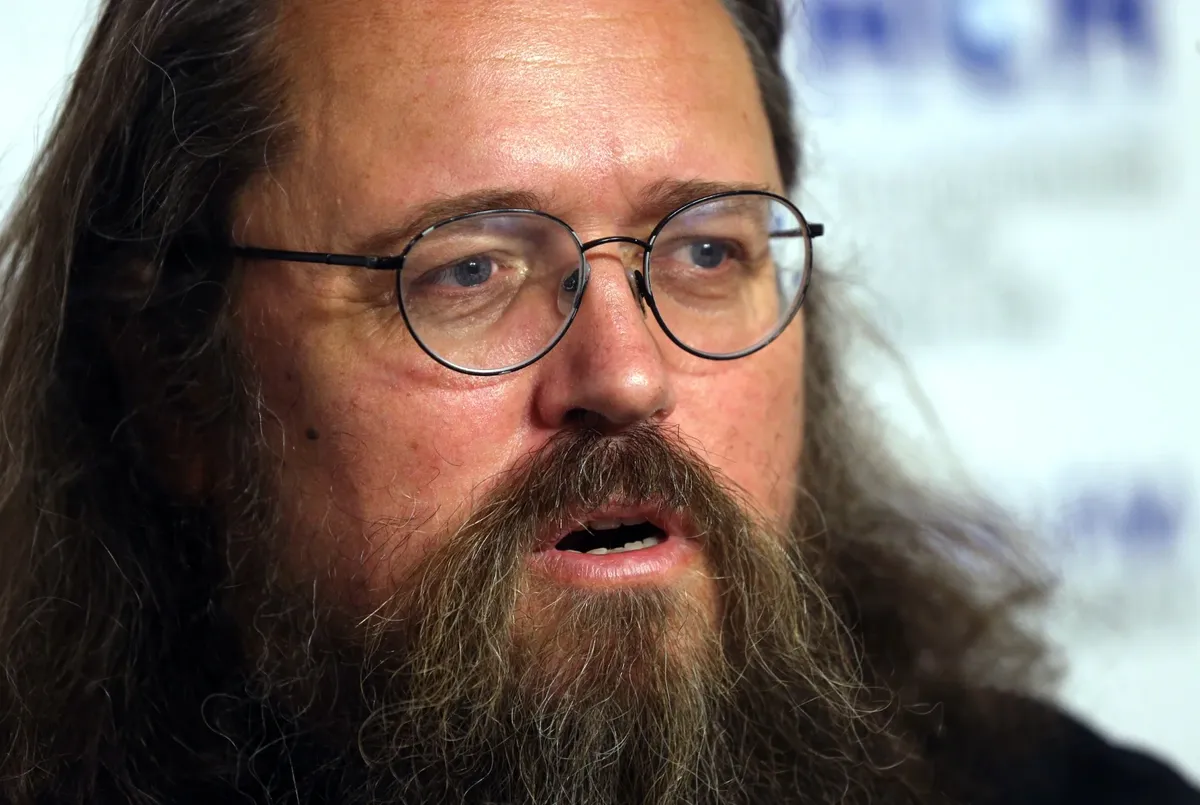
According to Kuraev, the “message” was provoked by one of the participants in the Russian delegation, who reproached the Jerusalem Patriarchate, whose flock mainly consists of Arabs friendly to Russia, for the fact that all hierarchical posts in the church are occupied by Greeks, whose policy is “multi-vector.” Theophilus III retorted that his church had never been involved in politics or business, and the discord in Orthodox life in the Holy Land was caused by the appearance of the Russian spiritual mission there in the middle of the 19th century. What finally shocked the Russian delegation was the patriarch’s recognition that the lighting of the Holy Fire “is a ceremony that is a representation, like all other ceremonies of Holy Week. Just as the Easter message from the Tomb once shone and illuminated the whole world, so now in this ceremony we perform a representation of how the news of the Resurrection from the Edicule spread throughout the world.” Kuraev’s phrase became a meme: “He probably couldn’t have spoken more openly about the lighter in his pocket.”
Christ criticized the people’s “thirst for miracles,” saying that faith should have an internal moral basis, and not arise under external pressure: “An evil and adulterous generation seeks a sign” (Matt. 16:4).
Already the first head of the Russian spiritual mission in Palestine, Bishop Porfiry (Uspensky), reproached the Jerusalem Greeks for manipulations around the Holy Fire. In the mid-twentieth century, the bishop’s namesake, professor of the Leningrad Theological Academy of the Russian Orthodox Church Nikolai Uspensky, explained the phenomenon by the cowardice and political prudence of the Jerusalem Greeks: “Without giving a timely and energetic explanation to his flock about the true meaning of the rite of St. fire, in the future they were unable to raise this voice in the face of the ever-increasing fanaticism of the dark masses due to objective conditions.” This hypothesis seems to be strengthened by an episode that took place during the British Mandate of Palestine in 1923. The newly appointed governor, in order to avoid mass unrest, allowed only the patriarch with the clergy, without the people, to enter the Church of the Holy Sepulcher on Holy Saturday. However, Patriarch Damian, who then relied on the support of the Arabs, refused to enter the temple without people, the fire “did not go away,” tension grew, and late in the evening the governor surrendered. As soon as the exalted crowd entered the temple, and the patriarch entered the Edicule, the fire immediately descended.
One of Theophilus’s predecessors, Patriarch Diodorus, who repeatedly visited the Soviet Union, outlined a completely pious version of what he saw inside the Edicule: “From the depths of the stone on which the Body of Christ lay, an indescribable Light emanates. As a rule, it has a blue tint, but the color can change... Every year it appears differently... This light does not burn.” However, this version was refuted not only by Patriarch Theophilos, but also by the former locum tenens of the Patriarch of Jerusalem, Metropolitan Cornelius, who had the opportunity to perform the ritual on Holy Saturday 2001: “The prayers offered by the bishop sanctify natural fire, and, therefore, it has the grace of the Holy Fire. This is a natural fire that is lit from an unquenchable lamp.” In 2019-2024, a court in Athens considered a lawsuit against journalist Dimitrios Alikakos, who refuted the miracle of the descent of fire with references to his conversations with the archbishops of the Jerusalem Patriarchate Aristarchus and Isidore. They sued the journalist, but not for “insulting the feelings of believers,” but for divulging the secrets of a private conversation. The court rejected the claim.
Today, there are more supporters of the supernatural nature of the Holy Fire among the Slavs than among the Greeks. On Russian Orthodox websites before Easter, as a rule, publications “in defense of the miracle” appear. Their argument boils down to the testimony of pilgrims who saw flashes of lightning in the temple, spontaneous combustion of candles and lamps, and also tested for themselves that in the first seconds the fire did not burn. Among the supporters of this faith is such a theological authority of the Russian Orthodox Church (though with a controversial reputation, as Metropolitan Hilarion (Alfeev).
Between two fires
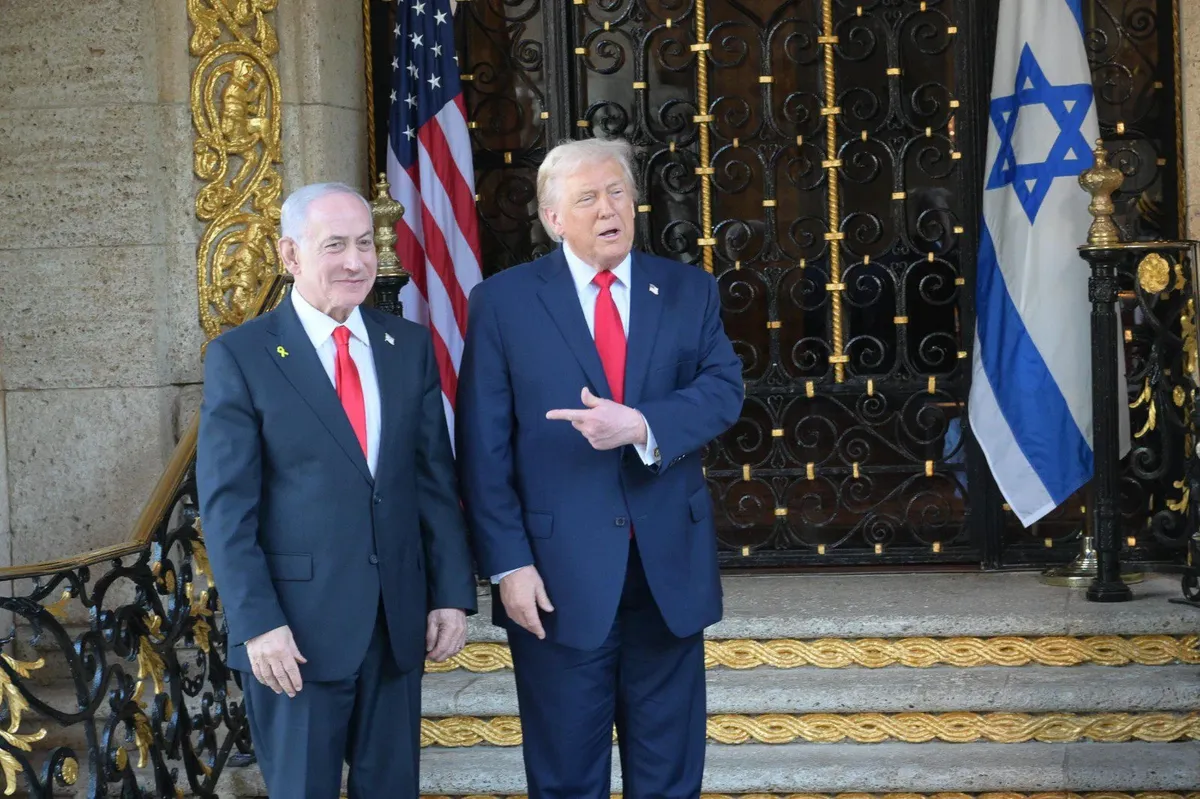
Just a few days ago, fears that an Israeli-American operation in the Middle East would disrupt the centuries-old traditions of celebrating Easter in Jerusalem seemed well founded. Such a major Russian expert on the Antichrist as General Apti Alaudinov (officially assured: “99.9% confidently we can say today that Trump is the Antichrist.” Such suspicions also circulate in the Orthodox community, and it is obvious that the “cancellation of the Holy Fire,” the root cause of which was Trump’s attack on Iran, would give millions of Orthodox Christians a “theological” basis to consider the US President the Antichrist, and our era as the time fulfillment of the Apocalypse.
But the Russian officialdom - RIA Novosti - is in a hurry to reassure the Orthodox: the end of the world is being postponed again. With reference to a source of not very high level in the Church of the Holy Sepulcher, the state agency assures that the Holy Saturday service at the Sepulcher will take place “purely with the participation of church ministers and internal personnel of the temple.” This is quite enough for Vladimir Yakunin to again receive his piece of the sacred fire in the courtyard of the temple, with which Patriarch Kirill from the pulpit of the Cathedral of Christ the Savior would once again bless the Russian government.