
Translated material
Loner
Lev Shlosberg* - about why he asked to be put in jail alone

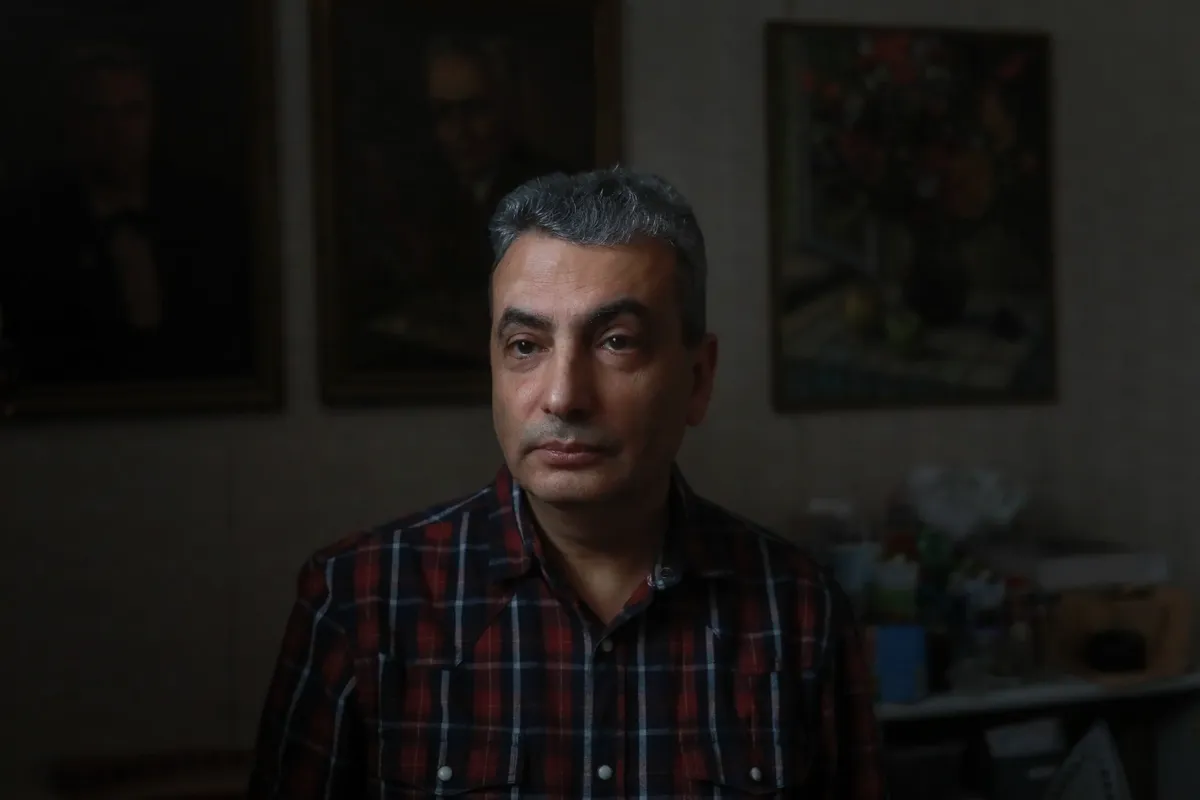
Photo: Sergey Elagin / Business Online / TASS
18+. THIS MATERIAL (INFORMATION) IS PRODUCED, DISTRIBUTED AND (OR) SENT BY FOREIGN AGENT SHLOSBERG LEV MARKOVITCH OR CONCERNES THE ACTIVITIES OF FOREIGN AGENT SHLOSBERG LEV MARKOVITCH.
On the eve of the end of quarantine, I wrote to the head of the pre-trial detention center with a request to continue being in solitary confinement: “Psychologically stable. Passed testing in the psychological laboratory of pre-trial detention center No. 1. I don’t experience any additional stress from being in solitary confinement. The position has been agreed upon with the lawyer.” My application was granted.
The understanding of the need for just such a decision came to me already in the first week of my stay in the pre-trial detention center. I realized that solitary confinement would be good for me.
The main thing a person must do in unfreedom is to preserve himself. Maintain inner peace. Save your sanity. Maintain spiritual harmony. And for some, perhaps, to find it.
In solving such a problem, you must first of all rely on yourself, your internal capabilities. From external forces you need the support of family and friends and books.
Achieving a balance between internal and external requires a person to work on himself. You need to carefully and calmly look at your inner world. Understand his condition - how strong the blow of lack of freedom was, what hurts, what worries, what requires adjustment or even reconfiguration.
No one can do this tactful job better than the man himself. Nobody knows you better than yourself.
I realized that it was important for me to preserve and protect my inner space. And in this personal matter, I don't need other people inside the prison.
Prison, as a container of unfreedom, leaves a person the opportunity to remain free and alone with himself.
A room measuring 2.5 x 4.5 meters is my temporary territory, 24/7 use of which should only be available to me. This is my home now. It is necessary to organize my life in this limited space so that everything in it helps me to resist and remain a free person within myself. Solitary confinement helps to shape a person’s personal space in conditions of unfreedom and thus protects the person.
In solitary confinement, a person is able to build his world in such a way that physical unfreedom does not destroy inner freedom.
A remarkable feature of loneliness as a form of psychological defense in conditions of unfreedom is that the ability to live harmoniously alone is in itself a property of a free person.
For an intellectual person, loneliness is not a burden or a punishment, it is an opportunity. An opportunity to get yourself in order. An opportunity to restore peace of mind. Opportunity to adapt to a different lifestyle. The ability to think without being distracted by anyone else. This is great value.
External silence is also important for internal silence. Human communication should be as broad as it is internally required. I realized that in a new life situation, the conversation within myself is most important to me. But not only that.
The space of solitary confinement naturally includes letters and books. The voice in the letter sounds clearer in the silence of solitary confinement. Books fill solitary confinement with the boundless space of literature. For culture there are no prison walls or walls at all.
A very important advantage of solitary confinement is the opportunity to be alone with yourself. There is no need to put on a mask in front of anyone - no strength, no protection, no ostentatious calm. A person can be sad, and during solitary confinement there is no need to hide this state from anyone. You can read a letter from a loved one and cry - and no one needs to see those tears. The possibility of preserving the naturalness of a person’s state in solitary confinement frees him from the forced artificiality of his external image, the need to “keep face” and waste moral strength on this extraneous necessity.
Of course, any direct analogies are inaccurate and risky, but the creators of monasteries and monasteries who strived into the reserved wilderness, often going into the earthly unknown in complete solitude, were looking not just for solitude, but for the very opportunity to remain spiritually free as far as possible from crowds.
The founder of the monastery closest to Pskov, Savva Krypetsky, even paved the way to his refuge through a swamp - so that the foot of a random person could not pass this obstacle.
Creativity in the vast majority of cases presupposes the physical loneliness of the author, who, in fact, becomes a co-author of the master.
Modern life is destroying the humanitarian phenomenon of loneliness as a natural state of a spiritual person (and this is not a religious category). Pervasive non-stop communication makes loneliness almost impossible, and this greatly affects the psyche, way of thinking and life of a person.
The inability to avoid forced and optional communication makes a person an involuntary follower of vanity - the main destroyer of human integrity.
Dependence on the burdens of the outside world can drown out a person’s abilities and talents, leave ideas and plans unfulfilled, and steal invaluable time of communication with loved ones and human experiences.
Solitary confinement in the Pskov prison castle allowed me to compare the personal space of life and the world surrounding this space, reminding me that the essence of human existence should not be predetermined by external circumstances, including force majeure.
I have never been afraid of loneliness as long as I can remember. Now I understand that loneliness in unfreedom opens up the opportunity for a person not to stray from the path to freedom.
Pskov Prison Castle
* The Ministry of Justice of the Russian Federation considers the politician a “foreign agent.”
This material was published in the seventeenth issue of Novaya Gazeta. Magazine". You can buy it in the online store of our partners.