
Translated material
Jew. "In the Womb of the Stepmother"
I looked for the answer to the “Jewish question” in Russian classics

Illustration: Petr Sarukhanov / Novaya Gazeta
18+. THIS MATERIAL (INFORMATION) IS PRODUCED, DISTRIBUTED AND (OR) SENT BY FOREIGN AGENT GENIS ALEXANDER ALEXANDROVICH OR CONCERNES THE ACTIVITIES OF FOREIGN AGENT GENIS ALEXANDER ALEXANDROVICH.
Cosmopolitan
All anti-Semites have Jewish friends, but Jews also have anti-Semitic friends, and I have one.
“God,” he says, “created you Jews so that people would think.”
I thought about it, but came to nothing. Perhaps because I am just enough of a Jew to be considered that way, and then not always, but when the need arises. Let’s say, when it started... and I didn’t like it, my opponents argued with me laconically and illiterately.
“Fluttery,” they explained, having immediately exhausted their arguments and their school reserve of spelling.
The first time I encountered this argument was when I was ten years old, when I was in a pioneer camp. On the line, one new girl looked at me and desperately shouted: “He’s a Jew!”
It was not a statement of fact that sounded in this exclamation, but a sum of assessments that expressed a pathologically complex attitude towards who I was and what I meant. More than a sentence, the girl’s cry characterized my position in the world. It was the understatement of the conclusion that made it universal. One word, in which, in essence, there was nothing offensive, defined me forever, because it did not require, did not need, and did not allow any additions: “Jew” - that says it all.
So I discovered the secret of my origin and learned to live with it. Long before I read about it in Sartre, I learned that anyone who is considered one is a Jew. And this means that the choice belongs not to me, not to my dad and mom, not even to the passport officer from the police department, but to a stranger to everyone: anyone who wants to.
In my time, Jewish nationality was piquant, like a dirty joke. They didn’t always talk about her out loud and often indirectly.
Thus, in William Pokhlebkin’s seminal culinary compendium “The Cuisine of Soviet Peoples” there was a place for Jewish recipes, but only at the very end - between the table of contents and the gastronomy of the Arctic.
Since I knew only Soviet Jews, I thought that all of them - from the building manager to the members of the Central Committee - were the same, because they carried within themselves the not entirely decent secret of their Jewishness. Now it seems to me that Jews of all countries and peoples are different from each other.
“Especially,” Bakhchanyan prompted, “when they sing “Jewish songs about their homelands.”
But then, as a boy, I lived with the most bizarre knee, which did not even consider itself such, because others did it for it. The Jewish nationality was shimmering, puzzlingly complex, containing many shades and bizarre combinations.
Take, for example, my father, whose nationality - and even then briefly - could be defined as follows: a Russian cosmopolitan Jew of the Soviet era. My father always remembered that he grew up near the Jewish Bazaar in Kyiv, spoke Yiddish and was keenly interested in any mention of Jews, believing that the very existence of this tribe implied a healthy skepticism towards totalitarian power. But this did not prevent him from knowing all of Eugene Onegin by heart and reverence for the rest of the classics, not necessarily Russian. For him, any culture served as a staircase leading from the same Yevbaz to a free but forbidden world, where he got there by moving to America and feeling sad about the past.

It's even more difficult with me. What for my father was a hobby and an exercise in self-improvement, for me became a profession, moreover, a calling, including a Jewish component along with everything else. It is not surprising that I moved to New York, where the national is organized like a Swedish breakfast and is not even a secondary feature. In such an environment, the Jewish question is no different from a myriad of others - insignificant, insoluble, absurd.
The stupidest thing is that I really believed in it. I even called one book “Cosmopolitan”, considering as such a tenant of the Tower of Babel and a subscriber to the Library of Alexandria.
“Nonsense,” said the wife, “in our country “cosmopolitan” is translated as “Jewish face,” but I didn’t believe her because I loved Woody Allen.
His eternal hero is a Jewish hypochondriac, whose cosmic neurosis no longer requires a psychiatrist, but a theologian. Each of his films, plays, and humoresques is an experience of philosophical humor, combining pathos with mockery.
Woody Allen turned metaphysics into a spectator sport. Watching the fight between a little bespectacled Jew and the Universe is a fascinating experience.
“Especially,” I concluded for myself, “those who like me live in New York.”
Like Faulkner - Yoknapatawpha, like Joyce - Dublin, like Bulgakov - Kyiv, Woody Allen created his mythical New York and populated it with people similar to himself, to whom I hoped to cling to.
At first, as it turned out much later, Woody Allen himself failed, who was forced out of his beloved city. Even later, it turned out that it was not so easy for other Jews to forget about their place, even in New York, where there are more of them than in Jerusalem.
That morning, the huge block reserved for the campus of the glorious Columbia University was in unprecedented silence. It was especially disturbing compared to the previous night, when a pro-Palestinian, but in fact simply anti-Semitic demonstration kept neighbors from Broadway to Hudson awake.
The riot of students and Palestinian activists who had come from nowhere was stopped by armed police. Having cordoned off the university, she emptied the classrooms. In one, where the most stubborn ones had barricaded themselves, the ancient doors had to be broken down. The battlefield was left to the authorities, and when I arrived to look at it, the streets were unusually empty. A lone passerby walked past the police vans. Taking a closer look, I saw on it a defiantly white kippah, like on a holiday. Actually, that’s why he came here, to show himself. For him, the “Jewish question” again demanded an answer, as it did for me. Therefore, I began to look for it where I left it - in Russian classics.

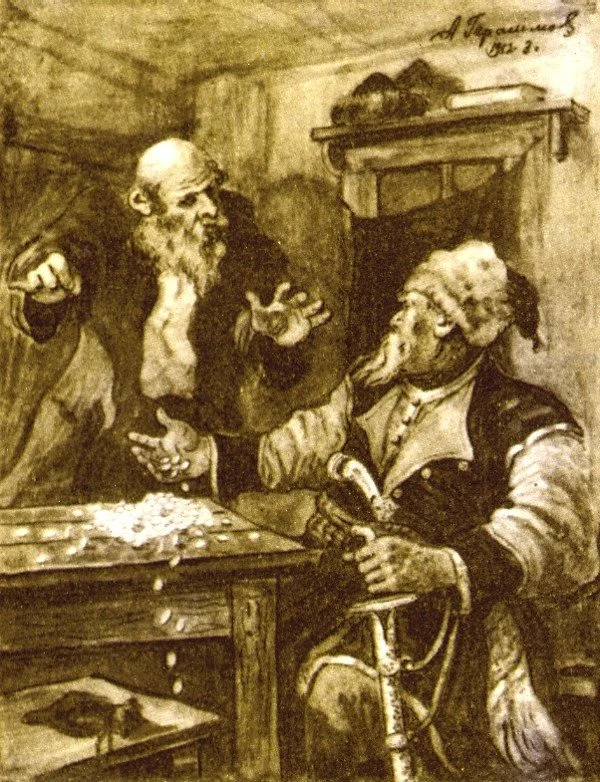
Yankel
The evolution of the Russian Jew did not begin with Gogol, but reached its apogee in Taras Bulba. This reflected the epic, almost folklore and largely fairy-tale nature of the story. If Taras is a hero, then Yankel plays the role of a magical assistant assigned to him not even by the author, but by the genre (and Propp).
This is not immediately noticeable, because we meet the Jew in an extremely humiliated state. At first, Yankel appears to the reader as a relative - because of the same Gogol - a small man, so small that he became “somewhat like a chicken.” However, like Bashmachkin, who by the end acquired an infernal appearance and a gangster character, Yankel gradually grows up. Having started as a small trader, he acquires villainous traits on a completely different scale.
“He has already... little by little sucked out almost all the money and has strongly marked his Jewish presence in that country... everything fell down and became decrepit, everything was drunk, and what was left was poverty and rags; as if after a fire or plague, the entire region was eroded. And if Yankel had lived there for another ten years, he would probably have wiped out the entire voivodeship.”
In his new capacity, the Jew captures more and more narrative space, becomes more important and more familiar to Gogol’s reader. To put it bluntly, he vividly resembles the devil from “The Night Before Christmas,” who, on the one hand, can steal the moon, and on the other, is afraid of the blacksmith Ostap. Taras is like him, who seeks help from the Jews, because “ that’s what you Jews were already created for. You can at least draw a line: you know all the things; that’s why I came to you .”
And indeed, Yankel, although for money, serves as Bulba’s faithful assistant. He almost bought Ostap out of prison, and not succeeding in this noble deed, accompanies Taras to the place of execution: “and the Jew, like a nanny, sighing, wandered after him.”
This “miserable place” does not fit into the stable image of the Jew with his “eternal thought of gold,” but it does not amaze the reader, because everything that is connected with the Jews in the story is surprising. Having come to them for help, Taras and his author take the opportunity to go to a completely different world.
Catholic Poles represent unconditional enemies. Unable to bear their presence even for the sake of conspiracy, Taras burst into inappropriate abuse on a theological issue:
“You’re lying, damn son! - said Bulba. - You yourself are a dog! How dare you say that our faith is not respected? It is your heretical faith that is not respected!”
There is nothing to argue about with Jews, because their otherness precludes the existence of a common language. Hence the extravagance of Jewish life, within which Taras had the privilege of living for a short time. Once on the Jewish street, he is surprised to discover “Jewish stockings, short trousers and smoked goose” hanging on poles. If the goose hints at cracklings, short trousers are a sign of debauchery, then how “ Jewish stockings ”, as well as a little further “ Jewish shoes ”, differ from any others, I don’t understand.
Even more amazing is the Jewish housing where Taras spends the night before Ostap’s execution. This room is in an “ unclean house ”, where Bulba sleeps on a bench, Yankel sleeps on the floor, the owner sleeps in a closet, and “ two little Jews, like two domestic dogs, lay down on the floor near the closet .”
By letting Yankel and his fellow tribesmen into the book, the author allowed them to grow into textbook characters - strangers and nearby, inexplicable and inside, poor and rich, weak and cunning, humiliated and powerful, petty and eternal...
Gogol's Jew is a complete contradiction, but what is direct in Gogol?
Rothschild
The stability of Gogol's image of the Jew is confirmed by its appearance in a different era and in a very different author - Chekhov.
In “Rothschild’s Violin” it is played, of course, by another Jew, but he also looks like the typical “little man” of our classics: you feel sorry for him.
About Rothschild, unlike his namesake, we know almost nothing. He is not a hero in the story, and in every respect. Almost a comic figure, he is dressed by the author in a shabby suit that suits his appearance.
“Yakov seemed disgusted that the Jew was out of breath, blinking and that he had so many red freckles. And it was disgusting to look at his green frock coat with dark patches and at his entire fragile, delicate figure.”
But Rothschild looks especially pathetic when he puffs up in response to a threat: “But please, be quiet, otherwise you’ll fly over my fence! “When it almost came to a fight, “Rothschild froze with fear, crouched down and waved his hands above his head, as if protecting himself from blows, then jumped up and ran away as fast as he could. As he ran, he jumped, threw up his arms, and you could see how his long, skinny back trembled.”
Another thing is the central character - the undertaker Ivanov, whom Chekhov did not deprive, like Rothschild, of his Christian name and patronymic: Yakov Matveevich. The author writes about him that “ there were no people taller or stronger than him anywhere, not even in the prison castle .”
It is not very clear why this powerful man disliked the slender Rothschild, with whom he played in a Jewish orchestra at weddings and funerals. Perhaps, the author hints, music is to blame for this.
“This damned Jew,” complains the undertaker, “even the most fun managed to play pitifully.”
But the most original thing in the story is the inverted stereotypes. Instead of attributing to the Jew, as Gogol does, “the eternal thought of gold,” Chekhov gives this obsession to Ivanov, who knows one passion in life: counting losses. Upset by his wife’s fatal illness, he “took a book in which he wrote down his losses every day, and out of boredom began to sum up the annual total. It turned out to be more than a thousand rubles. It shocked him so much that he slammed the bills on the floor and stamped his feet.”
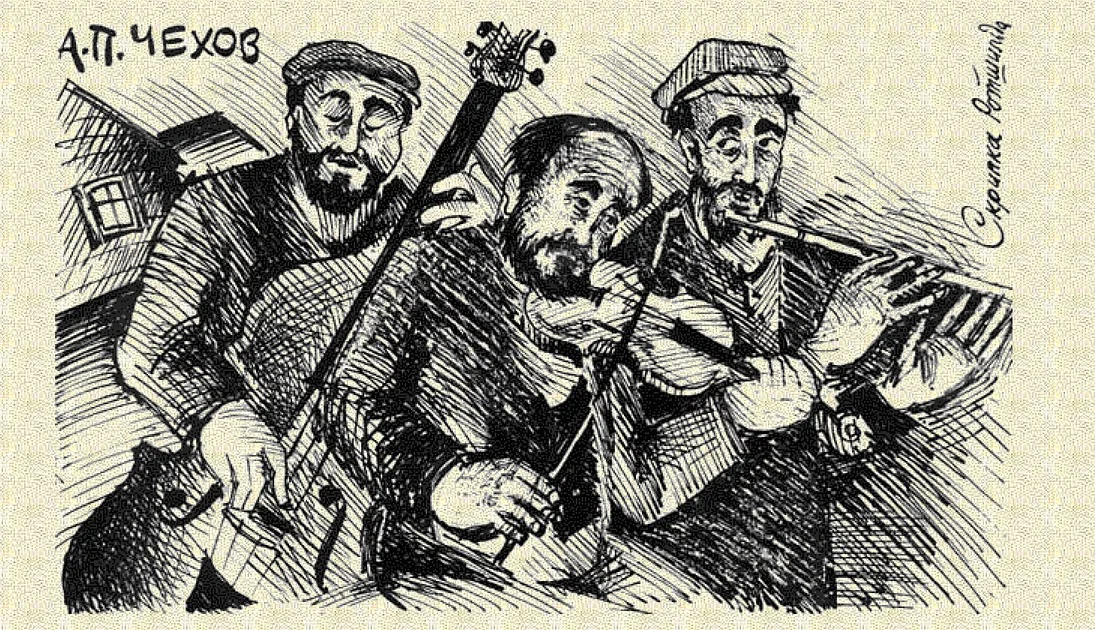
By the end, however, it is not money, but the violin that reconciles the antagonists. Having infected the Russian undertaker with the eternal Jewish sadness, she transformed the grief into music and returned to the source of the melody - Rothschild.
Ultimately, the little man in the patched frock coat won the prize - a magical violin that captivated all listeners.
“ He comes out with something so sad and mournful that the listeners cry, and in the end he himself rolls his eyes and says: “Wahhh!..”
Having brought, as is his custom, realism to a symbol, Chekhov abolished anti-Semitism with the help of art.
Not a Russian or a Jew, but a magical instrument, indifferent to such trifles, transformed a wretched provincial town, inhabited by insensitive, cowardly, that is, “gloomy people” into a temple of the muses.
“The city liked the new song so much that Rothschild was invited to compete by merchants and officials and forced to play it ten times.”
Actually, the author warned us about this, naming the story not after the hero, but after his violin, which was deeply indifferent to the Jewish question that was painful for everyone else.
Benya Krik
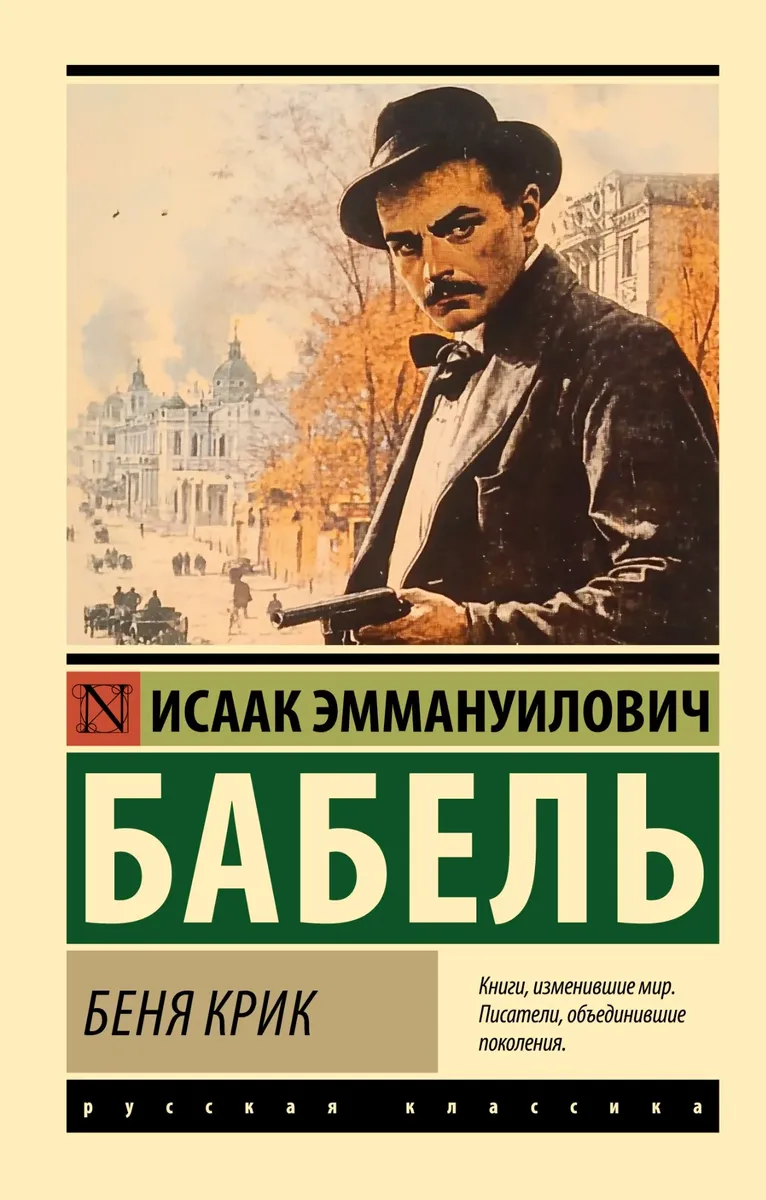
Babel reached the top “C” in the Jewish theme, simultaneously making a revolution in Russian literature. Without its Jews it would be incomplete and not so bright.
First of all, the Jews of Babel have nothing in common with the little people of the Russian tradition. What can we say if the nickname of one of the heroes is “a Jew and a half.” If there is a small person in Babel's Odessa, then this is its author, and literally.
“I was not fourteen years old, ” he recalls, “ but based on my height and frailty, I could have been passed off as eight years old .”
Living in a house that “smelled of onions and Jewish fate,” the narrator never grew up, judging by what others say about him: “you have glasses on your nose, but autumn in your soul.”
To get rid of his bookish Jewish boy complex, Babel changed his point of view and fell in love with bandits. Secret avengers of the “little man”, they seem like hyperbole weeds. Due to their size, they do not fit into the miserable space allotted to the Jews.
Babel openly admires the Odessa gopniks, introducing them to readers, like a ringmaster in a circus who enthusiastically shows the audience rare, dangerous and beautiful animals. What is Leva Katsap worth, who broke “a bottle of vodka on his beloved’s head.” Or Monya the Artilleryman, who fired into the air at a wedding. (I remembered the latter when I met a Brooklyn machine gun collector nicknamed Arturchik the Fascist.)
To distinguish his favorite characters from the environment, which includes “wild men from Nerubaisk and Tatarka,” Babel dresses them as if at a bullfight or at the opera. Instead of the pitiful rags of the former Jews, their costume uses the entire palette: chocolate jackets, cream pants, crimson vests and even boots of the same color beloved by the new Russians.
All this luxury came to the Odessa bandits by smuggling. She is constantly present on the pages to remind us that Odessa is a maritime city. It is open to all foreign winds and goods - from “cigars from the plantations of Pierpont Morgan” to “oranges from the outskirts of Jerusalem.”
But the main contraband is Babel himself, who unlawfully introduces into Russian literature an exotic stream alien to it, undiluted by morality.
“In the frenzy of noble passion,” the author boldly summarizes, “there is more justice and hope than in the joyless rules of the world.”
Having borrowed their predatory energy from the Odessa raiders, Babel walks around the buffet of his native language, translating Russian prose into Odessa according to his own rules. The main one is the denial of what made their predecessors famous.
“They write all this,” the author complained about his older contemporaries when he was still a young man with the pseudonym Bab-El, “in the most authentic language, point to point, as they say in the Olonets and Vologda provinces. It turns out they live there, it’s cold, there’s a lot of wildness. Old story."
To prevent things from happening like in the Olonets province, Babel discovered the Odessa language and spoke it himself. The narrator's style is stitched together from an extremely concrete, business-like and simple-minded text that suddenly explodes with the frenzied intensity of metaphors.
This stunning effect is not caused by undeniable beauty, but by a semantic shift. If the metaphors of another Odessa master - Olesha - become a metamorphosis that turns a gypsy girl into a broom, then Babel does not strive for similarity at all. What does “calm as jellied meat” mean? How can “the sun hang from the sky like the pink tongue of a thirsty dog”? Can drunk people “little in the yard like broken furniture”?
All this awkward richness, filled with strange, almost biblical expressiveness, is needed in order to shift reality, making it strikingly different from what is produced “in the Olonets province.”
Babel learned this method from his characters, who speak Russian just so that a person, according to my anti-Semitic friend, would think.
Babel's emphasis recreates the world of Russian Jewry through minimal and undeniable means. What works here is not vocabulary and syntax, but small but unforgettable details, like a funny phoneme, the wrong prepositions or confusion with gender: “what impudence” or “ unbearable dirt.” (This is how my Kiev grandmother could not master “y” and said “pil” and “mish”, which is why I miss her even more.)
Odessa, treated by Babel, is autonomous and closed. In the big Russian world around her, she has nothing to do except complain, like Benya Krik.
“But wasn’t it a mistake on God’s part to settle the Jews in Russia so that they would suffer like in hell? And why would it be bad if Jews lived in Switzerland, where they were surrounded by... solid Frenchmen?”
This Odessa, however, is an endemic and extinct, like the dodo bird, a unique phenomenon. Her decaying descendants were left with only Panikovsky, a small change from the Odessa raiders. But he cannot replace Babel’s heroes, whose best portrait is a specific speech that can neither be faked nor imitated, only overheard.
Actually, that’s why in my time Babel was known by heart and remembered on any occasion and on every occasion. The strong and elegant heroes of “Odessa Stories” seemed to be taking revenge for all the insults inflicted on the unlucky tribe of Soviet Jews. In their eyes, Babel managed to turn the ghetto into an idyll, albeit a criminal one. Well done, the proverb says, and snot is beautiful.
Gurevich
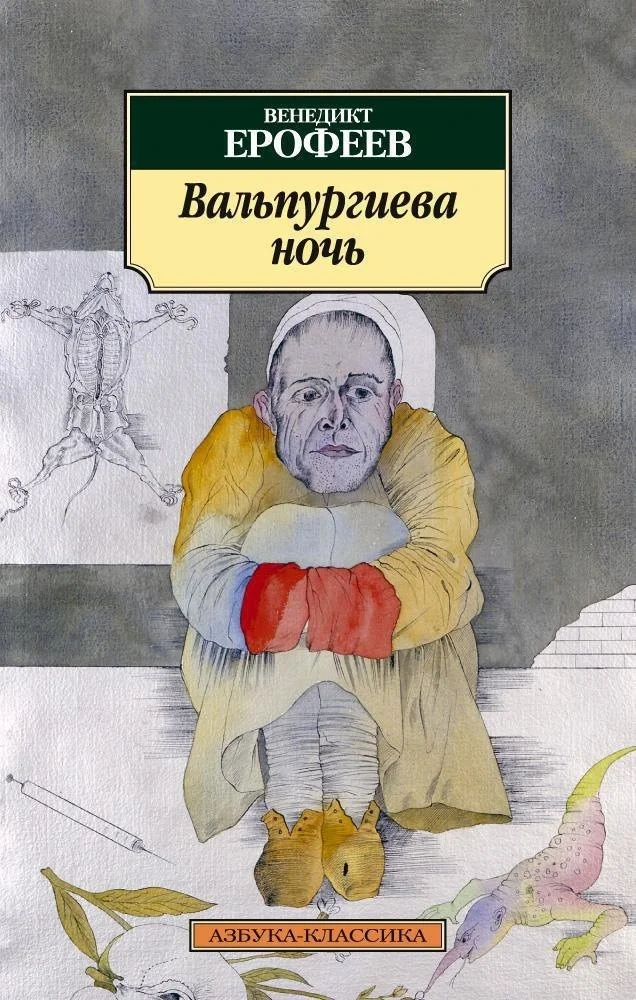
The evolution of the Russian Jew from a small person to a big one ended with his transformation into a hopelessly superfluous person. This is how he ended up in the surreal, very funny and ruthless tragedy of Venedikt Erofeev “Walpurgis Night”.
A fan of Boileau, the author carefully ensured that the action was allocated to one sacred night on the eve of May Day, and that it took place in one place - in a madhouse, or more precisely, in its third ward. It is, presumably, half the size of “Ward number six”. The characters of the play, varied to the point of caprice, grotesquery and parody, live in it in terrible cramped conditions and black resentment.
In the play they are called “leap people” , in life they are called drunks. Freed from the norm of everyday life, they live in a holiday that even medical personnel with their torture instruments cannot cancel. The horror of imprisonment only highlights the realm of the spirit in which the heroes of the tragedy reside.
“We are foundlings and not yet found. But they are surrounded by gossip, and we are surrounded by legends. We are fictional, they are documentary. They are efficient, and we are limitless. They are experienced people. We are an unprecedented people. They are the barking ones, we are the flaming ones.”
This monologue, like everything best in the play, is pronounced by its main character, Gurevich. In ordinary life, if there is such a thing, he serves in a “hardware store as a Tatar.” But in the hospital he is a poet of absurdist madness.
Gurevich's speeches constantly stray into glossolalia reminiscent of Sorokin. At the same time, his words are full of wild poetry, the author himself confessed his love for it, quoting Sasha Cherny in his notebooks - “ I love oranges and everything that happens to rhyme.”
Throwing down the “loudly boiling cup” of his rhetoric onto his listeners, Gurevich takes the pose of a prophet of a drunken world, freed from earthly fetters along with common sense.
As a comrade and like-minded person said about him, “you are a Leo!” True, Isaakovich,” and that’s the point. Gurevich's significant feature is his Jewish origin. An invalid of the fifth count, as they joked in my youth, even in the Kunstkamera set up on the stage he stands out for his role - the main and fatal one.
Gurevich is another par excellence. He is that extra person who, as the inevitable Bakhchanyan corrected Satin, “sounds proud.”
The author made Gurevich a Jew, because a paradoxical status is available to him: to be a stranger, but one of his own, to understand everything, but from the outside, to become a victim of a tragedy, but also its hero.
The uniqueness of this figure is determined by the specifics of the Jewish situation, as Gurevich describes it.
“It’s as if you are occupied, and occupied for a reason, in accordance with an agreement on mutual assistance and close friendship, but still occupied... In short, you feel yourself inside grace - and yet not at all there... well... like in the womb of a stepmother...”
“—Applause,” the author inserts a remark, boasting about the definition.
The sick kinship of Jews with their stepmother-homeland dooms them to “keep a distance of pogrom proportions.” In the hope of destroying it, Gurevich comes to a crazy world with good news and a good mission.
“Yes, the intention was: to bring the disunited together, to pacify the angry ones... to introduce them to a little joy... to bring dawn into the twilight of these souls, barred here until the end of their days...”
In a tragedy entirely built on evangelical allusions and New Testament imagery, Gurevich took on the role of another Jew. The third chamber is his Cana of Galilee. But before being horrified by the travesty of sacred history, we must remind ourselves how it all ends.
The May Day feast turns out to be a Walpurgis Sabbath. Miraculously acquired wine for the holiday turns into poisonous methyl alcohol. And the curtain falls on the mountain of corpses. The last to writhe in agony under the blows of the orderly Bori Mordovorot is Gurevich himself. A prototype of either Christ or the Antichrist, he, unlike Venichka from the poem “Moscow - Petushki,” left neither disciples nor heirs.
Erofeev wrote “Walpurgis Night” on the eve of the end of the story in which its action unfolded. There is a reflection of the imminent sunset on it, the pathos of the apocalypse sounds in it, but there is no hope associated with it.
Erofeev killed his chosen people on stage - leap-day people not of this world. He dealt with both their prophet and the image of a Jew born in this fatherland, which only seemed eternal.
New York
* The Ministry of Justice of the Russian Federation included “foreign agents” in the register.
This material was published in the seventeenth issue of Novaya Gazeta. Magazine". You can buy it in the online store of our partners.