
Translated material
Less taxes, more debts. How war and sanctions hit the budgets of the Northwestern Federal District regions

Russian regions have entered a phase of a systemic budget crisis: expenses are growing faster than income, revenues from the key income tax are falling, and debts are growing and becoming more expensive. This is especially clearly visible in a number of regions of the North-West, primarily in the Arkhangelsk, Vologda, Murmansk regions, Komi and Karelia. "Chronicles.Media" studied the Operational Report of the Accounts Chamber of Russia on the execution of the consolidated budgets of the constituent entities of the federation for 2025 and tells how the regions of the north-west distinguished themselves.
Scarcity instead of sustainability
The budget crisis of the Russian regions, which manifested itself in 2025, is characterized by a sharp increase in the deficit. The Ministry of Finance expected the deficit of the consolidated budgets of the regions to be 52.3 billion rubles, but in fact it amounted to 1.5 trillion - almost 30 times more. Over the four years of war, the balance of regional budgets has almost turned upside down: if at the end of 2021, 66 regions ended the year with a surplus and 19 with a deficit, then at the end of 2025, only 17 regions remained surplus, and 73 became deficit*.
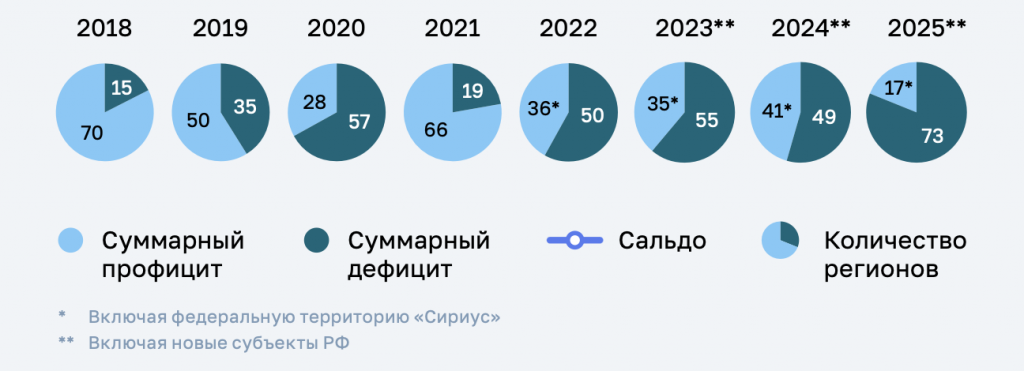
The main reason for the deterioration of the balance is that expenses grew faster than income. According to the Accounts Chamber, in 2025, revenues of consolidated regional budgets increased by 5%, and expenses by 9.9%. In other words, more money came into the budgets than a year earlier, but obligations grew even faster.
At the same time, most of the taxes collected were transferred to the federal budget - as of December 1, 2025, 57.1% of tax revenues came from the federal budget. In its annual reports, the Accounts Chamber provides such data only from last year - then the federal budget accounted for 56.6% of tax revenues.
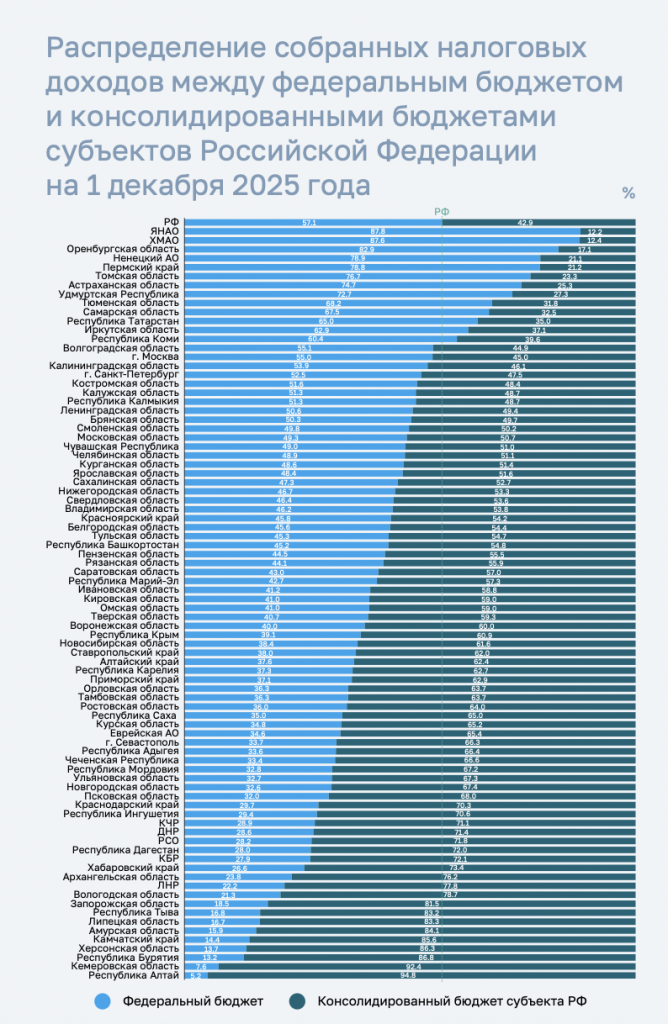
That is, in 2025, most of the taxes collected went to the federal level. This imbalance in itself is not new, but against the backdrop of a growing deficit, it looks especially painful for the regions.
But there are significant exceptions here. Thus, the Accounts Chamber stated that in five regions, including the Murmansk region, at the end of 2025, the federal budget was actually in the red: due to VAT refunds, the state returned more to business than it received in taxes. This is typical for export regions, but it also shows how unstable the tax base has become.
Business no longer feeds
The main sources of income for the consolidated budgets of the regions are two taxes: corporate income tax and personal income tax (NDFL). That is, taxes on businesses and taxes on citizens. In pre-war 2021, revenues from these two taxes were approximately equal: 4.7 trillion rubles from personal income tax and 4.5 trillion from business income tax. By 2025, these proportions have changed significantly, now income from personal income tax is more than one and a half times more than from income tax. Moreover, corporate tax revenues have been declining since 2023.
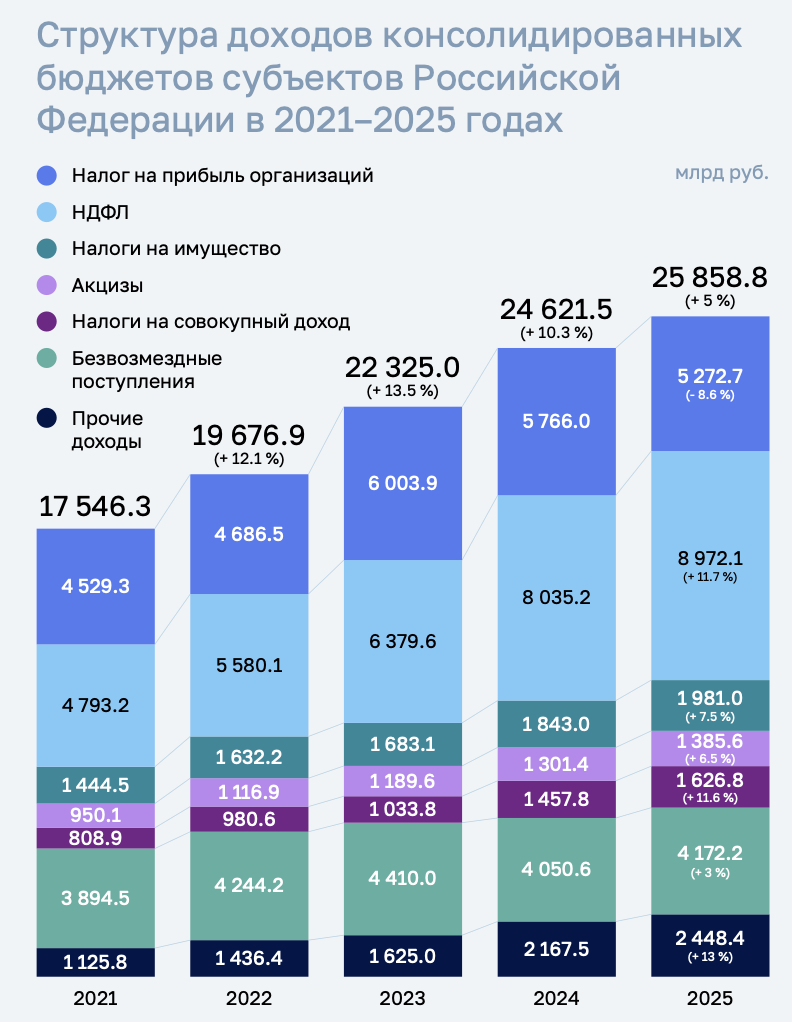
The income of citizens, not businesses, is becoming the main source of replenishment of regional and municipal budgets. This trend is dangerous because it records a decrease in business income, which may be followed by a decrease in household income.
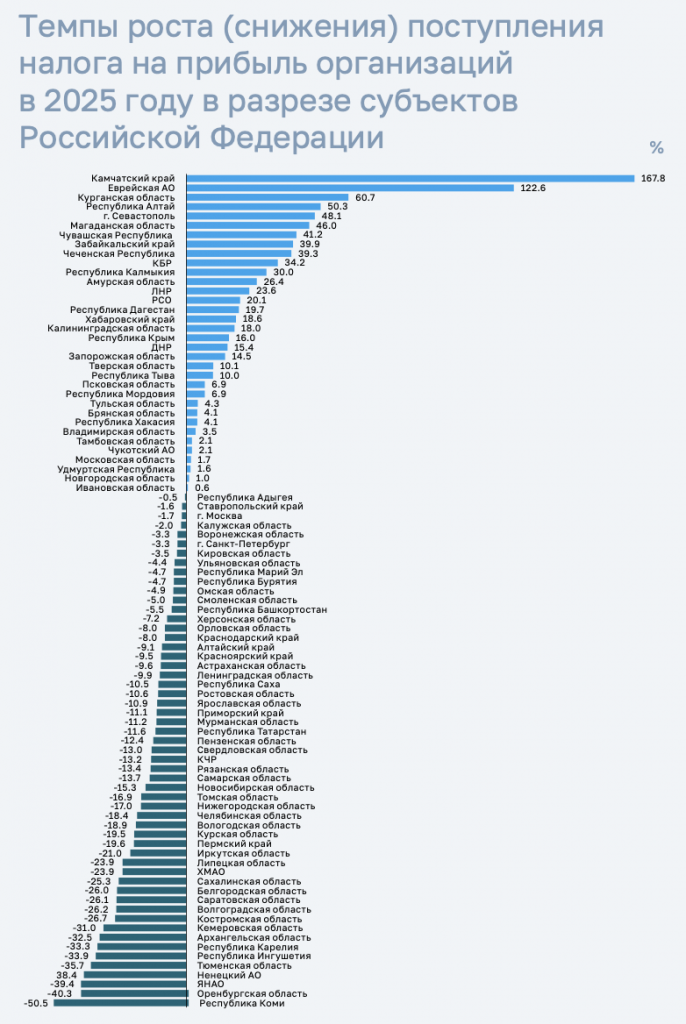
In their report, the auditors of the Accounts Chamber directly state that the decrease in income tax revenue is the influence of external factors related to the state of the world and domestic markets, the maintenance of sanctions restrictions, fluctuations in exchange rates, instability of logistics connections, changes in the key rate of the Bank of Russia and others. All those problems that the Russian authorities have been brushing aside for the last four years.
Expensive loans instead of cheap money
In 2025, regional debts and the cost of servicing them sharply increased. Compared to 2024, the state debt of the constituent entities of the Russian Federation increased by 10.6%, and their constituent municipalities by only 3.1%. At the same time, the Accounts Chamber recorded a sharp increase in loans from credit institutions, i.e. in fact, we are talking about bank loans that were provided at high interest rates in the context of a high key rate set by the Central Bank as part of the fight against inflation. The maximum interest rate was 29.13% per annum.
High interest rates on loans expectedly led to an increase in the cost of servicing public debt. Compared to 2024, such expenses increased by 41.3%. At the same time, in 2024 these expenses also increased compared to the previous period - by 17%. Before that they were declining.
The Northwestern regions are mentioned several times in the Accounts Chamber report as one of the most problematic. The problems of the Northwestern Federal District do not seem accidental. This is where the regions focused on metallurgy, timber industry, raw materials extraction and export are concentrated. And it is precisely these industries that the Accounts Chamber directly names among the most vulnerable to sanctions, logistics restrictions, exchange rate fluctuations and the high rate of the Central Bank.
Arkhangelsk region: debt trap
The Arkhangelsk region has become one of the all-Russian leaders in terms of the level of deficit to tax and non-tax revenues of the regions - 28%. That is, expenses exceeded income by almost a third of all budget revenues. At the same time, the region also became the leader in the size of public debt in relation to its own income - it amounted to 122.5%. Moreover, two-thirds of the national debt are loans from credit institutions; moreover, almost half of these loans were received in 2025, already in conditions of high interest rates. To pay off all the loans to the Arkhangelsk region you need to pay your entire annual budget. And even more!
Against this background, the region was among 16 subjects in which tax and non-tax revenues decreased. This was most affected by a decrease in income tax revenues, primarily from companies in the oil and gas industries, the timber industry and the pulp and paper industry. In 2025, the decline in corporate income tax revenue was 32.5%, and compared to pre-war 2021 - more than 22%.
The Arkhangelsk region is the most obvious example of how falling incomes and expensive borrowing turn into a debt trap.
Vologda region: the worst deficit in the country
There are no less problems in the Vologda region. And in many ways they are similar.
At the end of 2025, the Vologda region became the all-Russian leader in the level of deficit to tax and non-tax revenues of the regions - 30.2%. Against this background, the region recorded a decrease in its own budget revenues - tax and non-tax revenues.
This is due, first of all, to a reduction in income from income taxes - the governor of the Vologda region has his own approach to working with the largest taxpayers in the region. As a result, tax revenues have decreased by almost 20% over the year, and by almost 50% since pre-war 2021.
At the same time, the Vologda region became the only region in Russia where there was a decrease in revenues from the second budget-forming tax - personal income tax. Receipts decreased by almost 5%.
But unlike the Arkhangelsk region, the Vologda authorities have not yet accumulated significant debts: a fairly average public debt of 19 billion rubles consists entirely of budget loans, i.e. may be written off under certain conditions.
Komi: collapse of profits in the forest region
Another region that holds the record for the number of budget problems in the north-west of Russia is the Komi Republic.
There is also a decrease in own income here, also due to a reduction in revenues from corporate income tax. As in the Arkhangelsk region, this is due to a reduction in tax revenues from the timber industry and the pulp and paper industry. Compared to 2024, there was the largest decline in such revenues - more than 50%, and compared to pre-war 2021, corporate income tax revenues fell by 40%.
At the same time, Komi does not experience significant problems with public debt, but half of all debt is loans from banking institutions, and the banking component of the debt increased sharply in 2025, when the Central Bank increased the key rate. That is, Komi’s national debt, although relatively small, is very expensive.
Murmansk region: sanctions, expensive debt and profit drawdown
The Murmansk region also continues to experience the consequences of international sanctions in the form of a reduction in revenues from one of the main budget-forming taxes - corporate income tax. In 2025, compared to the previous period, the reduction was more than 10%, and since the beginning of the war - almost 50%.
Largely for this reason, the region has already managed to accumulate significant debts, which amount to almost 80% of its own budget revenues or 76.5 billion rubles. At the same time, three quarters of the state debt (56.3 billion rubles) are loans from credit institutions and almost half of them (22.9 billion rubles) were received in 2025, at high interest rates.
St. Petersburg: a wake-up call from a “rich” region
The northern capital is one of four Russian regions where, over the past three years in a row, there has been a negative trend in corporate income tax revenue. At the end of 2025, revenues from it decreased by 3.3%. Let us remember that this is one of two budget-forming taxes for the regions.
At the same time, St. Petersburg showed an increase in revenues from personal income tax - 5.9%. But with a downward trend in business profitability, as demonstrated by the dynamics of revenues from relevant taxes, in the long term, problems may begin with revenues from personal income tax.
At the same time, St. Petersburg sharply increased its public debt on budget loans - by 20.7 billion rubles or 71%. This is a third of the entire St. Petersburg government debt.
The budget of St. Petersburg does not yet look like an emergency, but it is important as a symptom: even one of the richest regions of the country has been losing income tax revenue for the third year in a row. This means that the problem has long gone beyond the subsidized territories.
Karelia, Pskov and Novgorod: poor regions are becoming poorer
Among the smaller regions of the North-West, problems are also growing, although they manifest themselves in different ways.
Thus, Karelia and the Novgorod region are included in the list of regions where revenues from corporate income tax have sharply decreased compared to pre-war 2021. Accordingly, in Karelia by 47.1%, in the Novgorod region - by 23.4%. But if in the Novgorod region, at the end of last year, at least a small increase in these revenues was recorded (1%), then in Karelia a sharp drop was again recorded (33.3%). This is apparently due to sanctions pressure on the timber industry complex, which is systemically important for the Karelian economy.
For the Pskov and Novgorod regions, federal transfers have always played a significant role, and in 2025 this support in the form of subsidies decreased significantly: in the Pskov region - by 29.6%, in the Novgorod region - by 27%.
***
The budgets of the northwestern regions in 2025 showed several dangerous shifts at once. Firstly, regional finances are increasingly dependent not on business profits, but on household income, that is, on personal income tax. Secondly, it is precisely the export and raw material regions, which until recently were considered donors, that now often find themselves among the main problem regions. Thirdly, the deficit is closed not only through budget loans, but also through expensive bank loans.
This means that the regional budget crisis can no longer be attributed to the ineffectiveness of individual governors or “mistakes on the ground.” The problem is systemic: the income base of the regions is shrinking, expenses continue to rise, and the center is taking more and more taxes, which go to finance the war. The North-West in this design does not seem to be an exception, but a confirmation of an established trend.
* The Accounts Chamber of Russia takes into account regions in accordance with the Constitution of the Russian Federation; in 2025, the federal territory “Sirius” was taken into account separately
The publication uses infographics from the Operational Report of the Accounts Chamber of Russia on the execution of consolidated budgets of the constituent entities of the federation for 2025
Alexander Shurshev