
Translated material
Nation, form up!
Interview with political scientist Alexander Iskandaryan - about how the identity of states and the people living in them is born

Photo: Alexander Miridonov / Kommersant
In a joint project of Novaya Gazeta and the “You Will Be the Third” program on FM 106.5 “Business Wave” radio, Ruben Ishkhanyan and Lianna Khachatryan talked with the director of the Caucasus Institute, Alexander Iskandaryan, about how national states are formed after the collapse of the USSR and how their identity is formed: is it possible to choose it and why does it not depend on history? Watch the full podcast episode on the Novaya Gazeta channel. Armenia".
— You moved to Armenia 25 years ago after it gained independence and became a republic. Did this fact influence your decision to repatriate? And do you consider yourself a repatriate?
“I don’t feel good about this word when applied to myself.” Repatriation is when a person returns. And I never returned. On my father’s side, my great-grandfather left Armenia. On my mother’s side, my ancestors never lived in what is now Armenia. In the 19th century there was such a strange type of migration through Erzurum, Iran to the Russian Empire. I don’t know what to call me, but an emigrant is wrong, because I am an ethnic Armenian. And I had an Armenian identity before I moved.
I have been in Armenia since 2002. Is this related to the fact that the process of formation of a national state was taking place in Armenia? Yes, connected. But I would call this process in English National state - state of citizens. In Russian, the word “nation” has a component of “ethnic state” - and this is wrong. For example, in Russian “building the National state” should be translated as state building, and not nation building. And this process is very interesting to me, and to be present at it, and to be inside, and to see how it happens, was one of my strong motivations.
—What is the difference between a people and a nation?
— In modern science, it is more correct to say “theory of nationalisms.” Some say that the concept appeared after the French Revolution, that is, in the 18th century, but there are researchers who believe that the origin of the process began in the 17th century. There are researchers who say that if there is a nation, then there must be print capitalism, that is, there must be universal literacy, school education, newspapers, in order to unite a large number of people with a single identity. There should be an opportunity to tell them about it. There is a theory called primordialism (from Latin - “original”), and, based on this paradigm, nations have always existed. A tribe is already a nation. But science doesn't think so.
Blood is not a nation. Science understands that a nation is a spirit, that is, a culture when people feel united.
So this is a later phenomenon.
Interestingly, this term was born in Poland and meant aristocracy. In order to feel oneness with people you don’t know and will never know, you need to have an identity. Here the question arises: what happened before?
And this question is interesting. Until modern times, the normal state was the empire. But the inhabitants of the empire did not have the same identity that we have. A person defined himself by religion or, which was not always the case, by citizenship, that is, who his king or shah was. Imagine that until today in Afghanistan, a significant part of the population does not know that they live in Afghanistan.
With linguistic identity it was even worse, because there were no literary languages. For example, what was the nationality of Joan of Arc? If we judge her from the modern world, then with a high probability she was German, because in the place where she was born and lived, the language of communication was German.
—Are there exception nations? For example, what if we are talking about Armenians?
— Of course, there was a feeling of Armenianism in society, but let’s try to understand what was included in the concept of “Armenians.” The word “Armenian” - hai (հայ) - the self-name of the Armenians, initially indicated that the person was a parishioner of the Armenian Apostolic Church. An Armenian is the person who reads the “Our Father” in the church on Grabar. At the same time, by the way, he can be Persian-speaking, Turkic-speaking, or Georgian-speaking.
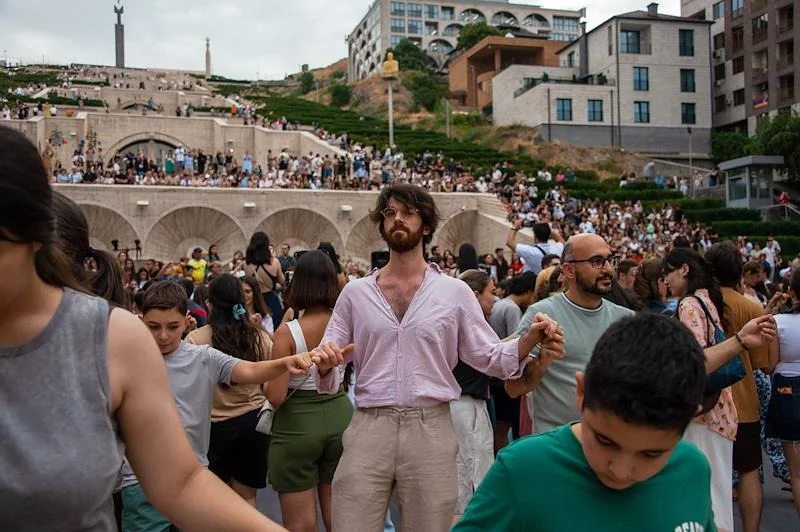
By the way, in America a couple of decades ago the term ABC (Armenian by choice) was born. This is a copy of Hebrew by choice - such a term existed much earlier. And this means people who were born in a completely different culture, but at some point decided that they wanted to be Armenians and, in a sense, mastered this identity.
But why do we perceive Armenians as an exception? It’s very simple - our language and religion are the same. Moreover, religion separates us, Armenians, from all surrounding nations. Firstly, our church is a separate autocephalous (independent) church. Secondly, for the last 1500 years people belonging to other religions have lived around us.
Saint Mesrop (Mesrop Mashtots - creator of the Armenian alphabet) realized that the dynastic state would end very soon, and it ended during his lifetime. Accordingly, in order to preserve the self, something else is needed. And he came up with a brilliant idea, which later came to the minds of leaders in Europe - to combine language with faith.
And make the text the center of identity, and then prepare students who will create these texts. On their basis, Armenian culture and identity began to be built.
After one and a half thousand years, we see that this society has survived. But it was something else before the 19th century. In the 19th century, elements of political identity began to emerge. Political parties, the struggle for independence, political goals. This was already the construction of the National State. And after that time we can consider that we are a nation in the political sense. The Jews have a similar story.
— Is it possible to say, given the complex history of Israel, that they have established themselves as a national state?
— This is an interesting, not a classic story. The idea originated in the context of the Central-Eastern European national movements - in the Austro-Hungarian Empire, where the broth of the creation of different nations - from the Czechs to the Croats - was boiling. Political Zionism was invented by Theodor Herzel: he was originally from Budapest, worked in Vienna, and proposed various territorial options for creating a “homeland of the Jew.” His idea is settler colonialism. The plan was supported by the main Jewry of the world at that time, that is, the Jewry of the Russian Empire, and all the first leaders of the state of Israel. And what seems most important to me: traditional Jewry took this with hostility, because for a decent rabbi in the 19th century this phenomenon was extremely alien.
They did not perceive themselves as a nation, they perceived themselves as a religious community.
It’s the same as if now all Christians declared themselves a single nation, and everyone - from South Africans to Yakuts - should come to one place and build a state there in one language, which still needs to be created. Undoubtedly, this is a unique type of nation building.
— Chechnya had an attempt to build a national state. Can we say that it failed?
- No, I don’t think it failed, because the Chechens to a great extent feel more and more like a nation in the modern sense of the word. As a result of the first Chechen war, a situation arose in which Chechnya received half-recognition, and as a result of the second Chechen war - this is the end of the 20th century - it was suppressed. But the project is not forgotten. This is a region that is very different from other regions of Russia. The legal field is different. Those laws that work on the territory of the Russian Federation do not work there. For example, you cannot buy alcohol. You can drive to the Stavropol Territory and have a drink there, but in Chechnya you cannot order a glass. A woman cannot go to work with her head uncovered. There is no such law in the Russian Federation. The religious has become part of the ideology, behind which there is already the ethnic. This often happens in the East. I would call Chechnya a proto-state.
— What characterization would you give to the current construction of the Armenian national state? Is something changing: the attitude towards the church, towards the diaspora?
— How can it be that an Argentine, a Ukrainian, an Iranian, a Greek, a Russian and an American have exactly the same aspirations simply because they are all Armenians? People in the diaspora are different from people back home because they are not here. Now the state of Armenia is on the ruins of what existed for 30 years. If we survive, we will invent new narratives. Maybe we’ll come up with different ones, this happens among many nations, maybe we’ll develop some new foundation for building a political nation. Everything that is happening to us now is happening throughout the entire post-Soviet space. And sometimes it’s more difficult than ours—look at Ukraine.
This is what is gradually changing: when an ethnic Armenian from outside Armenia used to come to us, we said: he is ours. Now we are learning to say this about the Yezidis, about the Russians, about the Molokans, about the Greeks - that they are ours. But this is a process, it takes time.
— Don’t you have the feeling that we are returning to the Soviet past?
— I have a very bad attitude towards historical analogies and a good attitude towards geographical ones. When they tell me that the same thing happened in 1915, I treat this with great suspicion, because entities change a lot. It is impossible to compare the Ottoman Empire of the early 20th century with what we have now. It is impossible to compare the Armenian population of Western Armenia and the Republic of Armenia now.
And geographical analogies are the right thing if you compare Armenia with Georgia, Armenia with Serbia, Georgia with the Philippines, Chechnya with Corsica, Ireland with Bosnia. This way you can dig up the general and semantic.
Processes are taking place in Russia that we saw in the Soviet Union. The current North Caucasus, in terms of the birth of nationalist ideology, is similar to the South Caucasus of the 1970s and 80s. We see such processes taking place in Tatarstan and Yakutia. But that doesn't necessarily mean it'll get anywhere. We've seen Scottish nationalism go back 700 years. And what?
— How is identity built?
- This can happen in very different ways, in different societies, in different nations, in different states. In Africa, the colonialists cut states into squares. In the Middle East, too, they simply drew and instilled in people these squares, that is, those types of identity that they never had. And where was the border before? Nowhere, and now there is barbed wire. A person from Northern Syria has much more in common with Northern Iraq than with Southern Syria. These are just completely different people. That's how they cut it. The Middle East is now crumbling before our eyes. And in some places, unfortunately, identity is still built through genocides and deportations.
But let’s wait: this is not a natural process, it happens to people. Ultimately, in a broad sense, it is the texts that define it.
Recorded by Anna Kachurovskaya