
Translated material
Skyscrapers - to go
In St. Petersburg, from April 2, a planning project and a land surveying project in the Primorsky district were submitted for public discussion

Lakhta Center area. Photo: Alexander Koryakov / Kommersant
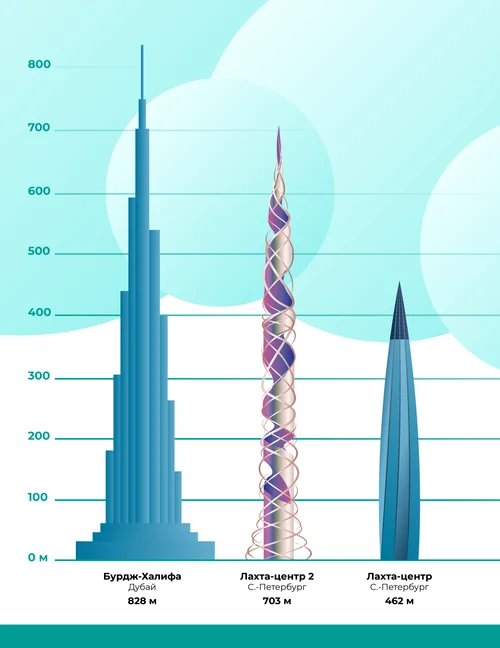
The Primorsky district is exactly the place where Gazprom is going to build two more skyscrapers - Lakhta Center-2 and Lakhta Center-3 with a height of 555 and 703 meters, respectively (Novaya Gazeta has repeatedly talked about these plans).
Until April 13, they will collect the opinions of residents of the Primorsky district and deputies of the Legislative Assembly (only they have the right to submit comments) on projects, the exhibition of which is posted on the official website of the Committee on Urban Planning and Architecture. There are already comments. And significant. Another question is whether this will affect construction plans, because in recent years public opinion on these issues has tended to be neglected.
First of all: most of the territory of the planned construction of skyscrapers is included within the boundaries of the world heritage site “Historical Center of St. Petersburg and Associated Groups of Monuments.”
This imposes serious obligations not only on St. Petersburg, but also on Russia as a whole. And this includes the obligation to inform the UNESCO World Heritage Committee of intentions to undertake or permit construction work on the territory protected under the 1972 Convention concerning the Protection of the World Cultural and Natural Heritage that may have an impact on the outstanding universal value of the property.
However, according to the Convention's Implementation Guidelines, notification must be given as soon as possible (for example, before drafting the main documents for specific projects) and before any decisions that would be difficult to reverse are made, so that the Committee can “assist in finding appropriate solutions to ensure the full preservation of the Outstanding Universal Value of the property.” Then wait for the Committee's recommendations.
The said Convention was ratified back in the Soviet years. But the documentation that was submitted for hearings states that over the years no federal legislation has appeared that would implement the provisions of the Convention in our national legislation, and therefore the St. Petersburg authorities refuse to implement this Convention.
That’s exactly what it says: yes, this is a world heritage site, but we have no obligations to UNESCO, we can build what, how and where we want.
This position is, to put it mildly, questionable.
The provisions of the Convention are said to be “self-executing”: neither the Convention itself nor UNESCO requires the adoption of any federal laws to implement the Convention. Moreover, the presence of detailed Guidelines for the implementation of the Convention is, in fact, the “implementation” of the Convention into the legislation of all participating countries.
But the St. Petersburg authorities, trying to support the construction of new skyscrapers in Lakhta, ignore these norms.
The UNESCO mission, as Novaya Gazeta reported, was in St. Petersburg not so long ago. And they told her about construction plans in Lakhta. But the results - the final report on the impact of construction on the world heritage site - are not yet known, however, documentation on the planning of the territory is already being submitted for hearings, without waiting for the mission's report.
The most serious complaint about the documentation (which residents are already submitting) is that new skyscrapers will inevitably appear against the backdrop of panoramas of the historical center of St. Petersburg.
At the same time, the St. Petersburg administration takes a crafty position: since the territory for the construction of skyscrapers itself is not included in the boundaries of the cultural heritage protection zones, objects of any height can be built there.
And neither the visibility of these objects from any, even the most valuable viewpoints of the historical center, nor the degree of influence of skyscrapers on the protected panoramas has legal significance.
The comments indicate that the legal balancing act of Smolny does not negate the fact that in the center of St. Petersburg there are many protected points and paths for viewing panoramas from which the existing 462-meter skyscraper Lakhta Center-1 is now visible. This skyscraper aggressively invades the panorama of the Peter and Paul Fortress and the Spit of Vasilievsky Island from the Palace Embankment and Kutuzov Embankment, the panorama of the Neva from the Trinity Bridge and Voskresenskaya Embankment, the panorama of the Petrovskaya and Petrogradskaya embankments, etc.
Based on photographs of the invasion of Lakhta Center-1 into city panoramas, including protected ones, several visualizations of the appearance of two new 555- and 703-meter skyscrapers were created in the context of the historical part of the city.
These visualizations make it possible to quite clearly assess the harmfulness of the two new skyscrapers to protected panoramas: such dominant objects as the Peter and Paul Cathedral or the Rostral Columns will lose their dominant position, protected within the regimes of protection zones.
And, as noted in the comments, no official assessments of the impact of new skyscrapers on protected panoramas have been presented (Novaya Gazeta also talked about this): to a request from the Yabloko faction in the Legislative Assembly of St. Petersburg, Vice-Governor Nikolai Lynchenko responded that the impact of the skyscrapers planned in Lakhta on city panoramas was not considered at all by the government of St. Petersburg...
And one more important point.
Until 2020, the construction area fell within the boundaries of the protection zones. These boundaries approximately coincided with the boundaries of the Olgino Village element of the World Heritage Site, and the St. Petersburg authorities told UNESCO experts that they did not approve buffer zones of the World Heritage Site, because instead of these buffer zones we have security zones.
And in 2020, when it became known about Gazprom’s plans to build another (at first there was one, then a second one was added) skyscraper to the west of the first Lakhta Center, this territory in the eyes of Smolny suddenly sharply lost its historical and cultural value.
As a result, part of the “Olgino Village” element, where construction is planned, is not protected either in itself as an element, or by buffer zones, or within protection zones.
Similarly, in 2020, when the draft of the first edition of the subject of protection of the historical settlement of St. Petersburg was discussed, this project included a map of panorama disclosures, in which the construction area was in the area of visibility of protected panoramas from protected viewing paths.
But in 2020, this map was not included in the subject of protection approved by the Ministry of Culture, and was subsequently included there, but again with a cut-out viewing sector exactly on the territory of the construction of new skyscrapers.
Coincidence? Don't think…

But these are not all the comments that residents send to the territory planning documentation.
They write that the planning project violates the requirements of the Land Use and Development Rules (LRU) of St. Petersburg regarding the maximum permissible utilization rate of the territory.
That excess development density creates excess anthropogenic and technical load not provided for by the current General Plan, despite the fact that the existing road network in this area is already operating at capacity limits.
That the implementation of the project without proportionate development of the road network will lead to a transport collapse in the Primorsky region (where systematic congestion and kilometer-long traffic jams are still recorded).
That public transport is overloaded, the distance between bus stops is increased, and this violates the standards of transport accessibility and quality of service to the population.
That an increase in traffic will block the passage of emergency vehicles (EMERCOM, ambulance) and limit the right of citizens to unimpeded access to housing and recreational facilities.
That the project materials do not contain current calculations of the capacity of the road network, taking into account the synergistic effect of the work of all three towers, and the existing interchange project was developed exclusively for the first phase of the Lakhta Center and is not designed for the additional flow of tens of thousands of employees and visitors to the new facilities.
And much more, substantiating the residents’ demands to reject the planning project submitted for hearing.
But, as has already been said, will the St. Petersburg authorities listen to them? Alas, there are many examples of how people do not listen: quite often, even when the opinion of citizens is almost unanimously negative, urban planning documentation is still approved. After all, the decision made at the hearing, according to the law, is only advisory in nature for the authorities. Let us recall that Novaya Gazeta told how in Krasnodar, despite the almost one hundred percent negative opinion of the residents, the authorities still approved urban planning documents for the construction of a temple on Yubileiny Embankment. Simply brushing aside public opinion.
Whether this situation will repeat itself in the Northern capital is still a question. But the way city authorities have responded to public opinion on such issues in recent years does not inspire much optimism.
However, we are still waiting to see what UNESCO says.
Vladimir Maksimov