
Translated material
“How are you doing there, descendants?”
The Russian space program has problems with trampolines, so on Channel One we listen to signals from the constellation Lyra

A well-known meme with Gagarin, who, smiling, holds a telephone receiver in his hands and asks us, descendants, how we are here. Are we going to Mars? Or something else inspiring. And we, with varying degrees of wit, answer Yura that we have complete f### here.
Yuri Alekseevich did not even live to see the Americans land on the moon. However, millions of our compatriots “did not live to see it.” Even the best opinion polls show that approximately half of Russians do not believe that the landing actually took place. Less systematic analytics show up to three quarters of non-believers. The coincidence of Cosmonautics Day with Easter this year symbolically moves science into the plane of faith and unbelief.
It so happened that from my window I could see the Roscosmos skyscraper on the horizon. The long and painful construction of this object was also symbolic and, at some point, also became a matter of faith. Against the backdrop of a series of failed launches and a general lack of any achievements in the space field, this led me, as an observer, to the idea that our space ambitions end somewhere at the height of the spire of a huge office in which people will be doing who knows what.
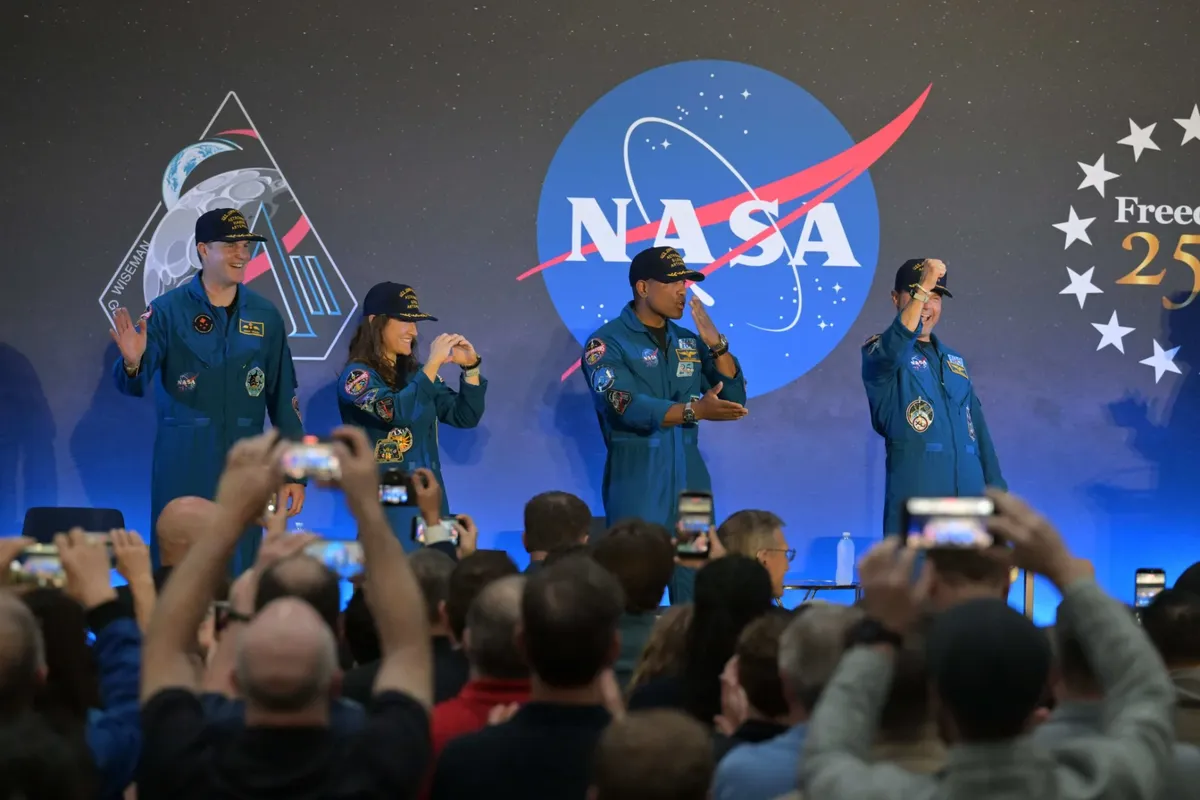
NASA's mission to the Moon ended last week. The flight revealed a bunch of small and medium-sized problems, the mission itself turned out to be very expensive, some technical solutions were based on simplified developments from 60 years ago, but the overall success from a scientific, technical, political and even romantic point of view is obvious.
How do we respond? On Channel One that same evening, a lady spoke in prime time, claiming that she was receiving signals online from the constellation Lyra and, in confirmation of her words, immediately began to make various sounds, very similar to the way children depict signals from space or as the dog Ressi did in “The Adventures of Electronics.” Katya Lel, Heroes of Russia, experts were in the studio, and it was the 26th year of the 21st century. Along the way, a popular channel of space skeptics, looking at the satisfied astronauts who returned to Earth, writes: “According to cosmonaut Oleg Novitsky, on the third to fifth day after landing he could already walk independently. However, adaptation can take place differently for different people: for some, the process takes longer. But Americans are cut from a different cloth. Even their women can walk freely on their own an hour or two after landing. And the black man almost runs and applauds.” In general, apparently, they didn’t fly anywhere again, but they fooled us all! Not like contactees with the constellation Lyra. They promised, by the way, that we will soon live 150 years. Great. It remains to quote the legendary one from the manager of AvtoVAZ: “We can, but why?”
The head of Roscosmos on the same days announced 14 partnership programs worth 50 billion rubles, which by cosmic standards is not even a penny, and cooperation in space exploration with Zimbabwe, and now I don’t even know who will benefit more from this cooperation at the moment.
The entire budget of Roscosmos, by the way, at the current exchange rate is approximately $4.3 billion. Almost six times less than NASA’s budget, but space in the States is being developed not only by NASA and, in a sense, not so much by NASA—Elon Musk and Jeff Bezos won’t let you lie. Our space is predominantly military. Its most important task is to launch satellites that will somehow replace the Starlinks disabled by the same Elon Musk. Elon Musk, alas, is not our help. We got his dad Erol, who was dragged to the Easter service, and before that he went on tour around the country, absorbing and broadcasting every word of a man whose portfolio seems to contain all the vices you can imagine. But we don’t have any other Musks for you, nor do we have any other partners except Zimbabwe.
But all jokes aside, we are in real trouble with space.
In 2025, Russia will have 17 successful space launches. New Zealand has the same number - it has caught up with us. China has 90, the United States has 175.
The lunar race is in full swing. The Artemis mission will continue with new expeditions, and three landings on the Moon are already planned between 2028 and 2032. China is a little behind, but by 2030 it also plans to fly around the Moon, land vehicles on its south pole, and first tests on processing and studying lunar regolith on the surface of the Moon as a demonstrator for a future lunar base. China intends to send people to the moon at the beginning of the next decade. There is a chance that the Chinese will even try to get ahead of the Americans. India plans to bring lunar soil to Earth in 2029, and Japan plans to place scientific equipment on the Moon.
The last time Russian spacecraft successfully landed on our satellite was exactly 50 years ago. Luna 25 crashed in 2023. Luna 26 is due to fly in 2028, but subsequent launches have already been pushed back into the 30s. There is no need to seriously talk about any manned flights or the creation of lunar bases, despite the rollicking statements of space officials that “Russia will have a reusable rocket,” “it will send its vehicles to Venus,” “the first rocket of a private company will be sent.” When all this really happens, then we’ll talk. Because all this was promised many times and never came true. A video of Rogozin, who promised a flight to the moon in 2023, went viral the other day. As a result, even the notorious Rogozin trampolines didn’t let anyone go anywhere.