
Translated material
Knight's move
Legendary director Adolf Shapiro brought Don Quixote to the stage of the New Riga Theater

Scene from the play. Photo: oteatre.info
Alvis Hermanis took a long time to reconstruct his theater. Now it is a masterpiece of modern design with touching archival greetings. Among them, for example, is a capsule with advertisements, tickets, and business cards from the beginning of the 20th century, namely 1901, when the building was founded. Most of the evidence is in Latvian, but there are a couple of artifacts in Russian as well. And when they opened up the floor in the auditorium, they found... well, what do they find under the chairs? Wrappers, receipts, license plates and even champagne corks are all displayed in the window. The new loft-style Riga theater is imbued with nostalgia, elegantly filtered through a sieve of fatal drama. Restored interior elements, posters, fragments of old masonry - everything looks more or less sentimental. If it weren’t for the preserved historical stage and the invitation of the long-time inspirer of this stage, Adolf Shapiro, with a production as multidimensional as history in general and a view of progress in particular can be interpreted today.
“Don Quixote” fell on the heads of the Riga audience in the literal sense of the word. The viewer was not injured - but the books that fell from the ceiling onto the actors could well have injured those who were gaping. Thus begins the scene of the amusing Inquisition - the prologue to the great novel read here and now. However, there is a victim - this fire was started as an edification to the world's most famous would-be reader, crazy about the romance of the hidalgo.
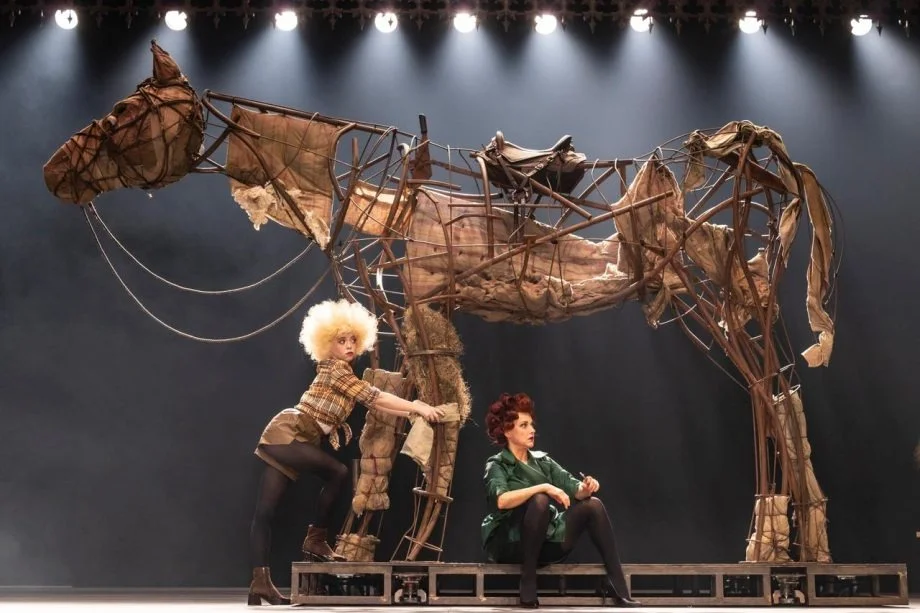
Here they seemed to have forgotten him - but he is alive, and his horse is in perfect order. Well, everything is fine - the skeleton has been preserved. Looks scary. An exhibit of the Darwin Museum is three meters high. But this does not bother the hero at all. On the contrary, the hero cleverly laid out the fossil with a greasy mattress, garbage bags, adapted a basin and a spear, a ladder - what else does a hero need for his exploits. Windmills? Voila. Over there on the horizon, a megafan the size of this horse is accelerating. Doesn't remind you of anything?
Oh yes! Squire! Sancho Panza, an overgrown trainee in shorts, spins around with his knees drawn up on a three-wheeled donkey. The donkey, as expected, is much more reliable and mobile than the resurrected nag.
Contrast and exaggerated dimensions - whatever you say, an ideal metaphor for you and the reality around you. Although at first, of course, it’s fun. That's what we're counting on! As well as relying on the imagination of the wonderful artist Martins Vilkarsis. The same mix applies to the performers of the main roles. Kaspars Znotins (Don Quixote) and Gundars Abolins (Sancho Panza). Once young talents and like-minded people, today they are top-class actors, and intellectuals too! It was Gundars Abolins who translated the text of the play from Russian into Latvian.
With the play “Don Quixote,” Adolf Shapiro returns to the stage, which he considered closed to himself for almost 35 years. There were reasons for this. The turbulence of the 90s did not spare either cultural roots or seedlings. And the famous Riga Youth Theater, the legendary place of power in theatrical Latvia, was the case, the curtain was lowered. And the director left the country, went to Russia, Greece, both Americas - then wherever his rare talent was and continues to be appreciated.
Returning is a risky thing. Gain is no less traumatic than loss. Therefore, Shapiro chose the topic with bias. Odyssey, again, does not tolerate banality, and Shapiro - who knows - fuss. So Cervantes was read with particular care. Playing up the comic nature of the mise-en-scène, editing the episodes anew, the director step by step moves the arrow from pity to longing for freedom, from madness to fearlessness, from sacrifice to immortality. At the end of the day, his parody knight turns into an incredibly flexible character, capable of “making a goat” not only to his first lords-readers, but also to our cynical contemporaries. You look at the stage and realize that the mighty Spaniard also sealed a capsule in his masterpiece. It seems to have been opened by Munchausen ibn Yankovsky. (The rhyme doesn’t let go until the end!) I opened it - and there is a strain of wandering compassion! Ephemeral, but invincible. And the artist’s happiness is to catch this virus, infect the viewer with it and confirm his resistance to the environment.
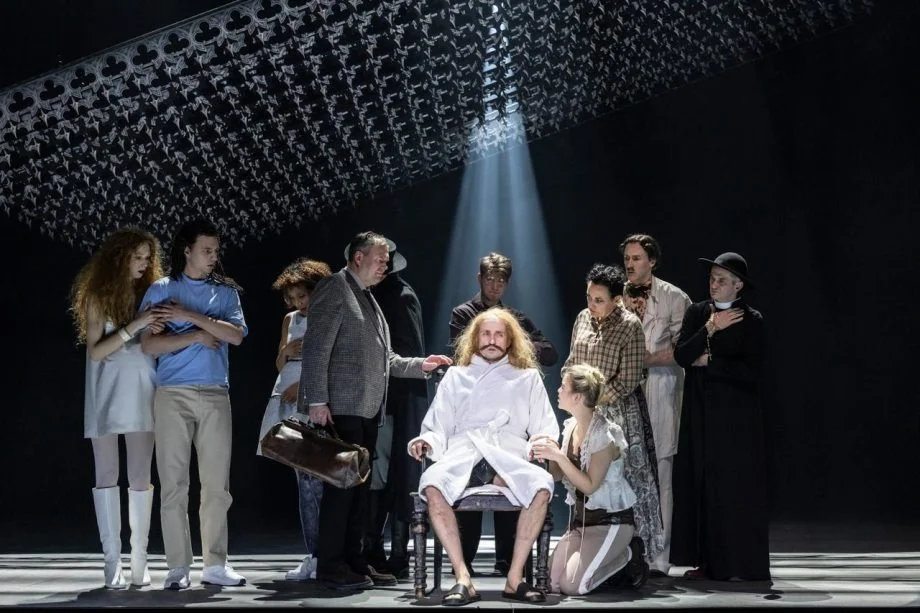
Meanwhile, Wednesday is not asleep. And he’s not going to sleep. Starting a conversation these days with book burning is worth a lot. However, no one knows from which side and at what moment the four-century-old text will blaze. Cervantes then took and provided the knight with a magical speech in honor of peace and salvation. Let it into the hall without banknotes - they will attribute it to you as a fake. After all, no one will believe that these lines were not collected today. And not today’s agenda, as they say. Just as no one will quietly gasp and unsee the Last Supper in the scene of a feast at an inn. End of the first act.
What I mean is that it will definitely blaze. But keine Panik auf der Titanic! Adolf Shapiro already has at least experience in fighting fire - in his “451 degrees Fahrenheit” (Et Cetera Theatre, Moscow, 2007) books did not burn like a child. And then there was hope. In Don Quixote, the ashes are clearly still capable of being carried away - even if only from Bakhtin’s carnival! So Sancho has room to grow, while his blessed owner hides the polished museum armor under his sanatorium robe. These are unlikely to save you from ballistics, but they will certainly preserve your ideals and warmth. And, God willing, it will still be useful. So get on your horses, gentlemen! And just to be sure, here is a portrait of the elusive Dulcinea Toboso. In the finale, his photocopies fall straight into the viewer’s lap. Let the viewer know that there is perspective. And she's beautiful!
Anna Arkatova , Riga