
Translated material
“Of all decisions, always choose the best.” Armen Zakharyan - about education during the war
The publishing house of the Babel bookstore (Tel Aviv) published Armen Zakharyan’s book “Letters of Dark People”, which grew out of the popular release of his YouTube channel “Armen and Fedor” . Literary critic Lisa Birger talked with Armen Zakharyan about why to engage in education during the war.
— The first question is, of course, about the history of your new book. Did it come from an episode of the channel, or is it the other way around?
“I’ve been working on this subject for many years. It seems to me that for the first time I spoke with some short story about him back in the summer of 2023, and by that time I had already been interested in him for several years, read, studied. He seemed - and continues to seem - very important to me.
A large public work was released in the fall of 2025 on the channel. I know that this episode was a milestone for many of our viewers: I give lectures, meet people, and regularly after each lecture they come up to me and thank me for this particular work. It turned out to be very consonant with the moment - with the feelings and fears that we are all experiencing now.
https://www.youtube.com/watch?v=4lIfx8Zyk_8
And therefore, when Zhenya and Lena Kogan from Babel and I talked about a possible book, it seemed to me a good idea to release this work in this way. YouTube is spoken word, a slightly different genre. It was necessary to work on the text, bring it to a format that is suitable for publication.
— I was struck by the preface - there is not a word in it about the connection of times, or about how to read this story today. On the contrary, you seem to be deliberately distancing yourself from modernity.
— I was inspired by those author's prefaces that can be found in texts of the 16th century, maybe the second half of the 15th or the first half of the 17th century. This is the historical period in which the entire history of the confrontation between Johann Reuchlin and Johann Pfefferkorn is placed.
In general, in many ways I feel like a person who partly lives in that era. Machiavelli, when he lived in exile, in a letter to Francesco Vettori, talks about how he comes to his study in the evening, opens his favorite books - the books of the ancients - and finds himself in the company of people with whom he always has something to talk about, whose company he incredibly values. He lives in parallel in two worlds: in his 16th century - and at the same time in the world of antiquity. I sometimes experience something similar. This, of course, does not allow one to isolate oneself from the surrounding reality - it is too blatant to be isolated from it. But this makes you feel at home - there, in their company.
— It always seemed to me that you were primarily interested in modernism—the 20th century between the two world wars. Joyce Project, Proust Project... But lately you are increasingly turning to much older texts. Which era is your favorite?
- Here I will refer to Michel Montaigne, who said this quite comprehensively: “Sometimes I contradict myself, but as Demades (the Athenian orator - Republic) said, I never contradict the truth.” Apparently there was a period when I was practically lost in Joyce. It was a very important existential experience that taught me a lot.
At the same time, the era as a historical parallel that is closest to me is the Renaissance in a very broad sense. From the proto-Renaissance of the 14th century, Boccaccio and Petrarch first of all, but also Dante, whom Losev called a figure who embodied the proto-Renaissance itself, right up to very late Renaissance literature, which not all researchers agree to recognize as Renaissance. For example, before Cervantes and Shakespeare, and this is already the beginning of the 17th century. It is with this enormous era, spanning the 14th, 15th, and 16th centuries, that I most identify myself.
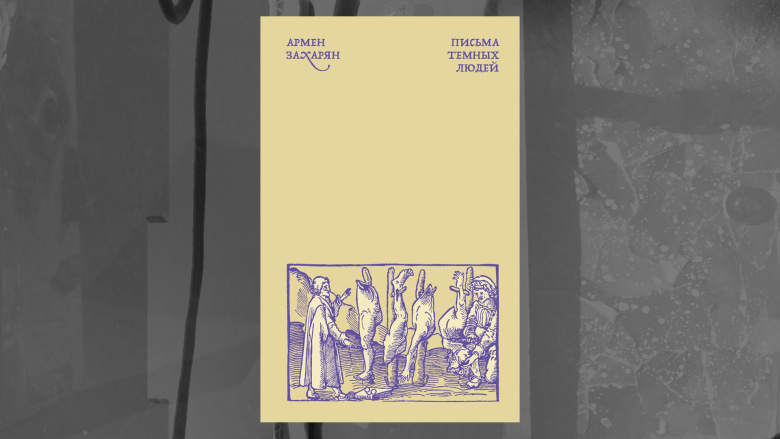
Cover of Armen Zakharyan’s book “Letters from Dark People” (2026)
— You speak five languages, do you read the books you talk about in the original?
— When there is an opportunity to work with the original text, I definitely work with it. But it is not always possible to read fully - sometimes it requires a lot of effort. For example, I am learning Italian, I hope that soon it will be a full sixth language. But I can work with texts in Italian now, because knowledge of other foreign languages, including Spanish, helps a lot with this. And I don’t speak German at all. If I open the original, I’ll most likely understand individual words, but I won’t be able to piece together the picture as a whole.
From the latter, I was pleased to carry out the work of comparing various Russian translations of Don Quixote with the original. I came to unexpected conclusions. Perhaps this will later turn into some material for the channel, or a lecture, or a course of lectures.
- I ask from a specific observation: very often I see the experiences of people who think that translations are absolutely correct and absolutely incorrect - and when reading “incorrect”, they are convinced that they cannot see the true light of the text. Is this a real problem?
“It doesn’t seem to me that this problem is really acute.” The recipe that I use myself: you need a good level of English, first of all. It is into English that the most high-quality translations are made from a wide variety of languages. You will never master all languages. You cannot speak German to read Faust in the original, and Spanish to read Cervantes, and Sumerian and Akkadian to read the Sumerian and Akkadian versions of the Epic of Gilgamesh.
Very often it turns out that you want to read some ancient text - for example, Parzival, a chivalric romance of the high Middle Ages, written in Middle High German by Wolfram von Eschenbach. In Russian, as far as I know, there is only one translation option, incomplete and somewhat distorted stylistically. But if you look for translations into English, you will find translations for every taste: one literally conveys the text, the other artistically processes it. English in this regard becomes such a lifesaver.
— What do you read for yourself, not to prepare for lectures?
— What I read for preparation is the same thing that I would read by choice and for personal pleasure. When I read Machiavelli's History of Florence or Thomas Malory's Le Morte d'Arthur, I really enjoy it immensely. And this is what I choose to read, what I choose to talk about.
— You are talking about the happiness of the reader who reads with pleasure. But here’s a question about the nature of this pleasure: in “Letters from Dark People,” is it the book itself that touches us, or the plot for which it has become a lever? What exactly produces that same effect?
Subscribe to read in full
Subscribe to Redefine.Media to read Republic
Subscribe [You can pay with a Russian or foreign card. The subscription is renewed automatically. You can unsubscribe at any time.]
Where does the subscribers' money go?