
Translated material
Desert style vaudeville
About Dmitry Krymov's play Uncle Vanya - in New York

Scene from the play Uncle Vanya. Photo: Marina Levitskaya
Dmitry Krymov released the premiere of Uncle Vanya at the La MaMa ETC theater in New York; the block of shows lasted two weeks and ended on April 12. With the actors of his Krymov Lab NYC, the director reimagined Chekhov’s world-famous play “Uncle Vanya,” leaving its plot skeleton and adding another skeleton, a chicken one, to talk about the senseless cruelty that has engulfed the world.
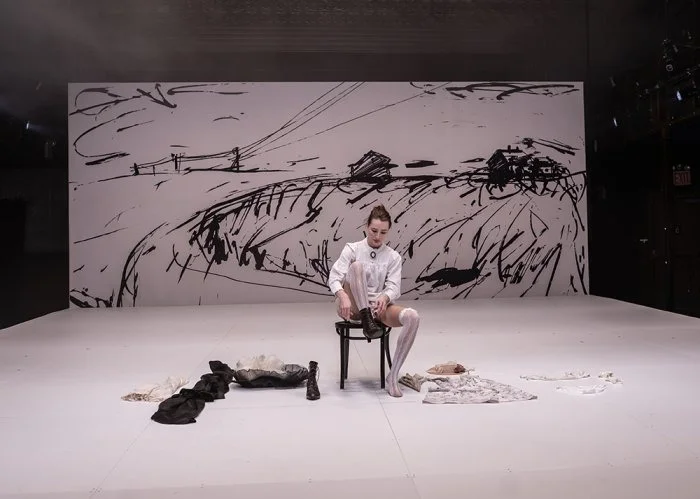
Immediately after the show, a wave of reviews poured in - and since the performance (the first of the Krymovskys) was broadcast online, viewers from Russia joined the general chorus for the first time in a long time. The genre of the play was defined as “ grotesque elegy, desert-style vaudeville .” The desert motif supports the minimalism of the scenery, but the scene of action still remains the village, which is indicated not only by the sign silently rolling onto the stage with the inscription Countryside, but also by the backdrop, where a careless landscape of the rural hinterland appears on a white canvas, like splashes of ink. It was drawn by artist Emona Stoykova, who designed all of Dmitry Krymov’s previous performances at La MaMa. The inspiration for the set, as the director said, was Van Gogh’s painting “Crows in a Wheat Field,” painted by the artist shortly before his death. And this is the third ~~whale~~ skeleton on which Uncle Vanya stands.
Krymov began working on “Uncle Vanya” while still in Moscow. The premiere, which had long been widely known in narrow circles, was planned at the Theater. Pushkin, where his “Kostik” was then performed with great success - based on Chekhov’s “The Seagull”. But February came, and Dmitry Krymov never returned to Russia. The director approached the ideas invented for that “Uncle Vanya” in America at workshops, but did not take them to Uncle Vanya - too much time had passed, the relevance was lost.
Krymov built the performance at the La MaMa theater around the professor’s wife Elena Andreevna: she appears on a white stage in a black St. Petersburg outfit, on her head is a black hat with a large white feather (and here she is somewhat similar to Maria Smolnikova in the Moscow Art Theater “Seryozha”). Elena Andreevna wants to change into a light dress - after all, she came to the village to take a break from the bustle of the city. It seems like an idyll all around: summer, chickens roam, birds sing, cows moo somewhere, dogs can be heard barking.
The serene and happy atmosphere is disturbed by insects. Lots of insects. With unsuccessful attempts to brush them off, not to let them bite you, that general nervousness begins, which will only grow further.
Alien to rural life, the professor's wife, like a magnet, attracts the locals - as annoying and blood-sucking as flies. Focused on their problems, they drag Elena Andreevna into them. The brutal Astrov unceremoniously interrupts her changing clothes - and the professor’s wife will remain in only a corset and lace stockings until the end. The doctor, almost without looking at Elena Andreevna, will spread a map on her lap and will pompously feel sorry for the rain forests, while at the same time holding Elena Andreevna with the same map. Professor Serebryakov, who has as much talent as height (in the play he is played by a short man), will begin to read pathetically primitive texts about Raphael and Mona. Sonya, in love, will ask Elena Andreevna for help in matters of the heart, and the notorious Uncle Vanya will mumble about his feelings and the professor’s mediocrity. They all leave the common semicircle, sit down in the center, next to Elena Andreevna, and bring their problems and tragedies to her, wanting to be heard. “Young, sensitive and beautiful, she attracts the inhabitants of the Voinitsky estate, like a priest at confession,” said the description of the performance.
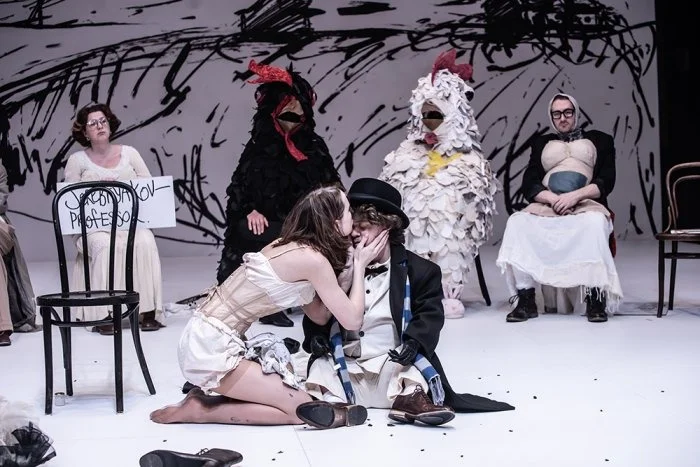
Of all the characters, I really feel sorry for only the mother hen - the hen who runs around with her chicken, wanting to protect it from death. She tells Elena Andreevna, pointedly pointing her finger under the grate, that all her children were taken by him... Korshun. From a small detail in Chekhov’s “Uncle Vanya,” when the old nanny calls chickens around the yard and worries that the chickens will be dragged by crows, Dmitry Krymov extracts the tragedy of a mother who lost all her children and, against this background, received post-traumatic syndrome. She imagines a childish “mom-mum-mama”, she doesn’t know who Monet is, she has a black eye under her eye, probably given by her husband, and a flask of intoxicating drink helps her bear the hardships of an unbearable life.
She will not see how deftly the portly old nanny will break the neck of her last little yellow chicken, which she, like a child, placed on Elena Andreevna’s lap.
All that will remain with the chicken are the small skeletal bones of her child, gnawed by the inhabitants of the Voinitsky house and folded with the mother’s trembling hand on a black napkin. She will scream and cry, fight in hysterics, but at least she will receive at least some sympathy only from Elena Andreevna, who was nursing her chicken.
Dmitry Krymov, confident that Chekhov is writing about unhappy people who cannot do anything, even if they want something, says:
"This is us. We live in the same situation, in the same world.” We are the unfortunate mothers whose children are carried away by a metaphorical kite or killed for the sake of a conventional chicken soup for a professor who will not touch it.
We are Uncle Vanya, forced to eat chicken, which he does not like. We are Elena Andreevna, who, because of her sensitivity, instead of relaxing in the village, gets drawn into other people's problems. We are Professor Serebryakov, who a few years ago wrote one thing, and now something completely different. And so “not only Pavel Alexandrovich, but also Ivan Petrovich, and Alexander Sergeevich, and Dmitry Anatolyevich” changes. We are Astrov, who worries about forests and dead animals, but does not notice the people around him or the chicken bone in his hand.
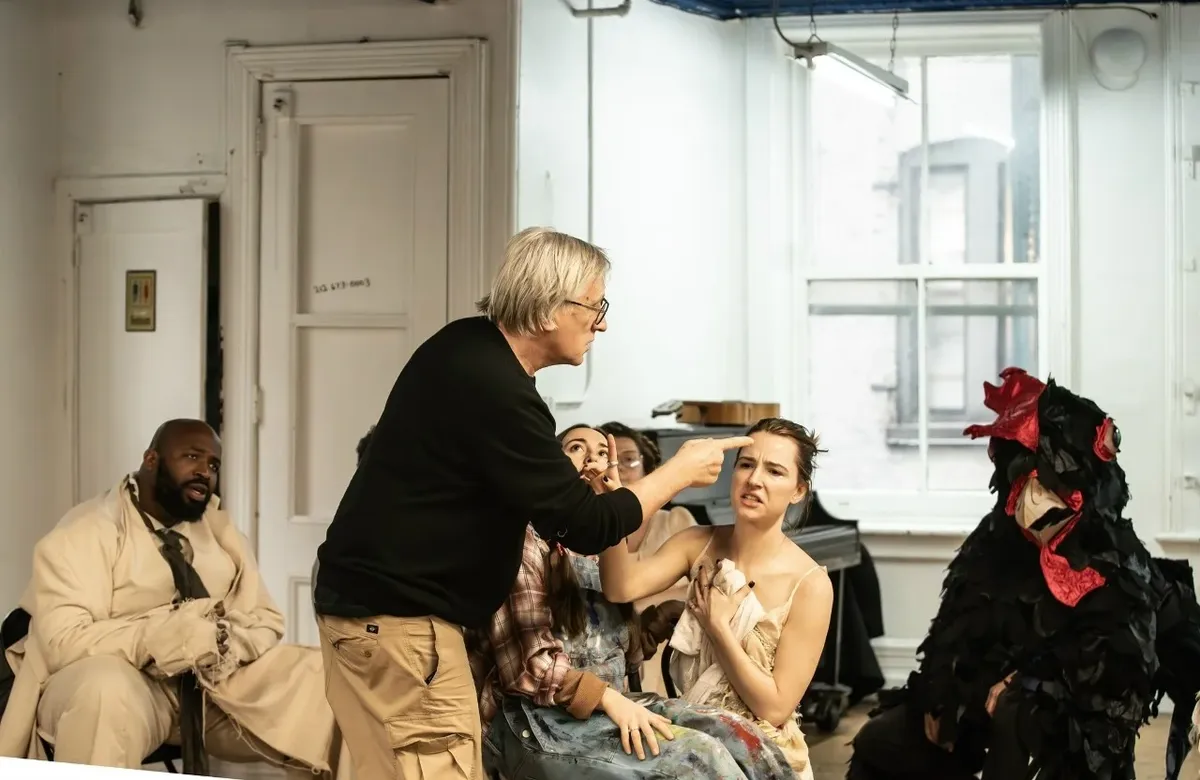
In the play, Dmitry Krymov tries to diagnose chronic diseases not only of the Russian, but also of the American audience. So, Telegin, whose rights are constantly infringed, is played by a dark-skinned actor - and it is with Telegin that Elena Andreevna, albeit for a short time, is born a feeling of beautiful, sublime love.
How else Uncle Vanya resonates with the New York audience is difficult to say, not being there. But for the viewer, Moscow Prime Minister Dmitry Krymov becomes a breath of fresh air and creative freedom, which become more and more rare every day after 2022.
It seems that this performance gives those who remained in Russia a reason to think about what changes have occurred in ourselves over these four years. We have become tougher, it is now more difficult to force us to empathize - as if in the first years everything connected with February had already faded away, and news about human casualties became everyday. The general tragedy and horror of the first years turned into everyday life and personal tragedies of those whose loved ones died. And if at first it seemed that it was impossible to get used to this, now (how right the psychologists were!) you understand: a person gets used to everything.
That is why the story of a mother collecting the bones of a murdered child is not perceived as keenly as it could be, but it makes us remember that once upon a time there was not such an impenetrable armor of indifference between the soul and the world around.
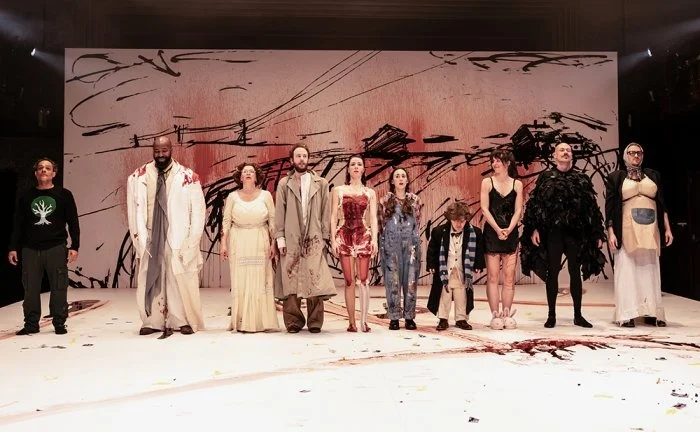
Today's Russian audience is much more pierced by the finale, where the same explosive force is concentrated that returns Chekhov's canonized play to its freshness and revolutionary nature. A notorious intellectual, anxious and worthless Uncle Vanya, who recently tried to expose the professor, strike up a relationship with Elena Andreevna and prove his importance in every possible way, who ran and shouted that he (he!) is the main character of the play and that he was tired of eating the hated chicken meat - this Uncle Vanya grabs a gun and, unlike the original text, no longer misses. He kills everyone. Everyone except Sonya.
His spring of patience, compressed to the limit, straightens out - and the whole scene is covered in blood, the graphic black and white landscape is filled with huge red spots. And it becomes easier. It’s as if with the shots the viewer’s inner spring, also compressed more and more tightly every year, weakens a little. Before you have time to come to your senses, Sonya, dragging the corpses from the stage, pronounces the most famous monologue about the sky in diamonds and about the fact that we will rest...
Surprisingly, after the performance, despite all the absurdity and cruelty, there remains hope for a bright future, where “all earthly evil, all our suffering will drown in mercy.”
Maybe this is because after the bloody finale, cleaners come onto the white stage, and while they are washing the theatrical blood from the scenery, Dmitry Krymov, talking with the audience, cries at the thought that his friends in Russia have just watched his play with him, and the audience from overseas tells him that they miss and love him.
Margarita Usoltseva