
Translated material
Full-scale exhibition about full-scale ***
How the organizers again tried to connect the Northern Military District with the Great Patriotic War and Orthodoxy - and what came of it

Exhibition “Near the War: People. Stories. Signs." Photo: social networks
The exhibition of the first full-scale exhibition about the Northern Military District continues - “Near the War: People. Stories. Signs” from the “Russian Style” project and the All-Russian Museum of Decorative Arts. We tell you how the organizers again tried to connect the Northern Military District with the Great Patriotic War and Orthodoxy - and what came of it
...An exhibition dedicated to the Northern Military District opened at the Museum of Decorative Arts. The location was clearly not chosen by chance: if you walk through the permanent and exhibition spaces of this museum, it becomes clear that the main theme in it is the preservation of Russian cultural heritage, and sometimes excessive “Russianness” can be seen in all the halls. That is why the appearance of the exhibition “Near the War: People. Stories. Signs” from the “Russian Style” project seems quite justified. It is noteworthy that this is one of the few or even the only exhibition dedicated to the Northern Military District, for which you have to buy a ticket, although for veterans of the Northern Military District, as usual, admission is free. True, you will have to buy a complex ticket; there are no separate tickets for sale for this exhibition - therefore, it is difficult to trace the level of interest in it.
The first thing a visitor sees when entering the museum is “Near the War”; it is impossible to pass by. And dads joyfully drag their wives and children to the exhibition with the words: “You definitely need to come here.”
The title of the exhibition uses a word that we cannot use in relation to the North Military District, but, as we see, state media and museums can.
But here it is no coincidence - the organizers of the exhibition draw the now classic parallel between the Great Patriotic War and the Northern Military District, declaring both of these events “sacred”. The idea is not new, but in this case it is implemented as comprehensively as possible - the exhibition has a clear concept. “The concept of the exhibition is built around two chronological interior rooms that recreate the living environment from which people went to the front during the Great Patriotic War and today,” the press release says. Actually, there are only three halls here: a warrior’s room in our days, a warrior’s room during the Great Patriotic War, and a hall that unites these time periods with the help of propaganda posters and state Orthodoxy.
First, the viewer finds himself in the present day: several propaganda posters, a military uniform with Z-symbols and a room model. And I must say, it is the room that inspires true fear. More precisely, the way the organizers see the average SVO participant is awe-inspiring. In front of us is a bunk bed, on which there are even toys. Obviously, the organizers are aware that the average SVO participant is yesterday’s child. He has a computer on his desk and anime paraphernalia everywhere. We are presented with the room of not just a young man, but a teenager who has barely graduated from school, who has just turned 18. It is at this age, according to the organizers of the exhibition, that a person should go to SVO.
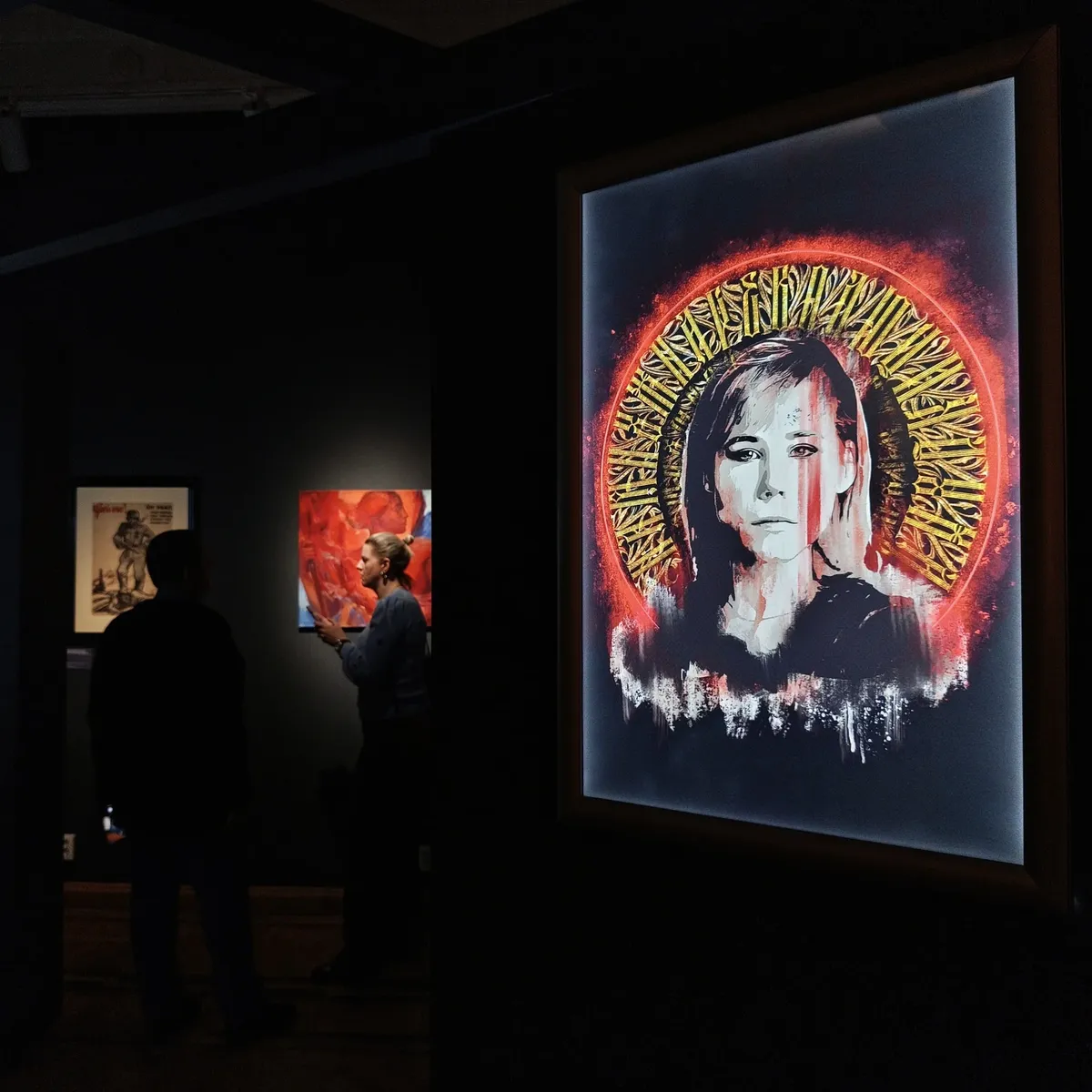
If we turn right from this hall, we find ourselves in an additional fourth hall, in which for some reason they forgot to turn off the film about decorative arts. But the main thing here is the icon painted on the lid of a shell box by the artist Anton Belikov (who is also the curator of the exhibition) during his service in the Northern Military District. The icon, popularly known as the “Trench Savior,” was in the church in Avdeevka and will return there after the exhibition. And this is a completely familiar technique: to consecrate the Northern Military District with state Orthodoxy. According to the organizers, “in the combination of a deadly container and a merciful look lies the whole truth of the current moment. There, on the front line, faith becomes the only indestructible shield.” The parasitism on the topic of religion continues in the next room.
This hall combines two time periods: the forties of the 20th century and our days. And the first thing we see is a triptych from the “Warriors” series: three full-length paintings, reminiscent of icons in their image, depicting a sniper, a mother and a tanker. The rest of the hall contains all kinds of propaganda posters that were used during the Second World War and are still in use today. At the same time, the feelings that arise in the viewer when watching are anger and hatred, and not compassion at all. The organizers of the exhibition clearly tried to connect SVO with faith in God and give it “sacred” status, but something went wrong.
The most brutal posters of that time: “Let’s destroy the fascist vermin!”, “Avenge them!”, “Kill him! He killed your loved ones, burned your house, ruined your farm!” - although they are real posters of that time, their selection suggests that the main goal of the exhibition is not a demonstration of a “merciful look”, but a call to violence. To accomplish this task, there are other exhibits in the hall - for example, a screen with AI animation: on it there are many posters with many slogans very quickly replacing each other: “When you think, decide, when you decide, don’t think,” “A hero is born for himself, but dies for the people,” “I die, but I don’t give up!” and so on. The slide show is accompanied by very specific music, and if you watch it for a couple of minutes without looking away, the video sequence seems to hypnotize, awakening humility and a willingness to come to terms with your difficult fate. In this case, propaganda, perhaps, really works, because the viewer, without realizing it, begins to think about things that he did not want to think about before and would not be worth thinking about. However, the main thing here is to switch to something else in time (for example, to an exhibition of Soviet ceramics that is suddenly discovered in the next room).
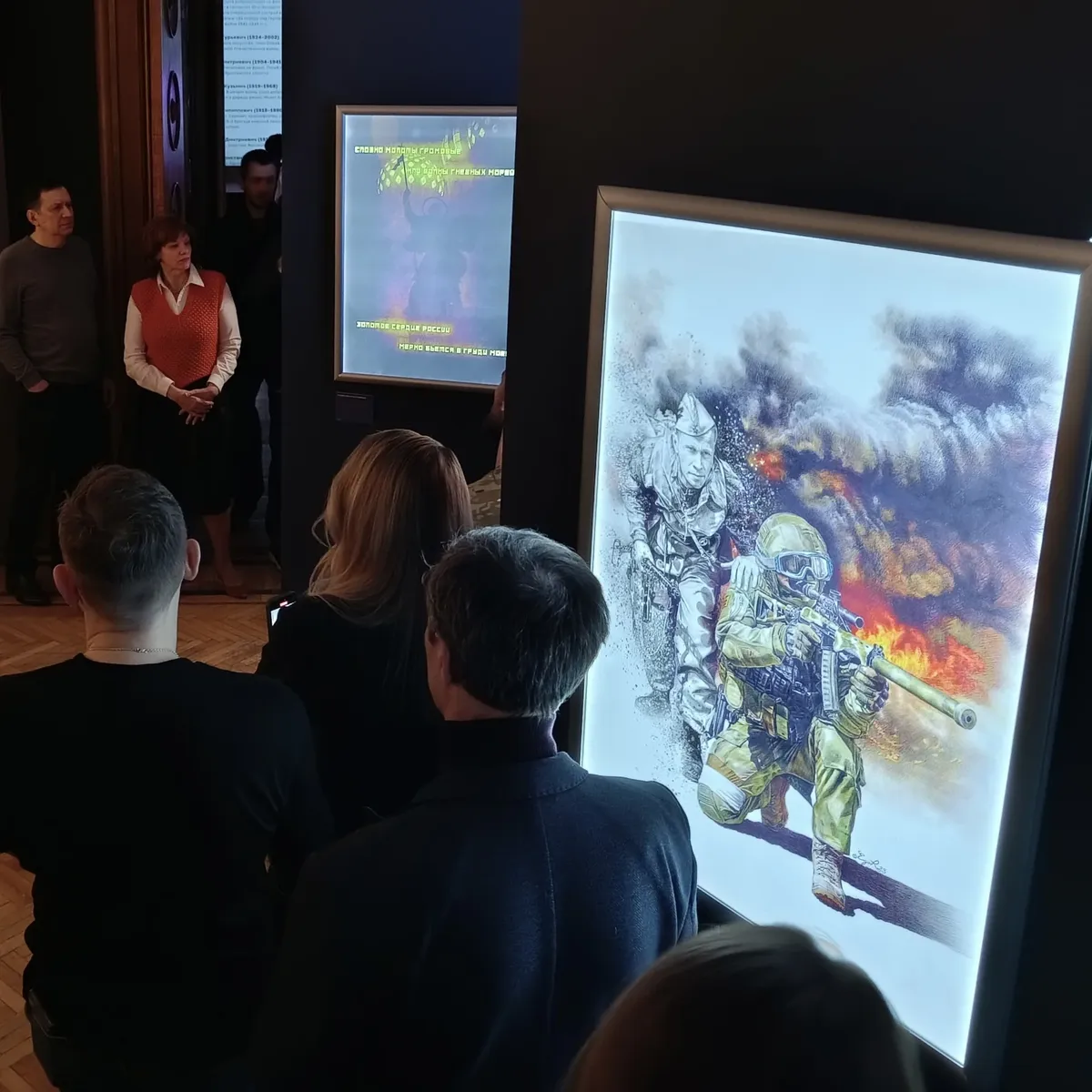
Modern posters are also quite widely represented - and most of them appear to have been created by those who were/were directly involved in the fighting. This is determined by the name of the author, who often does not call himself by his real name - it is either a call sign or a set of incomprehensible letters. Even if there is a name, something like a call sign is still indicated in brackets: Andrey Muravyov (DaZbasta), Svetlana Tyurina (Lana Bright), 614 art, and so on. The works of these authors do not represent any artistic value, although, as is known, poster art can be quite interesting. Absolutely tasteless images are also presented, reminiscent of a forced exhibition about SVO among high school students in the village. Here you can also find works dedicated to the unity of the peoples of Russia in battle, the strength of the clan (the spirit of ancestors, they say, helps to fight), love on the battlefield (sic!), many images are dedicated to the memory of propagandist Daria Dugina - there are many subtopics. This room, without a doubt, is key for the exhibition - and the oppressive atmosphere that it “gives” lives in the visitor for some time after visiting it.
There is nothing fundamentally new to see in the last room: here awaits the room from which a person went to the front during the Great Patriotic War. Classic military uniforms and no less classic posters - for example, “Have you signed up to volunteer?” This is where the exhibition inside the museum ends. But there is another exhibit - in the courtyard. This special exhibit in the museum courtyard is a UAZ-452 car (popularly known as “Loaf”), painted by the famous muralist Alexander Tsypkov. This work of art is so unremarkable that on the way to the exhibition you may not even notice it, even if you know in advance that it is the “central exhibit”. Why a mediocre “loaf” painted with images of cherubs appeared in the museum courtyard seems, to put it mildly, incomprehensible to a passerby unprepared for the exhibition.
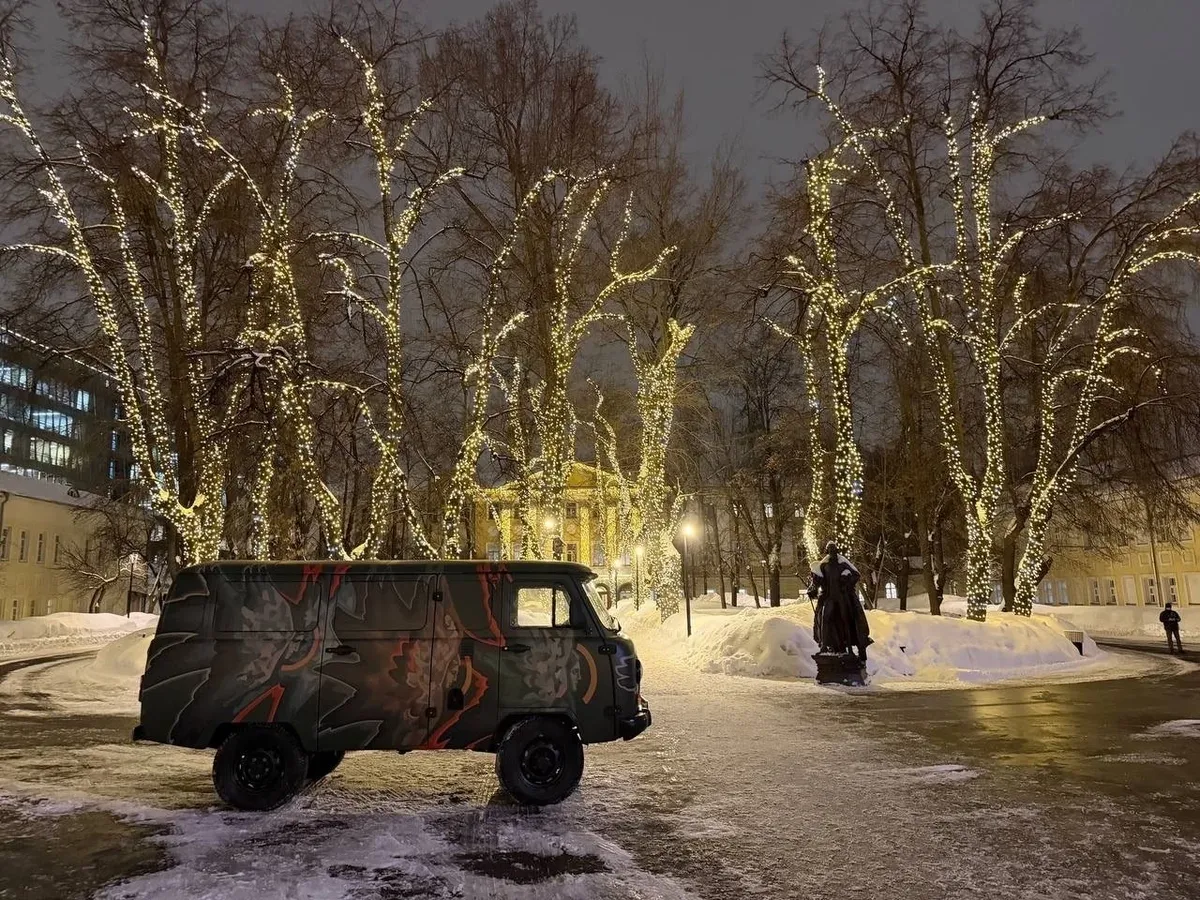
Even more questions are raised by the fact that the Museum Development Fund bought it for some reason and also attracted donations from employees - apparently, their own funds were not enough. It’s interesting how the modestly dressed grandparents-caretakers were presented with the information that it was necessary to chip in for such a valuable exhibit. Everyone chipped in 1000 rubles, like for Marina Ivanovna’s birthday from the accounting department? Or was the format of voluntary donations chosen? Or maybe tribute was collected only from the administration? Unfortunately, there are no answers. And after the exhibition, the car painted with cherubs will go back to Avdievka to deliver humanitarian aid.
But for all its absurdities, the exhibition clearly achieves the effect that was wanted from it. People do not pass by the exhibition and carefully examine each work, taking photographs with the exhibits with the whole family.
Many Russians already really equate the Northern Military District with the Great Patriotic War, and in many ways this happened precisely because of such cultural initiatives.
Moreover, it is clear that many agreed with the “sacred status” of the SVO. And all this makes it clear: we live in a reality where SVO has ceased to be something distant and in four years has completely integrated into the image of a modern Russian metropolis. And not only in the metropolis: in four years, what we cannot name, but the exhibition organizers can, has become part of the everyday life of the country. Now all of them - from Moscow to Kamchatka - live in the same mode: near the war.