
Translated material
Death by lightning. Yaroslav Shimov - about the murdered and forgotten president

Can you name offhand the names of the US presidents who died as a result of the assassination attempt?
Probably every somewhat educated person will immediately remember John Kennedy and, after thinking for a couple of seconds, add Abraham Lincoln to him. Deep connoisseurs of American history may recall the name of William McKinley , who was shot and killed by an anarchist in 1901. And almost no one will remember James A. Garfield , who was the 20th President of the United States for several months in 1881, until he was assassinated by one Charles Guiteau (or Charles - he was a descendant of French Huguenot emigrants).
The story of the assassination of President Garfield was recalled a couple of months ago by actor and director Matt Ross , who shot a mini-series about it - very short, only 4 episodes - called “Struck by Lightning” (in the original the name sounds less pretentious: “Death by Lightning” - Death by Lightning). It is connected with the phrase of Garfield himself, who, after his election, responded to the proposal to strengthen his security that preventing an assassination attempt is as difficult as avoiding death from lightning if it does strike. It turned out to be a well-filmed, sad, historically quite accurate, despite minor mistakes, and a rather philosophical series about what politics is and how human memory works, creating our ideas about history.
This is a double portrait. On the one hand, there is a president who did not want power and fame, but by force of circumstances ended up in the White House and tried to do what he considered right for his country, which was deeply dysfunctional at that moment. On the other hand, his killer, who, on the contrary, longed for fame and success, but, having failed to achieve them, decided to become famous for at least a high-profile crime - committed, in his opinion, also in the name of the common good.
The United States during the Gilded Age was a country where huge fortunes were quickly made and, at times, squandered just as quickly. The economy was growing rapidly, the “Wild West” was being explored, but poverty was spreading just as quickly among those ordinary people for whom this century turned out to be anything but gilded, and certainly not golden. Many of the fruits of the North's victory in the Civil War were sacrificed in favor of reconciliation with yesterday's slave owners of the South, who partially restored their dominance over the freed black population through racist "Jim Crow laws." Politics became oligarchic, turning into a struggle between Republican and Democratic party machines, whose bosses, like the influential New York senator Roscoe Conkling , were the uncrowned kings of America.
Politics has become oligarchic, turning into a struggle between party machines
It was under these conditions that the rise of James Garfield took place - a modest congressman from Ohio, a self-taught and self-made man, a Civil War veteran, who at the Republican Party pre-election convention in 1880 unexpectedly became the “dark horse” of the presidential election. He himself planned to support another candidate, General Sherman . But the corrupt bosses did not reach an agreement among themselves, and the energy of the provincial delegates, dissatisfied with the dominance of political machines, turned in favor of Garfield, who made a bright speech at the congress. The only thing Senator Conkling and his assistants were able to achieve was to “supplement” Garfield with their own man, New York Customs Chief Chester Arthur , who became a candidate for vice president.
Today, Garfield, with his fiery denunciations of the corrupt elite and calls to return power to the people, would probably be considered a populist. However, unlike many of today's talkers, he had a well-thought-out program for cleaning out the Augean stables of American politics. This is what he did after winning the election and taking office in March 1881. (In those days, the inauguration of US presidents took place in early March, and not at the end of January, as now). Garfield managed to form a government of reform supporters and, in a couple of months, break Conkling's seemingly indestructible corruption machine. But already on July 2, at the end of the fourth month of his presidency, a man with a pistol was waiting for him on the station platform in Washington.
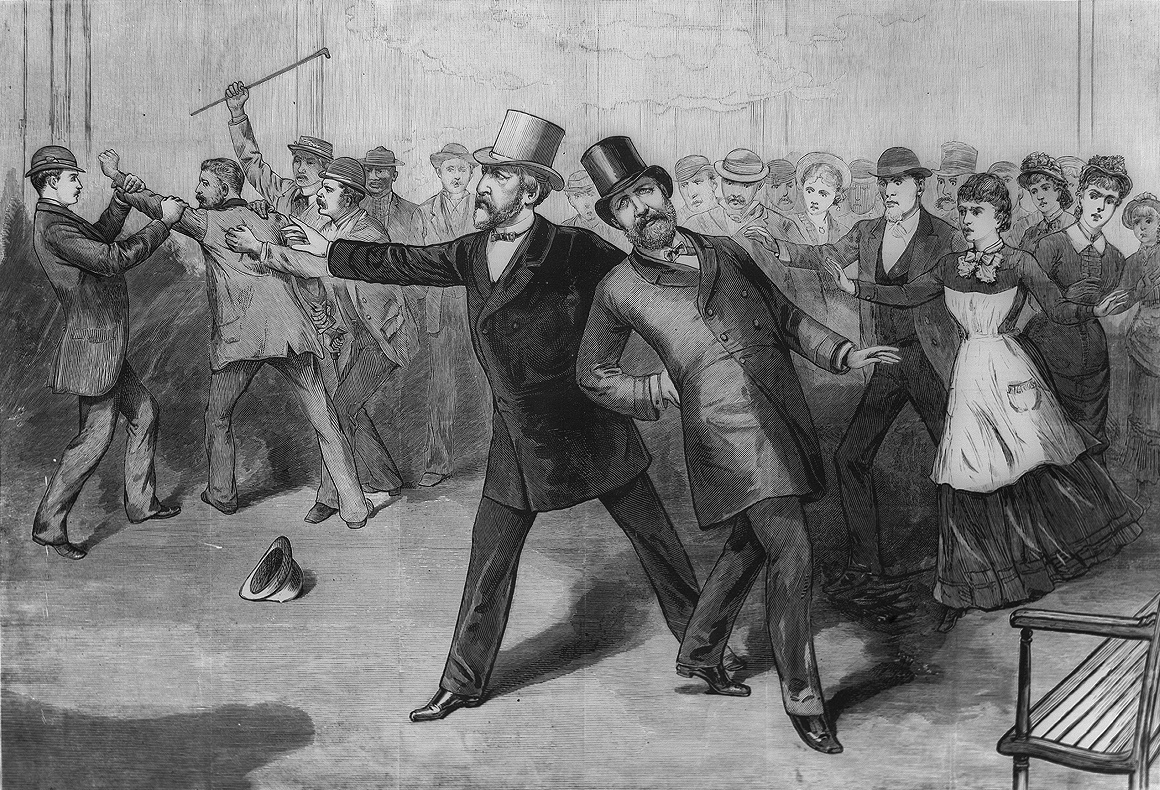
Charles Guiteau was a lone killer, not associated with the president’s political opponents, although, as he himself stated after his arrest, he counted on their gratitude for what he had done. Moreover, during the campaign he supported Garfield and even attended a reception with him at the White House, but with a very mundane goal: to achieve some kind of appointment, best of all - to the diplomatic service in France, the homeland of his ancestors. The refusal embittered Guiteau, a mentally unstable man, and he decided that he would make another, very unique “career” by eliminating the president.
In Struck by Lightning, Guiteau evokes sympathy right up until the murder. He had a hard time as a child with a cruel father, his only close person was his sister, he had no luck with women - even in the sect that preached free love, to which Guiteau joined, he did not enjoy success with the “sisters”, who gave him, in consonance with his surname, the contemptuous nickname “Get Out”. He became a petty swindler, obsessed with starting his own newspaper. In Garfield's unexpected presidency, he saw an opportunity to finally get to the top, but it didn't work out here either.
Our traces remain in life even when our names disappear from short human memory
Guiteau was, one might say, a professional failure, an empty man whose life was eventually filled with hatred. But he didn’t even really succeed in killing the president: Garfield’s wound at first did not look life-threatening, but the killer was “helped” by incompetent doctors who introduced an infection into the wound. After suffering for two and a half months, James Garfield died on September 19, 1881. Guiteau was hanged in Washington a few months later. Apparently, before his execution, he completely lost his mind, because on the scaffold he danced, laughed and shouted poems of his own composition.
James Garfield, as played in the series by Michael Shannon , does not look like a charismatic leader, but rather a man of duty, sober, rational and somewhat skeptical. His life and death become a sad hymn to the principle “do what you must, and come what may.” His strength lies in the fact that, unlike the “gods of smoky rooms” opposing him, as political strategists of that time were called, he does not play politics, but does it based on principles and beliefs. And this, like the tragic death of the president, becomes the reason for the amazing transformation of Vice President Arthur: having become Garfield’s successor, he will continue his reforms, sending Conkling and his entourage away.
Both Garfield and his killer were soon forgotten, becoming, as the president's widow says in the show, "footnotes at the bottom of the page in a future history textbook." It's terrifying and calming at the same time. Perhaps for history we are all, rulers and losers, millionaires and murderers, not so important in ourselves. What we do is more important: one way or another, our traces remain in life even when our names disappear from short human memory.
Yaroslav Shimov – journalist and historian, columnist for Radio Liberty
Opinions expressed in the "Author's Rights" section may not reflect the views of the editors
Death by lightning. Yaroslav Shimov - about the murdered and forgotten president