
Translated material
We must live while they give us
“Vygotsky” by Anton Bilzho was awarded by the MIFF jury for best director, and Sergei Gilev, who played the scientist, was awarded for best leading role

Still from the film “Vygotsky”
“Vygotsky” is not a standard biopic, but rather an impressionistic portrait, the view of modern authors on the affairs of long ago, explaining us today. And this is the special courage of the creators of the film, director Bilzho, producer Yegor Odintsov and actor Sergei Gilev (rightly awarded the prize for best leading role).
The public mostly heard about the outstanding scientist. Therefore, they immediately give her a life preserver - “intertitles”. Like, you don’t need to know anything about Vygotsky. The inscriptions below - like author's postcards - will explain and comment on the action in an ironic way.
Instead of a “born-achieved-died” chronology, we are offered a poetic parable about the thirty-seven-year-old Don Quixote of science, a genius whose life span is measured in the last months. In this movie with a non-linear structure, everything is slightly shifted. The thirties are approaching their dark apogee, black craters and the immediate danger of being erased from science and life are breathing in our backs. But the air itself is filled with the sunny dust of summer and the endless babble of children in white Panama hats, intently building their palaces out of sand and clay. And also the heated discussions of fanatical scientists about the ways of developing science and their idealistic belief that with this very science it is possible to transform the world sliding into the abyss.
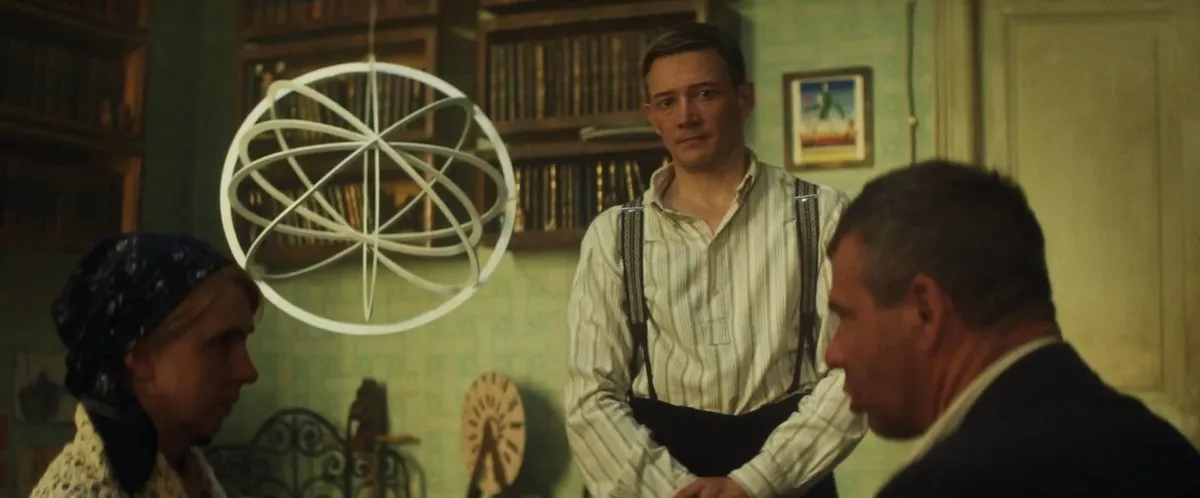
So, 1934, the talented scientist Lev Vygotsky (Sergei Gilev) enjoys the special trust of the head of all Soviet medicine, Nikolai Semashko (Alexander Semchev). But he is dangerously ill. Under pressure from his beloved wife Rosa (Nelly Uvarova), he agrees to several sessions of psychoanalysis with a talented student of Freud and Jung, the world star of psychology Sabina Spielrein. She discovers the origins of his Gomel youth trauma, persuades him to undergo treatment... but they argue more about the method of raising a “new man”.
Vygotsky is convinced that “personality” is not an innate, but a social concept, that higher mental functions (thinking, speech, will) are formed not from within, but through social interaction, culture, speech is an instrument of thinking and a source of consciousness. He explores ways to educate a child through play and adults. However, all these serious scientific problems, research and experiments have been turned into a game. Just like the life of a scientist from a communal apartment, ready for any eccentricities to prove his theory.
This is not even the flow of life - bright bursts, the most unexpected encounters that shape and change the personality of a psychologist and pedologist before our eyes. His fights with fierce conservatives, the formation of a new science of pedology, the contradictions between the social and the individual, play and reality, development and learning - this whole cycle of problems turns his life into a scorching whirlwind.
They are already writing about him in the newspapers, saying that they consider his theory idealistic and bourgeois. In the communal apartment, a vigilant comrade “keeps an eye on him and other neighbors”, rushing to “report” before he is “reported.” And he knits sheets to organize the escape of a troubled teenager from a psychoneurological boarding school.
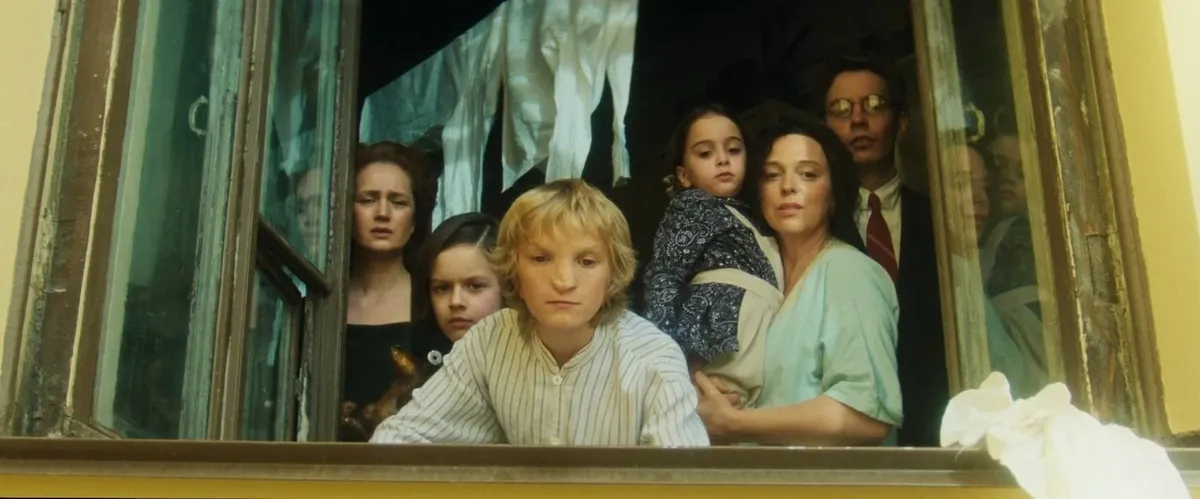
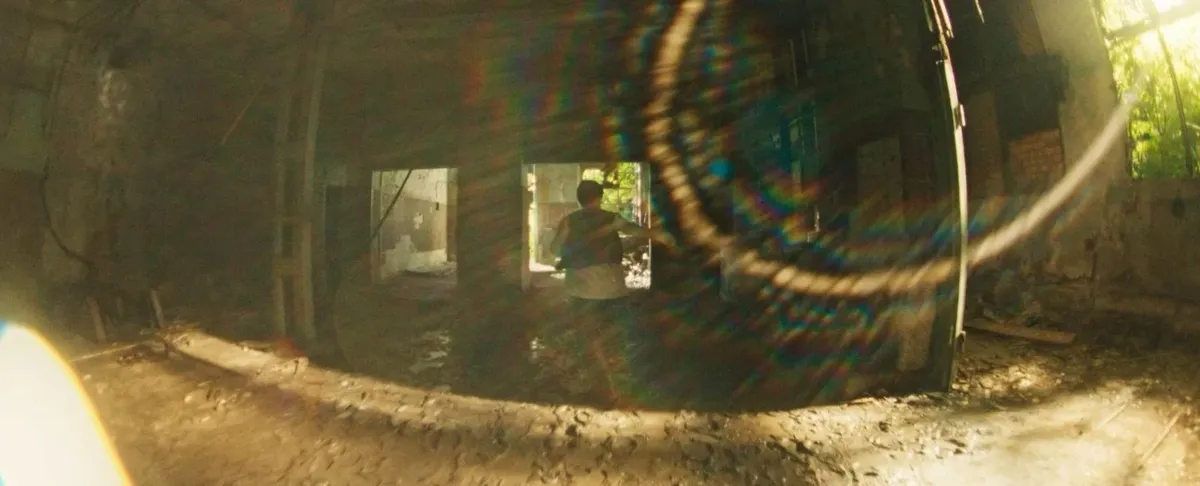
Tragicomedy jumps on the bandwagon of absurdity. Daniila Fomichev’s camera is a living, moving one, emerging from under the sheets in the long corridor of a communal apartment as soon as possible towards a sunny day, hiding in a closet, jumping up in the uneven course of an old tram, hurrying to race with a black funnel. A game with angles, demonstrating who is the boss here in the country (in the scene with the PNI, this is a sculptural headmistress in a red scarf).
The musical score by Mark Dorbsky does not accompany the action - it sets an nervous dance rhythm, jumping from melody to cacophony of “chaos” (we remember the ill-fated article dedicated to the avant-garde opera “Lady Macbeth of Mtsensk” by Shostakovich - only two years before its publication).
Sergei Gilev plays the genius with his childish sincerity, phenomenal determination and passion, and uncompromising dedication of himself - every drop - to science. The actor does not “reproduce” a specific person on the screen; rather, with light strokes he creates an image built around the idea of “game”. It focuses on the vitality of the hero, wandering, or rather, running through labyrinths between doubt and confidence, self-irony and mortal fatigue from everything: consumption, misunderstanding of loved ones, severe pressure from superiors, battles with scientific opponents, increasingly reminiscent of prosecutors. Their idea is that man is the fruit of physiological reflexes, and in general a needle in a haystack of important social transformations. Inside this “carousel”, Gilev tries to recreate the inner world of the thinker - through the music of acting.
On the screen, time itself is not yet completely black - it is motley, assembled into a mosaic of heterogeneous details:
a clever polygraph device created by Vygotsky’s closest friend, one of the founders of neuropsychology, Alexander Luria;
a theremin that “sings” melodies in the neighborhood until its creator is arrested;
biomechanics of Meyerhold and his student Eisenstein for psychological experiments;
Purge Commission;
Director of the institute Kornilov (Vladimir Mishukov) with a cockroach mustache and the desire to turn a person into a function;
attempts to cure an alcoholic with the help of a book about Indians and plum juice.
But at the top of this heterogeneous shaky pyramid is the cast phrase of Sabine Spielrein: “We must live while they give it.”
“Vygotsky” is not at all ideal, but it is a completely non-trivial film about the madness of the brave, whose talent and nobility, at least for some time, keeps the world from falling into the abyss...
Of course, this is Anton Bilzho’s best film, I hope it will arouse interest in the almost forgotten name and discoveries of the scientist. Outside of film history - the defeat of pedology in 1936. But it was on the basis of Vygotsky’s research that Russian neuropsychology, pedology, and partly neurosurgery developed. His discoveries are the basis of inclusive education. And the most important principle of communicative learning: dialogue. Dialogue, not a monologue, not a pointing finger, is the engine of human development. From birth to death, a person becomes himself only in dialogue - with others, with culture, with himself. A person. As Vygotsky’s daughter wrote: “He was the “best of people” - not in terms of the scale of his fame, but in terms of the quality of his humanity.”