Date
Author
Максим Привин; Михаил Михневич; Дмитрий Сухарев
Source

Preserved copy
Translated material
From fines to 12 years in prison. Who is Judge Irina Furmanova
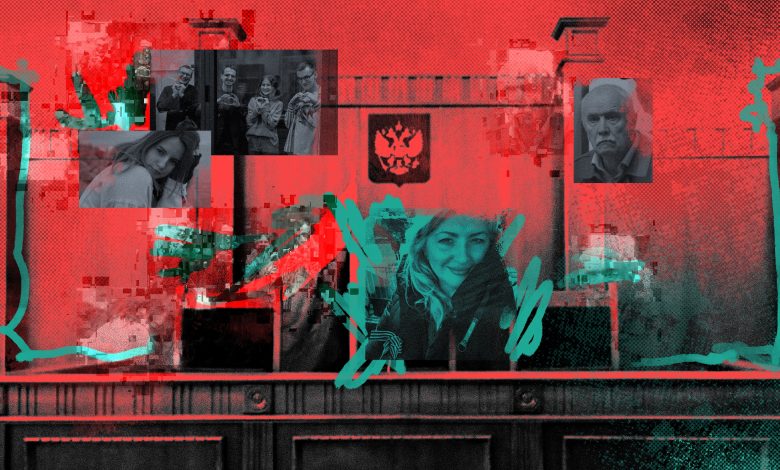
On April 8, 2026, the St. Petersburg City Court handed down one of the harshest sentences in a political case in recent years. Six activists of the “Spring” movement were sentenced to terms ranging from 6 to 12 years in prison. The decision was made by Judge Irina Furmanova, a person who in recent years has become one of the key participants in the judicial machine in cases of “state security” in St. Petersburg.
This sentence does not appear to be an accidental cruelty of the judge. Irina Furmanova has been consistently considering cases of espionage, treason and other politically sensitive offenses for more than ten years and invariably delivers harsh sentences. “Chronicles” presents a portrait of one of the harshest judges in St. Petersburg.
How "Spring" was tried
The case against the Viasna youth movement was initiated on June 5, 2023. The next day, searches took place in Barnaul, Novosibirsk, St. Petersburg and Tver. Six people were detained: Pavel Sinelnikov from Barnaul, Anna Arkhipova from Novosibirsk, St. Petersburg residents Evgeny Zateev, Vasily Neustroyev and Valentin Khoroshenin, as well as Tver resident Yan Ksenzhepolsky. All of them were taken to Moscow and sent to a pre-trial detention center. There are 15 more activists involved in the case, most of whom are wanted.
In the summer of 2024, the trial began in the St. Petersburg City Court. Those detained in the Viasna case were charged with six articles of the Criminal Code:
— dissemination of “fakes” about the armed forces;
- inclination to mass riots;
— creation of a non-profit organization that infringes on the rights of citizens, and participation in it;
— calls for action against state security;
— creation of an extremist community and participation in it;
— “rehabilitation of Nazism” by a group of people using the Internet.
In fact, the Spring movement is engaged in education and has held public events.
By the decision of Judge Irina Furmanova, the accused received from 6 to 12 years in prison.
From administrative cases to criminal ones
Irina Furmanova was born in Krasnoyarsk in 1975. According to the publication “Chronicles.Media”, she spent her student years at the St. Petersburg University of Trade Unions and lived in the university dormitory. And she connected her professional career with St. Petersburg.
Since 2006, she worked as a magistrate in the Admiralteysky district of the city - in an area that included the city center, including Sennaya Square. It was there that opposition rallies regularly took place, and it was there that the administrative files of protest participants often fell to her.

In those years, such cases were still at the “grassroots level” and were considered in magistrates’ courts. Those detained were given small fines for participating in protests or administrative detention. According to the recollections of participants in those trials, decisions were often predictable - fines were imposed regularly.
“An overdressed blonde with nails and expensive bags, like something out of a bad TV show that was popular at the time. She was always several hours late for her own meetings, and when she did arrive, she immediately left for a coffee break. After that, without understanding, she imposed a fine, because the police wrote everything to her in the protocol...”
recalls Alexander Shurshev, who headed the Youth Yabloko in St. Petersburg in those years.
Members of Youth Yabloko and the NBP cannot remember that Irina Evgenievna handed down acquittals to rally participants. But the system at that time still allowed them to be challenged, and higher courts often overturned such decisions by Furmanova.
Along with the degradation of the judicial system in Russia, Irina Furmanova’s career also changed. In 2010, by decree of President Dmitry Medvedev, she was appointed a judge of the Leninsky District Court of St. Petersburg, where she tried ordinary criminal cases: robbery, robbery, murder. And already in 2014, by decree of President Putin, she was appointed judge of the city court. It was then that Furmanova began to engage in matters of a completely different scale.
Treason Judge
In the St. Petersburg City Court, Furmanova's specialization was cases related to state secrets, espionage and treason. This is a separate category of processes - usually closed, with the participation of the FSB, with limited access to materials and an almost complete absence of public control. Participants in the proceedings are most often required to sign a non-disclosure agreement, and there is no talk of admitting the press.

The outcome of cases involving state secrets is practically a foregone conclusion - the accused almost always receive real sentences and are sent to a colony. It is all the more surprising that in 2019 Furmanova stopped the criminal prosecution of the former general director of Power Machines, Roman Filippov, accused of disclosing state secrets. This is a rare example when a case of this level did not end in a guilty verdict. But then this happened at the request of the investigation, which could not prove guilt.
In 2021, Judge Furmanova sentenced Vladimir Grabovsky, a 63-year-old pensioner and former employee of the Aerogeodesy state enterprise, to a suspended sentence, who sold a disk with maps of the General Staff of the 1970s for 9 thousand rubles. The buyer in 2018 was search engine operator Anton Kolomitsyn, against whom a separate criminal case was opened for obtaining information constituting a state secret. Kolomitsyn did not wait for the end of the investigation and left for the Netherlands.
At the same time, on the Aerogeodesy website itself, old topographic maps can be purchased legally.
However, these “lenient” sentences are rather the exception to the rule. So in 2020, Irina Furmanova sentenced 71-year-old Viktor Prozorov to 14 years in a maximum security colony on espionage charges. Prozorov worked as the chief designer of the Sevastopol Central Design Bureau "Chernomorets". No later than 2015, he became a Russian citizen and regularly went on business trips to China and Iran for work. He allegedly divulged the state secret to “a certain Chinese intelligence officer.”
In 2022, a court presided over by Furmanova allowed the extradition of 24-year-old Belarusian citizen Yana Pinchuk. She was later sentenced to 12 years in prison in Belarus for participating in protests in the summer of 2020.
In 2024, Furmanova sentenced 77-year-old scientist Anatoly Maslov to 14 years in a maximum security colony. Anatoly Maslov was the chief researcher at the Institute of Theoretical and Applied Mechanics (ITPM) of the Siberian Branch of the Russian Academy of Sciences in Novosibirsk. The main direction of his work was aerogasdynamics. He was accused of transferring data on the development of hypersonic missiles to China. This case became one of the most high-profile trials against scientists accused of transferring data abroad.
In 2025, Furmanova sentenced Ukrainian tractor driver Viktor Rudenko to 10 years in prison for “espionage.” Rudenko was accused of transmitting data on the movement of Russian troops to the Ukrainian Armed Forces while living in the Kharkov region. The man did not deny that he helped the Ukrainian military, saying that he did it “in the interests of his homeland” and did not admit guilt.
In the same year, Furmanova sentenced 69-year-old Magomedgadzhi Rabadanov to 5 years in a general regime colony under the article on confidential cooperation with a foreign state. He allegedly was going to give out data to Ukraine in order to contribute to the military defeat of Russia.
Career instead of family
Against this background, the sentences in the Viasna case do not look like something unusual for Judge Furmanova, although the terms of 6 to 12 years that the young people received are horrifying. Little is known about the personal life of the judge. Irina Furmanova has a daughter, Anna, who, after her parents’ divorce, remained to live with her father and his new family. In 2024, 25-year-old Anna was declared bankrupt due to a debt of 102 thousand rubles.
The path of repression
“Let the world around you be beautiful,” is written on Irina Furmanova’s page on the VKontakte social network. And below it is signed: “It doesn’t matter to me whose side is strong. What matters is whose side is right!” As a result, there was neither beauty nor right left in her life.

The story of Irina Furmanova shows well how judges are changing in the Russian legal system and how the system itself is becoming increasingly stricter. Twenty years ago, she issued fines for rallies without even looking, which then seemed too harsh a punishment, and in 2026 she will also easily send young activists to 12 years in prison.
The story of Irina Furmanova is not so much the story of one judge, but a reflection of the transformation of the entire system. In twenty years, it has gone from fines for rallies to long-term sentences in cases of “state security.” And this path largely coincides with how Russian justice has changed.
Mikhail Mikhnevich, Maxim Privin