
Translated material
Between utopia and comics. Palantir is saving Western civilization
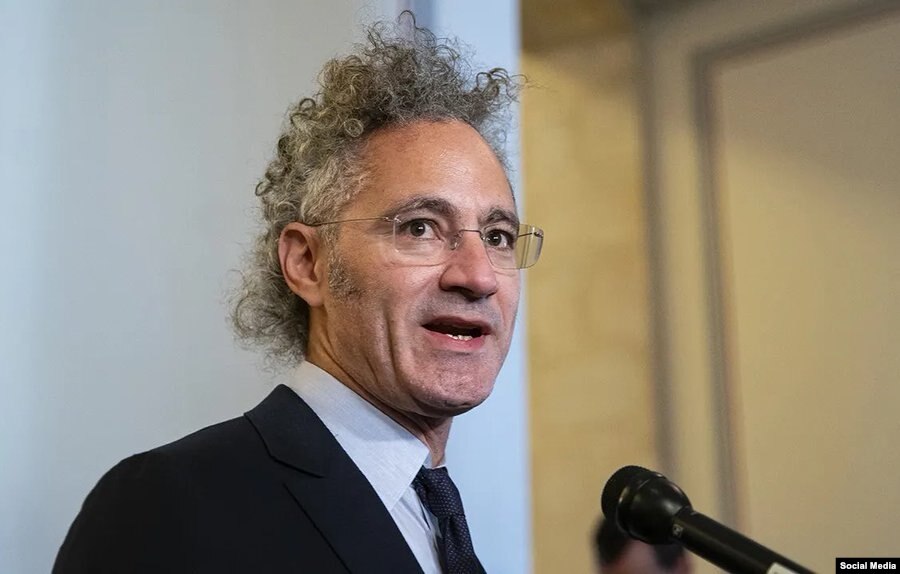
Alex Karp, CEO of Palantir Technologies, a data analytics software company with close ties to the defense industry, issued a manifesto responding to accusations that his company is helping to create a police state in the United States.
It seems that humanity, in its relationship with artificial intelligence, behaves like the inhabitants of a distant planet from the Strugatskys’ story “An Attempt to Escape”: they poke their fingers into the holes of an unknown machine left behind by a “sloppy supercivilization” and see what happens. At the everyday level, we have all learned to communicate with AI and extract small benefits. But we have not yet been given the opportunity to comprehend the existential consequences. Enthusiasts believe that AI will relieve our brains of routine, boring and time-consuming work, and this brain will engage in high creativity. But it may happen that without work the brain atrophies as unnecessary.
Til and Karp: the story of one friendship
Of course, those who run the AI industry did not foresee the consequences either. But they can’t admit it. They must position themselves as carriers of higher knowledge, and their business as a mission to lead humanity out of a historical impasse.
Like his peer and classmate Peter Thiel, Alex Karp studied philosophy, and then both ended up at Stanford University's law department. They became friends, although their views were diametrically opposed. As a teenager, Karp attended the school of civil protests, where his parents took him with them. Thiel recalled : “He was more of a socialist, and I was more of a capitalist. He constantly talked about Marxist theories of alienated labor and how it applied to all the people around us.” Stanford was engulfed in left-liberal sentiment at the time, and Thiel founded the student newspaper, the Stanford Review, to give a voice to the minority.
He was more of a socialist, and I was a capitalist
Looking ahead, let's say that their political views did not coincide in the future, when they were already business partners: Thiel became the first technology tycoon to support Donald Trump's candidacy in the 2016 elections, he made contributions to the election funds of right-wing candidates, while Karp voted for Hillary Clinton and donated to Joe Biden. Both graduated from Stanford Law School in 1992. But then their paths diverged. Thiel went to work as a clerk in court. Karp flew to Germany, to Frankfurt am Main (the city where Thiel was born), to continue his philosophical education at the Goethe University under the direction of Jürgen Habermas.
When Habermas died on March 14 of this year at the age of 97, Alex Karp published his memoirs about him. He says that in his senior year at Stanford, he wrote a letter to the famous philosopher because he did not want to follow the “beaten path”, received a dry response from his assistant, but still took the cheapest flight he could find - a Pakistani airline.
He writes that Habermas had an instinctive ability to “dispassionately identify inconsistencies of thinking and lack of intellectual rigor, wherever they may appear on the political spectrum.” But the memoirist himself is more inclined to criticize the left:
For many, the theater of discourse has become more important than what is happening in the real world, namely that the great successes of the progressive left in the mid-twentieth century in defending the interests of the lower strata of American society have degenerated into a kind of imperial overexertion: an obsession with theory that has completely supplanted practice and results.
He does not share his teacher’s cosmopolitanism:
Habermas championed a concept he called Verfassungspatriotismus, or constitutional patriotism—the view that one can remain loyal to the republic while rejecting the narrower, tribal loyalties that have dominated human history since the dawn of our species. The final end of this repulsive and unenlightened nationalism in all its manifestations, we were assured, was already at hand.
This idea was noble, but - as is now obvious in retrospect - it turned out to be amazingly premature and erroneous. He believed in the possibility of purely rational public discourse. I believed - and still believe - that such a discourse should be rooted in a more physical and traditional source, namely, national and cultural.
Perhaps time will prove him right, but, I’m afraid, not in our lifetime.

Jürgen Habermas entered the annals of philosophy as the author of the concept of the public sphere (Öffentlichkeit) - a space of public dialogue where private citizens carry out communication aimed at achieving consensus and conducted in compliance with norms and rules to which all participants in the discussion have freely agreed. This is how civil society is born. It is very important that this is precisely rational discourse: in a dispute, the most significant argument wins. And besides, the culture of this dialogue “begins with a readiness to refuse to perceive a political opponent as an enemy.” Habermas called such a discussion deliberation, and democracy, where the center of gravity shifts from the voting procedure to public discussion of problems, deliberative democracy. In the 18th century, the public sphere was coffee houses and salons, later, in the era of mass literacy, the press, and now, of course, social networks. Habermas had time to reflect on this metamorphosis. In his book “The New Structural Transformation of the Public Sphere and Deliberative Politics” we read :
A culture of dialogue begins with a willingness to refuse to perceive a political opponent as an enemy
Exclusive social media users seem to prefer to engage in semi-public, fragmented and self-contained communication, which distorts their perception of the political public sphere itself. If this assumption is correct, there is a growing number of citizens for whom an important subjective prerequisite for opinions and will to be formed in a more or less deliberative manner is threatened.
He was also concerned about the progress in the development of artificial intelligence. A year ago, in an interview with the Süddeutsche Zeitung, he decisively distanced himself from the so-called “Habermas machine” - an AI mediator that supposedly helps people reach agreement in a dispute. He opposed the purely speculative, advertising use of his name. According to the philosopher, public dialogue with the help of an AI mediator is a profanation, a “minimization” of the search for consensus, in which not only the result is important, but also the discussion process.
Karp spent eight years poring over his dissertation, and in the end Habermas refused to become his supervisor. He defended himself after another two and a half years under the guidance of another professor.
Where did Palantir come from?
Having received his PhD, Alex Karp was going to get married and stay in Germany (he writes that the girl he fell in love with offered him her hand and heart and still regrets that he did not say yes), but then Peter Thiel called him. This was in February 2002. Over the years, Thiel managed to create PayPal and just sold it to eBay for one and a half billion. Thiel was shocked by the terrorist attack on the United States on September 11, 2001. It occurred to him that if the CIA had a tool like PayPal's anti-fraud system, the terrorist attacks could have been prevented. This is what Thiel himself writes in one of his program articles :
The brute fact of 9/11 demands a reconsideration of all the foundations of modern politics... Today, if only out of a sense of self-preservation, we must look at the world anew, to think strange new things, thereby awakening from that long and profitable period of intellectual slumber and amnesia, which was so unfortunately called the "Enlightenment"... Is there a way to strengthen the modern West without destroying it at the same time, that is, a way not to throw the baby out with the bathwater?
Thiel suggested that Karp work together to save the West. This is how the startup Palantir appeared in 2003.
Palantirs are the "seeing stones" in Tolkien's legendarium . With their help, you can see what is happening elsewhere or has happened in the past, and two-way communication is possible. Palantir cannot be forced to show what is not there, but you can create a false picture of what is happening:
Now it is easy to guess how Saruman’s wandering gaze was captivated and riveted, and how from then on he was gradually cajoled and intimidated. Day after day, year after year, he peered into the witch's mirror and, under supervision from Mordor, absorbed Mordor's clues. The Orthanc seeing stone has become the magic mirror of Barad-Dur: now anyone who looks into it - unless he is endowed with an unbending will - will see and learn only what the Black Lord wants, and will become his prey.
(Translation by Vladimir Muravyov and Andrey Kistyakovsky)
Thiel is a diligent reader of The Lord of the Rings. Five of his companies bear names borrowed from the saga.

Why did Til need Karp, who couldn’t write code? One of Palantir's founding fathers, Joe Lonsdale, attributed this to problems with investors: "How the hell do you get them to listen to 22-year-old guys? We needed someone with a little more gray in their hair." Karp has tousled gray hair like Cosmo Kramer or Einstein, hereditary dyslexia, childhood hyperactivity disorder and a PhD - a mad genius from comic books, you can't help but notice. In addition, as a philosopher, he knew what ontology is, that is, he knew how to formalize information so that it becomes understandable to a computer.
He attracted some European investors. But their main and almost only client for the first three years was the venture capital company In-Q-It, created on the initiative of CIA Director George Tenet to invest in technologies suitable for espionage. The company did not have its own capital - it worked with money from the CIA. Langley is also home to romantics: Q is the code name of the head of the British intelligence research department from the James Bond films. Thiel and Karp offered the company their development called “Igor,” named after the Russian fraudster who robbed PayPal and forced him to create algorithms that identify suspicious transactions. The CIA has huge, but scattered and “multi-genre” databases. It is difficult to navigate them and look for intersections. Analysts get bogged down in an information swamp. Palantir's tools can organize this chaos. Things got going.
Kathryn Bigelow's film Zero Dark Thirty (in Russian release - "Zero Dark Thirty") shows that the discovery of Osama bin Laden, despite all the determination of the group's employees in searching for him, was the result of a fortunate coincidence: as they say, they pointed their finger at the sky. Today it is believed that Osama was tracked down thanks to Palantir technology. The company doesn't seem to confirm this, but there is a WSJ article on its website about exactly this. George Tenet, former National Security Advisor to President Bush Condoleezza Rice and former CIA Director David Petraeus are still listed as advisers to Palantir.
But these technologies also have a downside. When putting together the pieces of the puzzle, it’s easy to mistake random, meaningless connections for intentional ones: you sat on the bench where the attacker had just been sitting, took the same book from the library as him - and you’re already under cover. This is exactly how Donald Trump responded when he was “caught” in knowing odious personalities: you never know who I shake hands with! Based on a tip from Palantir, immigration police agents are detaining innocent American citizens, counterintelligence officers are opening an operational case against a passerby who inadvertently found himself next to a spy cache in the park...
"The temptation of meaningless pluralism"
Today, critics of Palantir write that it has allegedly turned into a monster, Big Brother, and Thiel is scaring the world with the Antichrist, which is coming if you stand in the way of technology development. Until recently, its leaders brushed aside accusations that Palantir has become a weapon of total surveillance: they say, we do not collect and store these monstrous databases of personal data, the government does this, and we only provide it with a tool for systematizing them. They claim that the company has a code of ethics and safeguards to prevent violations of civil liberties, but how can this be verified? Michael Steinberger, author of Philosopher in the Valley: Alex Karp, Palantir, and the Rise of the Police State, puts it this way: "I think of Palantir software as a toaster. If you burn your toast, you don't blame the toaster."
I think of Palantir software as a toaster. If you burn your toast, don't blame the toaster itself.
Alex Karp made similar excuses. "Nobody seems to care" that 98 percent of the actual day-to-day monitoring of Americans' activities is done by private companies, he said , often "simply because they want to sell us, like, cornflakes. That's the reality of life in the West."
Steinberger comments on these statements as follows:
Judging by his own words... he does not see multiracial, pluralistic democracy as the very essence of the West that must be protected... He sees the West rather as simply a collection of countries united by a common Judeo-Christian heritage and - to varying degrees - a commitment to the principles of free enterprise. I think this is exactly his position now.
Karp finally got tired of making excuses, and he published his manifesto. This, he claims, is a summary from the book “The Tech Republic: Hard Power, Soft Faith and the Future of the West,” which he co-authored with Palantir legal counsel Nicholas Zamiska, which was published back in February last year. This text contains 22 points, mixed quite chaotically and written in different genres. Some sound like bad journalism. For example, the last point:
We must resist the superficial temptation of empty and meaningless pluralism. We in America, and the West in general, have for the past half-century refrained from defining national cultures in the name of inclusivity. But inclusivity – what?
He doesn't really ask, he knows the answer:
Some cultures have produced major advances; others remain dysfunctional and regressive. Nowadays all cultures are considered equal. Criticism and value judgments are prohibited. However, this new dogma ignores the fact that certain cultures - and, indeed, subcultures - have produced genuine miracles. Others turned out to be mediocre, or even worse - regressive and harmful.
There are points that look like claims to an aphorism in the spirit of Nietzsche, La Rochefoucauld or Rivarol:
The caution in public life that we unwittingly encourage is destructive. Those who say nothing objectionable often say nothing significant at all.
But Karp's main message is that Silicon Valley owes the country a huge debt, and therefore must take part in protecting the nation and saving Western civilization as a whole.
The limits of soft power—high-flying rhetoric alone—have become apparent. For free and democratic societies to prevail, they require more than just moral influence. They need hard power, and in this century that hard power will rely on software.
Serving the country should be everyone's responsibility. As a society, we should seriously consider moving away from an all-volunteer army and entering the next war only on the condition that the risks and costs are shared by all citizens.
... The atomic age is coming to an end. One era of deterrence—nuclear—is ending, and a new era of deterrence based on artificial intelligence is on the threshold.
Of course, the future lies with autonomous weapon systems, that is, those where the decision on their use will be made not by a person, but by AI:
The question is not whether weapons based on artificial intelligence will be created, but who exactly will create them and for what purpose. Our adversaries will not waste time in theatrical debates about the feasibility of developing technologies that are critical to military and national security. They will act.
There is no coherent concept in the world, and this eclecticism reveals the author’s confusion. Karp is trying to ride the storm, to re-tame the Golem that has gone out of control. As Tolkien's Gandalf puts it, "weapons are dangerous whose properties are beyond our understanding." He himself does not know where all this will lead, but just in case, he scares him with enemies and pretends that everything is as planned. The very government from which it receives generous contracts is frightening.
Ultimately, says Karp biographer Michael Steinberger, "fear is what really drives him. One of the many amazing things about Palantir is that the company is in many ways the embodiment of Karp himself... He created Palantir to make the world a safer place - for himself or for people like him." He is afraid of the future and wants us to be afraid with him, say opponents of Alex Karp.
Between utopia and comics. Palantir is saving Western civilization