
Translated material
“The composition of the air in the country has changed”
Russians, it seems, have never been so dissatisfied with the government. Alexander Baunov - about how Putin became a burden and why people feel his fear
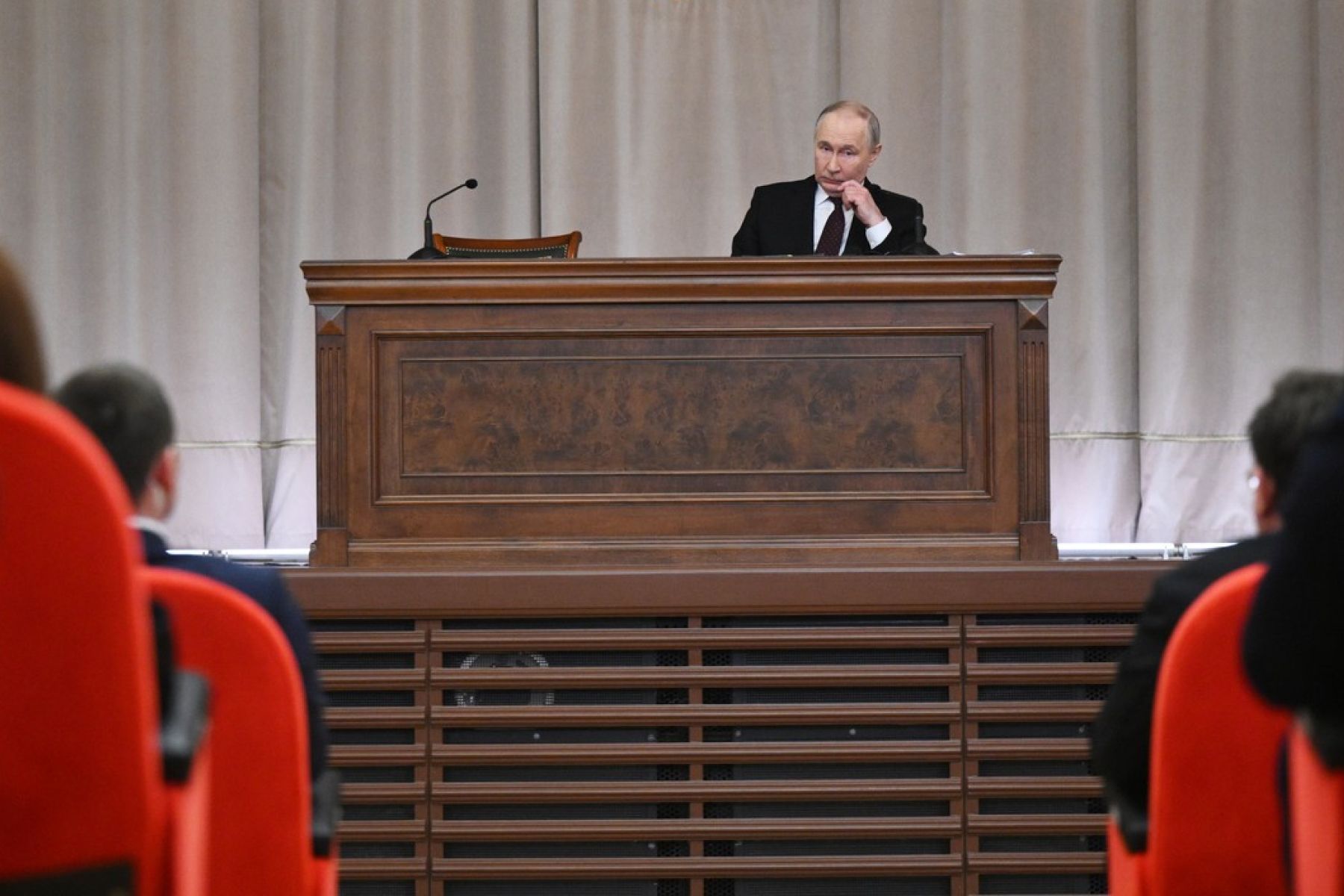
In 2026, dissatisfaction with the Putin regime reached its maximum. There is a split in the elites, and no one knows how to end the war. At the same time, the life of Russians is not getting better, but rather the opposite. The war has already actively come to the Urals, and in the meantime the FSB is breaking down the Internet in Russia, which was already blocked on all sides. Alexander Baunov, a senior fellow at the Carnegie Berlin Center for the Study of Russia and Eurasia, discusses how the authorities have once again violated their own unspoken agreement with society and what this may lead to.
In Russia, the composition of the air seemed to have changed or, if viewed from the outside, it became cloudy. Evidence comes from all sides. In social networks and in conversations on both sides of the border, images of the material and physical bottom are generously used. The recently invigorated businessmen are in a gloomy mood. Loyalists complain about bans and repression.
Everywhere there is undignified managerial chaos over trifles. The work of the editor-in-chief of RT suddenly appears among the candidates for a literary prize after the publication of the list, but the great Alexander Sokurov is invited to the Moscow festival for an award and is not awarded . The books of literary classics are plastered with threatening warnings, visually equating them to the works of “foreign agents.” The competent authorities publish long-term defense plans online, and it turns out that defense against enemy drones is planned in 2030. The “New People”, constructed on the knees of the AP, suddenly overtake the oldest Duma parties, only because they look a little less rabid.
Propagandists who celebrated victory three or four years ago, including over their acquaintances, are now rethinking their choice in interviews and video messages. The Tsar Bell of the Kremlin television broadcast reluctantly blared an apology to a model from a banned Instagram account.
In her address, Victoria Bonya claims that she knows the country’s problems better than the president, and no one among the general audience disputes this confidence. Of course it's better.
The Victory Parade is supposed to take place in Moscow, but there is no news of rehearsals, for which the center was previously closed for two weeks. Last year it was already April 23rd. From the parade, they report , there will be a walking version with a small number of personnel without equipment. Like collectors of car models - on a scale of 1:42. If we could, we would do a tabletop one. But the first person will be less likely to be on the podium in a known place at a predetermined time.
Heavy equipment has turned from a formidable weapon into clumsy targets not only on parade, but also in battle. Military correspondents collect electric scooters , hang the “loaves” with bottle boxes, but such equipment cannot be taken to the parade. You can bring in nuclear missiles - the last trump card, preferably uncharged ones.
It's primarily about fear. But also in the symbolic gap between the holiday and the real state of affairs. Everyone in Russia knows that winners are not judged. It turns out that we can judge not the winners. This process has already begun in relation to Vladimir Putin.
Are you angry about blocking? We understand! No one should tell you what to read or where to communicate. We are doing everything to help people in Russia maintain access to a free Internet. But we need your help. Dear readers not in Russia, we ask you to make a small monthly donation. We know there are hundreds more people who could do this. Dear readers in Russia, you also have the opportunity to support us. Together we will get through this.
Why Putin is becoming a liability
We are observing three related processes. The attitude towards Putin is changing, and economic optimism and the everyday patriotism associated with it, rejoicing in survival instead of development, are disappearing (thank you for being alive). Finally, people realize that it is impossible to win the war.
The symbolic milestone of 1418 days turned out to be fatal. The Russian regime drove itself into the chronological trap of the Second World War, declaring its opponents new Nazis, and placing its own mercenaries on a par with the soldiers of the Red Army. Now references to “a different nature of the conflict” do not work.
The entire state machine, media, government, parliament, church and intelligence services are still working for the same task - to hide Putin’s mistake made in 2022. But it's getting worse.
Putin is losing his magic power. Power is still undivided in his hands, but the magic of power is leaving. His real appearance also appears. People are increasingly noticing a slouching, bustling old man on thin legs with melted muscles under a saggy suit. The pre-war Putin with a naked torso on a black horse is now impossible to imagine. He jumped into the cauldron and got cooked there.
The speech changes to match the appearance - no longer regal. Once clear and, in their own way, menacing phrases also sag - they become rounded and confused, endless and sometimes meaningless. Often they run off in different directions from the topic. The grandfather from our yard, as expected, talks about politics, history and utility bills, but he does not immediately manage to express his thoughts. He embarks on impromptu retreats and negotiates to the point of complete fiction, like German soldiers who had no socks knitted in the rear. Or he talks about “foreign agents” who are not in danger in our country, as long as the sources of funding are revealed, although he himself recently signed a completely different law, and the reality is also completely different.
Putin is no longer a superman guarding the interests of ordinary people; he is more afraid of drones and the Internet than an ordinary person. He is confused and is no longer able to inspire confidence even in the representatives of the ruling elite. From a guarantor he turns into a burden.
How a new prosperity developed in Russia
The mood at the beginning of 2026 is strikingly different from that of a year ago. Russian society seemed to have come full circle from the darkest expectations of the beginning of the SVO through the euphoria of a survivor to a new cycle of doubts and fears. Even Putin's official rating has dropped noticeably.
Since the summer of 2022, people have been successfully getting used to the war. 2024 brought a mood of “everyday patriotism”, when after the first military shock, mobilization, departure of brands, departure of friends and celebrities, a wave of repressions and bans, Prigozhin’s rebellion, new prosperity emerged on the ruins of the old life. With it came a feeling of fragile calm and even optimism returned.
It turned out that Russia was not simply deducted from the world economy; the army failed the blitzkrieg, but returned from flight to the offensive. The ruble did not collapse uncontrollably, the state did not close the borders, and did not freeze deposits. Industrial growth, unemployment, and wages showed results better than pre-war forecasts. The Global South has not turned away, andrelations with Trump have returned Russia to the world of big diplomacy.
The regime has succeeded in imposing on society the feeling of one ship on which together they must survive or perish. It is impossible to sink the captain's bridge separately from the ship. The divergence of political language inside and outside the country, natural in times of repression, was inflated into contradictions not common in the history of other dictatorships. For many opponents of the war inside Russia, the historically dubious assertion that emigrants have no political future or even a present has become an axiom.
While "hard patriots" demanded more bombing, everyday patriotism rejoiced in the preservation of familiar forms of life despite the circumstances. Even for those opposed to the war, economic survival became a source of pride. So they and the war supporters had something like a common platform. In the spring of 2026, this general mood is no longer there.
How the authorities violated their own agreement with citizens
Having launched a full-scale aggression against Ukraine, the Russian regime destroyed previous compromises with citizens, but quickly offered them a new one: you can live outside of war, but you cannot be against war. For those who accepted the offer, the Russian regime was ready to allow a lifestyle as close as possible to the pre-war one. True, consent was not particularly asked.
This exchange was accepted by a huge number, if not the majority - some out of hopelessness, others out of sincere indifference to other people's troubles. The grievances of some Russians against Western companies in 2022 are indicative, when it was the West that became the source of disruption to the usual way of life.
By the spring of 2026, the Russian regime unceremoniously violated the terms of the compromise one after another. This time the source of discomfort was not strangers, but their own authorities, and this did not go unnoticed. Society agreed not to notice the war not at all in order to become the object of prohibitions and repressions. “Deceived, cheated!”
By introducing “Max” instead of the usual means of communication, the state literally unleashed the internal SVO: it rudely crossed personal boundaries, invaded the space of small communities - work colleagues, neighbors in the yard, family communication. The state’s official claim to foreign messengers is that they are opaque to it, which means that domestic ones are, by definition, transparent.
Residents of unfree countries are especially sensitive to the latter, because personal space is the only thing they have left after the state has seized public space.
Messengers are also an environment where people negotiate mutual paid services. The suspicion that the state wants to come for this money is reinforced by fiscal tightening in recent months, such as an increase in VAT from 20 to 22%, or by the fact that from July 1, banks will be required to indicate the TIN of participants in transfers in the fast payments system. Inflation dropped to 5.6%, but the subjective perception of rising prices and tariffs is completely different. It is based on receipts in stores and restaurants, and not on data from the Central Bank.
The country seems to be able to afford the current expenses for the war, but, as in public sentiment, there has been a reversal in the economy. The year began with the first budget sequestration in a decade, everyone was told to cut expenses.
Macroeconomic indicators indicate that Russia can afford the current level of military spending. Military growth no longer means increased income and opportunity. The tone of Putin's meeting on economic issues on April 15 was sharply different from the president's previous meetings with the economic bloc. Economists in the government, who recently felt more confident than the military, learned what it was like to be a Russian general. Negative growth of 1.8% for January-February, judging by the gloomy tone of the commander-in-chief, amounts to a retreat.
Why did Putin personally come under criticism this time?
After Putin returned to the Kremlin in 2012, many for some reason hoped that he would block the most odious initiatives of officials, maintaining the reputation of a reasonable ruler. The current internet shutdown has raised similar hopes—and equally futile.
Victoria Boni's performance was a truly turning point. Firstly, it was addressed directly to Putin, and not to lower-level bodies like Roskomnadzor, which means that the president himself was named as the source of the problems, albeit indirectly.
Secondly, the entire concept of the SVO was based on the fact that the president sits above the citizens and knows where the attack was being prepared from. The reversal completely reverses this construction. We, the people, know, but the president does not: neither about the Internet, nor about cows, nor about Tuapse.
It follows from this that he probably doesn’t know about the war, and didn’t know when he started either. Thus, the dictator’s dilemma was spontaneously discovered: by limiting information for others, he ceases to receive it himself and finds himself in the “Salazar” information bubble.
Meanwhile, Vladimir Putin confirmed that he personally approves of the restrictions. The painful conversation with a military communications operator at a festive meeting with women, in terms of the highest degree of coercion, was reminiscent of the dialogue with Sergei Naryshkin at a Security Council meeting on the eve of the start of the military military training. Putin literally forced his interlocutor to say that the telegram was dangerous for the army. As for Internet shutdowns, here too, according to him , “ensuring the safety of people is always a priority.”
The Russian leader is once again imposing the classic authoritarian trade-off of freedom for security, but the proven mechanism is stalling. People literally say: “Let there be drones, but let the Internet work.” The construct is laid bare: since citizens are willing to endure the dangers associated with their rights, whose safety are we talking about? They are offered to exchange their rights for the safety of the leader.
The feeling is growing that the blockages are not directed against enemies, but “against people.” At the beginning of the war, commentators on the pages of officials approved of punitive measures. Now the public greets the next acts of struggle against “traitors” with the phrases: “There are no other problems in the country.”
The red lines characteristic of authoritarian societies are most often formulated in the form of negative freedom: let those at the top do what they want, as long as they don’t touch me. The boundaries literally run along the threshold of the apartment and along the contours of the body. The classic barter of political passivity for private autonomy in modern Russia simply stops working.
The authoritarian USSR faced something similar when Yuri Andropov, without providing people with goods, tried to punish people for going shopping during working hours. Or during Mikhail Gorbachev's anti-alcohol campaign. And more recently, during the Covid restrictions, when even a real danger could not be exchanged for comprehensive restrictions.
How does the elite split manifest itself?
Victoria Boni's speech provoked a public split among the elites. Part of the civil bureaucracy clearly tried to take advantage of it to slow down the pace of prohibitions. Peskov said that the Kremlin knew about the appeal, and Kiriyenko’s subordinate Sergei Novikov even announced that “it is no longer possible to ban anything in Russia.” The curators of state media forced the militant Solovyov to go to peace.
Even Putin cautiously criticized those who are addicted to blocking. First, he recommended that the authorities better communicate with citizens, and then called on them “not to get hung up on prohibitions.”
What is unprecedented is not only the act of feedback at the highest level on the initiative from below, but also the cautious criticism of the first person towards the intelligence services, which Putin usually shields.
This looks like a win for the civilian bureaucrats. Most likely - temporary, on the eve of the Duma elections. The head of the regime, losing his balance, is trying to restore balance before the elections, but the security services are already taking people around Kiriyenko. They will inevitably continue to respond to the lack of success at the front with victories in their own rear. The power imbalance of the regime in wartime looks irreversible. But the regime doesn’t know how to end the war.
Why the real cause of all problems is fear
The real culprits behind the change in mood in Russia are not the intelligence services, rebellious bloggers, or rational elements within the ranks of the regime.
The successes of the Armed Forces of Ukraine forced the Russian authorities to break the compromise with the loyal majority, ready to ignore the war. And the Ukrainians' ability to hit targets deep inside Russian territory gave Ali Khamenei's assassination a particularly sinister meaning.
The Ukrainian military is carrying out sensitive attacks on oil plants, storage facilities and other facilities throughout almost all of Russia. Oil exports and military production have not collapsed, but the torches blazing from Ust-Luga to Tuapse create a picture of the inevitability of punishment, which, as we know, is more important than its cruelty.
Ukrainian resistance, combined with the revolution of the military-industrial complex, created a military stalemate and turned the front line into a kill zone. Military correspondents have even stopped demanding mobilization, because drones will now simply kill more people. The mistake of the First World War is being repeated, when armies fell into a technological gap and innovations like machine guns and barbed wire made the offensive spirit of previous wars meaningless.
The resilience of the Ukrainian civilian population, especially in winter, upset the Russian expectation of winning behind the front lines. Although the relationship between Ukrainians and the authorities has never been simple, citizens did not go to overthrow Vladimir Zelensky, but became concerned about buying generators.
Moscow’s expectation that the Western economy would collapse first in a head-on collision also did not materialize. The arena where Russia was preparing to demonstrate its advantages - military superiority and economic unsinkability - turned into a showcase of its vulnerabilities. Fear has become an all too prominent motive for the actions of the Russian authorities. The disappearing magic has to be replaced by coercion. Therefore, the Russian intelligence services are truly dizzy with their powers.
The outbreak of a major war in 2022 has forced elite groups to unite for survival. The uncertainty about its completion results in cracks in the foundation and ceiling of the regime, the entire building is distorted. Even if preserved, it will not look like itself.
Researchers who describe the end of political periods recognize this smell of extinction, difficult to convey in words. When the old power has not yet left, but has ceased to be perceived as natural, for granted.
They no longer want to lean on her as a source of strength. The authorities, in turn, rush to prove that everything is fine with them, fussing, accumulating mistakes, moving forward and backward, like a car skidding in the mud.
The system remains in its original place, but the perception shifts: it is “no longer the same.” A reversal in public sentiment is beginning, opening up the most unexpected possibilities, both attractive and scary. In Russia, a whole large literature of the beginning of the last century is devoted to this feeling. And perhaps another one will be dedicated this year.
Alexander Baunov