
Translated material
Empire as a crime scene. Kirill Kobrin - about how one junkie turned English literature upside down
Not long ago, Republic-Weekly released a special issue about detective stories. Today Republic publishes a dizzying essay by Kirill Kobrin about how Conan Doyle reinvented English literature by crossing detective stories with thrillers, why the 19th century ended with the first phrase from the story “The Man with a Cut Lip,” and how this half-forgotten story reflects all the problems of today. The essay's secondary characters are Stevenson, Oscar Wilde, Thomas de Quincey and the junkie Isa Whitney, with whom the 20th century began in world literature.
Purely metaphorically, the 19th century ended with the phrase “Isa Whitney, brother of the late Elias Whitney, D.D., Principal of the Theological College of St. George's, was much addicted to opium." This English sentence from Conan Doyle's story "The Man with the Split Lip" bears all the hallmarks of a verbose century, obsessed with cramming as much information as possible into any limited space - be it a novel book, a newspaper sheet, or even the title of an ordinary biographical dictionary of figures of a provincial principality:
"Famous people of Wales. A Bibliographical Dictionary of Eminent Welshmen, from Early Times to the Present Day, Includes Every Name Associated with the Ancient History of Wales, Compiled by the Rev. Robert Williams, a graduate of Christ Church College, Oxford University, and Perpetual Vicar of the parishes of Hlangadwaladr and Hridikroisaigh, both in Derbyshire; prepared for publication at Hlandovery, printed in London by Longman and Company in 1852."
The 19th century was insatiable, voracious for any knowledge that was considered useful, and everything was considered as such: you never know what could be useful? This century wanted to squeeze the surrounding world into itself, it swelled until it burst with a deafening roar - first in 1914, and then in 1917.
The 20th century began with the phrase “Isa Whitney learned to smoke opium.” In 1921, Marina and Nikolai Chukovsky cut off the late brother Elias, dean of the Theological College of St., who was unnecessary for further storytelling. George, leaving him in his time, when secular people were still interested in church positions. In the text translated into Russian, only the unfortunate junkie Aiza remained. Actually, we don’t need to know anything more about him, at least at the beginning of the story; We will learn some more details of Isa Whitney’s life along the way. Here they are, the calm pragmatism and serious lapidary style for which the 20th century was famous, at least for some of its main writers: Hemingway, Dobychin, Beckett.
I first read this story by Conan Doyle in translation; That’s why what remains in my memory is a good example of quiet modernist prose, and not one of those not very self-confident works that open up the shining horizons of a new genre. More precisely, they do not discover, but invent. Constructed from the material that is at hand.
However, first things first, as Sherlock Holmes loved. And Dr. Watson too.
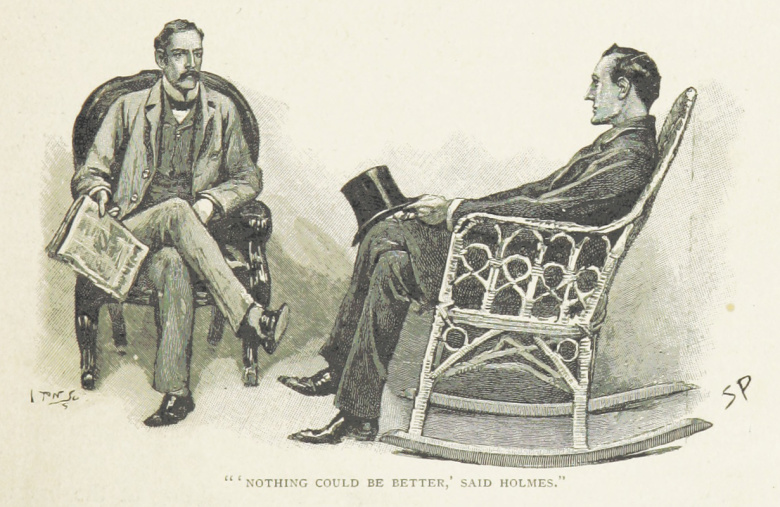
Illustration by Sidney Paget from Arthur Conan Doyle's collection of short stories, The Papers of Sherlock Holmes. London, 1894
The story "The Man with the Twisted Lip" was published - with illustrations - in Strand magazine in 1891; the following year, 1892, it was published in the collection of stories “The Adventures of Sherlock Holmes” next to such masterpieces as “The Union of Red-Headed People,” “The Speckled Ribbon” and “The Blue Carbuncle.” This is the first collection of stories about Holmes, a canonical book, which in its literary perfection (even if it is perfection of its kind) in the next century can be placed next to Joyce's Dubliners or Borges' Ficciones. An amazing collection of absolutely implausible incidents that happened to very strange people, many of whom today would be called freaks.
The operetta king of the non-existent kingdom of Bohemia fears the revenge of the fatal opera diva. An absurd red-haired pawnshop owner rewrites the Encyclopedia Britannica for a lot of money (thus anticipating Borges's Pierre Menard). A stepfather sets a poisonous snake he brought from India on his stepdaughters. Finally, the most comical thing, a parody of the Christmas story: a precious stone stolen on Christmas Eve is hidden in the craw of a fat goose, which a drunken bibliophile carries home to appease his wife who has abandoned him, but on the way he gets into trouble, loses the goose, which is picked up by an elderly messenger and for some reason brought - along with the lost hat of the drunken bibliophile - to Sherlock Holmes.
There is only one way to explain all this inexpediency, absurdity, utter nonsense - before us is literature written by a cheerful man with an excellent imagination, who is bored both in his social guise (a doctor, head of a family, house and practice in Norwich), and in his literature, no matter how beautiful it may seem to us today: Dickens, Trollope, Hardy, Tennyson and other Victorianism: a serious life and a very serious literature. Around the same time, several of Queen Victoria's subjects were planning an escape - no, not even an escape: they decided to reassemble their literature, put it back together so that it would not be boring (while leaving it serious). Wilde casually composed pieces that instantly became textbooks, the likes of which English literature has not dreamed of since the days of Shakespeare: light, strong, thin, as if made of titanium, immediately memorable forever. Stevenson discovered the treasures hidden by Captain Flint - and the sinister double that lives in the dark chaos of our lives, the second Self, Mr. Hyde. Conan Doyle smelled a magic potion, the incense of madness, in the fog of late Victorian London. Anyone who inhales it while walking somewhere along the Strand or near Waterloo station, the very next moment may encounter a short inhabitant of the Andaman Islands, the air tube bristling menacingly at his robe, the pouch tightly packed with deadly thorns.
All three were not English, all three were from territories once conquered by London: the Irishman Wilde, the Scots Stevenson and Conan Doyle. Typical imperial story. Wilde apparently took his Irishness quite lightly; he was an outcast on a different, non-national line. Stevenson was interested in politics, but mainly in Samoan affairs - the affairs of those islands where he settled several years before his death. But Arthur Conan Doyle, like Dr. Watson, was a patriot, an imperial and a servant; Not a single one of the wars fought by Great Britain since the end of the 19th century was spared his participation in one form or another. Even in the stories about Holmes, big politics peeked in several times, and these are not the worst stories.
Subscribe to read in full
Subscribe to Redefine.Media to read Republic
Subscribe [You can pay with a Russian or foreign card. The subscription is renewed automatically. You can unsubscribe at any time.]
Where does the subscribers' money go?