Translated material
Lower school of economics. “Margot has money problems”: we figure out how the series with Elle Fanning about the online fan turned out
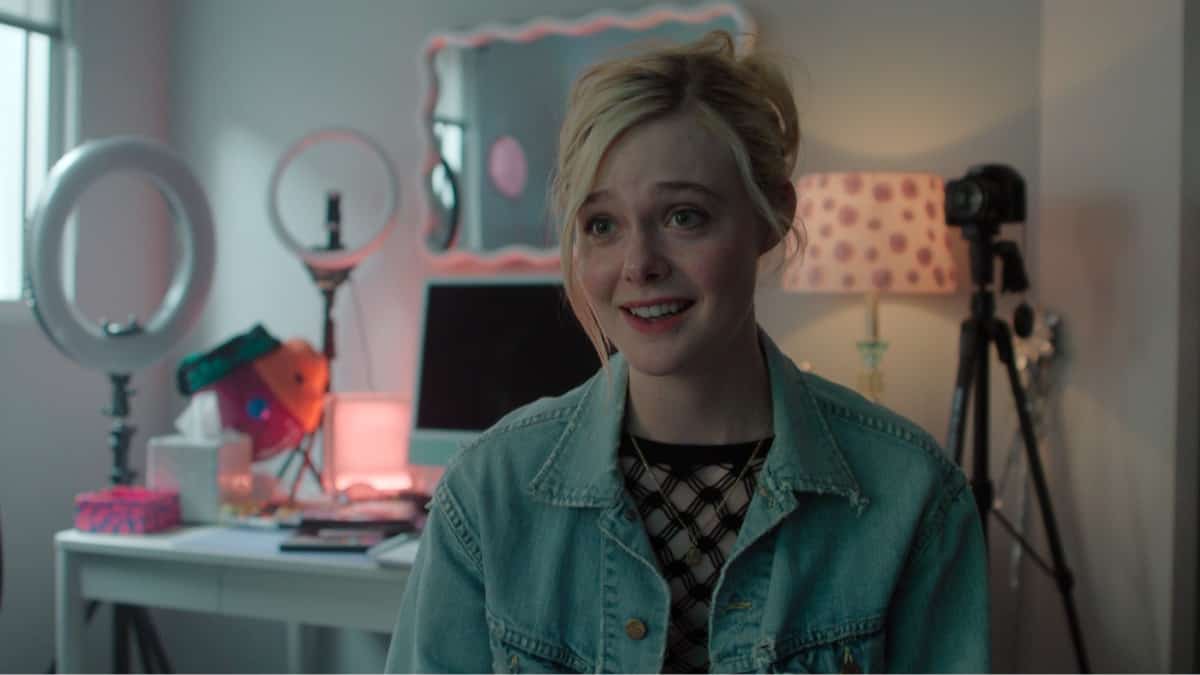
“Margot has money problems”: we figure out how the series with Elle Fanning about the online fan turned out
The comedy series “Margot Has Money Problems” from the creator of “Big Little Lies” and studio A24 is now airing serially on Apple TV+. Elle Fanning plays a single young mother who decides to make money on OnlyFans, while her mature, divorced parents try to restart their lives separately. Film critic Katya Stepnaya believes that the series “Margot Has Money Problems” is one of the best family dramedies in recent years, which wittily and honestly talks about the main pains of the young generation: poverty, social masks, the digital economy, broken families, single motherhood and sex work.
Young college student Margot Millett (Elle Fanning) impresses a married professor with the literary style of her essays and within a couple of weeks is basking in his bedroom under a waterfall of compliments about her beauty and intelligence. As soon as the pregnancy test shows two lines, the teacher disappears into a quiet haven with his wife and children. Margot, who lives with three neighbors, is preparing to give birth alone. She is criticized, but still supported by her mother Shaenne (Michelle Pfeiffer), a once upon a time Hooters waitress who also raised her daughter alone. Her dream is to settle down with a strange and pious control freak (Greg Kinnear) and this time stay married for the rest of her life. Margot's father, wrestling legend Jinx (Nick Offerman), has just come out of rehab: it's all because of strong painkillers after fights, from which he eventually switched to heroin. Now he asks his adult daughter to accept him and give him a chance. At a time when two out of three roommates are disgustedly moving out from Margot, who has given birth, the girl decides to register on OnlyFans to pay for breast formula and diapers. Her initial plan is to rate other people's dickpics using her literary talent and charge $20 for comparing dicks to Pokémon.
Margot Has Money Problems is not a satire on sex workers, but a portrait of an era where everyone is forced to sell some version of themselves to the public.
American culture loves stories of victory and success, but in recent years there has been an obvious awkwardness with them: too many have found themselves working three jobs, renting an apartment with roommates well into their thirties, and instead of saving for a car, they are saving for a dentist.
Hollywood finds itself in a strange situation: filming stories about rising to the top is almost indecent, but talking about poverty, illness, homelessness and debt is another trigger for already fucked-up viewers.
Typically, poverty in genre films looks like a temporary nuisance, much like rain in a romantic comedy: the heroine will cry under the canopy of a bus stop, and twenty minutes later she will meet the love of her life and move into an apartment that even a workaholic lawyer cannot afford in real New York. The series “Margot Has Money Problems” produces an unexpected effect because it understands and explains a simple thing: Margot has problems with money not because she has not yet found herself, but because now everyone has problems with money. The manager of a marriage agency in “Materialist”, the courier spinning like a squirrel in a wheel in “Lucky”, the bankrupt millionaires in “White Lotus” and the museum curator in “What a Drama!”

Ruth Thorpe's dramedy novel fell into the hands of David E. Kelly, a veteran of American television, the man who invented Big Little Lies and half the television neuroses of wealthy America. Now his signature satirical style confronts not the rich people on the California coast, but those who can't pay for food. It’s funny to watch until the moment you realize that almost everything that happens has ceased to be hyperbole.
Margot Millett is a student who becomes pregnant by her literature teacher, gives birth to a child alone, loses her job, and quickly comes to the conclusion that the American economy does not offer many ways for young mothers to make quick money. Such a description could easily turn into a sanctimonious morality tale about the fall or a glossy fairy tale about a girl boss who got it right the first time.
But OnlyFans is neither a symbol of liberation nor a tragedy, but a dreary sex work: nervous, unstable and emotionally draining, like many works of the digital age. And unsafe.
The modern Internet sells not only sex and objectification, but also a sense of access. Margot quickly understands the main rule of the platform economy: people pay not only for photos, but also for the illusion of intimacy. You need to respond to messages, maintain flirtations, act approachable, and constantly produce a version of yourself that others can emotionally consume. TikTokers, streamers, influencers, bloggers, coaches, authors of telegram channels and the media industry are engaged in similar selling of themselves: personality has become a micro-enterprise, and charisma has become a way to pay the rent. In this sense, Margot is not an exception, but a heroine of her time. In the age of emotional capitalism, OnlyFans takes this system to a frighteningly straightforward level. “Sister, save the vagina pictures for an emergency. We sold them for three dollars: that was a waste of a vagina!” - More experienced online fans warn Margot.

It is no coincidence that the storyline of Margot’s father, a retired wrestler, is built into the series. At first, Jinx's character seems like a parody: he spent his entire life in the carnival costume of American masculinity and found himself with permanently torn muscles, addiction and no roof over his head. Gradually, the series shows that Jinx anticipated the fate of Margot: wrestling was TikTok and online life long before the advent of the Internet. Wrestlers have lived within the attention economy for decades: creating characters, creating story arcs, selling emotional involvement to the public. Everyone is learning to be watchable and casting themselves around the clock. "Margot Has Money Problems" honestly shows the cost of this system - in the form of a young woman who responds to the senders of dickpics while a child cries on the bed nearby.
The most valuable thing in “Margot Has Money Problems” is tenderness. The series could easily become a cynical satire, where everyone monetizes each other and no one loves anyone. Instead, it turns out to be a story about a found family: a sweet roommate, a confused mother in a panic before the wedding, a father after rehab, online girls who help you take the first step. People here annoy each other, disappear, give bad advice, behave childishly, sometimes horribly, but keep coming back for second and third chances.
“Margot has money problems” is a phrase that in old Hollywood would have meant the beginning of a hilarious adventure. In the series, this name feels like point A, from which Margot will not go far, no matter how hard she tries.
But, as the wisest poor and the most conscious rich like to say, “the most valuable things are not things.” Some people understand this while crying on a huge yacht, and others - when a prodigal dad or roommate offers to sit with the child while you fall asleep on the move.