
Translated material
Didn't violate, but punished
The Constitutional Court refused to respond to the failure to implement its own decision

Head of the Yabloko branch in Tatarstan Ruslan Zinatullin. Photo: "Apple"
The Constitutional Court of the Russian Federation refused to consider the complaint of the head of the Yabloko branch in Tatarstan, Ruslan Zinatullin, against the interpretation by the police and the courts of the norms of two laws, which allows punishing citizens contrary to the legal position of the Constitutional Court itself. Noting: yes, this practice is illegal, but there is no need to reconsider the case.
The entire “violation of the law” on the part of Zinatullin consisted in the fact that on February 1, 2025, during an agreed picket in defense of freedom of speech and the press, he held a poster with the inscription: “Konstantin Smirnov is a journalist, not a criminal.” Novaya Gazeta talked about the “Smirnov case”. A well-known journalist from Ryazan, chairman of the regional Yabloko, has been in jail since January 1 last year on charges of extortion.
Smirnov does not admit guilt, believing that he is being persecuted both for his independent journalistic activities (he ran the popular publication “Side View” in the region), and for the fact that, as a deputy of the Dubrovichesky rural settlement from Yabloko, he actively opposed municipal reform and participated in public hearings on the issue of liquidation of rural settlements.
The police detained Zinatullin, accusing him of allegedly violating the regulations of a public event. Namely, it has nothing to do with its stated goals: the problems of freedom of speech and press.
Zinatullin explained what he had, and the most direct one - Smirnov was being persecuted for his journalistic work. But the security forces ignored this argument, and the Vakhitovsky District Court of Kazan found him guilty under Part 8 of Article 20.2 of the Code of Administrative Offenses of the Russian Federation (violation of the procedure for organizing or holding rallies, demonstrations, processions and picketing) and fined him 250 thousand rubles.
The Supreme Court of Tatarstan, the Sixth Court of Cassation of General Jurisdiction and the Supreme Court of the Russian Federation left this decision unchanged. Meanwhile, it completely contradicts the legal position that the Constitutional Court previously formulated!
In November 2018, the Constitutional Court issued a ruling “On the refusal to accept for consideration the complaint of citizen Igor Yuryevich Prosanov about the violation of his constitutional rights by paragraph 2 of part 2 and paragraph 2 of part 3 of article 6 of the Federal Law “On meetings, rallies, demonstrations, processions and pickets.” And it indicated that the legal regulation of public events established by this law “cannot be considered as allowing the symbols and other means of public expression of an individual opinion used by a participant in a public event to be recognized as prohibited by the legislation of the Russian Federation solely due to their inconsistency with the goals of the public event.”
And that “only the actions of organizers or participants of a public event can be recognized as violating the legislation of the Russian Federation when they behave destructively, in particular, they clearly intend to commit or, moreover, commit any actions that threaten public order and (or) public safety.”
In other words, even if campaigning at a public event really diverges from its stated goals, this is not a violation. You can only be held accountable if public order is violated. But not for the poster.
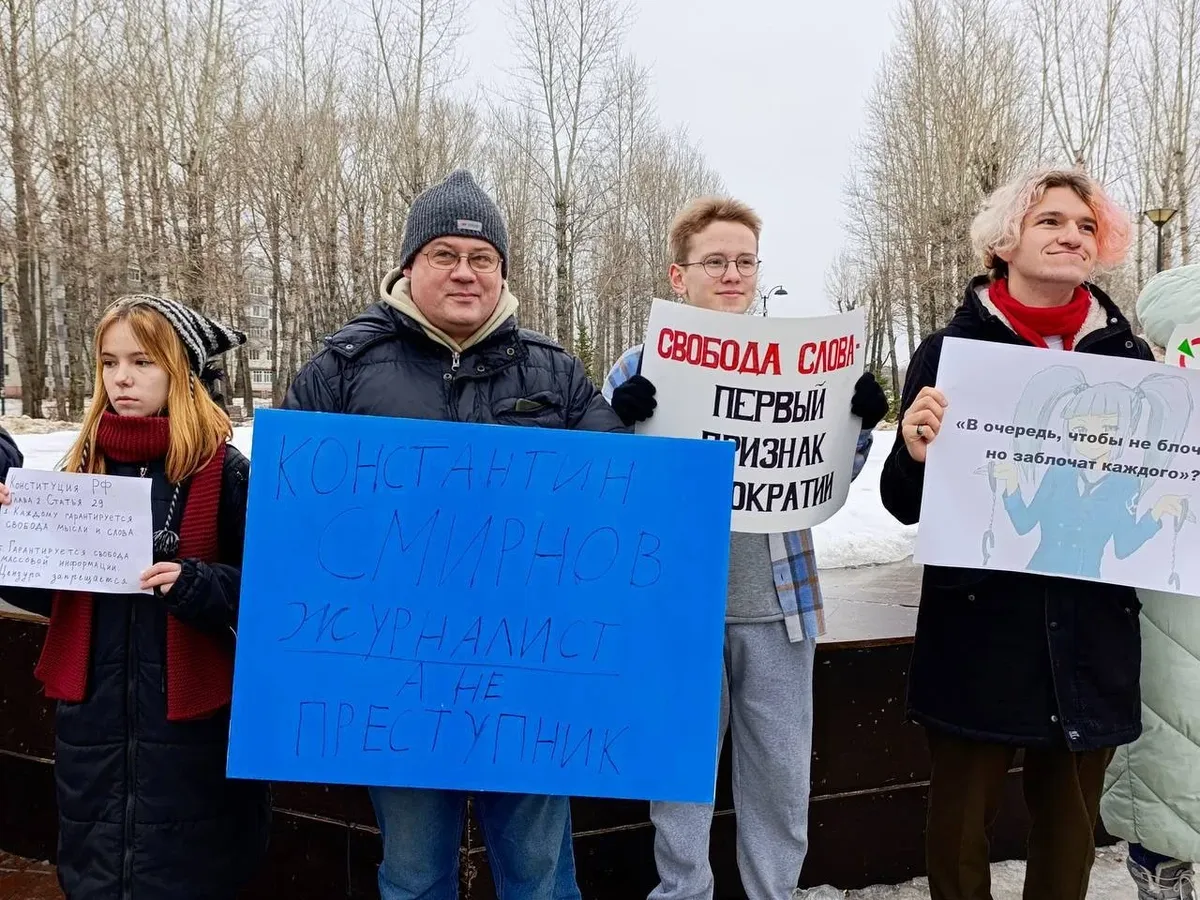
Zinatullin’s poster itself did not violate anything: there was nothing destructive, extremist or otherwise illegal in the text of the poster. And the court decisions in the case do not say that the text violated any laws. And no evidence was presented to the courts that the text on the poster “does not correspond to the stated goals”: neither examination, nor opinions of specialists - only subjective assessments of law enforcement officers.
Zinatullin was fined solely for the “inconsistency” of the poster with the “stated goals.” Contrary to the position of the Constitutional Court, which is generally binding for all government bodies, including the courts.
The courts of general jurisdiction were obliged to know about this position of the Constitutional Court. And if you forgot, you could remember: starting from the second court instance, Zinatullin directly referred to it in his complaints. But the judges, as can be seen from their decisions, ignored this argument.
In his complaint to the Supreme Court of the Russian Federation, Zinatullin left this as the only argument, and even printed it in a disproportionately large font - he believed that it was impossible to ignore the reference to the definition of the Constitutional Court. I thought in vain: Supreme Court Judge Kuzmichev also pretended that there was no such argument in the complaint.
There was only one thing left - to appeal to the Constitutional Court itself, which Zinatullin did. In addition to the above, the complaint stated that the law does not provide for preliminary approval of symbols and other means of visual propaganda used in public events.
But judicial practice allows them to be recognized as “not corresponding to the stated goals of the event” without any evidence. Simply because the police and judges think so.
Does this correspond to Article 31 of the Constitution of the Russian Federation? Of course not, the complaint says, since such enforcement is not just excessive, it is not aimed at implementing the constitutional right of citizens enshrined in this article, but, on the contrary, at preventing the implementation of this right. And it also allows for the imposition of fines comparable in size to criminal ones for actions that in no way impinge on public order and safety. Although Chapter 20 of the Code of Administrative Offenses deals only with those acts that “encroach.”
The Constitutional Court was asked to recognize certain provisions of Federal Law No. 54-FZ “On meetings, rallies, demonstrations, processions and pickets” and the Code of Administrative Offenses as inconsistent with the Constitution - to the extent that they, in the system of current legal regulation, allow for administrative liability solely for “non-compliance of campaigning with the stated goals of a public event.” And recognize the need to review the court decisions and rulings made in the Zinatullin case.
The response from the CC was surprising. In its ruling, the court repeated that it is impossible to prosecute only for “non-compliance with goals”, but said that the provisions of Federal Law No. 54 and the Code of Administrative Offenses themselves “cannot be regarded as violating the constitutional rights of the applicant.” And that “the assessment of the correctness and validity of judicial acts in a specific case, including the establishment and examination of the compliance or non-compliance of the used means of expression with the goals of the agreed public event, is not within the powers of the Constitutional Court.”
Firstly, the Constitutional Court was not asked to recognize the laws as unconstitutional. He was asked to recognize the unconstitutionality of their interpretation by the judges.
Secondly, the court writes that it is not its business to determine whether Zinatullin’s poster corresponded to the theme of the picket or not. But according to his earlier position, this has no legal significance at all! Meanwhile, the Constitutional Court itself indicates in this definition that Zinatullin was punished solely for “non-compliance.”
And thirdly, the Constitutional Court confirms that the law was applied by the courts contrary to the meaning of the constitutional norm, but does not indicate the need to reconsider the case. He admits that court decisions contradict the constitutional meaning of the law, but says: sorry, we can’t help, since the courts of general jurisdiction do not take our position into account.
An amazing observation: why then is the position of the Constitutional Court needed, if in courts of general jurisdiction it can be safely ignored? The danger of the ruling is that in subsequent judicial practice all this may be repeated.
Because ordinary courts are shown: even if you make a decision that contradicts the position of the Constitutional Court on this issue (that is, illegal), it will not be reviewed.
Vladimir Maksimov