
Translated material
Little victorious war
Little victorious war
A fragment of a chapter from the book “The Tsar in Person.” How Vladimir Putin deceived us all"
This year, the book “The Tsar in Person” by Roman Badanin and Mikhail Rubin is being published in translation into several foreign languages. The authors have made additions to the new edition, which are now available in Russian in an electronic version. The main thing is that the book now has a chapter on war, which now completes the part called “Kindness and Courage.” Vladimir Putin's courage is an important narrative of Russian propaganda, which has spent years inventing myths about his fearlessness. We publish a fragment in which the authors refute some of these myths.
Roman Badanin, Mikhail Rubin
Read the entire chapter in which we describe why Vladimir Putin needed to invade Ukraine in the electronic version of the book “The Tsar in Person.”
“When I was studying at intelligence school, one of my characteristics was written down as a negative trait: “Reduced sense of danger.” And this shortcoming was considered very serious,” Putin said, not without coquetry, in his first biography, Natalya Gevorkyan, Andrei Kolesnikov, Natalya Timakova. First person: conversations with Vladimir Putin, 2000 ×
, after which he repeated this story many times.
Over the ensuing decades, Russian propaganda has unearthed everything about the president that could make him look good, and lied on top of it. But she was unable to present the characteristics of a reduced sense of danger to the public. In order to highlight the president's courage, as a rule, two stories were used. You've probably heard about them. Now you have to find out that they are largely false.
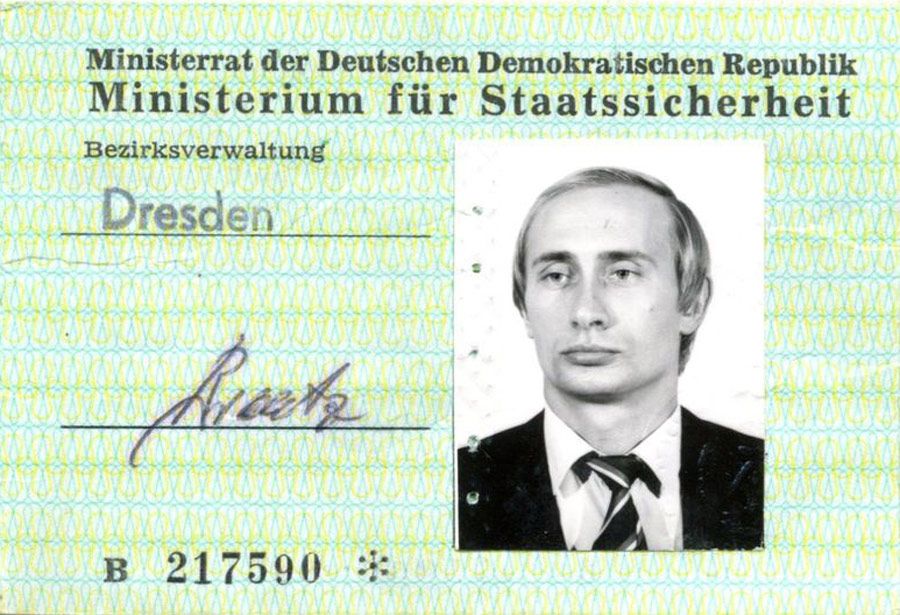
The end of 1989 - the German Democratic Republic is living out its last months. Already at the beginning of next year, the governments of the GDR and the Federal Republic of Germany begin negotiations on the unification of the two countries. The GDR officially ceased to exist in October 1990 ×
. In Dresden, where Putin serves, there are massive street protests. People also break into the building of the Ministry of State Security (this, by the way, will help save part of the secret service’s archives from destruction), and then go to the KGB station.
Russian propaganda will call the episode that followed the “deed” of the young Lieutenant Colonel Putin, who (while his superiors were at a loss) remained in the building behind the elder and was forced to “go out to the crowd.” These events, as presented by servile journalists, have become overgrown with so many legends that now there are at least three contradictory versions. For example, in the 2012 version, viewers were told an almost biblical parable. 5 thousand “drunk Germans” allegedly burst into the KGB courtyard, then Putin went down to the crowd along 12 steps with a pistol, which had 12 rounds of ammunition, and said: “I am an officer, I have 12 rounds of ammunition, I will leave one cartridge for myself, but, fulfilling my duty, I will shoot,” after which he slowly climbed up the same 12 steps, turned around and found that the crowd had begun to disperse. Program Andrey Karaulov “Moment of Truth” / Channel Five, October 1, 2012 ×
. The authors of this nonsense were not even embarrassed by the fact that the standard magazine of the Makarov pistol, which was in service with KGB officers, contained 8 rounds.
Probably, such symbolism even seemed excessive to propaganda, and in the 2018 election film about Putin, Putin. Film by Andrey Kondrashov / Russia-1, 2018 ×
TV crews decided to add evidence. In the film, a resident of the house next to the KGB building named Siegfried Dannat-Grabs speaks. For example: Resident Putin is remembered in Dresden / NTV, October 15, 2006 ×
: There were no five thousand besiegers; Putin was not going to shoot back personally, but he scared the crowd by ordering the building’s guards to defend themselves with weapons in their hands. However, the president himself immediately appears on the screen and spoils everything: according to him, he introduced himself to the crowd as an interpreter. For what? Out of fear or for conspiracy purposes? And most importantly: how could the translator give orders that scared the crowd? As has already happened, the most honest version of events can be found in the earliest source on this topic - that very first biography of the president from 2000 by Natalya Gevorkyan, Andrei Kolesnikov, Natalya Timakova. First person: conversations with Vladimir Putin, 2000 ×
.
Putin said there that he actually went out to the crowd, introducing himself as a translator, but did not threaten anyone, and, having discovered that people were aggressive, he simply called the headquarters of the Soviet group of forces asking for help, which, however, did not arrive for a long time due to the confusion of Moscow. The crowd dispersed not because of his words, but only a few hours later, when the military finally arrived at the scene. “I then had the feeling that the country no longer existed. It became clear that the Union was sick,” was how Putin interpreted his experience in Dresden.
It’s funny that the myth of Putin, who disperses a crowd of enemies with one word, echoes an earlier apocrypha about the same actions of Yuri Andropov. The future head of the KGB and the Soviet state in 1956 found himself in an unpleasant situation in the rebellious Hungary, where he then served as ambassador. The streets of Budapest were restless, the crowd dealt with Hungarian state security officers and communists. Andropov’s motorcade either came under fire or lost momentum for some other reason, and a group of Soviet diplomats had to cover some distance around the city on foot. The historiography left by colleagues and members of Andropov’s family described this episode in a heroic manner: “He walked with a firm gait, even at a leisurely pace,” and when the path was blocked by a group of rebels led by a “tipsy boy,” he “stepped towards him, and the guy instinctively took a step to the left, the crowd behind him parted, and we walked out of the ring along a very narrow corridor.”
How it really happened is now unlikely to be figured out by anyone, but there were definitely not bravura memories of those events. Different versions of what happened are given in Nikita Petrov’s book “The Time of Andropov,” 2023 ×
. Putin could not have been unaware of this dramatic episode in the career of his predecessor. Even ordinary people were aware that Andropov’s wife Tatyana, having seen enough of the Hungarian unrest, developed a nervous breakdown and, as a result, a lifelong addiction to drugs. Andropov’s marriage de facto broke up: the woman was in neurological hospitals, and Andropov, like Putin much later, appeared everywhere without his wife.
Years will pass, and Putin will unwittingly give himself away. In October 2011, rebel Libyans brutally killed their dictator Muammar Gaddafi, much of the bloody scene caught on video. Speaking at a press conference a few days later, Putin admitted that he had seen the horrific footage and was clearly frightened by it. “It’s impossible to watch without disgust,” said the Russian dictator and immediately found the culprit... in journalists Putin: it’s impossible to look at footage of Gaddafi’s murder without disgust / RIA Novosti, October 26, 2010 ×
. The media should not have shown the massacre of his former colleague in the global club of dictators. So Putin has probably more than once imagined his potential meeting with ill-wishers in a situation where there is no security nearby.
The second episode, invented by propaganda to highlight Putin’s courage, took place on the night from the first to the second millennium AD. Only the appointed acting The President of Russia flew to Chechnya on New Year's Eve, where the Russian army was fighting. According to the plan, Putin’s helicopter was supposed to land in Gudermes by 12 midnight, where everything was ready for the meeting. However, due to bad weather conditions, the plane was forced to land in Makhachkala, a city located several hours away from its destination. This path had to be covered by car, and as a result, Putin celebrated the New Year on the road, and arrived late to the military - this is how journalists of those years described this trip. Vladimir Putin described his first trip as acting. President of Russia made a trip to the North Caucasus / ORT, January 1, 2000 ×
. Naturally, if something dangerous had happened then, the Kremlin would not have failed to once again promote Putin before the presidential elections. But even Press Minister Mikhail Lesin, a professional boaster, who flew with Putin, did not find anything heroic in that business trip: “We actually flew over Grozny. Despite the fog, a glow was visible. People continued to fulfill their task” Natalia Gevorkyan. Person liable for military service / Businessman, January 5, 2000 ×
.
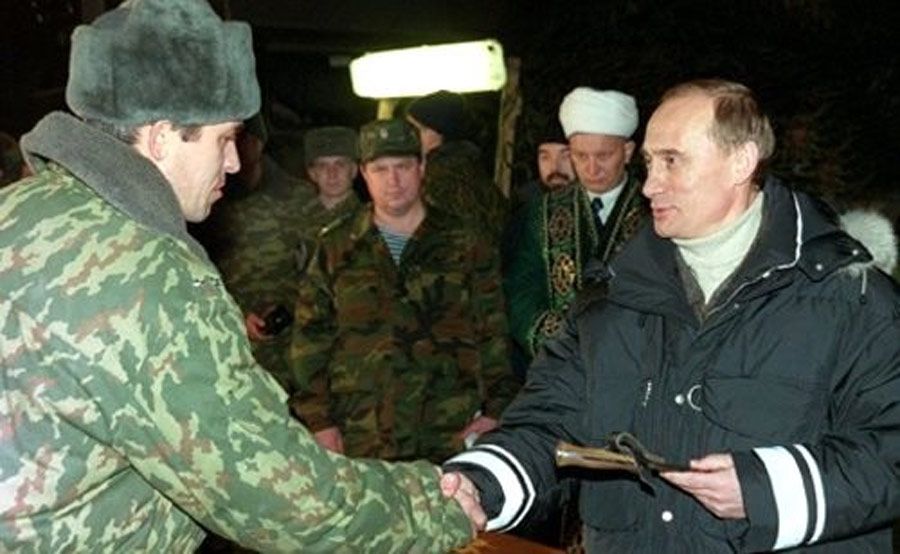
However, 18 years later, when Putin was already serving his fourth term, events in Chechnya began to look different. The president himself, giving an interview for a pre-election film about himself, suddenly announced: the helicopter was attacked by militants and therefore did not land in Gudermes. Immediately, Igor Sechin, then Putin’s secretary, appeared in the frame, like a jack-in-the-box, and caused even greater horror: not only did the militants fire at the helicopter, but they also mined the road along which Putin’s car was driving, “a landmine went off.”
We asked an official who worked closely with Putin at the time if he had heard about these incidents. “No, I would know,” he answered dryly.
Already during the war with Ukraine, the Kremlin repeated this trick. In August 2024, the Ukrainian army, desperately trying to distract the Russian army from advancing on its territory, managed to suddenly invade the Kursk region. For the sake of liberating the territory captured by the Ukrainians, the Kremlin spared no one: both conscript soldiers and even military personnel from North Korea took part in the battles. After about nine months, the Ukrainians were driven abroad. Soon, on May 20, 2025, Putin paid a demonstrative visit to the Kursk region.
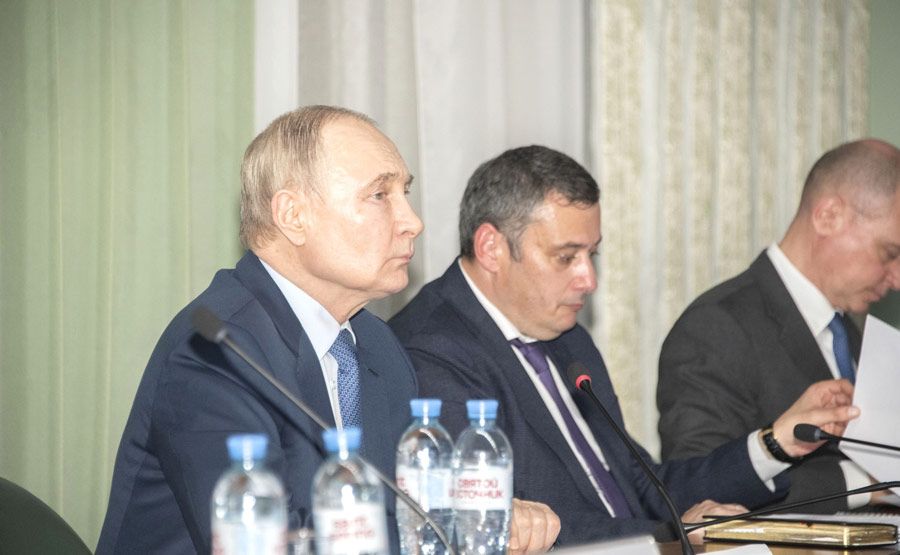
Another five days will pass and state media will report that Putin’s helicopter, flying to Kursk, “got into the epicenter of repelling the attack” of Ukrainian drones. Trip to the Kursk region: Putin’s helicopter was at the epicenter of a UAV attack / Russia-1, May 25, 2025 ×
. The authorities did not present any footage of the “attack,” but the media soon found out: the Kremlin once again made it up. The Ministry of Defense’s statement about Putin “at the epicenter of a drone attack” turned out to be a Kremlin production / The Moscow Times, May 30, 2025 ×
. After another seven months, Russian authorities will report a new “attack” on Putin: allegedly on New Year’s Day, 91 Ukrainian drones tried to attack the presidential residence in Valdai for 13 hours. Abstracts of the briefing by the head of the anti-aircraft missile forces of the Russian Aerospace Forces, Major General Alexander Romanenkov / Telegram channel of the Russian Ministry of Defense, December 31, 2025 ×
. Again there was no evidence.
Read the continuation in the electronic version of the book “The Tsar in Person.”
How to buy a book
The book by Roman Badanin and Mikhail Rubin “The Tsar in Person. How Vladimir Putin deceived us all" can be purchased on the publisher's website.