
Translated material
Lonely voice of a man
Irina Petrovskaya - about Vladimir Molchanov. Instead of an obituary. Very personal

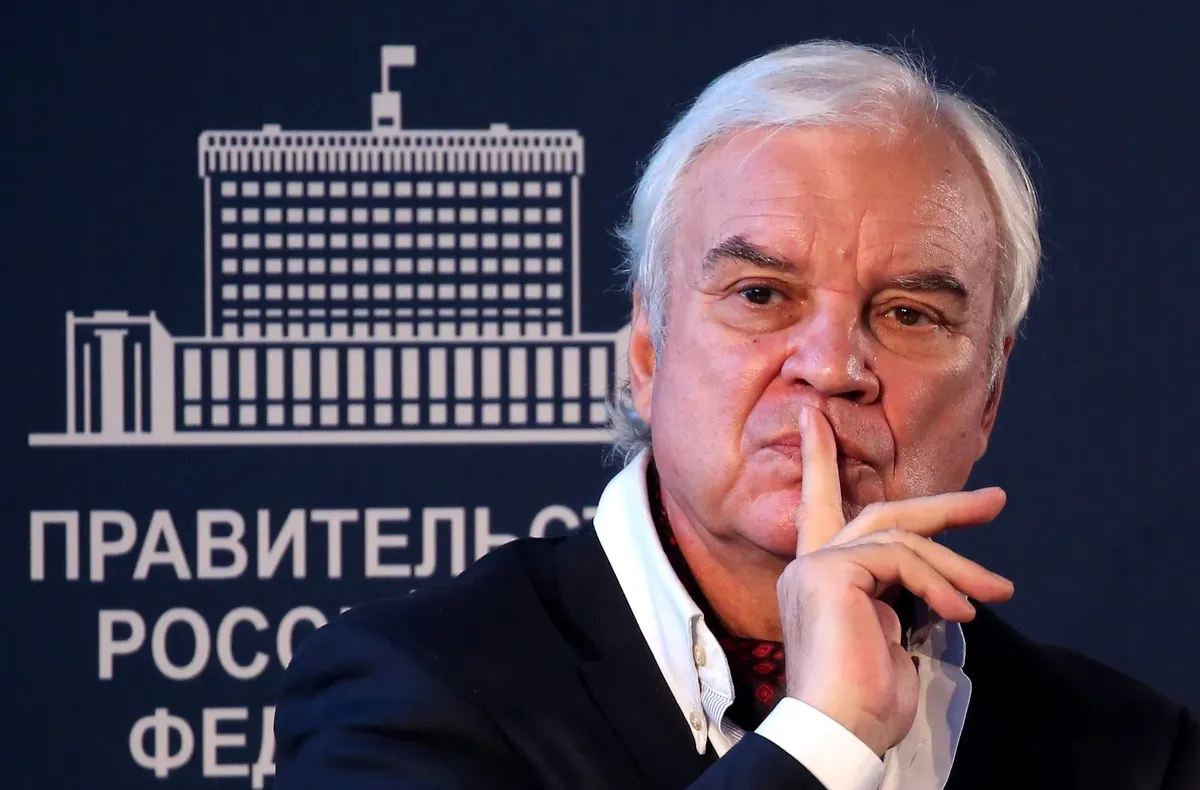
Vladimir Molchanov. Photo: Alexander Saverkin / ITAR-TASS
I remember very well the day when I saw Molchanov, as they say, live: August 23, 1991. Why do I remember so precisely? Because the putsch had just failed, and I was sitting in the reception room of the editor-in-chief of the Vremya program, Olvar Kakuchai, where I came to ask him about the work of the editorial office during these dramatic three days.
The office door finally swung open, and out came... Vladimir Molchanov. Like all television viewers in the country, I not only adored him, but also got used to seeing him in a different guise - in an impeccable suit, bow tie and with his signature: “Say, prince.” And now some other Molchanov stood in front of me - in faded jeans, a stretched sweater, and to top it all off, with a Belomorina - it later turned out that all his life, while he was smoking, he preferred cheap Belomorkanal cigarettes to all other tobacco products, which, frankly speaking, did not really fit with his aristocratic image and appearance.
However, I was surprised not only by his unusual appearance, but also by his very appearance within the walls of the State Television and Radio Broadcasting Center. After all, just three months ago, at the end of May, Molchanov said goodbye to viewers live and voluntarily left TV “due to unwillingness to participate in your activities” - this is how he formulated the reason for his departure in a statement addressed to the chairman of the State Television and Radio Broadcasting Company Leonid Kravchenko.
In January, after the Vilnius events, Molchanov refused to host the “Time” program when he was forbidden to talk about what was happening in the capital of Lithuania. But he devoted his other program “Before and After Midnight” entirely to these events. Those were the times. You can't do it here, but you can do it here.
And soon he went to the Donbass, where he shot the film “Slaughter” - about the monstrous conditions in which miners live and work. It was with this film that Molchanov ended his career on TV, and literally a few hours after its broadcast, one of the mines that Molchanov was filming and where, by the way, he himself went down together with the miners exploded. “More than 70 people died, that is, this was confirmation of the horror that we showed...” he said.
I wrote both about the film and about Molchanov’s departure from TV in the Ogonyok magazine, where I worked then. That’s why I dared to approach him and meet him, meeting the editor-in-chief of Vremya in the reception room. In live communication, Volodya, as he immediately demanded to be called, turned out to be completely devoid of stellar, excuse me, fanabery. And in general, all this “stardom” was alien to him - he communicated equally naturally with celebrities on air and with hard workers in a pub, where he filmed one of his most famous stories. He was sincerely interested in all people. It is surprising that ordinary men also accepted him as one of their own and talked as equals, although Molchanov in an elegant light raincoat seemed like an alien in the surroundings of a shabby and smoky pub.
During the August putsch, he photographed the streets of Moscow, barricades, Muscovites who came to defend the White House, confused soldiers on armor, and then the arrested members of the State Emergency Committee - Defense Minister Yazov, KGB Chairman Kryuchkov. His film “Three Days and Two Nights” can still be found on the Internet today.
The new head of Gosteleradio, Yegor Yakovlev, first of all returned Molchanov and other fired or resigned presenters to the air. However, he himself did not last long in a leadership position - a little more than a year. And soon Volodya went to REN TV, where the great Irena Lesnevskaya, in the hope of creating the TV of her dreams, gathered the best of the best under her wing: Molchanov, Rost, Ryazanov, Nikulin, Gorin, Filatov...
The last time we saw Volodya was at farewell to Irena Lesnevskaya. Her TV and her dream were squeezed out of her long ago; she had been seriously ill in recent years and left on New Year’s Eve. On December 28, very few television people gathered at the Vostryakovsky cemetery, where the farewell took place.
Not a single one of the TV bosses appeared at this mournful ceremony at all, as if fearing that Irena, even dead, would ask bluntly: “Why are you guys so foolish???” And Molchanov, also already seriously ill, could not help but come. We hugged. We didn't see each other again. And we won't see you now.
I am re-reading our correspondence with him over recent years. Now that Volodya is gone, I will allow myself to publish some of its fragments. I kept dreaming of talking to him on the air of our YouTube channel “BUT. Media from Russia". In July 2024, in response to my invitation, he wrote: “Hello, Irochka, I’m more or less. Now there are no two main companions of my life who raised me, sculpted me, scolded me and worked with me - Chata ( the wife of Consuelo Segura - I.P. ) and sister Anya ( Anna Dmitrieva, an outstanding tennis player and TV sports commentator - I.P. ) , who, as promised, waited for me from Israel from my creative evenings, we spent two days together, I told her everything, and on the third day she died. After that, I went to the village to visit my children and avoid other communication... I received an invitation for the next nine evenings in the cities of Israel in December and, which somewhat puzzled me, but slightly brought me out of my stupor, an order for a small book of 70-80 pages, related to memories of anything, but mainly about childhood, youth, that life, people who left a mark on my life... So I sat on the veranda, I don’t go anywhere, I don’t go with anyone I communicate, and occasionally go to Moscow for procedures. So don’t be offended by me, I’m not in the shape to communicate right now, especially via video. But in the fall, when I finish the manuscript and edit a 100-minute video for a program in Israel, I’m ready to appear before you and show my haggard face.”
But it didn’t work out either in the fall or in the winter. Volodya was either sick or away for a short time. On May 29 last year, he flew to Israel with creative evenings and an offer from a YouTube channel.
Sheinkin40 will make a series of programs for them with the same legendary name “Before and After”. On July 1, he wrote to me: “Arrived on May 29, worked five evenings, then non-stop descents to the bomb shelter. But I filmed 18 programs, 30 minutes each, and I hope to finish editing them tomorrow. Every time, even in the bomb shelter, I filmed a little on my phone - as a keepsake, since this (the war) was my first and, I would like, the last time... I was terribly tired, but somewhat revived.”
At the end of July I asked again if I had rested after a difficult trip and if I was ready for the meeting. “Almost rested. Yesterday I rested in intensive care, then in surgery, now in therapy. Post-Israeli departure.
I was less stunned by my condition than by the abomination of the ambulance that took me for 80 thousand from Ruza to Moscow, they said a lot of warm words, and obviously they leaked to journalists all my diagnoses, which I never disclosed even to close friends. It's terribly disgusting.
I had to block 32 unknown numbers today, so they found the phone of Anya, my daughter. Look what she sent me: “And don’t even think about approaching unknown numbers!!! The media have already called me with a question: Anna, this is Life.ru, your dad is on the verge of death, can you comment?” High level of journalism."
So our meeting was postponed over and over again. I wrote to him when the Sheinkin40 channel began showing his magnificent “Before and After” series. “Hi, Irochka, thank you for such attention. I didn’t expect that something would work out for me with a YouTube channel where I had never worked. But they called, and I took a risk. True, then, after filming during the war, bomb shelters and nerves, I found myself in illness for a long time, from which I still haven’t gotten out of to this day. There is still almost no voice. But I’m glad that I managed to depict and remember at least something “on the road.”
And almost the last - after my review of this 18-episode series of his. “Irochka, hello! I was sent your touching review at the start of my program. Thank you! Due to my technical stupidity, I still don’t really understand how to watch this YouTube. But from time to time someone sends me my program and even comments on it. And then they sent you. ...To be honest, once upon a time this was much more pleasing. The drive passed a long time ago and is irrevocable. In addition, this damn voice never returns (although the doctors believe it will), depriving me of the opportunity to communicate, film, or perform somewhere. But I’m not used to sitting in a cage, counting the steps I’ve taken during the day and stupidly doing nothing. That's why the mood is sad. But thank you! Dispelled it a little...” I tried to encourage him: “If the doctors think so, it means he will come back!!! Let's believe! How are we without your magical voice? No way!"
Probably, it would be necessary to explain to those who did not catch Molchanov in his best times on TV about what he himself, his program “Before and After Midnight” and the documentary films he shot meant to many people who revered him for his talent, honesty, nobility and dignity. But in the mournful days of farewell to him, a lot will be written and said about this. And you can find his series “Before and After” on the Sheinkin40 channel. Volodya talked there a lot about time, about himself, and about his work and life - before TV, on TV and after TV. He joked - “on the road.” It turned out he wasn't joking. Foresaw.