
Translated material
Behind closed topics
How the Venice Biennale showed the world the whole of Russia. Summing up

Performance in the Austrian pavilion at the Venice Biennale. Photo: AP / TASS
Art, whether modern or eternal, rests, as we know, on an image, on a symbol. That is, the ability to compress the surrounding reality so that it all fits into something compact - a portrait, a sonata, an installation or an object of video art. In this sense, the Venice Biennale achieved something that no work of art of any kind had been able to achieve for a long time: neither literature, nor cinema, nor theater, nothing - in three days it managed to show the world the whole of Russia. Not as a state and territory, but as a community - as it is now, no worse, no better.
It seemed that the last four days had turned every Russian-speaking intellectual into an expert on contemporary art. There is probably little point in describing in detail the hurricane in the media and Facebook*, which did not subside throughout the second half of May and drowned out rare remarks about Victory Day, but the genre requires context.
In general terms: for the first time since the outbreak of hostilities, Russia took part in the Biennale of Contemporary Art in Venice - a kind of “Olympic Games” for artists from all over the world. Twice - in 2022 and 2024 - the country, for obvious reasons, did not go to Venice and, as those who follow this “Olympics” were sure, should not have gone for a long time. And yet, the 61st Biennale showed that the window to Europe is still not completely caulked - at least, the windows of the Russian pavilion into the Venetian Gardens (Giardini) were definitely not caulked (the commissioner of the Russian pavilion is Anastasia Karneeva - the daughter of former FSB general Nikolai Volobuev, who, together with the daughter of Foreign Minister Sergei Lavrov, Ekaterina Vinokurova in In 2016, she founded the company SmartArt, specializing in sovriska).
And Russia, which for four years had been demonstrating with all its might its deep hostility towards Europe, now rushed to Venice with poorly hidden pride, and Italy greeted it with the usual southern hospitality. It soon became clear that it was in vain.
Now this biennale is called the most scandalous in history - and this is a very serious accusation, given that its history dates back to 1885, and it survived the years of World War II and the Cold War. Ministers from 22 countries issued a note of protest against Russia's participation this year, and an open letter with more than 10 thousand signatures was sent to the President of the Biennale, Pietrangelo Buttafuoco. The European Commission took away a grant of 2 million euros from the biennale, and Ukraine imposed personal sanctions against Karneeva. Artists and authorities in many countries protested not only against Russia’s participation, but also against Israel’s participation, and in the end, five days before the start of the biennale, the entire jury resigned.
And yet, on May 6, the Russian pavilion opened its doors and windows in Giardini - the media wrote about this event in formulations worthy of ranking with “negative growth”, “claps” and all the other newspeak of recent years: “The Russian pavilion opened in a closed format.”
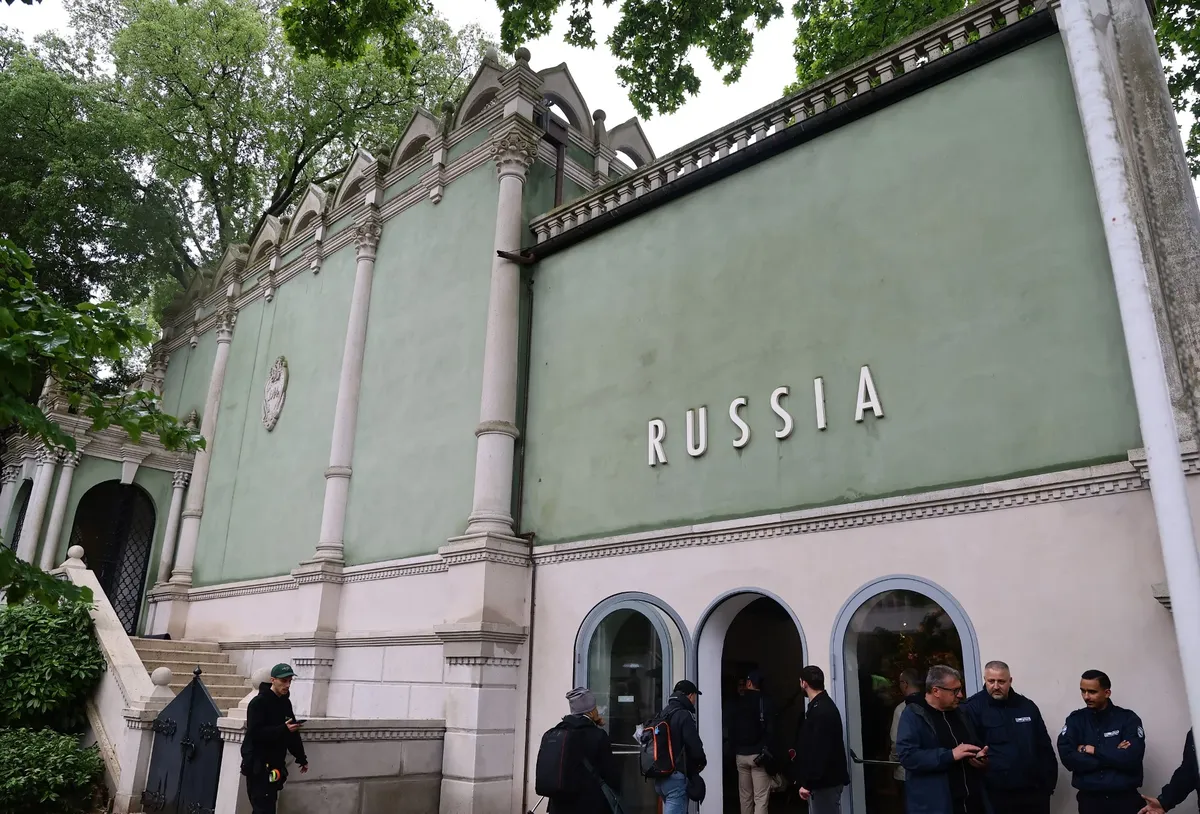
After the end of the “program for our own” - in the first days only the press and VIP guests were allowed into the biennale - the pavilion was closed completely: it was announced that visitors would be able to look at contemporary Russian art from the outside via broadcast. But the past four days were enough for the scandal to become even louder: during the closed opening, under the windows they protested against the participation of Russia, Putin and the fighting of Pussy Riot**, surrounded by clouds of pink smoke and in pink balaclavas, and half-naked activists of the Ukrainian movement Femen with slogans on their chests. Photos from the action spread all over the Internet - and showed the world not only that Pussy Riot have gone through an amazingly short creative path since the action in the Cathedral of Christ the Savior, but also that, it turns out, even now there is still a way of speaking out that is still capable of uniting Russians and Ukrainians. It was hard to believe in the second after 2022, but art, whatever it may be, still really unites.
Finally, another reason for protest was found: on May 2, Russian and Italian cultural figures addressed the president of the Venice Biennale with an open letter against the participation of director Alexander Sokurov in the conference - again closed - called “Dissent and Peace.” The letter was signed by 37 people: artists, gallery owners, directors (including Oscar-winner Pavel Talankin***) - and referred to the fact that Sokurov’s dissent, in their opinion, was not expressed clearly enough. One of the signatories, Sasha Skochilenko, was immediately reminded that Sokurov, supposedly unworthy of being a “voice of dissent,” actually went to see her in court, but there were no comments. Sokurov's performance was canceled - either (according to the organizers) due to his “unavailability”, or (according to his own formulation) due to logistics problems and non-flying aircraft.
The director responded to all this with a truly biblical tone, close to “Forgive them, for they do not know what they are doing.” And the oppositionists, measuring each other's purity of conscience, finally quarreled.
After three days of reading all kinds of opinions and reviews, the most comprehensive reaction, in the subjective opinion of the author, was the reaction of Novaya Panfilova columnist, who on the very first day gave a medically accurate diagnosis to all this: “Contemporary art has left the pavilion.”
And this is true: what happened these days inside the Russian pavilion may have been art, but it certainly did not reflect today’s Russia and hardly said anything about its future. Knowledgeable people write that Russia actually brought quite talented musicians to the biennale, and traditional folk laments about the triumph of death and rehashes of the folk song “A green garden blossomed at our gates” from the Sudzhansky district sounded good. Maybe - the quality of musical performance, unfortunately, is beyond the author’s competence (the position of the sujans is within the competence, and the author knows that the performance of their songs in Venice did not help them much). Otherwise, the pavilion gave a rather cemetery-like impression: decorated in a very Moscow way - flowers everywhere - it did not make any movement and did not say anything, only sang about death.
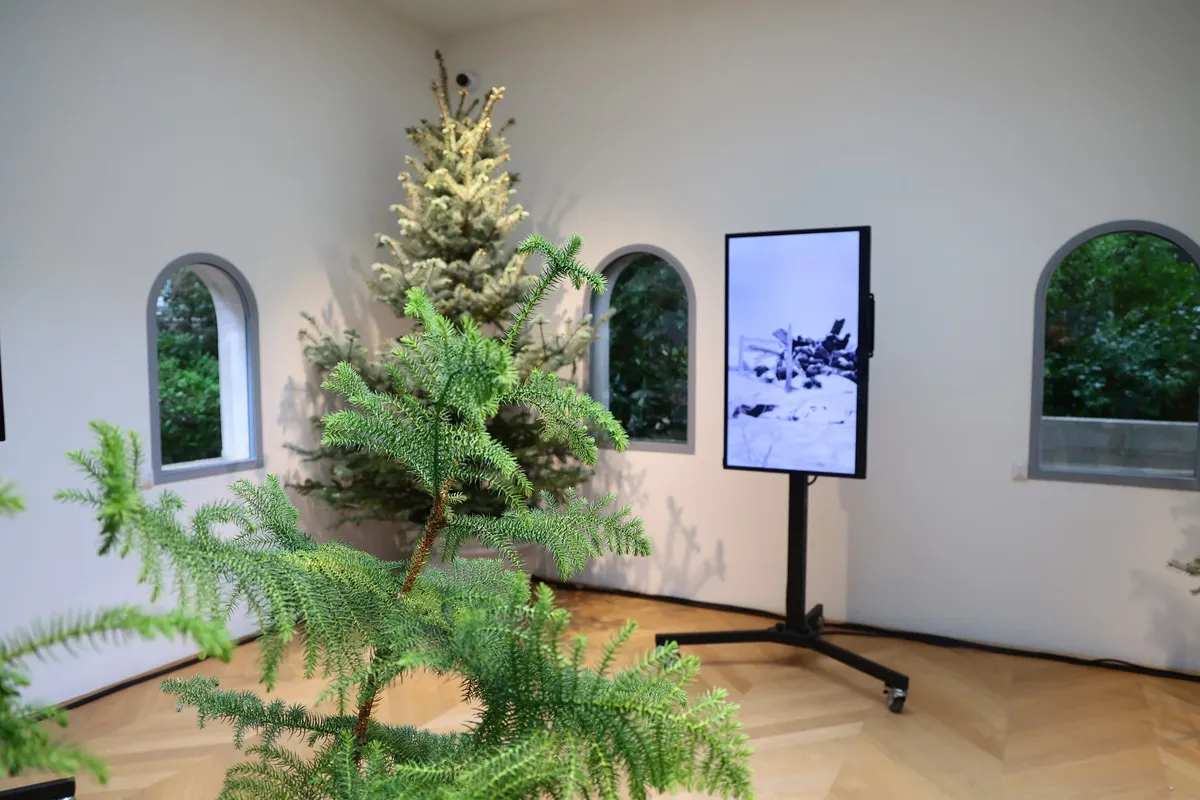
The ordinary Christmas trees in plastic buckets on the second floor of the pavilion - in a small hall dedicated to the indigenous peoples of Komi and Tuva - looked especially heartbreaking. The dedication consisted of the fact that on small screens flashed footage of a winter plain, swept by a blizzard, on which a Tuvan woman was either raking snowdrifts with her hands, or interviewing a horse (apparently, for lack of a more worthy interlocutor). All this should probably be described in high academic vocabulary with the obligatory terms “decolonization” and “anti-imperialism” included, but in fact it had little to do with either one. Just a video (the cheapest art object that does not require transportation costs), just Christmas trees in buckets and just Tuvans and Komi in folk costumes - a rich culture, once again not explained, but popularly reduced to a snowdrift and a plague. In addition, it was switched to “silent” mode.
All this was presented under the promising title “The Tree Rooted in the Sky.” Promising - because it was a quote from Simone Weil. Her latest treatise, Rooted: An Introduction to the Declaration of Duties to Man, was recently translated and published by Ivan Limbach Publishing House. It was this context that promised so much: in the text, Weil says that a person’s duties towards another person are higher than his rights, although rights are sacred. She writes that each member of society “has a single and constant duty: at the level of his responsibility and to the extent of his power, to help any person in all mental and physical hardships that could destroy or cripple his earthly life. <…> The needs of a human being are sacred. Their satisfaction shall not be subject to considerations of state, or to considerations of money, nationality, race, color, or to the moral or other value ascribed to the person concerned, or to any other condition.
The only legitimate limit to the satisfaction of one person's needs is the needs and needs of other people."
Even in his treatise, Weil says that the need for truth and freedom of expression is the same natural need as the need to eat and drink, and that in the field of thought there should be no pressure at all and no restrictions, that any propaganda should be completely prohibited. And also - that depriving a person of a profession, or historical memory, or homeland is a crime, because a person, like a tree, needs to take root.
In short, Weil’s treatise is a manifesto of humanism and pacifism, and one could expect something from a curatorial program that risked quoting from such a text (even keeping in mind that the entire program was agreed upon with all the top brass and approved personally by Shvydkiy). Expectations were not met.
Here, by the way, it is interesting to remember that the now canceled Alexander Sokurov, who participated in the biennale in 2020 - that is, for the last time before February - created a work there that speaks much more about our today than the herbariums in the pavilion and pink balaclavas outside its walls. In 2020, he and his students installed a sculpture in the black pavilion hall based on Rembrandt’s painting “The Prodigal Son”: father and son were separated and surrounded by a video in which cities were blazing with hellish flames, bloody rivers were flowing, and people were walking across scorched fields, from whom fire flowed instead of blood. Sokurov's prodigal son looked around with an expression of indescribable horror, and could no longer return to any father, and there was nowhere to expect forgiveness. It’s not for nothing that they say about the biennale that its purpose is to talk not so much about now, but about tomorrow.
And now the “round table” dedicated to dissent and peace issues, cleared of all those who knew about both first-hand, judging by the video broadcast, sounded no less funereal: smooth, streamlined, safe and glossy. Alberto Barbera, curator of the film program, showed a timeless classic - Charlie Chaplin's speech from the film The Great Dictator, calling for peace and unity. Wong Shu and Liu Wenyu, curators of architecture, spoke about Chinese gardens as a symbol of harmony and resistance to the usual worldly chaos, Willem Dafoe read poetry. Choreographer Wayne MacGregor talked about caring for the human body, which in miniature reflects all global conflicts and wars, Caterina Barbieri ended with a smooth musical composition with a powerful soothing potential. All. At this point the closed conference closed, but in short speeches in Italian, Chinese, and English, the Russian trained ear managed to catch the usual Aesopian speech:
It was no longer in Russia and not in Russian that people far from political persecution learned to dodge sensitive topics, speak in hints and wink: “But you and I understand everything.” Divide topics into closed, semi-closed and open in a closed format. Talk about peace and remain silent about war.
And then an exhibit was taken out of the Kazakhstan pavilion that referred to the theme of Soviet political repression (a typewriter that wrote denunciations, from which red threads spread out in all directions like streams of blood). And then in the St. Petersburg Manege they opened an exhibition in red, white and black colors with a huge head of a soldier in an iron helmet pulled down over his burning eyes, and someone compared it to a scene from the film “Kill the Dragon.” And everyone began to joke that this is what the real Russian pavilion at the Biennale actually looks like.
On May 9, Victory Day, the doors of the pavilion in the Giardini closed, leaving the audience - both those standing nearby and those who watched everything through screens and kilometers - with a feeling of complete moral failure. Venice really showed us all of us. Artists with authority, demonstrating their own independence, but at the first call rushing to fit into any context. Protesting actionists, unable to invent a single new creative move in fifteen years, but making other people's death and war their profession. Masters whose work is already being studied in universities, but who still, it turns out, are not completely white for some and not black enough for others - and therefore do not fit into any group or crowd, but sadly and quietly repeat only: “All this is bitter, all this is hard.”
Venice again showed the absolute inability of those fighting for the title “Voice of Conscience” to stop gnawing at each other’s vocal cords. She indicated from afar the names of those whose names are raised on banners the higher the more beautifully they died, but whose voices were not heard and remained.
She showed an ancient building with the inscription Russia above the entrance, with doors closed from outsiders, from behind which could be heard buried cries and the clinking of glasses. And all this - in clouds of glamorous pink smoke.
Not a single curator, not a single director could have composed a more visual, more comprehensive program. More precisely, one smog is the best of directors, who always prefers to remain anonymous.