
Translated material
Coming out of the darkness
What data on payment systems in Armenia tell us
Photo: Alexander Patrin / Kommersant
The gradual emergence from the shadow of the Armenian economy is probably one of the main results of the 2018 revolution. Thanks also to this process, the country’s budget revenues and expenses were more than doubled in just six years, and in terms of GDP growth rates the country regularly shows one of the best results in the world. The rapid development of non-cash payments played an important role in the fight against the gray economy.
In this article we will try to trace the main stages and trends in the development of non-cash payments, based on statistics from the Central Bank of Armenia on transactions with plastic cards.
The kingdom of cache and how to part with it
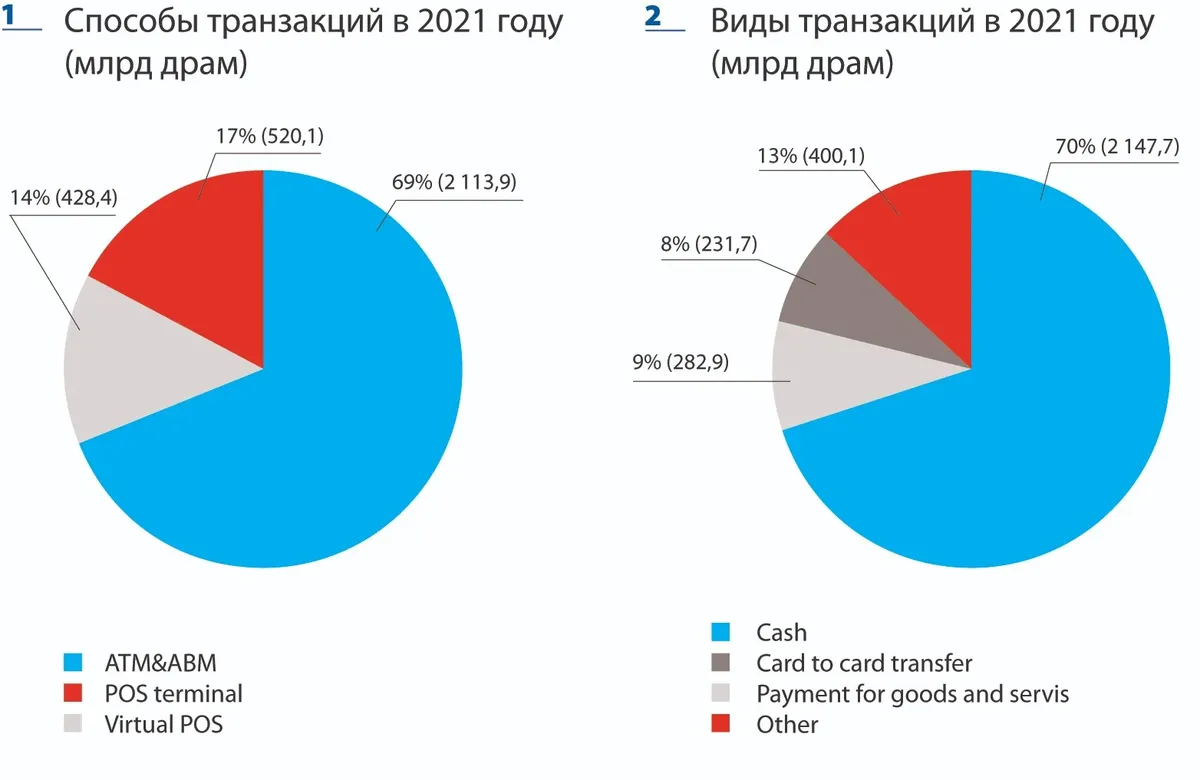
Let's start our story in 2021, when the total turnover of transactions within the country using cards issued in Armenia has already exceeded 3 trillion drams.
True, even this year the overwhelming volume of transactions (69%) was carried out using ATMs, and the share of payments through payment terminals was only 14%. Another 17% of card turnover was done through virtual terminals. The distribution of transactions by type of payment looked similar: cash withdrawals accounted for 70% of the turnover, and payments for goods and services accounted for only 9%. The situation is, to put it mildly, grayer than gray. (See graphs 1 and 2)
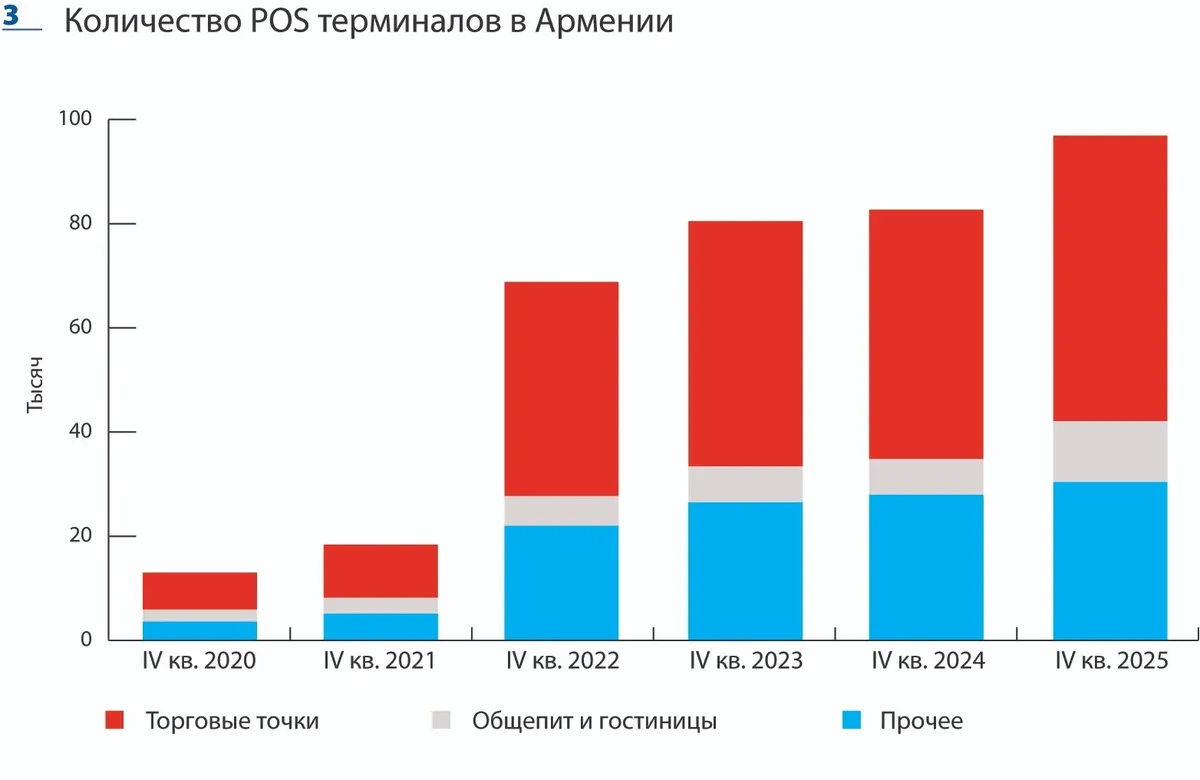
And so, on January 18, 2022, a law was adopted that strictly regulates non-cash and cash payments in the country and obliges entrepreneurs using cash registers to ensure that card payments are accepted. On July 1 of the same year, the law comes into force, and the number of payment terminals per year grows more than three times, and in retail outlets more than four times! By the end of 2025, there will already be five times more terminals than at the end of 2021. (See chart 3)
The result of such global changes in the payment infrastructure may seem modest at first glance. In 2025, the share of transactions made using ATMs, although significantly reduced, continued to account for almost half of the total turnover (49%). The share of transactions through payment terminals increased only to 19%. But this is only at first glance.
Firstly, during this period the volume of card transactions more than doubled and amounted to almost 6.5 trillion drams, which is already a good step towards whitening the economy.
And secondly, look at the dynamics of payment for goods and services through terminals. In 2022, volumes doubled, in 2023 they doubled again, and in 2025 they were already 6 times higher than in 2021. (See chart 4)
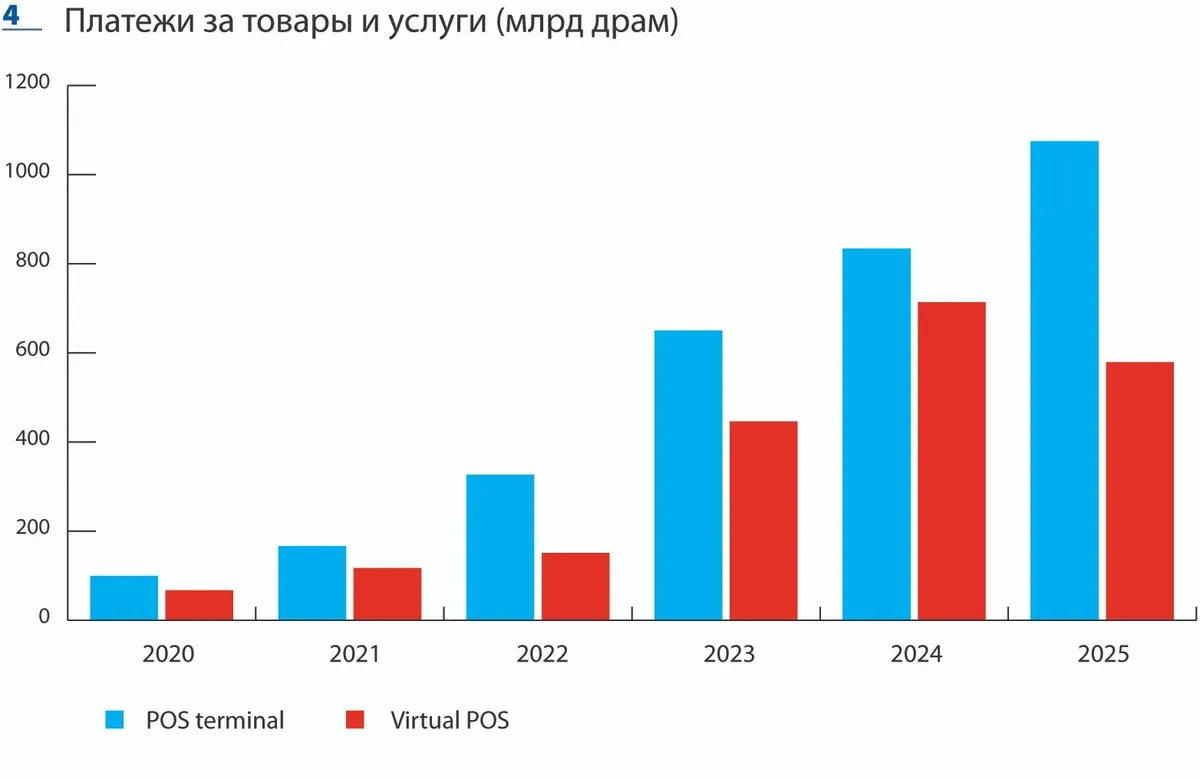
Electronic payments for goods and services grew at almost the same rate - a fivefold increase even after the fall in 2025. And these are only payments within the country, excluding payments for goods on foreign marketplaces.
As a result, if in 2021 one dram spent from bank cards to pay for goods and services accounted for 7.6 drams of cash withdrawn from an ATM, then by 2024 the value dropped to 2 drams.
You can also calculate the ratio of all conditionally “gray” and conditionally “white” payments, adding transfers from card to card and “other” transfers to cash, and payments for utilities and settlements with the budget to payments for goods and services. (See chart 5)
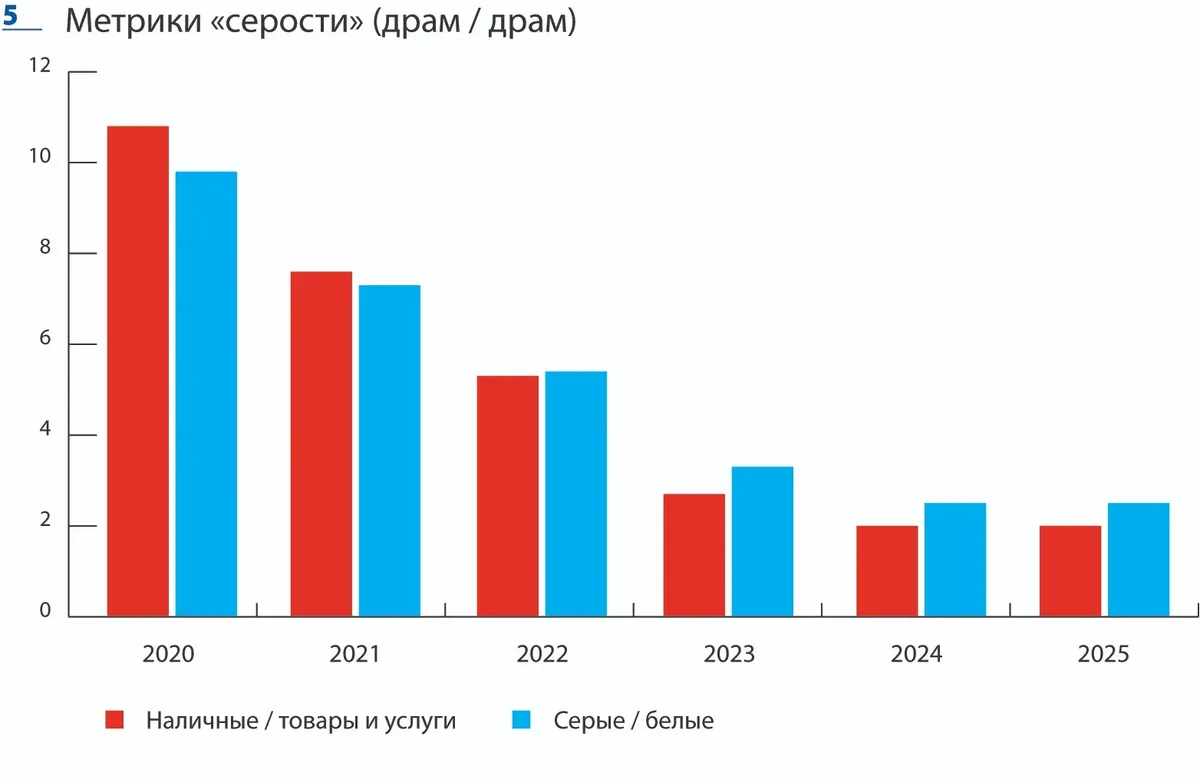
In addition, in parallel with the government, the Central Bank of Armenia has actively joined the process of increasing the transparency of payments. Thus, from July 1, 2024, the requirements for identifying clients when depositing funds onto cards through ATMs have been significantly tightened. As a result, turnover from such operations decreased by more than 10 times from the peak values in 2023. Following this, although not for long, the turnover of transfers from card to card decreased significantly.
In general, success is clearly evident. But the attentive reader probably noticed in the last graph a clear lack of progress in 2025 compared to 2024. Perhaps this was one of the reasons why the government decided to radically expand the experiment with ArCa maps.
ArCa Maps
First, let's look at what role ArCa played in the country's card payment volumes. (See chart 6)
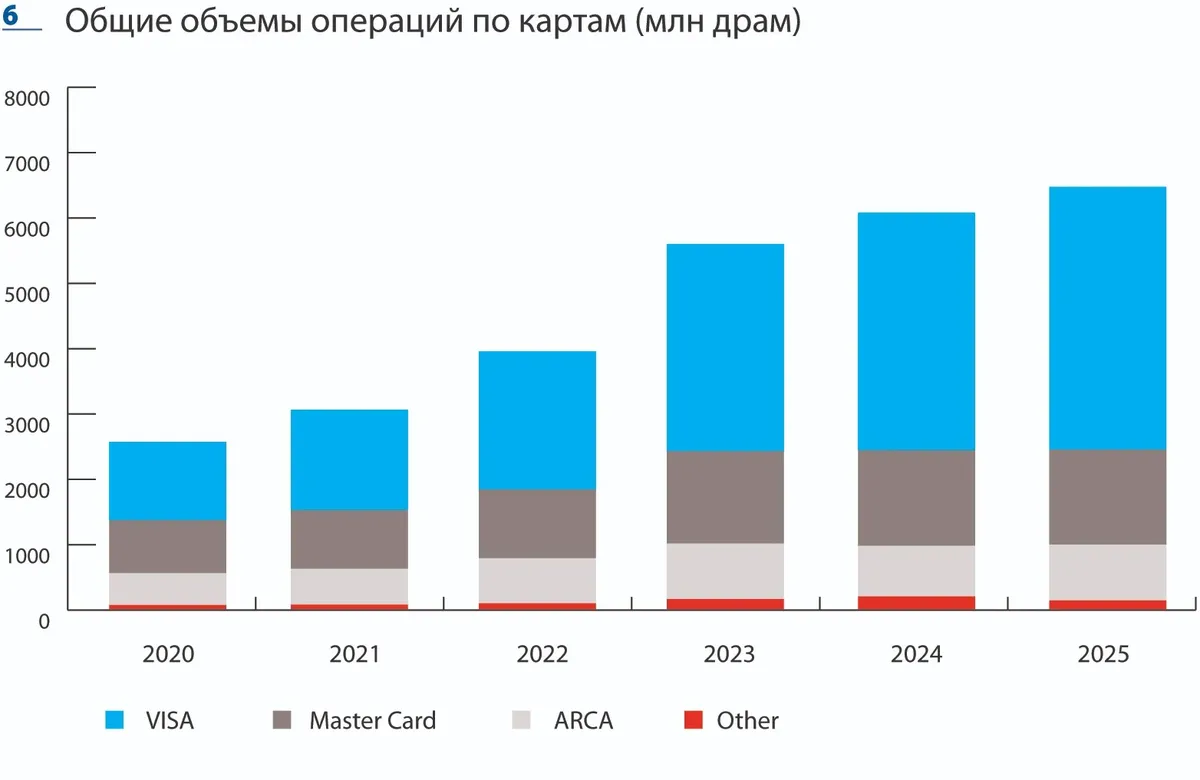
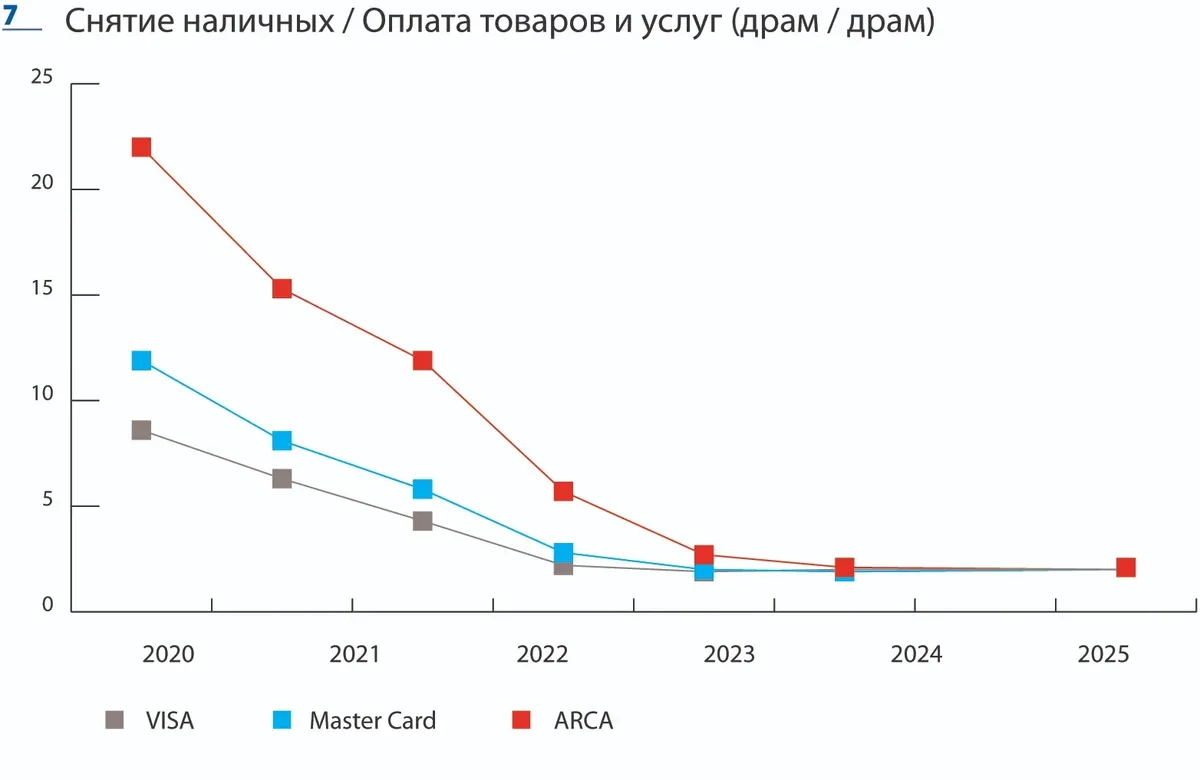
As you can see, the volume of transactions on ArCa cards grew steadily until 2023, but this growth was much more moderate than that of VISA. ArCa gradually lost market share: from 19% in 2020 to 13% in 2023. ArCa seemed to remain a system for pensioners and public sector employees - the most conservative group of users - which was also reflected in the structure of operations. From 2020 to 2022, cash withdrawals accounted for 75% of total transaction volume, and the ratio of cash withdrawals to payments for goods and services was a multiple of Visa's. (See chart 7)
But in 2022, the government decided on an interesting experiment: instead of direct indexation of pensions, a 10% cashback was introduced on expenses paid with cards.
And here is the result: already in 2023, with a total increase in volumes across the system by 23%, the growth of cash withdrawals slowed down to 3.7%. And in 2024 and 2025, ArCa became the only payment system where cash withdrawal volumes began to decline rapidly - by 13% and 17%, respectively. As a result, the ratio of cash to payments for goods and services quickly caught up with competitors.
But there is also a big “but”.
In parallel with this process, ArCa users have tried and loved the card-to-card transfer operation. In 2025, such transactions amounted to 220 billion drams, which is 26% of all transactions in the ArCa system. And this despite the fact that the volume of such transfers in other systems was declining.
As a result, ArCa (which occupies only 13% of the total payments market) accounted for more than 37% of all card-to-card transfers in 2025.
Since 2026, the government has expanded the experiment by starting to pay cashback on purchases to all ArCa holders. We will see the results of the first quarter in the coming months.
"World" cards as a mirror of Russian relocation
And of course, our story would be incomplete without a story about the difficult fate of the “World” card. The payment data here, like a mirror, reflects the impact of Russian emigration and sanctions.
Chart 8 shows data on the volume of transactions in the country using cards issued outside of Armenia. As you can see, back in 2021, the share of transactions using Mir cards did not exceed 4%, and the annual volume was less than 10 billion drams.
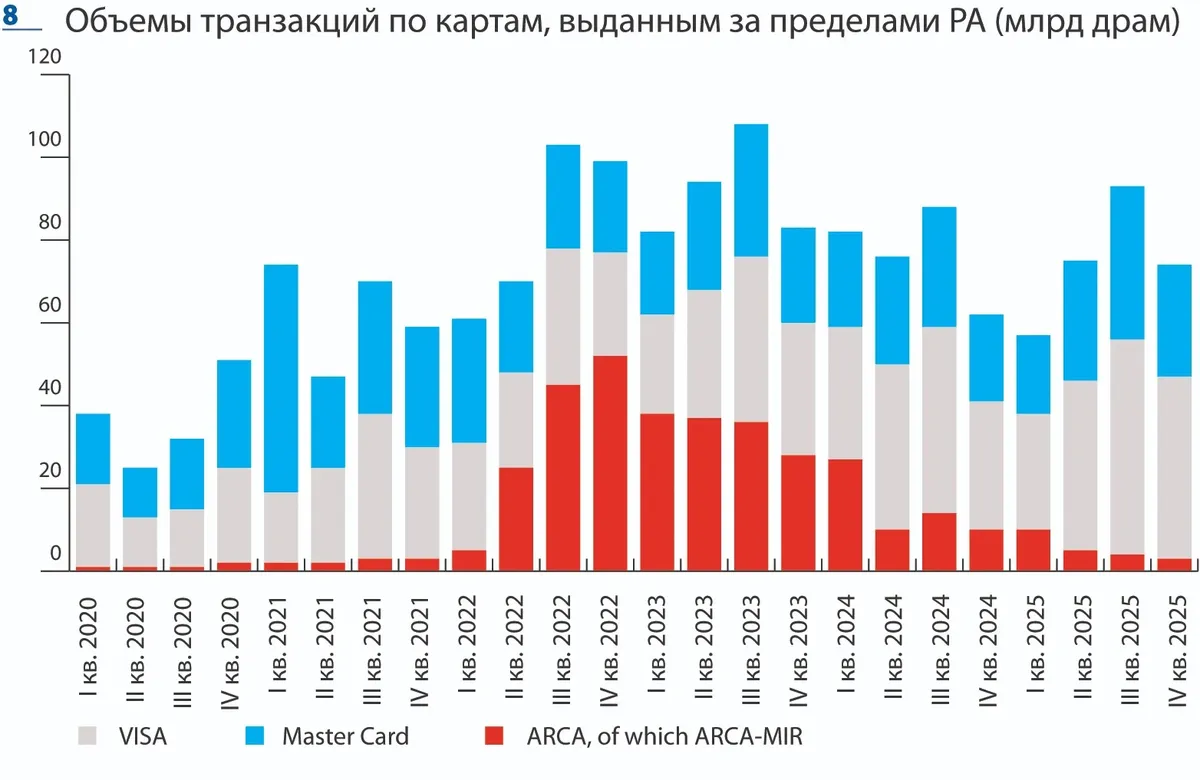
And immediately after the start of the war in Ukraine, the situation changed dramatically: already in the second quarter of 2022, turnover on Mir cards amounted to 25 billion drams and took first place, overtaking both Visa and MasterCard.
But these were just the beginnings: after the start of mobilization in the Russian Federation in the fourth quarter of 2022, the volumes exceeded 50 billion drams and turned out to be higher than for all other cards issued outside Armenia combined.
In 2023, the Russian emigration, who decided to gain a foothold in Armenia, had already acquired local maps, but for Russian tourists “Mir” remained practically the only available tool. As a result, although quarterly volumes were significantly lower than the records of the fourth quarter of 2022, annual turnover amounted to a record 139 billion drams (37% of the total turnover on foreign cards).
On March 30, 2024, Armenian banks (excluding VTB’s subsidiary), fearing international sanctions, stopped servicing Mir cards. The annual turnover collapsed by 77 billion drams, and in 2025 it decreased by another 39 billion and amounted to only 22.6 billion (7% of the total foreign turnover).
At the same time, as we perfectly understand, the Russian tourist flow has not gone away. And it turns out that more than 100 billion drams of annual turnover have now simply gone into cash, and Russian tourists, who a few years ago were one of the drivers of the development of the non-cash payment system, now play the opposite role. Although, of course, these amounts are now quite insignificant on the scale of the entire rapidly developing payment system of the country.
* * *
The path the economy has traveled since 2018 is impressive: budget revenues have doubled, and non-cash payments have become commonplace. But the shadow sector is always extremely flexible: as soon as one door closes, another opens.
Whether the government will be able to maintain the pace of emerging from the shadows in 2026 will largely depend on the success of the digital integration of conservative groups of the population and the effectiveness of new Central Bank regulations.
Ivan Karpenko*