Translated material
The authorities plan to open the tourist season, hiding the level of pollution: what is happening in Tuapse a month after the oil spill
Environmentalists call what is happening the biggest disaster in the region, there are not enough volunteers, many beaches have not even begun to be cleaned

In April, Ukraine carried out massive drone attacks on Tuapse several times, causing major oil storage fires at the marine terminal and refinery. As a result, a large amount of oil and petroleum products ended up in the Tuapse River and the Black Sea. The authorities cheerfully report on the elimination of the consequences, hide the real level of pollution and claim that by June 1, Tuapse will be ready to receive tourists . VERSTKA’s sources in government, environmentalists and volunteers involved in cleaning up pollution are confident that this is not the case: many beaches remain untouched after the spill, and oil products are still floating in the sea, moving along the coast to the south. This could ultimately lead to repeated strandings.
In order not to miss new texts from “Layout”, subscribe to our telegram channel
“I think that Rospotrebnadzor gave direct instructions not to publish data on pollution. In this region, the desire not to disrupt the beach swimming season hovers over everyone; they are all terrified of this,” says an ecologist who spoke with Vestka on condition of anonymity. “[Opening the season] can lead to an increase in cancer, reproductive dysfunction and other dangerous health consequences due to benzopyrene, a dangerous carcinogen that is formed when oil burns.”
Why did an oil spill occur in Tuapse?
Expand ↓The pollution of the coast of the Tuapse region arose as a result of a series of massive drone attacks from Ukraine.
On April 16, after a drone raid, technological equipment in the seaport of Tuapse caught fire. The fire was extinguished on April 18, but even then an oil spill into the Black Sea and the Tuapse River was recorded.
On April 20, Ukraine once again attacked the Tuapse seaport with drones. The area of the oil spill in the Black Sea and the Tuapse River at this stage was already estimated at 10 thousand square meters.
The fire in the seaport was extinguished on April 24, four days after the attack. On the same day, due to heavy rains, oil products overflowed through booms on the Tuapse River into the sea.
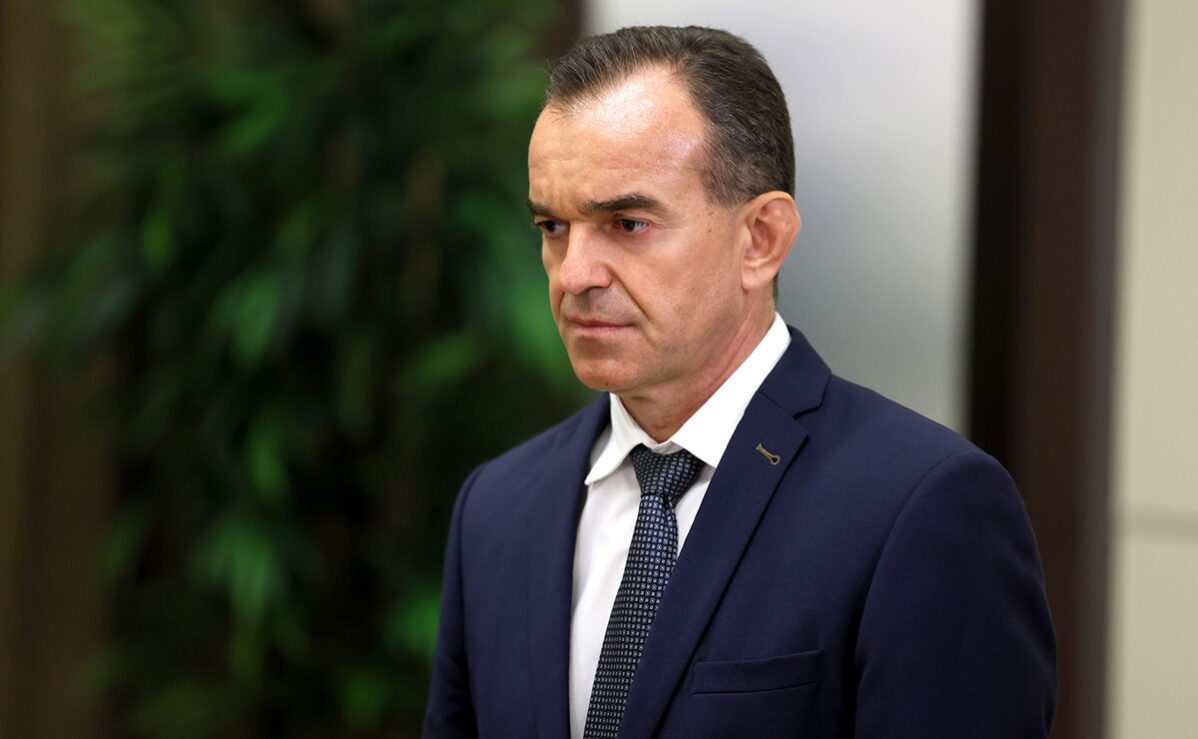
On April 28, Ukraine again attacked the city with drones, this time the oil refinery caught fire. The governor of the region, Veniamin Kondratyev, and the head of the Ministry of Emergency Situations, Alexander Kurenkov, urgently came to the city; they declared a regional emergency. The fire at the refinery was extinguished in about a day.
On the night of April 30 to May 1, after another drone raid, the sea terminal caught fire, which was extinguished on May 2.
An ecologist who spoke with Vorstka is confident that the authorities and owners of the Tuapse oil refinery should have been better prepared for drone attacks from Ukraine.
“Any facility where large quantities of petroleum products are stored must have an embankment - an earthen barrier in case of a spill. When, after the first strikes, oil products began to flow into the river, it became clear that the defense could not cope. It was necessary to check the embankment on the territory of the refinery and raise it to the maximum level. This is a simple measure known to any oil worker, which requires only a couple of bulldozers and an excavator, says the expert. “If this had been done on time, oil products would not have flowed into the river after the next attacks, because it was obvious that the attacks would be repeated. This is a huge professional failure on the part of those who manage oil park security.”
While the regional authorities of Tuapse and the Krasnodar Territory publish daily reports on thousands of cubic meters of oil-contaminated soil collected from beaches, report on the number of people and pieces of equipment involved, but remain silent about the level of water, air and soil pollution, environmentalists call what is happening one of the largest and most complex disasters in the region, even compared to the oil spill off the coast of Anapa in 2024.
“If in Anapa up to nine thousand tons of fuel oil from two tankers could get into the environment, then here there is only one tank with finished products - maybe up to 20 thousand tons,” says ecologist Zhora Kavanosyan. It is unknown how many tons of oil spilled after four fires at the refinery, at the seaport and at the oil storage facility.
“This is the largest environmental disaster of recent times, at least for the southern region, both in scale and in its consequences,” writes ecologist Evgeniy Vitishko. “We have already heard something about excesses of benzene and soot, but we don’t yet have information on soil, sea water, river water.”
According to ecologist Zhora Kavanosyan, during the cleansing of the sandy beaches of Anapa, a person could work for two hours, leave the beach and breathe normal air. In Tuapse there is no such possibility, because there will always be carcinogens on any surface and in the air: working, much less resting there, is much more dangerous.
The beaches near Tuapse are steeper and mostly pebble; cleaning them, compared to the sandy, flat beaches of Anapa, is more difficult. “The fuel oil is instantly buried inside the pebbles to a fairly large depth. It’s simply impossible to load all these pebbles into containers and take them away,” says the ecologist.
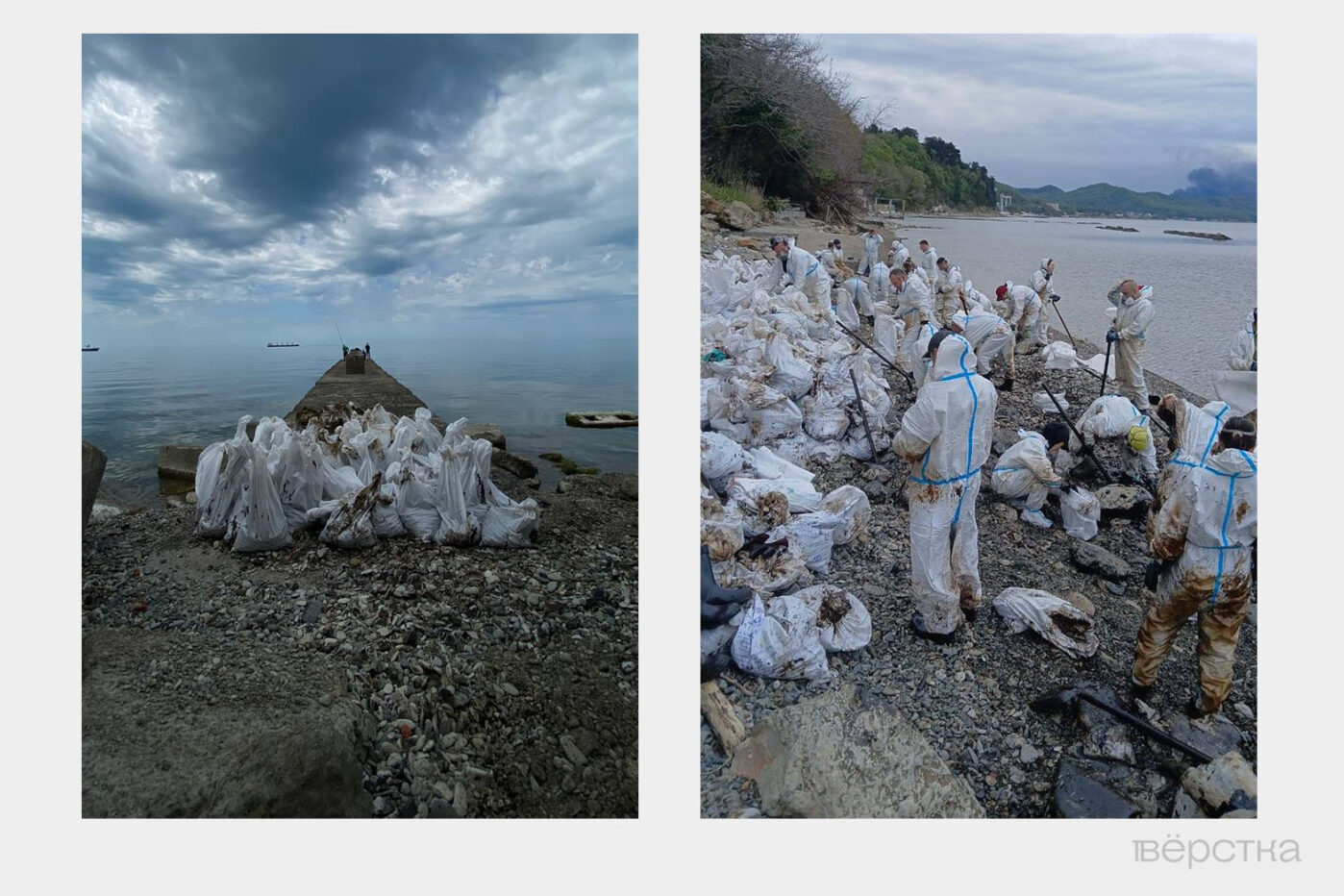
On April 20 and 21, due to the burning of oil products, “oil rains” occurred in Tuapse and nearby settlements, spreading toxic substances to the soil and all other surfaces in the area.
What is “oil rain” and how is it harmful?
Expand ↓“In the event of a strong fire at an oil facility, not only smoke and soot rise into the air, but also vapors of light oil fractions. When the air cools, some of these substances settle back, but in the form of oily droplets and dirty sediments. This is how what is called oil rain occurs. Together with it, toxic compounds of the BTEX group: benzene, toluene, ethylbenzene and xylenes enter the environment. Therefore, an umbrella does not help here; the problem is not only in precipitation, but also in the air that you have to breathe,” explained the Transparent World environmental monitoring project.
Such rain is dangerous due to delayed consequences: toxic substances settle on plants, causing chemical burns and interfering with photosynthesis, pollution accumulates in the soil. Birds suffer greatly: oil fractions destroy the structure of the feather and deprive it of its water-repellent and heat-insulating properties, as a result of which the bird can die from hypothermia.
Among other things, there is a risk of continued releases of petroleum products from the sea. A satellite image from May 6 recorded muddy spots from the Central Beach of Tuapse to the villages of Shepsi and Magri, which is about 12 kilometers on the surface of the water i . The beaches are cleaned, but at any moment, oil products from the sea can fall on them again and again.
An additional danger is that the fuel oil buried in the pebble beach evaporates when the temperature rises and when directly heated by the sun, causing toxic carcinogens to rise into the air.
The authorities do not publish specific results of measurements of air, water and soil pollution with a list of pollutants and comparisons with maximum permissible standards, publishing only laconic messages about “slight excesses” of pollution levels. An environmentalist who spoke with Vorstka calls this an official environmental crime on the part of Rospotrebnadzor and the Ministry of Emergency Situations.
“Many pollutants, in addition to an increased risk of cancer, in particular the growth of leukemia, can also lead to hereditary diseases and can affect the formation of the fetus, in general, reproductive function,” he says.
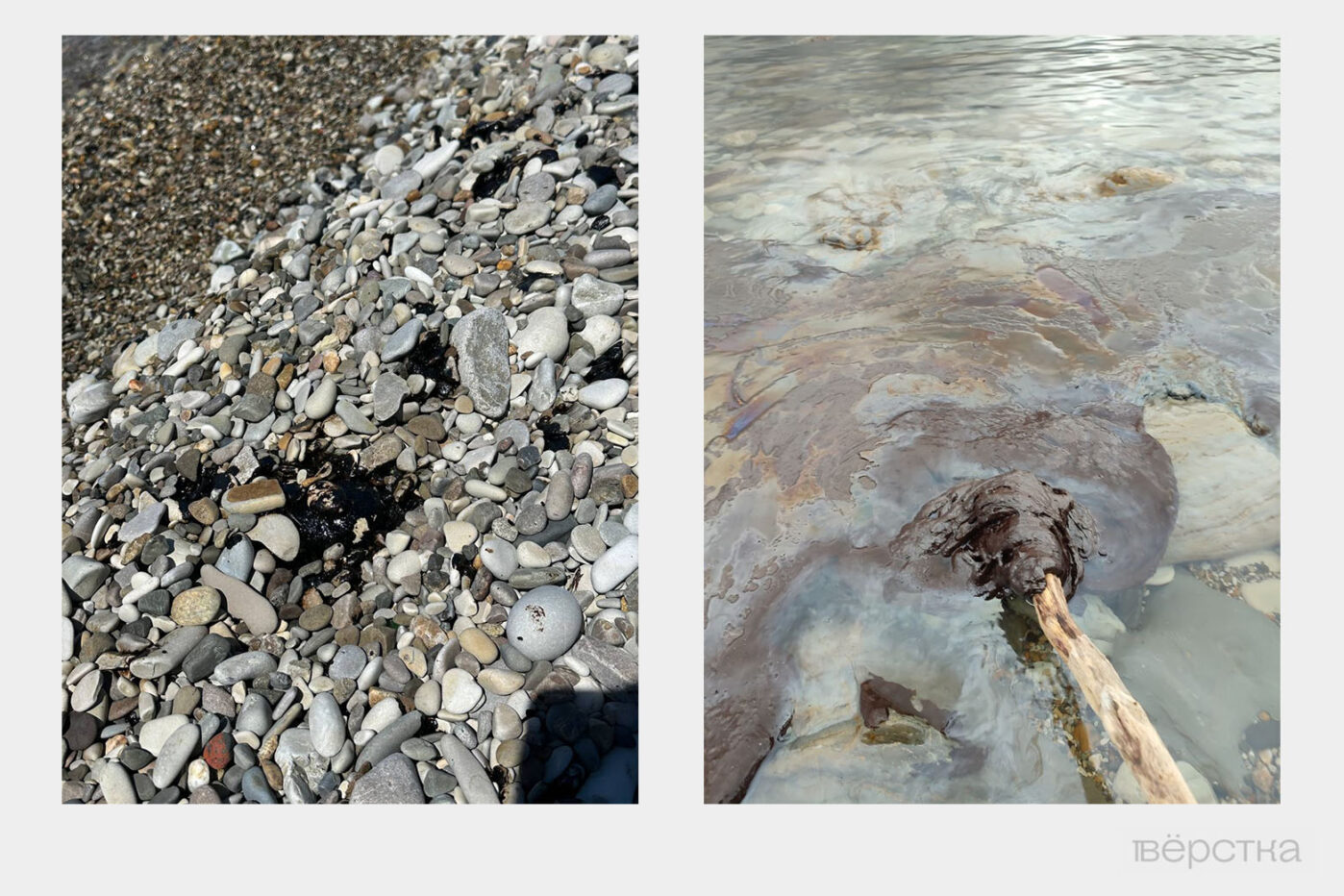
Environmentalists agree that it is dangerous to open the pebble beaches of the Tuapse region this summer. “If there is no re-pollution, the beaches will most likely be cleared [only] by next year,” says Vverstka’s source.
“There is no goal to declare the entire coast suitable for recreation”
There are no plans to cancel the tourist season in Tuapse, a Kuban official told VERSTKA on condition of anonymity. When asked how this is possible in the conditions of an environmental disaster, he answered briefly: “We are preparing, we are cleaning.”
An interlocutor close to the Ministry of Economic Development of the Russian Federation (the structure of this department includes the Department of Tourism) explains the fear of officials to cancel the season as follows: “These are not only economic, but also political, image losses. Cancellation would mean that the war has reached very far and is interfering with the lives of Russians. That is, it reached not only Kuban, you understand, but further - to the Far East, to Norilsk, to all those for whom rest was shining. Therefore, we need to solve the problem as soon as possible, patch everything up and give Russians a normal life.” According to him, the central beaches and those where children will relax will be cleared and covered with sand. Particularly problematic areas will simply be fenced off: that is, there is no task to declare the entire coast suitable for recreation.
The head of the Tuapse municipal district, Sergei Boyko, on Soloviev Live, has already stated that the beach in Tuapse will be cleaned by June 1 and the resort will be ready to receive tourists.

“Of course, there are probably places that, let’s say, are wild beaches that we haven’t reached yet, haven’t recognized, people signal us, we mark them. But we see that there is no longer any spread,” Boyko said on May 2. — Just yesterday at the operational headquarters, which takes place twice a day, the marine rescue service reported that there were no oil stains on the water surface, that’s it, we cleaned everything up. All that remains is to clean up the shore.”
So far, the authorities are sticking to plans to open the tourist season in Tuapse on June 1, confirmed Vorstka’s interlocutor close to the Ministry of Economic Development.
In addition to the image component, there is also a material issue. For example, competitions for children's vouchers have been completed: the purchase of holidays for 24 children from Khanty-Mansi Autonomous Okrug in a health camp in Tuapse from June 24 to July 14 has not been cancelled. And 135 children from Norilsk will go on two races in July-August. The authorities of some regions directly state that they do not intend to cancel the purchased vouchers. In the Vladimir region they reported that they do not plan to cancel contracts for children’s health.
Private entrepreneurs are also worried about the possible disruption of the season. “They won’t survive there if there are no tourists, if there is no season,” one of the volunteers tells Vorstka. “They tell us, ‘Thank you,’ because if [the volunteers] didn’t remove anything, then [the authorities] would be the last to remove it.” As Kommersant wrote , at the beginning of May many reservations were cancelled. The Russian Union of Travel Industry recorded a 43% decline in bookings in May.
In Russian management logic, recognition of a major disaster is often perceived as recognition of the failure of power in a particular territory. An interlocutor close to the presidential administration explains that for officials the political risk is also expressed in “the loss of chairs, or even heads.”
“No one ever wants to take full responsibility, and if you manage to resolve it quickly, the consequences will not be so terrible. To put it mildly, the president was not immediately aware of the scale of the disaster; it only became clear when it became impossible to hide it. This means that they were unable to resolve it quickly. That’s why [Governor of the Krasnodar Territory Veniamin] Kondratyev and his team are walking under the sword. There will be criminal cases,” he believes.
Vorstka’s source also agrees that the cancellation of the season will cause discontent among Russians. “All the years while the war was going on, people went there to relax. Yes, the flow has dropped, but not critically, the beaches are full. Accordingly, not everyone is concerned about security issues [out of fear that a drone will fly in]. Even fewer are those who are immersed in the environmental agenda. There are more of these in large cities like Moscow and St. Petersburg, and from there fewer people go to the Black Sea to relax than from the outback. They reason like this: the authorities said that everything was removed, which means they removed it, but they couldn’t hear the screams of the volunteers. They worked for the sea for a year,” he says.
In order not to miss new texts from “Layout”, subscribe to our telegram channel
Criminal cases in the team of the Governor of the Krasnodar Territory Veniamin Kondratyev
Expand ↓Kondratyev is no stranger to criminal cases in his own team: during the years of his governorship, several high-ranking officials of the region found themselves under investigation, arrests or at the center of corruption scandals.
Former vice-governor Yuri Gritsenko, who oversaw construction and architecture, was detained in a case of abuse of power; another vice-governor, Sergei Vlasov, who was in charge of the construction and housing and communal services sector, found himself under investigation for bribery in 2024. Alexander Nesterenko , who headed the Main Construction Directorate of the region, also appeared in corruption stories surrounding government contracts. Even the agriculture bloc, which has been supervised by Vice-Governor Andrei Korobka for many years, regularly became the object of claims from security forces due to the distribution of subsidies and land. The region has set a record for the number of criminal cases against vice-governors: over ten years, at least seven deputy heads of the region have been prosecuted.
Some officials tried to avoid punishment for the war. Former vice-governor of the Krasnodar Territory Alexander Vlasov announced in the fall of 2025 that he was going to war, and a few hours later his home was searched, and he was later arrested in the case of possible theft of funds allocated to supply war participants. In December 2021, a bribery case was opened against the former mayor of Krasnodar and the first vice-governor of the region, Andrei Alekseenko, but in 2022 he left to work for the occupation administration in the occupied territories of Ukraine . On May 13, another ex-vice governor, Anna Minkova, was sentenced to 5.5 years for fraud.
While the regional authorities are busy trying to hide the real consequences of the oil spill and not disrupt the tourist season, cleaning only the Central Beach of Tuapse, volunteers are engaged in rescuing and washing animals and cleaning all other beaches.
Volunteers are traditionally not liked in government circles. As “Vestka” previously wrote, the state often looks at independent volunteers as “dangerous guys who can organize themselves for some purpose.”
Vorstka’s interlocutor in the administration of one of the resort towns of Kuban spoke ambiguously about the volunteers. “Of course, it is commendable that citizens want to help and save nature. But there are situations when it is difficult to organize them, they do not have enough skills and tools, but at the same time they have their own understanding of how to, for example, clean the beach. The situation is understandable, but problems happen because of it,” he explained.
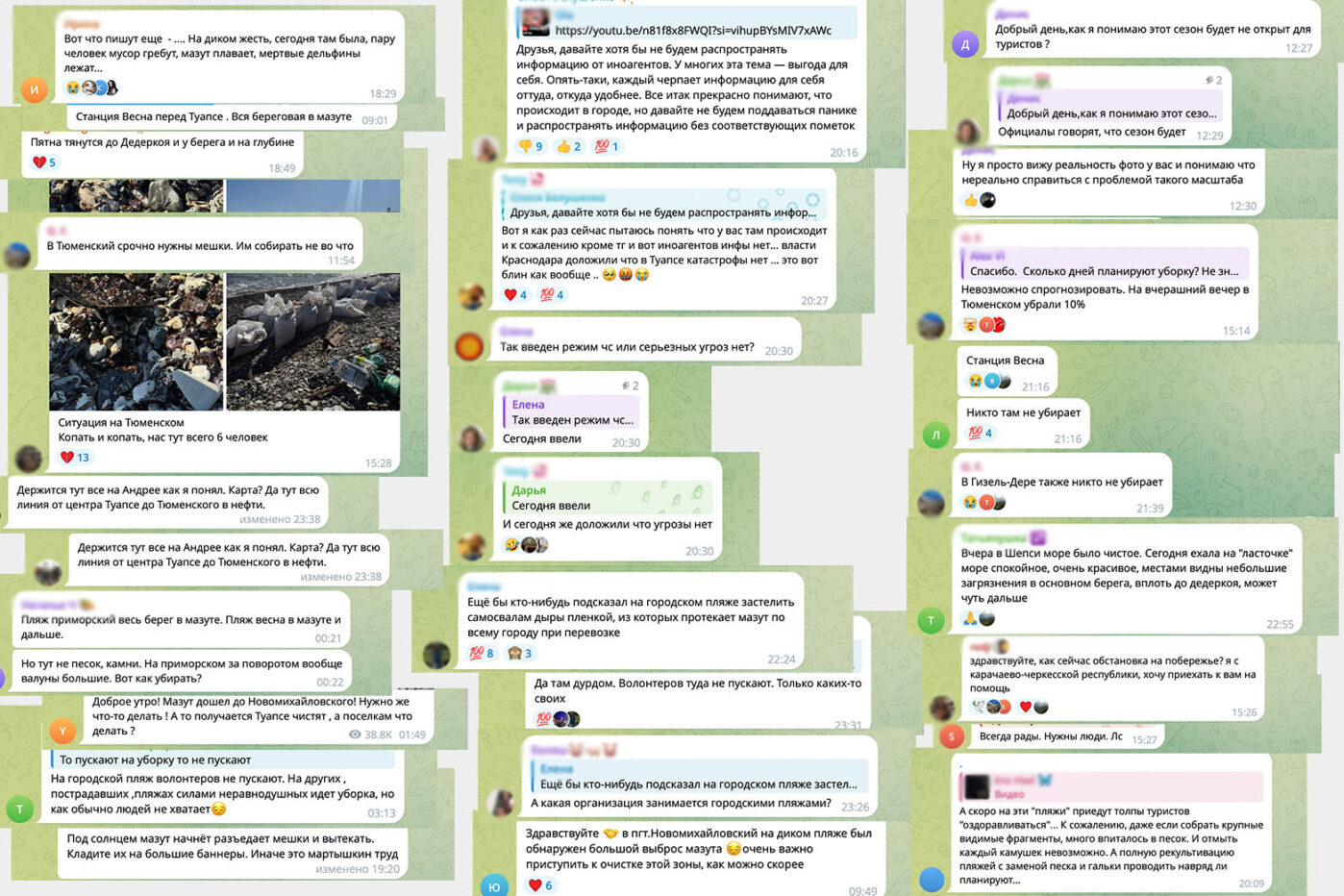
Since the coronavirus pandemic, the authorities have tried to organize volunteering as a systematic work with the state. This is how the federal organization “We Are Together” appeared, and the Duma adopted a whole package of laws that protect volunteers - but in essence this applies to those who work with government organizations.
On May 2, the Tuapse authorities held a round table with volunteers and, as one of the meeting participants says, they were “recognized.” “There is no special interaction or close dialogue [with the intelligence services and authorities], no systematic assistance is provided. Volunteers do not create problems, and they are not disturbed in return,” he describes.
During the round table, volunteers were actually recommended to register on the website dobro.rf, which is controlled by the affiliated organization “We Are Together.” However, registration there did not become mandatory. “Rather, this is a way to later declare that people helped Tuapse through this platform,” says the interlocutor of Vorstka.
An interlocutor in “We Are Together,” in a conversation with “Vestka,” called this approach in Tuapse “justified” because “volunteers should help the state, and not look for mistakes.” According to him, in a difficult situation, “coordinated work” is required, and if volunteers “really want to help, then they will not be against organizational assistance.”
“Volunteers do not create problems, and they are not interfered with in return either”
According to a volunteer who spoke with Vorstka, for the first few weeks they were not allowed to clean up oil products from the Central Beach of Tuapse. Volunteers caught, washed and treated animals and birds, and independently began cleaning other beaches.
“I understand the administration - we really are not professionals. Surely the Ministry of Emergency Situations will remove the fuel oil better,” said volunteer Sergei, who came from Sochi to clean the beaches. “But understand us too - there was no one here, no one at all.” We wanted to help nature and people, we put so much effort into this work. And none of them even said a simple “thank you” to me. But they said, boy, you’re not even local, what are you doing here anyway?”
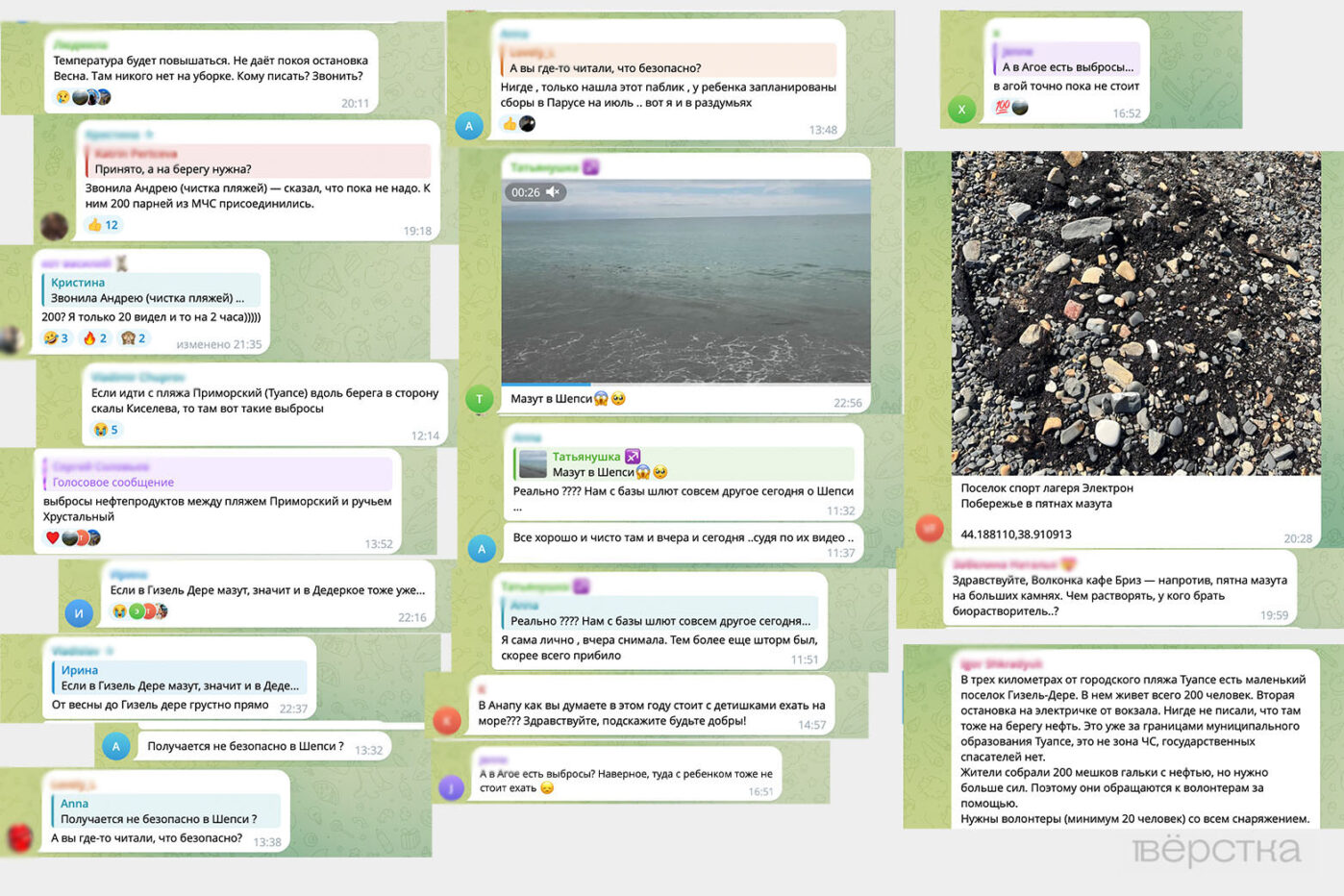
For almost a month now, through telegram chats, some volunteers have been coordinating others and organizing the purchase of personal protective equipment (PPE), consumables, food, medicine, animal feed and everything that is needed locally i .
At the same time, after the May holidays, the interest of Russians in the problem in Tuapse, according to one of the volunteer coordinators, subsided significantly: “[There are] not enough people everywhere: to look after the dogs and clean the shore.” The interlocutor of “Verstka” believes that this is due to the lack of information about the problems on the Black Sea coast in the general information field.
“The fuel oil will still remain, and it will quietly poison people”
Contrary to the words of the head of the Tuapse district, Sergei Boyko, who on May 2 said that the beach was already almost 95% cleared, environmentalists and volunteers claim that this is not so.
“Even if everything is clean from above [on the pebble beach], even if the sea is visually clear near the shore, the fuel oil will still remain, and it will imperceptibly poison the people who walk there, and especially lie on the beach,” says an ecologist who spoke with “Vestka” on condition of anonymity. “The lower your respiratory organs are above this beach, the more you will receive a dose of this pollution.”
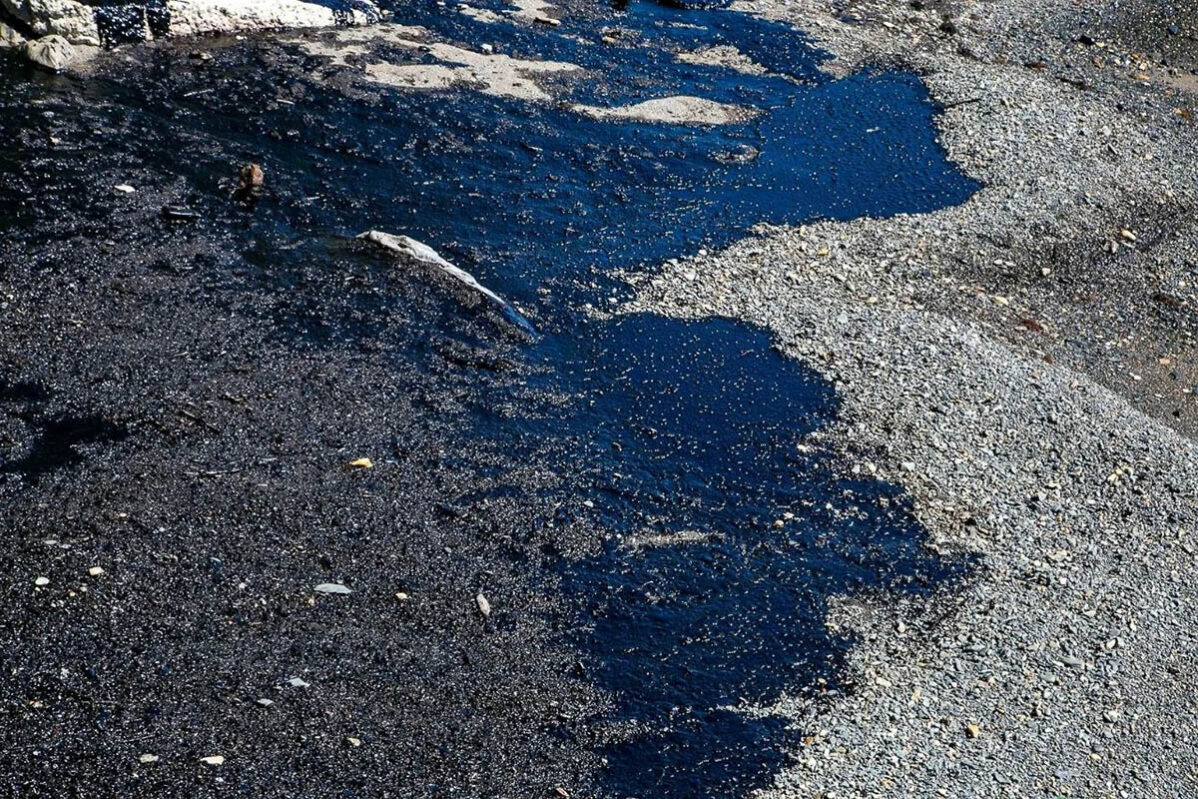
According to the latest (at the time of publication) report of the Operational Headquarters of the Krasnodar Territory dated May 12, 27.7 thousand cubic meters of contaminated soil and water-fuel mixture were collected and removed from the coastline, but this information does not provide any objective understanding of how clean the beaches actually are.
“This format [reports on cubic meters of removed soil] was chosen because officials need to show that work is in progress. But in order to assess these volumes, you need to understand how much has spilled out, says an ecologist who spoke with Vorstka. — In both world and Russian practice, an assessment of the volume of spilled petroleum products is always required. Now we are seeing the first such large spill for which there is no assessment at all.”
If we summarize the reports of volunteers about pollution in certain areas of the beaches, after April 16, oil products were noticed on the coast from the village of Novomikhailovsky in the north to the village of Shepsi in the south: this is about 60 kilometers. Ecologist Zhora Kavanosyan believes that coastline protection equipment should be proactively installed in Gelendzhik, Novorossiysk and Sochi.
On May 13, fuel oil emissions were already noticed in Crimea: local residents and employees of the local administration began cleaning them up.
“Local authorities are trying to demonstrate that they can cope on their own, because to take maximum measures they need to wash their dirty linen in public. All managers are always afraid of this, because the country has built a system in which you should not bother your superiors, not show that the problem is big. You have to quietly solve it yourself,” says Vorstka’s interlocutor.
“People are already swimming on some beaches, while others are being cleaned,” one of the volunteers tells VERSTKA. He assumes that the season will be opened in any case, despite the fact that the fuel oil will remain in the sea.
Cover: Dmitry Osinnikov
You can support “Layout” from any country in the world - it is still safe and very important. We really need your support now
How to help us