
Translated material
Publicans military
They decided to scare St. Petersburg with a super-pathetic exhibition about the national “heroic spirit.” “All” Russian wars were squeezed into “Manege” - and what happened

Exhibition “Russian Imperative” at the Manege Central Exhibition Hall. Photo: Natalya Shkurenok
On the occasion of Victory Day, the exhibition “Russian Imperative” opened at the Manege Central Exhibition Hall in St. Petersburg. The very first photographs from the opening of this exhibition caused a strong reaction on social networks: discussion participants compared the design of the Manege antechamber with propaganda posters from the Second World War. And those posters were far from promoting Soviet aesthetics.
If it weren’t for the strange installation that captures the attention of viewers literally upon entering the Manege, the exhibition as a whole most likely would not have attracted serious attention. But the authors and designers of the exhibition did their best: in the antechamber of the Manege, visitors are greeted by a giant mask of a soldier in an iron helmet with glowing headlight eyes. It is fixed at a high altitude, surrounded by the contours of either the Kremlin towers or guns looking into the sky. The composition, made in black, red and white colors, reminded many of the propaganda pictures of the late 30s and 40s of the 20th century, familiar from films and posters.
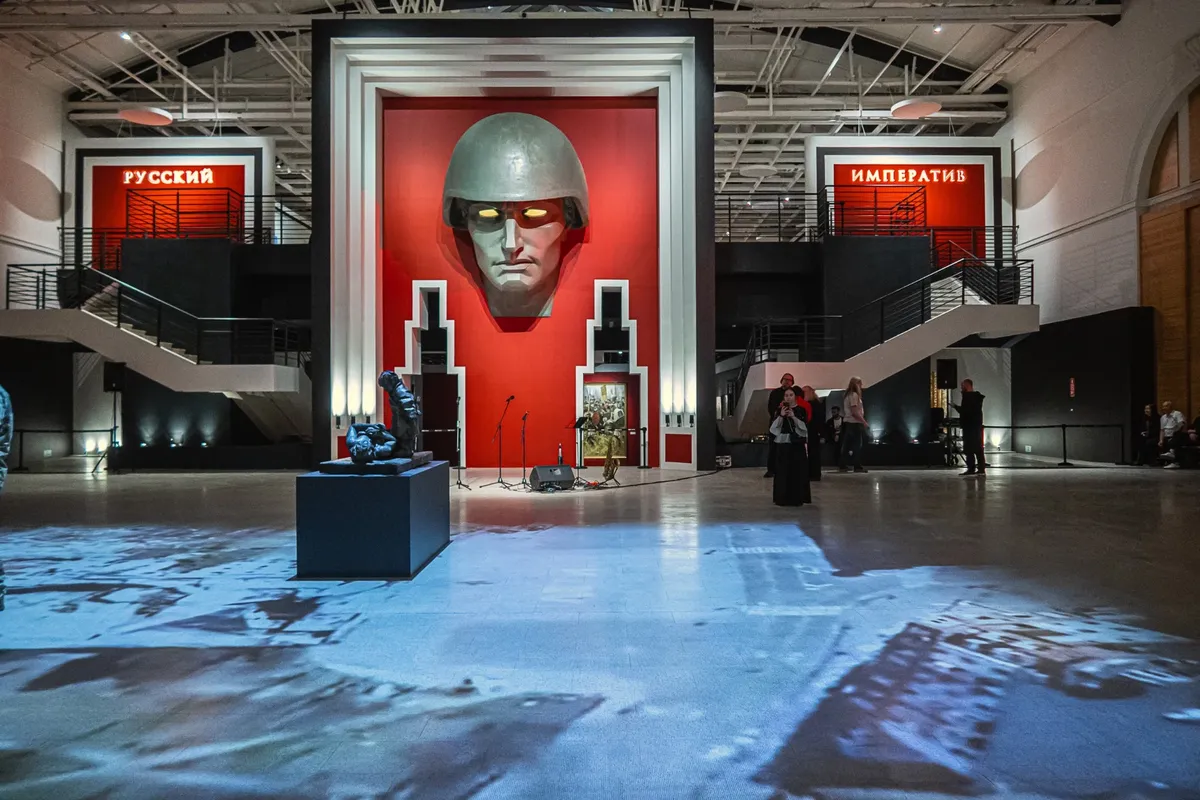
The participants in the discussion of photographs from the opening of the exhibition were especially astonished by the figure of the Vice-Governor for Culture of the St. Petersburg Administration, Boris Piotrovsky, standing in front of a monstrous mask with glowing eyes in a black suit, standing at ease.
The organizers of the exhibition themselves, in official press releases and statements at the opening, said that the prototype of this installation with a mask is the monument to Alexander Matrosov, created according to the sketches of the sculptor Evgeniy Vuchetich. The monument was erected in Dnepropetrovsk (Ukrainian city of Dnepr), since Alexander Matrosov was born in Ukraine.
In 2023, Ukrainian authorities ordered the demolition of the monument. Probably, the authors of the exhibition in the St. Petersburg Manege tried to restore historical justice and, “to spite the arrogant neighbor,” reincarnate the disappeared image.
But they got too excited: the monument in the Dnieper was a modest stele with the conventional contours of a human figure, which was completed by a head in an army helmet. Vuchetich’s sketch depicted Matrosov’s face with a fairly high degree of accuracy - the round face of a simple village guy, with a curled forelock protruding from under the upper edge of his helmet. Performed by the authors of the installation in the St. Petersburg Manege (sculptor Ilya Mishanin), a village guy with full lips and curly hair turned into a monster from science fiction films or computer games. Various variations on the theme of this installation have already appeared on the Internet, including with the face of Oleg Yankovsky in the role of the Dragon from Mark Zakharov’s film “Kill the Dragon,” inserted under the mask using Photoshop. Why the exhibition's authors needed such a transformation is anyone's guess.
“Oleg Grigoriev has a line: “To express everything at once, I hit the pelvis with my fist.” Likewise, this composition appeals to all totalitarian aesthetics at once - to Mussolini’s, first of all - it is similar to their headquarters in Milan. Towards the aesthetics of German Nazism,” says Marina Koldobskaya, a St. Petersburg artist. “But it looks much more like the set of some Hollywood pavilion where Star Wars or another science-fiction blockbuster is being filmed. It is clear that the authors wanted to greatly frighten the audience, to express something super-pathetic and majestic, but it turned out to be a sort of demonic farce. I don’t know who chose these particular designers and why, but the composition looks as if there were no brakes, there was no voice that would say: guys, this can’t be done, it’s in bad taste. There seem to be no moral or aesthetic authorities.”
The exhibition itself deserves a separate discussion. In recent years, the Central Exhibition Hall "Manege" still tried not to create purely casual, "Danish" exhibitions, filling even those that were dedicated exclusively to official calendar events with meaning.
Many people remember the exhibition two years ago dedicated to the 80th anniversary of the lifting of the blockade - poignant, humane, touching. And even last year’s winning exhibition for the anniversary, filled with officialdom, at least tried to talk about the value of human life, about the tragedy that any war leads to.
This time, the organizers of the exhibition, focusing on the history of all the wars and hostilities that Russia has waged and continues to wage in the foreseeable past, lumped everything into one pile - the Battle of Kulikovo, the war with Napoleon, the Great Patriotic War, the Civil War, the Russian-Turkish War, the Northern Military District, the actions of the Wagner PMC in the Middle East and other military operations in different parts of the world. Guided, as follows from the official press release, solely by “the heroic spirit and national identity, trying to comprehend military events in art - from the formation of the Russian state to the present day.”
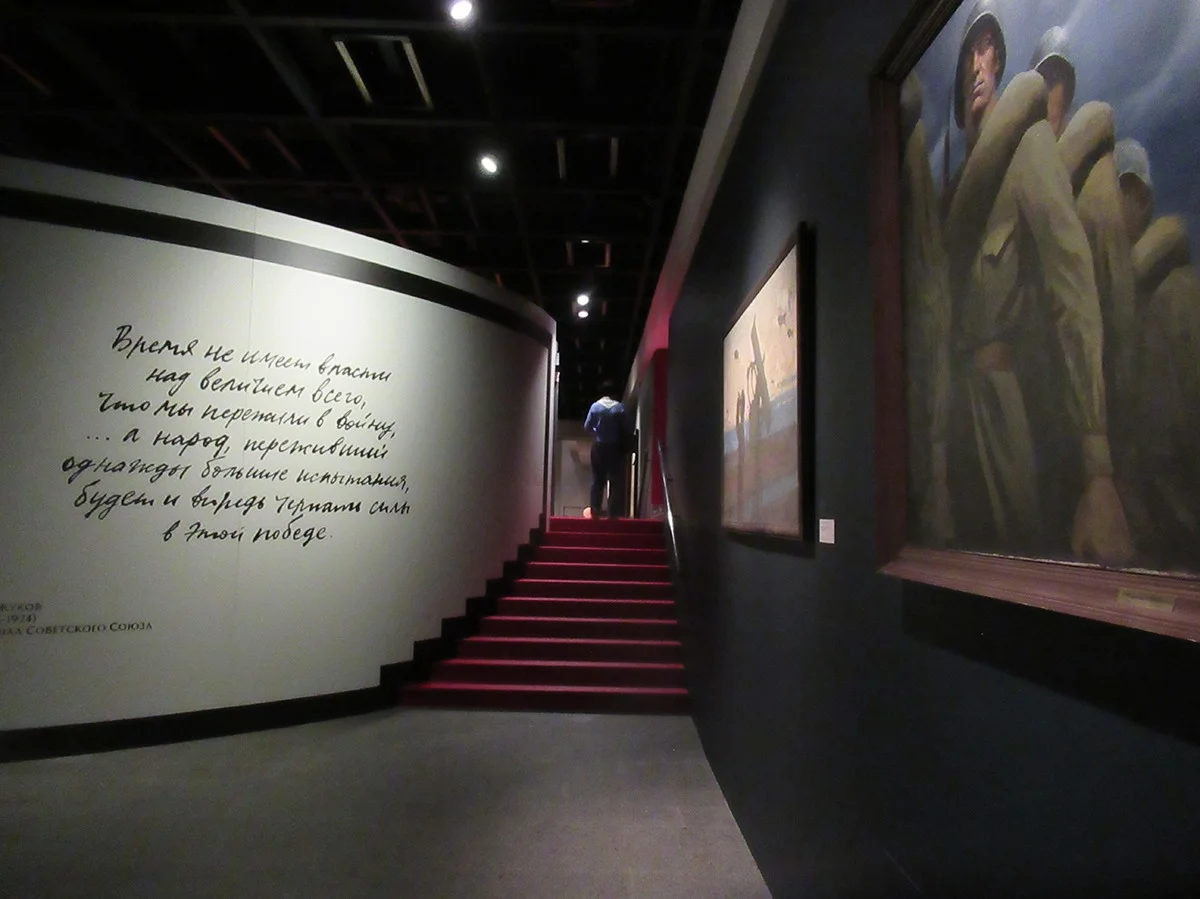
Apparently, for these reasons of “heroic spirit and national identity,” the exhibition’s authors plunged the first floor of the Manege into almost complete darkness—the walls were painted black, there was minimal lighting, and the illumination was directed only at the exhibits. A separate space on the ground floor is allocated for an auditorium: in the dark, there are chairs in front of a large screen, and a chronicle of the events of the Northern Military District is shown on the screen non-stop. True, in this chronicle there is a minimum of military action, there are no destroyed cities, but the “peaceful” soldier’s everyday life is widely represented - leisure, communication with local residents and fellow soldiers.
The space in the very center of the first floor is allocated for a kind of pantheon: a round structure of four segments (apparently left over from the previous exhibition of Alexandre Benois), at the top along the circumference in niches illuminated by red light there are sculptural portraits - from military centuries to participants of the Northern Military District with encrypted call signs. To see them, you need to climb several steep steps and try to read the text on the label in the dark.
A sculptural portrait of Dmitry Shostakovich unexpectedly appears in the line of these people in uniform - an easily recognizable profile, thin-framed glasses, a civilian jacket. It seems as if Shostakovich ended up here by accident - they forgot to label his bust, the only one in this row.
Such accidents occur here more than once.
For example, among the works on military themes, “Sketch for Composition V” by Wassily Kandinsky suddenly appears. Why? Maybe because the work was written in Germany?
But it was created in 1911, and when the First World War began in 1914, the artist left Germany, never returned there and died later in France. True, there is a version that his fellow artist, the German Franz Marc, also used the techniques of Kandinsky’s painting style to create camouflage protection for German artillery from French bombing. So, Kandinsky also came to the Manege for company - also as a manifestation of the “heroic spirit and identity.”
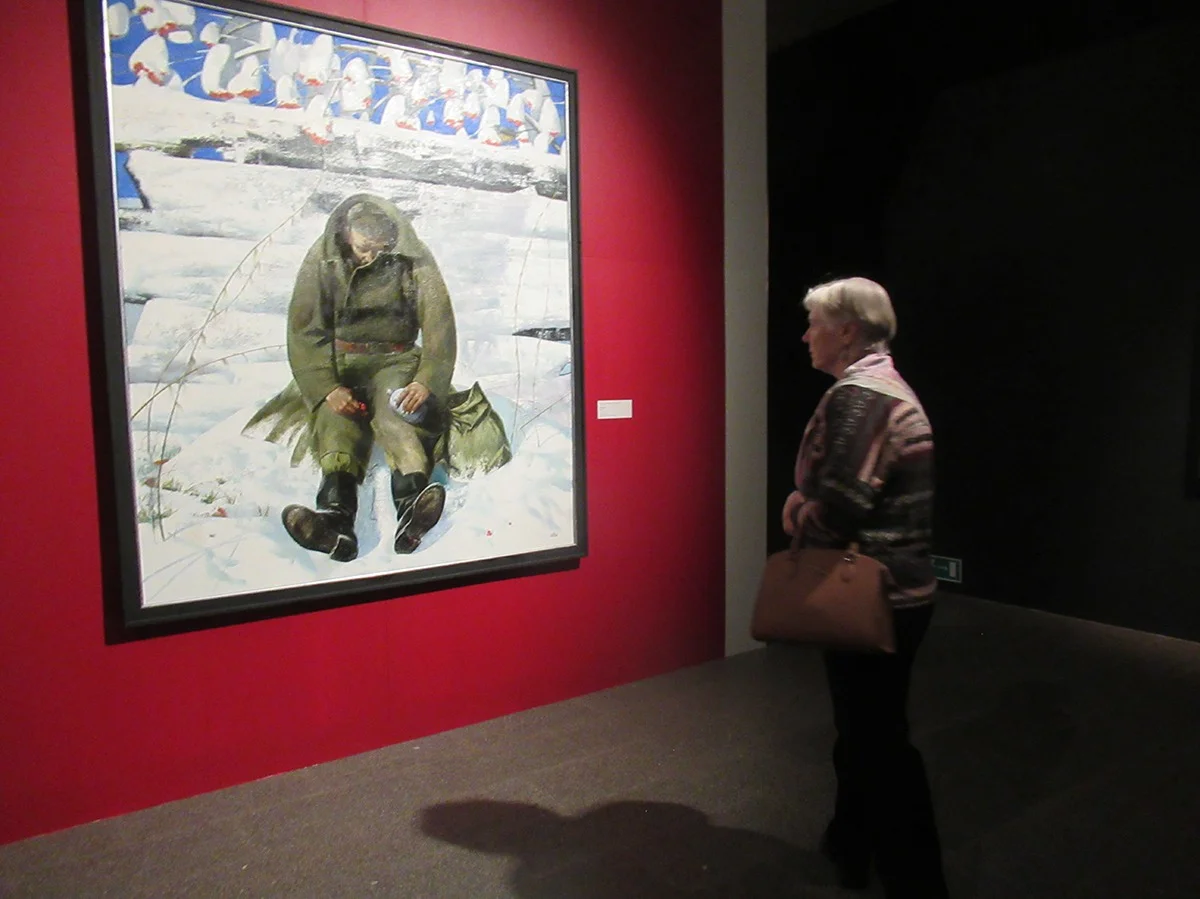
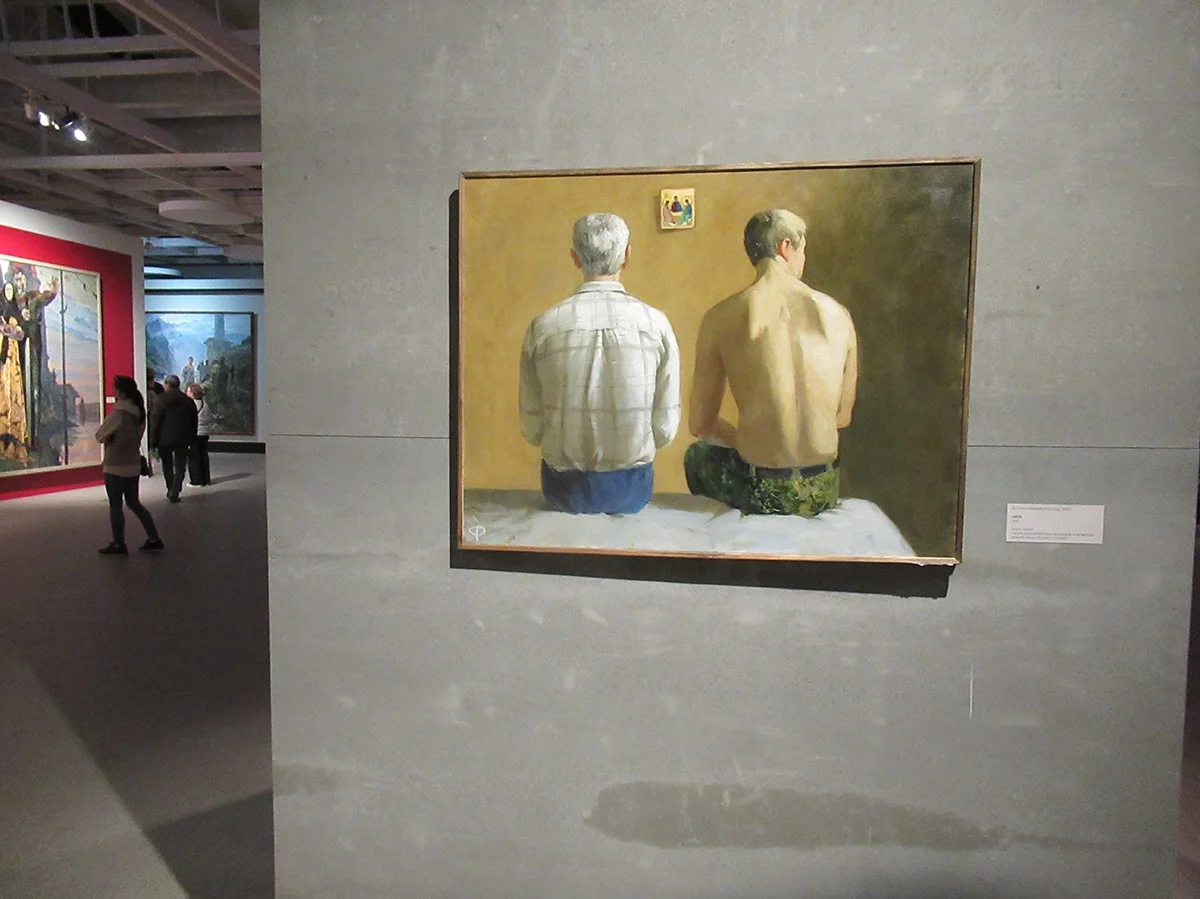
The second floor of the Manege is completely devoted to the work of young artists, dedicated mainly to Soviet and Russian military operations of recent decades, primarily the Northern Military District. Free space, white walls, bright light - the authors of the exhibition seem to invite viewers to rise from the dark yesterday to something bright. Why? Back to people in military uniform with weapons in their hands, to images of various types of military equipment intended for killing. A special place in the exhibition on the second floor is occupied by stands with painted steel plates of body armor - a new type of modern folk art, especially widespread in the south of the European part of Russia, in regions close to the battlefields of the Northern Military District (it seems that the progenitor of the Russian project was the action of the famous artist Banksy, who back in 2019 painted a body armor for the British rapper Stormzy). Two years ago, the first exhibition of such items was held in Krasnodar as part of the project “Russian Style. Steel" (partner of the Central Exhibition Hall "Manege" in organizing the exhibition "Russian Imperative"). Many of those works have now been brought to St. Petersburg. Most often, religious symbols are depicted on these small steel plates, and some are even designed as icons.
But what especially attracts attention is the extremely modest presentation at the exhibition of works on the themes of tragic and bloody events that have died down quite recently, which our country has not yet comprehended - the Afghan and Chechen wars. Perhaps only two works are devoted to the events in Chechnya, both tell about Yevgeny Rodionov, who did not renounce his faith. And only one talks about the Afghan war, about sending cargo-200 to the homeland - apparently, against the backdrop of closed coffins flying from a distant foreign country, the organizers do not want to talk about heroic deeds at all.