
Translated material
These are boys' drawings
Portrait of artists Garegin Harutyunyan and Harutyun Aghabalyan, who created the mural “The Color of Pomegranates” on “Parajanov” houses in Yerevan

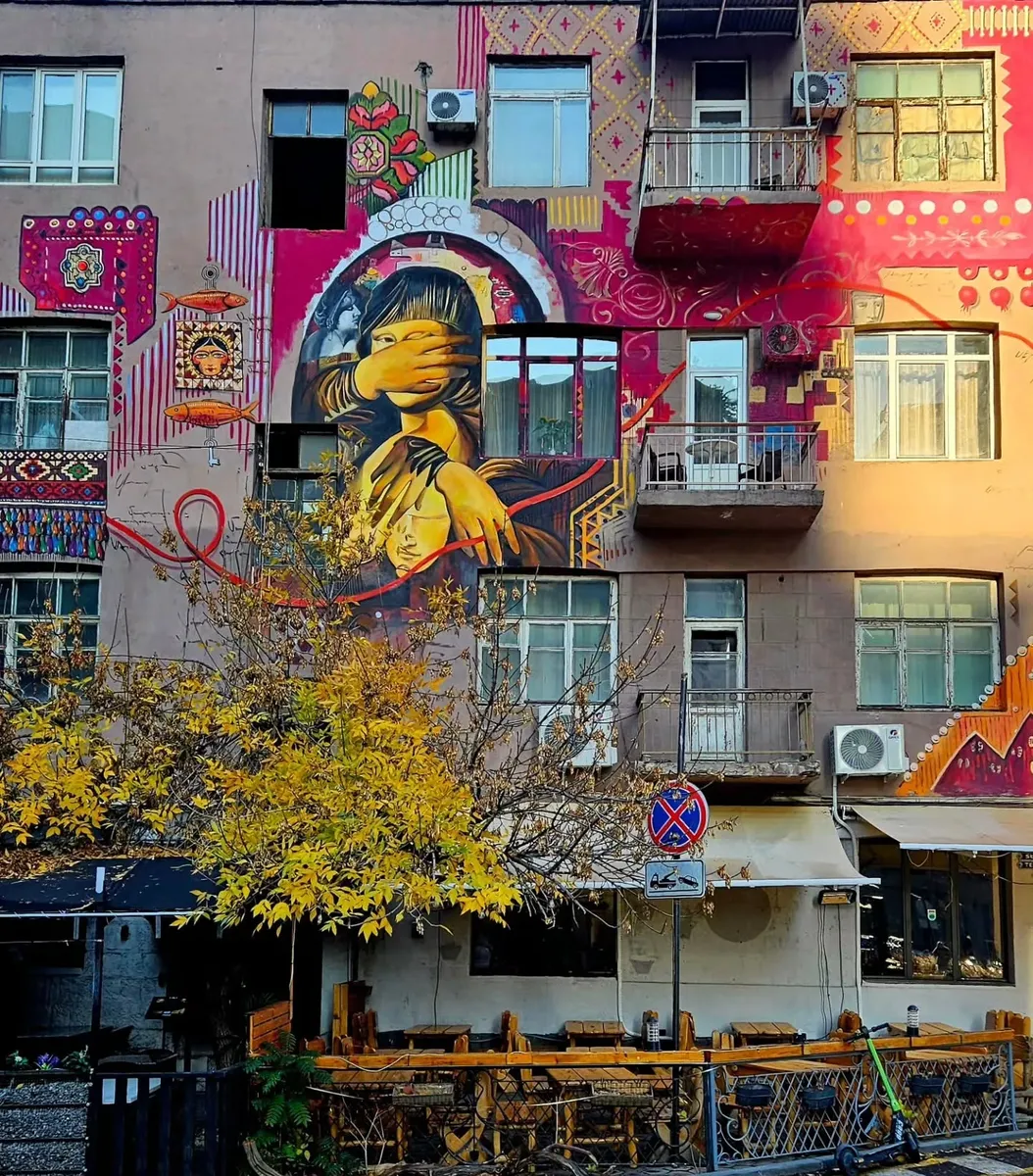
Mural "Parajanov". Northern Avenue, Yerevan. Photo: Garegin Harutyunyan archive
The famous street artist Banksy once noted that “graffiti defeats other forms of art because it becomes part of the city, a wayfinding tool. For example: I’ll be waiting for you in that pub where across the road there’s this wall with a monkey with a chainsaw painted on it.” If we talk about Yerevan, then murals have long become an integral part of it, but perhaps the most discussed among them today is the mural-collage “The Color of Pomegranates,” dedicated to Sergei Parajanov. It is impossible not to notice it when you walk along Northern Avenue, the main pedestrian street in the city center. It occupies the facades of three once completely ordinary four-story residential buildings, about which today they say: “pomegranate houses”, “Parajanov’s”, as well as “the house of “Ladies with an ermine”, “the house with Gioconda” and “the house with Parajanov”.
The authors of this collaged mural are artists Garegin Harutyunyan (GaReggin) and Harutyun Aghabalyan. They continue to work on it: there is still plenty of free space on the walls for new fragments of Parajanov’s fantasies. By the way, this spring the head of the administrative district of Ketron Petros Petoyan and the director of the Parajanov Museum Anahit Mikaelyan signed a memorandum of cooperation with the guys. This means that the street art of Harutyunyan and Aghabalyan in Yerevan is officially approved, paid for and has a future.
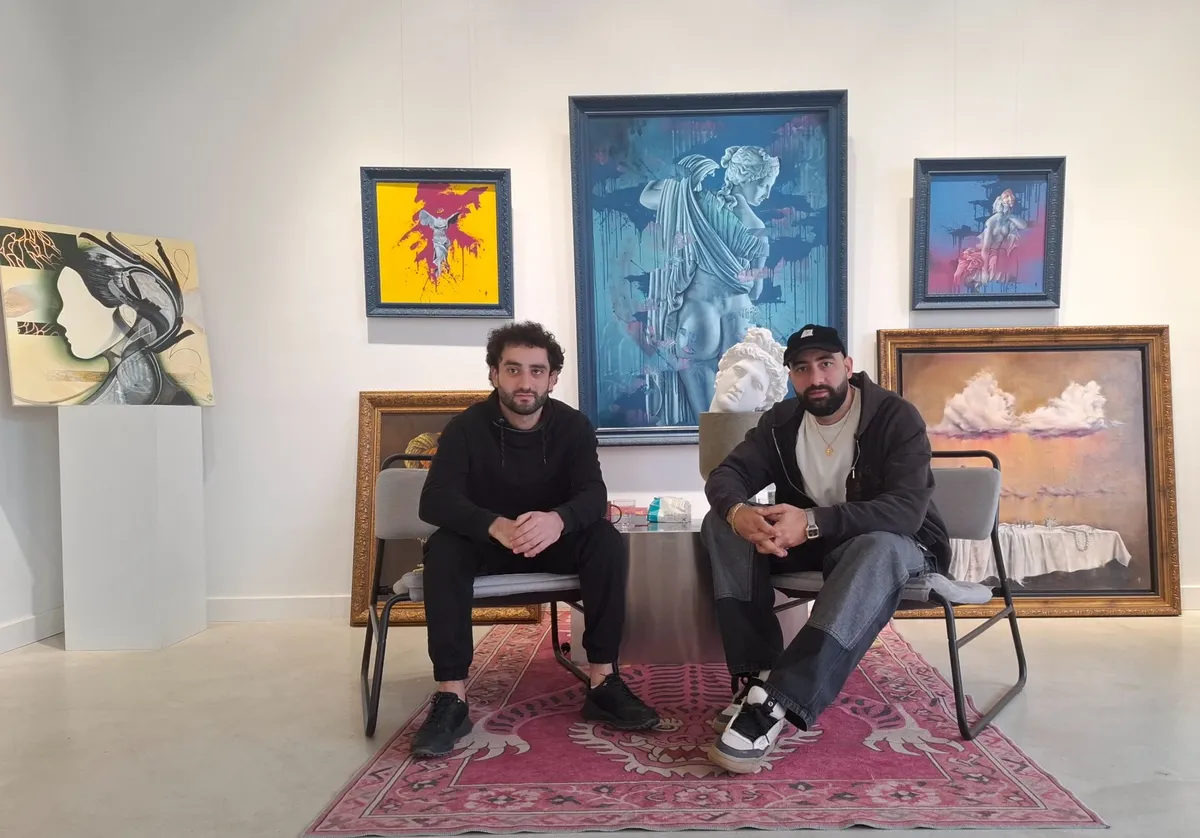
For a conversation and personal acquaintance, Garegin Harutyunyan invited me to his studio Gareggin Art Studio. It is located on the first floor of a new building near The Dalma Garden Mall - with display windows, spacious and very bright.
In addition to Garegin, his friends work in the studio - designers, tattoo artists, painters. In total - eight people. They are all united by a healthy ambition to work so that they say about the capital of Armenia: “Oh, there is so much good art in Yerevan!”
Garegin Harutyunyan graduated from the Hakob Kojoyan Higher School of Arts, the Armenian Pedagogical University and the Yerevan Academy of Arts. He considers his grandfather, the architect Albert Zhamkharyan, to be his first and main teacher. Today, Garegin Harutyunyan’s solo surreal works are in private collections in the USA, Russia, Poland, and Lithuania. And he works on street art projects in collaboration with his friend Harutyun Aghabalyan; their graffiti and murals can be seen not only in Yerevan, but also in Dilijan, Gyumri and even on the island of Bali.
“Garegin and I understand each other very well,” says Harutyun Agabalyan. — We develop the ideas for all the murals together. And then we create them together too. The result is the illusion that the mural was painted by one person. This is what we strive for!
The guys created the first mural at the end of a three-story administrative building of a former garment factory in Dilijan, this was in 2022. At that time, the Karifabrika cultural cluster had already begun to be created on the territory of the bankrupt enterprise, and it was important for the artists to record the historical past of this place with their work.
In 2023, Garegin and Harutyun flew to the island of Bali. They were unable to rest for more than a week: after seeing an unfinished one-story stone house, they decided to decorate one of its gray, nondescript walls with a graffiti version of the bright painting “Walking Woman” by the outstanding Armenian artist Martiros Saryan.
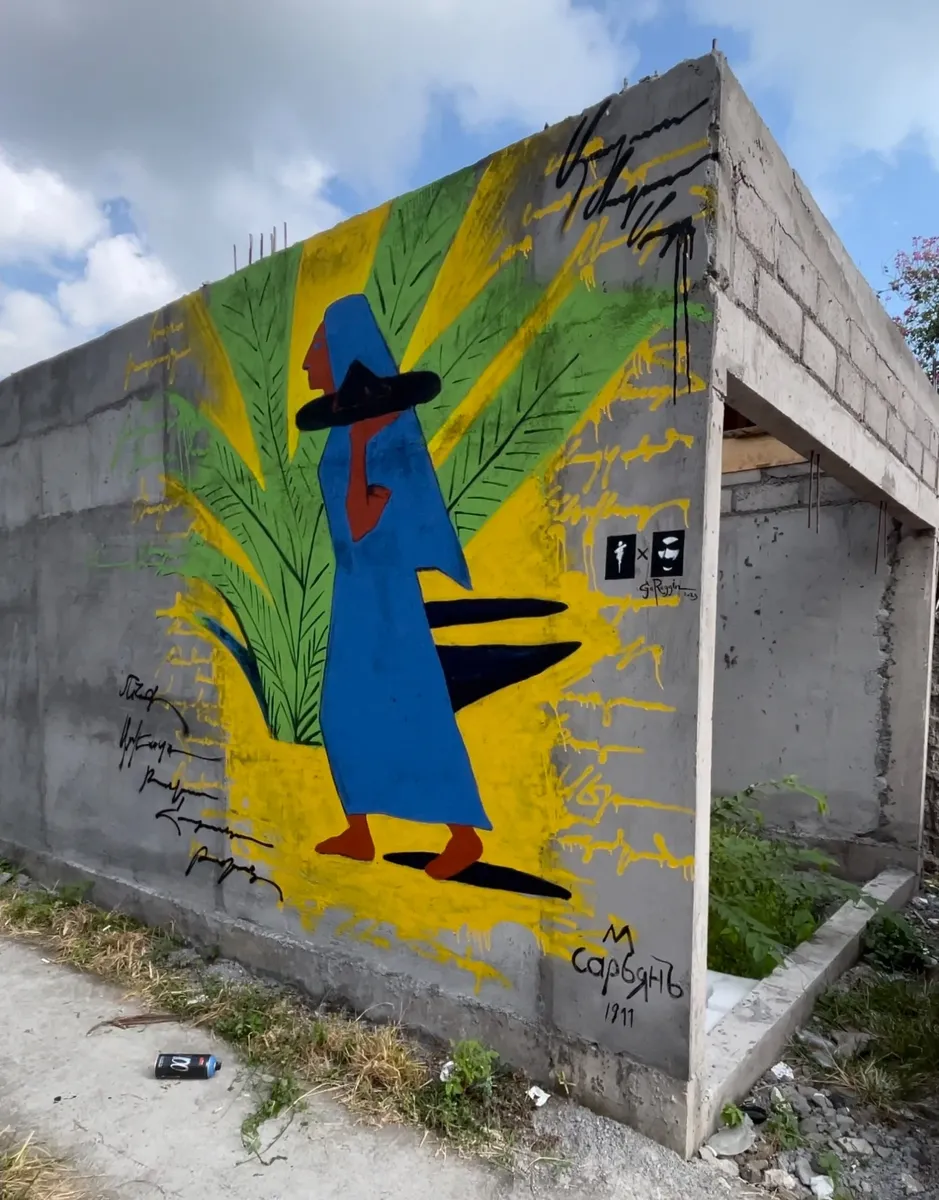
— From Yerevan to Bali is more than nine thousand kilometers. Perhaps they have never heard of such an artist as our Saryan. We wanted to introduce people from the other side of the planet to Saryan’s painting; we love and respect this artist very much,” says Garegin Harutyunyan.
The guys created their first Yerevan mural in 2025 at the end of one of the houses on Saryan Street. This is a surreal composition “Motherhood”.
— Every woman “keeps” the culture and traditions of her family, wisdom and grace. This is the most valuable heritage that she can pass on to the world, - this is how Garegin explains the meaning of the composition.
When in the middle of last year the creative duo Harutyunyan-Agabalyan was offered to improve the appearance of rapidly deteriorating four-story houses that did not fit well into the business style of modern Northern Avenue, the artists decided to use these houses to popularize the work of Sergei Parajanov.
— We chose Parajanov because he was a person who saw art differently than everyone else. His films and collages showed everyone our culture from a unique perspective. Parajanov proved with his creativity that you can be a free artist, even when everyone around him tried to limit him, says Garegin.
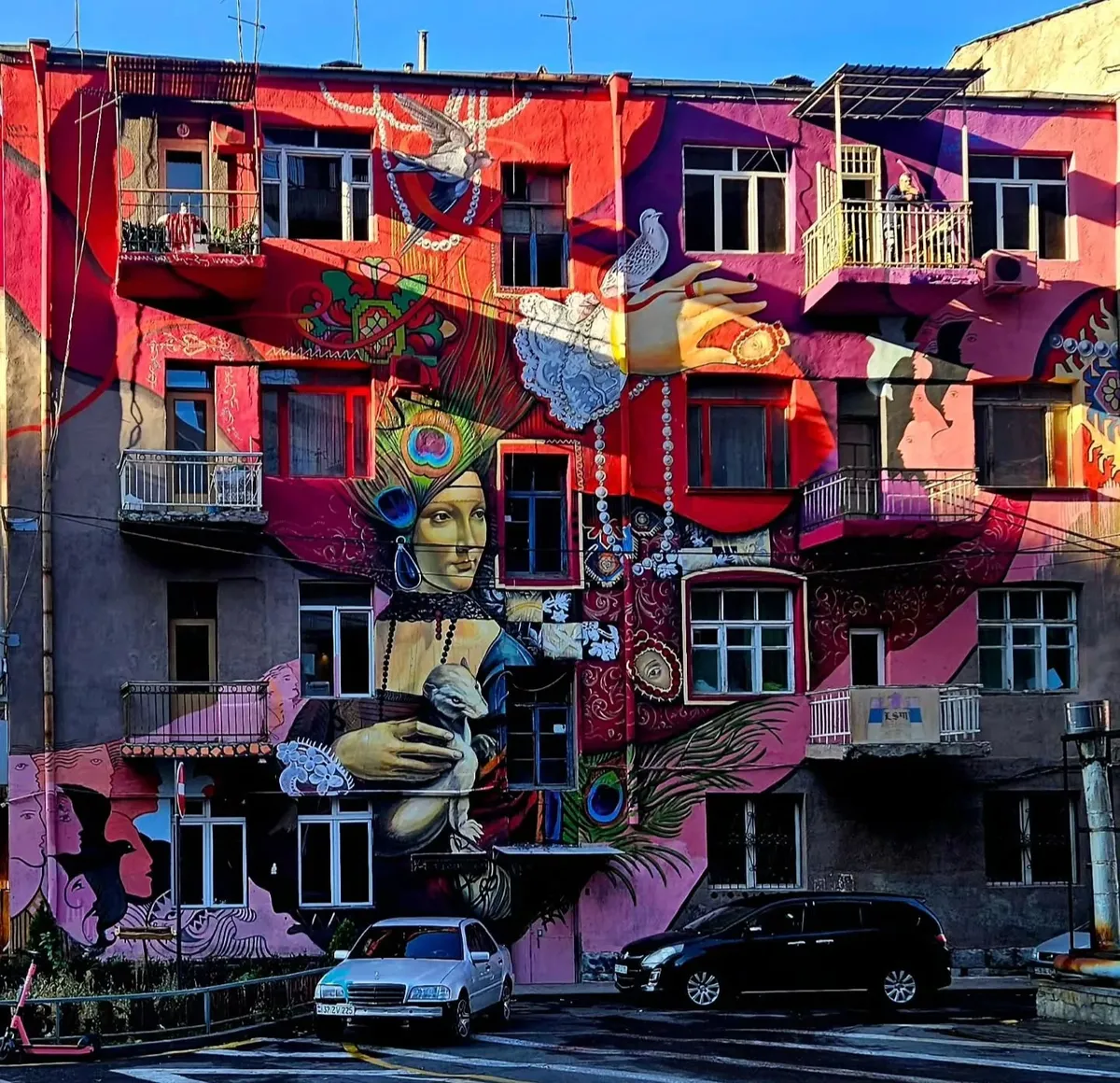
“For us, this mural is not just a wall painting. This is an opportunity to remember the great master and inspire new generations to recognize and appreciate his legacy,” adds Harutyun.
The artists worked on the sketch of the mural “The Color of Pomegranates” in Dilijan. The transfer of this sketch to the walls of a residential building in Yerevan was approached with caution: there were no guarantees that the residents would react favorably to them.
- Oh yes! At first the residents looked at us askance. They thought we would dirty the windows and balconies with it. And that we will generally ruin the appearance of the house. But we work very carefully, and we communicate with people with respect and politeness,” says Garegin.
“The residents quickly realized that they shouldn’t be afraid of us. And that there is no point in conflicting with us. They began to like our painting and watched our work with interest. Every now and then they came out onto the balcony to treat us to coffee and fruit,” recalls Harutyun. “Now when we meet, we even hug!” And some residents of the “pomegranate house” tell us that now they live in the most beautiful house in Yerevan!
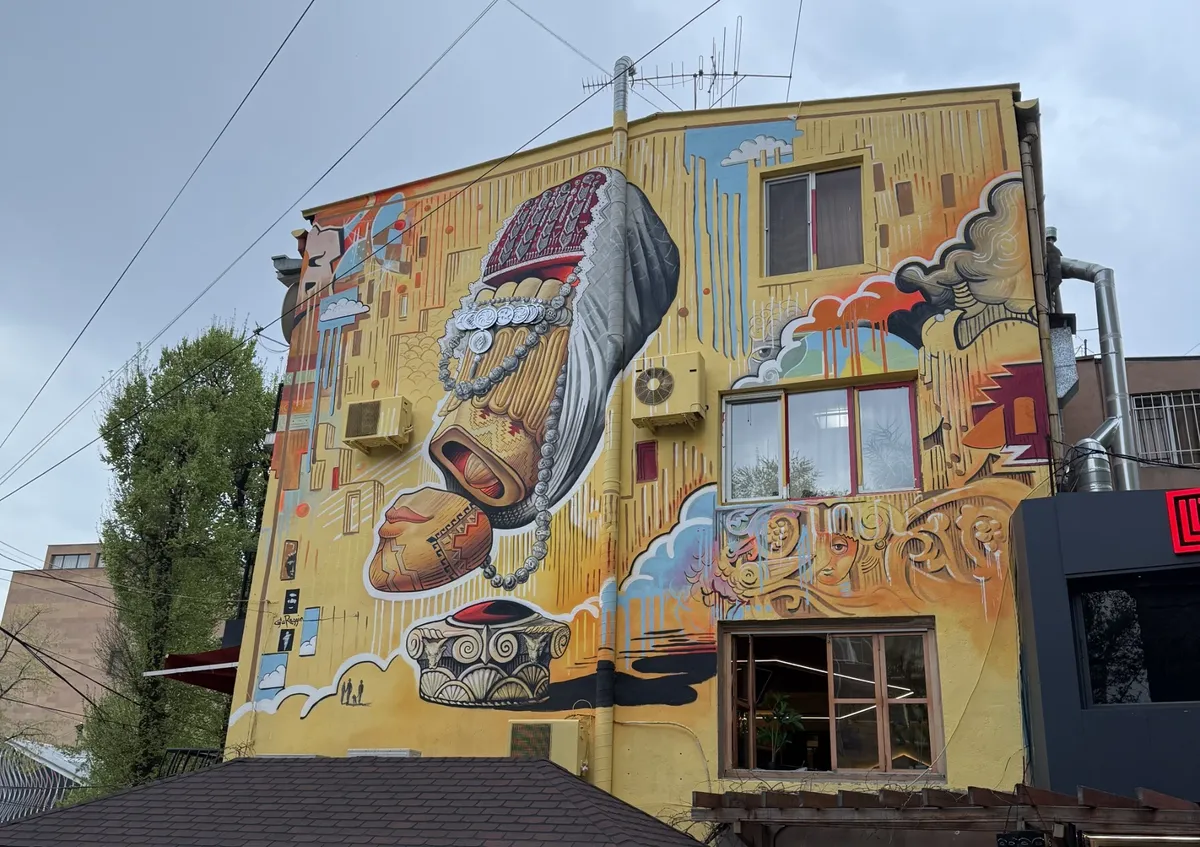
The uniqueness of this house, according to the artists, is that it not only attracts the attention of passers-by, but also carefully “looks” at them and at the city - through the eyes of Parajanov and the heroes of his collages. “The Pomegranate House” has become “alive”; it invites dialogue.
Without the financial assistance of the Kentron district administration, it would have been almost impossible to create this mural: to work at heights, you need to rent a crane, which is very expensive.
Closer to summer, the Harutyunyan-Agabalyan duo will continue working on the mural “The Color of Pomegranates.” At the same time, the artists will create a graffiti copy of the medieval portrait of the great Armenian poet and philosopher Grigor Narekatsi; it will decorate one of the stone verticals near the Yerevan Church of St. Sarkis, on the left bank of the Hrazdan River.
— What is the most difficult thing about working as street artists? — I ask Garegin and Harutyun finally.
Harutyun replied:
— Personally, for Garegin and me, the most difficult thing is not to look at the ground when you are painting the wall of a tall building. Because more than anything else in the world we are afraid of heights.
Aisylu Kadyrova