
Translated material
Selectivity of optimism
What's wrong with the president's encouraging assessments of the state of affairs in the Russian economy?

Photo: Vladimir Smirnov / TASS
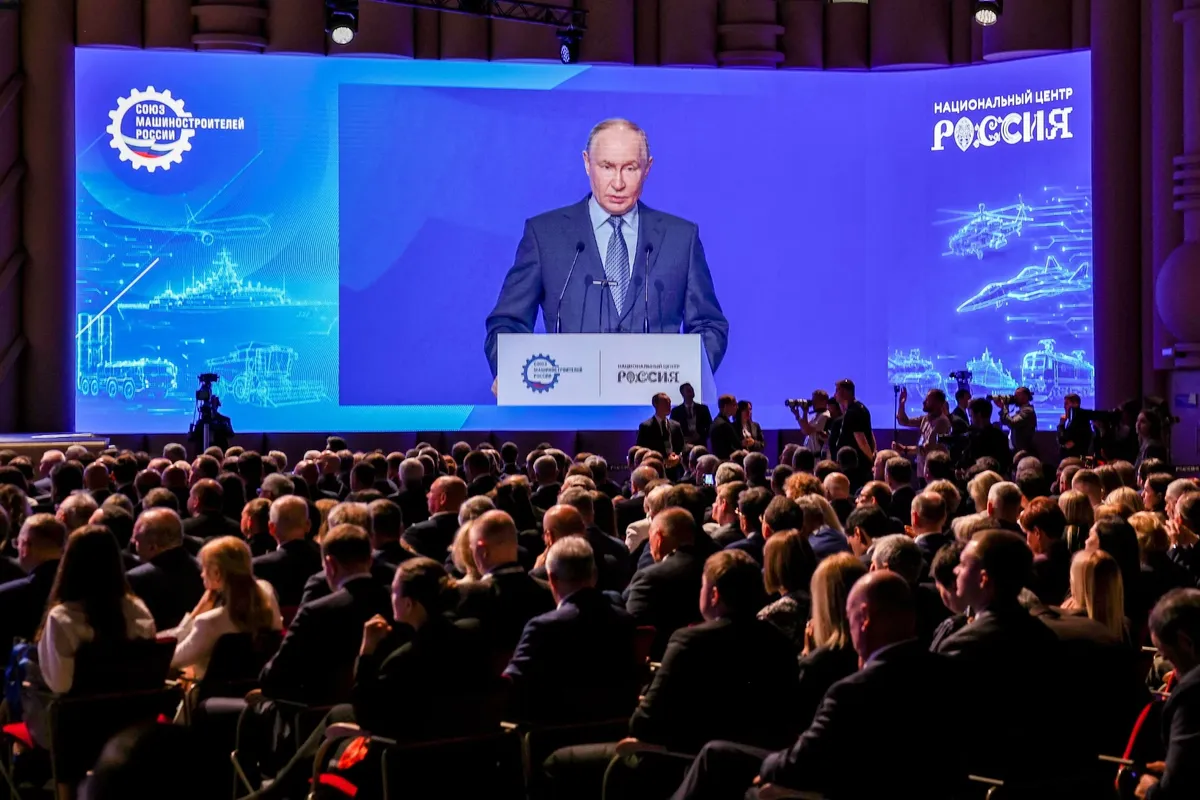
On May 14, the president attended the X Congress of the Russian Mechanical Engineers Union and gave a lengthy speech there on the state of affairs in the economy. By the way, not so long ago Putin met with large private businesses, but at that meeting he spoke in the sense that he came because he was invited, and there was nothing special to talk about.
As they say, feel the difference and evaluate your priorities. Mechanical engineers are Rostec, Roscosmos, Almaz-Antey, Uralvagonzavod. These are the main recipients of budget money and government orders, corporations of “priority areas,” as experts carefully call them. That is, the very ones that ensure the fulfillment of “military-political tasks” for the sake of which the Russian economy was so distorted. What about business? What's business? He should just chip in for the same thing, and he will chip in - without any additional meetings or conversations. So what did the “locomotives” of the Russian economy learn?
Nothing new, except how to correctly assess what is happening in the public sphere, even if in reality something else is happening. The assessments expressed by Putin are precisely a concentrated expression of the official view on current economic dynamics.
The key feature is the reliance on positive values of individual indicators for March 2026 in the absence of any context that would allow assessing the sustainability and nature of the recorded improvement. And in general: are there any improvements?
Let's see how the president's theses look in comparison with the available statistical data and in that very context.
1. “The measures [of the government and the Central Bank] gave a positive result” and “positive statistical data for March”
The statement is based on the March surge in a number of statistical indicators. Indeed, in March 2026, industrial production grew by 2.3% year-on-year, manufacturing by 3.0%, retail trade by 6.2%, wholesale by 8.0%, and GDP increased by 1.8%. However, interpreting these figures as evidence of a reversal of the trend for the better for the economy requires serious reservations.
First, the March figures are based on an extremely low base in January-February, when the economy experienced difficulties due to the simultaneous impact of the calendar factor (three working days less than a year earlier) and abnormally cold weather. According to the Central Bank of the Russian Federation, the calendar effect could subtract up to 0.5 percentage points from the annual GDP growth rate. In March, this effect was completely exhausted, and in a number of industries the closure of quarterly plans was added, which affected the final statistics. Thus, the March growth is largely explained by the compensation of temporary dips, and not by the start of a new expansion cycle.
Secondly, (this is just about context) the summary indicator for the first quarter generally remains negative or near zero: the Ministry of Economic Development’s GDP estimate is minus 0.3% year-on-year, the index of basic economic activities is minus 0.7%. Following the results of the quarter, the manufacturing industry went into the negative zone for the first time since 2022 (-0.7%), and the positive result of the industry as a whole (+0.3%) was ensured only by a slight increase in mining production.
Thirdly, macroeconomic indicators do not support the version of a stable positive reversal. The manufacturing business activity index (PMI) dropped to 48.1 points in April, returning to the compression zone.
What those gathered, of course, knew about - for they “shrank” themselves, but chose to remain silent.
2. “Overall, the country’s GDP increased by 1.8% in March”
The figure is correct, but its isolated presentation to the audience somewhat distorts the picture of economic dynamics. The March pace looks high precisely because it is compared with March 2025, when the dynamics were weak. At the same time, according to the results of the first quarter, GDP decreased by 0.3%, and the official forecast of the Ministry of Economic Development itself for 2026 in the base case assumes growth of only 0.4% - that is, the economy is teetering on the brink of stagnation and recession. A conservative version of the same forecast assumes a decline of 0.5%. Against this background, highlighting the March indicator as evidence of the success of the measures taken looks flawed.
3. “Consumer activity has accelerated,” retail added 6.2%, wholesale – 8%
When analyzing these numbers, it also makes sense to consider the effect of a low base and one-time factors. In January-February, retail trade turnover, according to Rosstat, increased by only 0.5% year-on-year; the index of entrepreneurial confidence in retail fell to minus 8 points, the minimum since 2006. The March surge was concentrated in the non-food segment (+9.1%), where pent-up demand for passenger cars played a significant role. At the same time, at the end of the year, the Ministry of Economic Development predicts an increase in the total turnover of retail trade, public catering and paid services by only 1.2% - three times lower than last year, and the growth of real disposable income of the population slows down to 0.8%.
The statement about the acceleration of consumer activity, therefore, is valid only for one month and does not reflect either quarterly or annual dynamics.
4. “Industrial production increased by 2.3%, manufacturing industry by 3%”
Yes, Rosstat data confirms this. However, a structural analysis of industry dynamics shows that the March jump of more than 80% was ensured by an increase in output in sectors related precisely to the “priority government order” - that is, provided by those who listened to this speech by the president. But at the same time, 19 out of 24 types of activities in the manufacturing industry showed a decline in the first quarter. Industries such as metallurgy (minus 10%), woodworking (minus 7%), chemical and textile production deepened the decline.
It turns out that the positive dynamics of a narrow group of dual-use industries masks the ongoing contraction in most civilian industries. 5. “Unemployment remains at a low of 2.2%” The unemployment rate is indeed at historical lows. However, its persistence in the context of a slowing economy is explained not by the expansion of demand for labor, but by the peculiarities of the market’s adaptation to difficult realities: companies, fearing a future shortage of personnel, do not lay off staff even with a decrease in workload, but are moving to part-time employment and curbing wage growth.
Low unemployment in this case is not an indicator of the health of the economy, but on the contrary: a reflection of its structural imbalances.
6. On the need to “consolidate positive momentum” and “prioritize support for growth”
This call by the president comes into certain conflict with the actual economic policy pursued by his own government.
Currently, budget, tariff and monetary policies are primarily aimed at redistributing resources in favor of “priority sectors”. The growth of regulated tariffs for 2027–2029 is planned at a level twice the inflation target. The key rate is projected to be 14.0–14.5% on average for 2026, which limits investment activity.
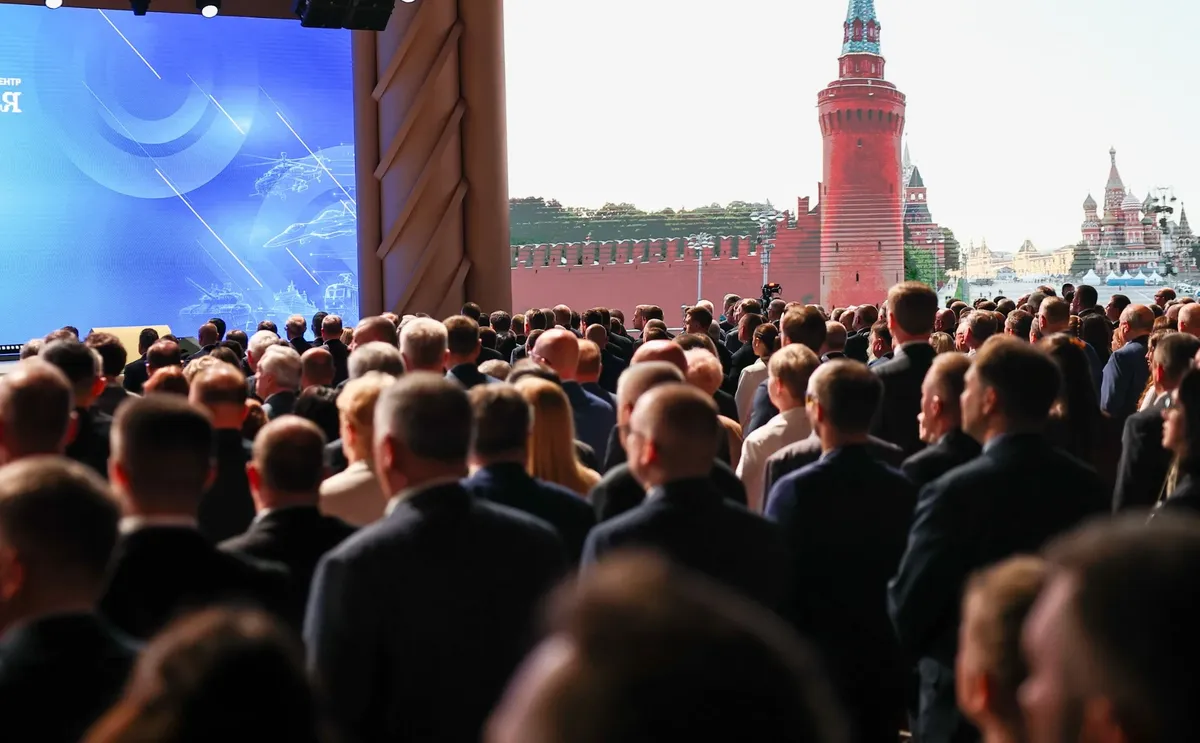
Under these conditions, how should we react to statements about primary attention to economic growth? More like declarations. Well, or as for the mantra on duty “to the public” - not the one that gathered in the hall, but to the television audience.
***
The discrepancy between public estimates and data contained in official government documents (near-zero GDP dynamics in 2026 and the risk of recession) is the main thing that must be taken into account in any analysis of Russian economic policy.
Nikolay Belyaev