
Translated material
How to lose to everyone at once
Local elections in Britain have become a referendum on confidence in government and a political springboard for right-wing populists
At the beginning of May, local elections were held in Britain, the results of which impressed both experts and ordinary voters. The routine procedure actually turned into a vote of no confidence in the government. Even those who predicted the failure of the Labor Party were shocked by the scale of the political earthquake, which revealed public fatigue and a thirst for change.
In England, the composition of councils of districts and small towns was determined, and in Scotland and Wales new compositions of regional parliaments were formed.

YouGov polls even a few weeks before the vote painted a picture that was not pleasant for Prime Minister Keir Starmer: the majority of Britons expressed dissatisfaction with the work of the government, and the prime minister himself increasingly looked like a politician who, instead of the promised reset, brought the country only additional problems.
The failure of the Labor Party was predictable, but the real scale of what happened shocked even the skeptics.
Already in the first hours after the votes were counted, the British media vied with each other to find synonyms for the word “catastrophe” - and this word, when applied to the current situation, did not look like an exaggeration.
In England alone, Labor lost 1,496 local council seats. In the British system, it is these councils that are responsible for everyday life, from roads and waste collection to planning permission and new car parks. In addition, Starmer's party lost control of 38 councils. For the party in power, this means the loss of an entire layer of political infrastructure. In dozens of places where Labor had once confidently controlled local government, it has completely lost its control.
But the main thing is that these elections for the first time recorded on paper what political scientists have been warning about for the past few years. Britain is finally ceasing to be a country where two big parties take turns replacing each other in power, and all other political forces exist somewhere on the periphery. According to the BBC summary table , which recounts local voting results and projects them into a conditional national picture, the populist Reform party received the most votes - 26%, followed by the Greens - 18%, and the Conservatives and Labor received only 17% each.
How the elections shook the prime minister's seat
The results of the May elections provoked a real storm in the ranks of the ruling Labor party. Before the vote, Downing Street could still talk about “tough decisions”, the “challenging Tory legacy” and the need to give the government time. But after the local votes were counted, these arguments no longer worked. When the party in power loses nearly 1,500 local council seats in England, loses the lead in Wales for the first time, and fails to make the expected breakthrough in Scotland, it no longer looks like temporary voter fatigue. This looks more like a signal of serious problems: voters are not just annoyed by the policies of the party in power - they are actively trying to find a replacement for it.
Keir Starmer reacted to the failure of Labor in his usual manner - without much emotion and without the slightest hint of voluntary resignation from the post of prime minister.
As he assembled the Cabinet in Downing Street, he said he was responsible not only for the election defeat, but also for the failure to fulfill the promises with which Labor came to power. And to fulfill them, you need to stay in power and work. “The country expects us to continue to govern. This is what I do,” the prime minister said.
However, not everyone in the party agreed with Starmer's position. By mid-May, 95 Labor MPs out of 403 in parliament, including several members of the government, spoke in favor of Starmer's resignation in one form or another (in Britain, members of the government remain members of parliament). Some demanded that the prime minister leave immediately, others demanded that he at least name the timing of the transfer of power for the election of a new leader.

Behind the scenes, several cabinet ministers, including Home Secretary Shabana Mahmood and Foreign Secretary Yvette Cooper, spoke out against Starmer, BBC sources said. The first member of the government to resign was Deputy Minister of Housing Miatta Fahnbulle. At the same time, she called on Starmer to name a clear deadline for the transfer of power. She was followed by Parliamentary Secretary for Women and Children Jess Phillips. Former Health Secretary Wes Streeting said if a leadership race was called he would take part in it.
At the same time, the very need to track who remained silent, who supported, who came out through which door and who said what to journalists already shows the scale of the crisis engulfing the Labor government. Typically, politicians watch their opponents with such intensity and attention, not members of their own cabinet.
But the most serious challenge for Starmer came from the actions of the mayor of Greater Manchester, Andy Burnham, whom the British press long ago dubbed the “king of the north.” Many in the party consider Burnham to be a more charismatic and “popular” alternative to Starmer. And Burnham himself seems ready to get into the game. Shortly after the election, he announced that he was ready to return to the British Parliament. There is more behind this statement than meets the eye. The status of a member of the British Parliament is a prerequisite for participation in the election of the Labor leader (he will also become prime minister if the current head of the cabinet resigns).

Burnham's supporters organized the opportunity to return to parliament with lightning speed. Already on May 14, the MP for the Makerfield constituency - this is between Manchester and Liverpool - Josh Simons announced his resignation. This means that early elections will soon be held in the constituency to choose a replacement for the retired Simons and send a new MP to the British Parliament.
However, Labor - including Burnham - will still have to fight for this seat. The Makerfield constituency is a perfect example of how Labor is losing voters even in places where people used to vote for them for decades. More and more votes are flowing to the Reform party and Nigel Farage.
The day the Reform Party became the first
Let's finally talk about the main winner of this vote - the Reform party, led by right-wing populist Nigel Farage. It received 1,453 parliamentary seats and control over 14 municipal councils. This is the most important result, because it confirms that Reform has turned from an irritating party into a real force at the municipal level. Where only yesterday it had no power, no leverage, no responsibility, now hundreds of elected representatives and the first full-fledged springboards of local power have appeared.
Farraj's party performed especially well in England outside London. Reform was confidently capturing areas that had voted Labor for decades. In the British political dictionary there was even a separate phrase for such places - red wall. These are former industrial constituencies in the north and midlands that have been an area of strong Labor support for years. Now people are increasingly voting not for leftist economics, but for irritation, anger and one charismatic politician who promises to punish the elites for their inaction and indifference to the fate of the little British man.
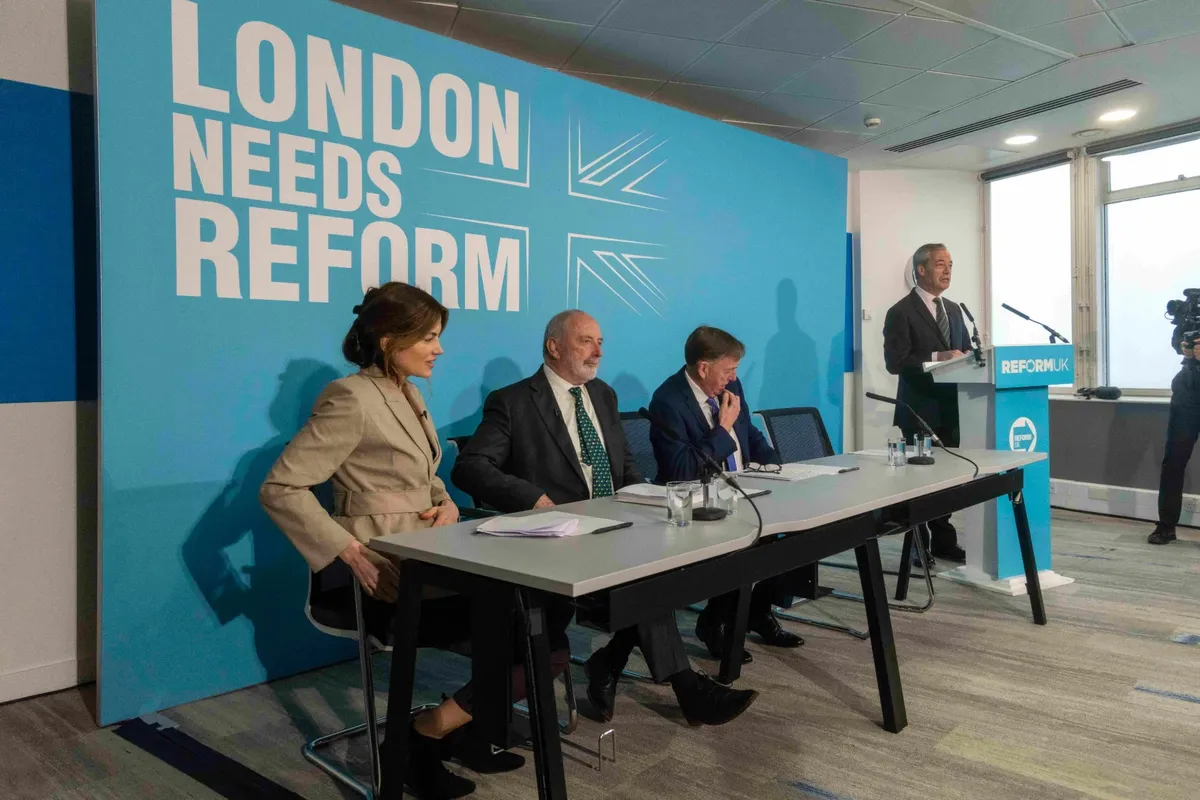
Nigel Farage has successfully touched several sensitive nerves in British society. According to YouGov and post-election analysis of the British press, Reform received particularly strong support among older, less affluent, less educated and more disillusioned voters, among those who supported Brexit, and among people who believe that traditional parties have long since stopped talking to ordinary voters and realistically reflecting their aspirations.
Reform has made talk of losing a sense of control a theme of its campaign. It was this calming sense of control that she promised to return to people (classic populism with a right-wing bias).
Another secret to the success of Farage and his party is simplicity. While Labor and the Conservatives have meticulously explained why the country's economy has time and time again turned out to be more complicated than it seems, Reform argues that it is actually much simpler than you were told. And judging by the survey results, people like this message. This may not be the best news for the country's intellectual life. But for electoral politics, Reform is an effective strategy.
And the bet paid off. Reform was able to capture the votes of not only former Conservative voters in southern England, but also former Labor supporters in the north and central parts of the country. In London, however, Reform's success was extremely limited. The capital's electorate is younger and less receptive to this type of campaigning.
England, Scotland and Wales: the collapse of the old order
If Labor had failed only in England, then Downing Street could still pretend that the main reason for everything was just an unfortunate local situation in one particular part of the UK. But the results in Scotland and Wales showed that the political divide runs much deeper.
In Scotland, the Scottish National Party (SNP) won again. According to the consolidated results, it won 58 seats. And Labor and Reform shared second place, receiving 17 seats each. This is a painful outcome for Labour. Several years ago, the party hoped that independence fatigue and generational change would allow Labor to return to its status as the main alternative to the SNP. However, Starmer's party members not only failed to achieve this, but also shared second place with Reform, a party that they had not taken seriously until recently.
Wales went even further. There, the largest force for the first time became Plaid Cymru, the Welsh National Party, which had long been something of an outside irritant for Labor but was never perceived as a systemic threat. Now everything is different. Plaid received 43 seats. In second place is Reform Wales with 34 seats. Labor fell to third place, winning only nine seats.
...Labour's defeat can be explained by several reasons. And the first of them is that the party was unable to convince people that life, albeit slowly, is changing for the better. Labor came to power promising progress and solutions to stagnant problems. But in the end, the lumbering machine led by Starmer was unable to create even a sense of movement. The majority of Britons believe that the cabinet is doing a poor job of dealing with economic challenges, the problem of filling the budget and immigration.
As a result, the party lost support in several layers of society at once. Those who wanted tougher decisions on migration issues voted for Reform. And those who considered Starmer too cautious, bureaucratic and paying little attention to the “social sphere” switched to the Greens and the Liberal Democrats.
Keir Starmer's multi-year strategy has failed. For years, all his actions were based on accuracy, discipline and refusal to take risks. After the turbulent reigns of the last few Conservative prime ministers, this seemed like a sensible strategy.
But the chest turned out to have a double bottom: normality works when the voter wants a break. Yet in 2026, large parts of the British electorate wanted simple, quick solutions to problems that had been building up for years. Starmer has carefully built an image as the calm leader of a competent team of reformers. However, as a result of the prime minister's excessive indecisiveness and caution, his cabinet began to look not like a government of change, but like a type of old apparatchik, as far removed from the people as possible.
The Conservatives also lost, but less noticeably
For the Tories, the results of the May elections also turned out to be very painful. Although the ruling party failed the campaign, voters never turned towards the official opposition.
The Conservatives lost hundreds of seats in local elections in England, especially in the south and east - parts of the country that for years were considered their fiefdom. In London the figures were slightly more optimistic. But in general, the Tories have not come up with an answer to the question: why vote for them if Reform is now on the ballot with even more right-wing slogans, and on the left the Liberal Democrats are offering a more moderate program?
Historically, conservatives have been a melting pot of people of all shades of right-wing views, from business conservatives to cultural traditionalists. But now this machine no longer works.
Some former voters, considering the Tories too cautious and old-fashioned, are going to Farage. And another part of the electorate, tired of the constant crisis and economic instability provoked by Brexit, does not want to return to a party strongly associated with the chaos of the last Conservative governments.
What's next?
The main outcome of this election is clear: the two-party system that has defined British political life for the last century no longer describes British politics. The swing, which worked on the principle “if one of the two big parties loses votes, the other automatically gains them,” stopped. They were replaced by a still unusual leapfrog. Britain is entering a period of more fragmented and less predictable politics.
“The results of this election highlight and confirm the division and fragmentation of British politics,” says leading British election expert John Curtis.
In the future, this may contribute to the rise of forces that in reality are supported by only a small part of the population.

“In fragmented politics... a relatively low but still winning vote share can yield disproportionate benefits. As a result, this could open up the possibility of governments being elected - including even majority governments - on the basis of relatively low shares of the vote,” Curtis notes in his extensive analysis for the BBC.
The coming months will certainly not be quiet for the Starmer government. After a failure in the elections, any controversial government decision will be perceived especially sharply, any compromise as a sign of uncertainty, and personnel changes as a possible preparation for internal struggle. If the cabinet of ministers fails to show the public at least a few noticeable successes in the near future, talk about a possible change of prime minister will become louder and louder.
The election results also show that the debate about the possible independence of Scotland and its separation from Britain is not closed.
With parties pushing for a more autonomous - and sometimes radically different - relationship with London gaining strength in Cardiff and Edinburgh, the central government will not be able to simply ignore extremely painful and sensitive issues about the future of the United Kingdom for years.
The May elections may also have foreign policy consequences. Of course, we shouldn’t expect any fundamental changes in Britain’s position on all key issues. However, a cabinet under political pressure will clearly face additional difficulties in making difficult decisions. And there are many difficult issues on the agenda: from restarting relations with the European Union in key areas to spending on defense and industry and, of course, migration policy.
If we try to sum up the outcome of the May 2026 election in one sentence, we can say that British politics is once again becoming a space where almost anything is possible - except perhaps boredom.
Margarita Krovelschikova