
Translated material
Did Philip Kirkorov help Bulgaria win Eurovision? Not everyone confirms the involvement of the Russian artist. Russian propaganda is trying to “appropriate” success for itself
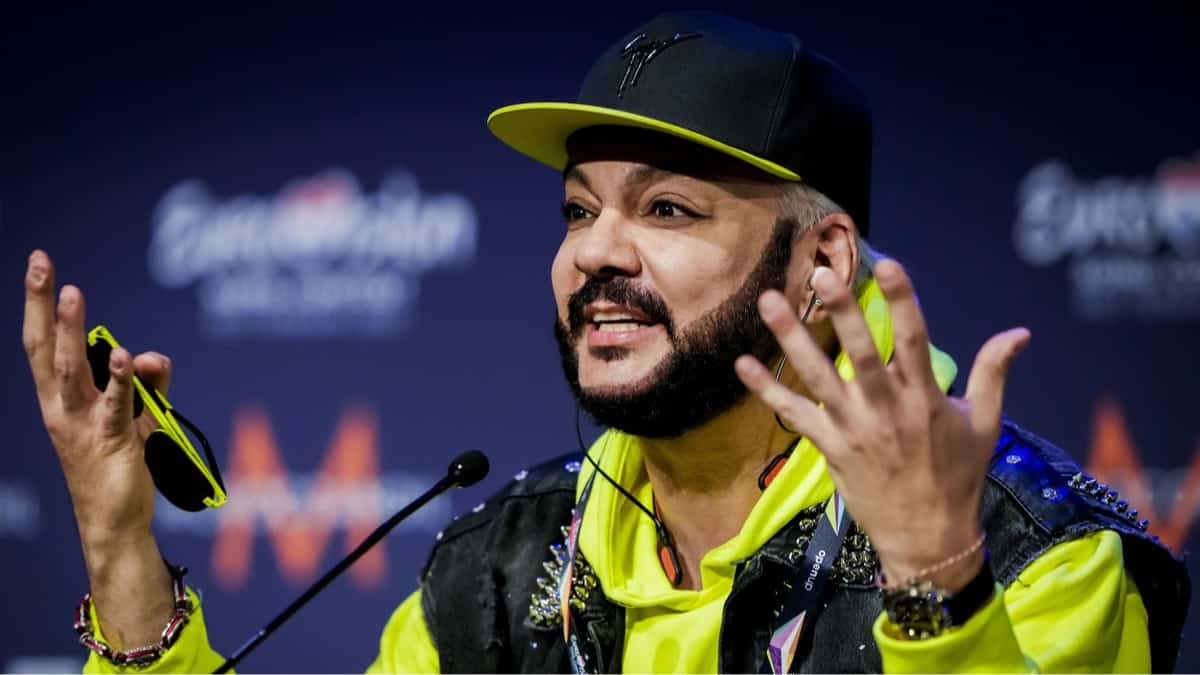
Not everyone confirms the involvement of the Russian artist. Russian propaganda is trying to “appropriate” success for itself
Russian singer Philip Kirkorov, who supports the actions of the Russian authorities, said in an interview with Yana Churikova that his team helped the Bulgarian singer Dara win Eurovision 2026 with the song “Bangaranga”. According to him, he could not refuse his “small homeland” and began preparing the singer from scratch - from choosing a hit to working with sound engineers. However, officials and participants in the trial say that they have not heard of Kirkorov, and his name is not on the official lists of participants.
In a conversation with Novaya-Europa, Bulgarian analyst Georgi Angelov admitted that Kirkorov could really help the Bulgarians. However, according to the editor’s interlocutor, something else is much more important: the story about the artist’s involvement fits perfectly into the mechanics of pro-Russian disinformation.
Kirkorov is a regular participant in Eurovision. In 1995 - as an artist: he represented Russia and took 17th place. Then - as a producer and co-writer of songs. He helped some Russian artists, for example, the Tolmachev sisters (2014, 7th place) and Sergei Lazarev (2016 and 2019, both times 3rd place). He also worked with Belarusian Dmitry Koldun (2007, 6th place), Ukrainian Ani Lorak (2008, 2nd place) and Moldovan artists - the group DoReDos (2018, 10th place) and singer Natalia Gordienko (2021, 13th place). But never before had the team with which Kirkorov collaborated won.
At Eurovision 2026, which ended on May 16, the Bulgarian singer Dara took first place with the song “Bangaranga”. Immediately after her victory, information appeared about the participation of the Russian singer in the preparation of Bulgaria: immediately after Dara’s victory, Russian TV presenter and regular commentator of the competition Yana Churikova included an “exclusive” voice message from Kirkorov in her stream. He said that it was his Dream Team that prepared the artist for the performance:
“It’s a sin for me not to stand under the flag of my small homeland, Bulgaria, with which I have so much in common. When Bulgarian television approached me with a request to support Bulgaria this year, I could not deny myself the pleasure. <...>
I don't have to be there for the business to live and exist. Therefore, we began preparations, chose a singer, and began preparing for the Bulgarian national selection,” said the artist.
The Dream Team, according to Kirkorov, also includes the Greek composer Dimitris Kontopoulos - and he is indeed listed as one of the composers and authors of the words of “Bangarangi”. Kontopoulos is the author or co-author of many competition songs produced or promoted by Kirkorov for different countries. So, in 2014, Kontopoulos and Kirkorov wrote the song “Shine” for the Tolmachev sisters - Russia took 7th place at Eurovision. In 2016, their song “You Are The Only One” with Sergei Lazarev brought Russia 3rd place.
Kirkorov called performer Dara a "wonderful singer" but said she had one problem: "She didn't have a hit."

- This is how it happens. Voice, appearance, dancing. But there was no hit. But we saw potential in it. “I saw that she could be a diva,” the singer said.
Dara won the Bulgarian national selection, performing three songs in the final. According to Kirkorov, they were written by Dimitris Kontopoulos. On a website run by Eurovision fans, Kontopoulos is listed as the composer of Curse , This Is Me and Bangaranga . The official website of the Bulgarian broadcaster BNT confirms that Dimitros is at least a co-author of “Bangaranga”. On the singer's official YouTube channel, Kontopoulos is also listed as the composer of Curse, but there is no mention of his work with This Is Me on the same channel.
Churikova explained Kirkorov’s decision to talk about his work with Dara only after her victory as a conscious act of the Russian artist: according to her, he began to “disown” the competition in advance, so as not to harm the Bulgarian delegation. Although Kirkorov did not come to Sofia, he was constantly in touch with Dara’s team, Churikova claims.
According to her information , Russian sound engineers Andrei Konoplev and Gleb Elesin, who work with the Dream Team, also participated in the creation of “Bangarangi”.
Neither the singer’s team nor Bulgarian TV officially confirmed information about Kirkorov’s involvement in the preparation of Dara’s performance. Kirkorov's specific contribution to Bulgaria's victory at Eurovision remains unclear. However, producer and composer Kontopoulos on his Instagram reposted the story of singer Sergei Lazarev, who wrote that “Dream Team” worked with the singer Dara, not without the participation of Philip Kirkorov.
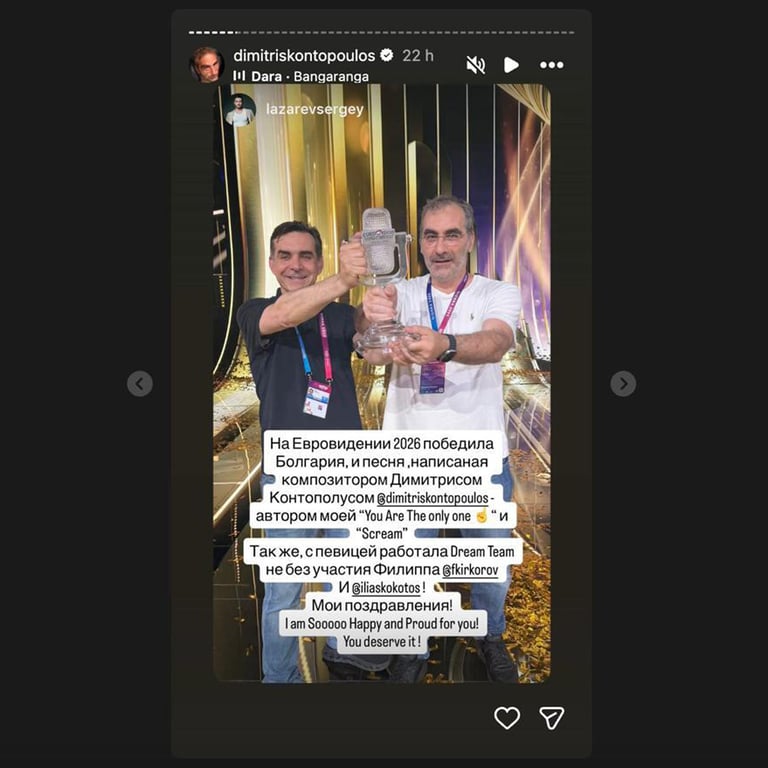
“New-Europe” wrote official requests asking the singer’s team, Kontopoulos, sound engineers Andrey Konoplev and Gleb Elesin, as well as producers Ilias Kokotos and Monoir (real name Cristian Nicolae Tarcha) to clarify the situation.
By the time the editorial material was published, only Monoir responded: he stated that he personally did not know whether Kirkorov participated in working with Dara.
A representative of the Ukrainian delegation, which also participated in the work on Dara’s speech, said that he had not heard about Kirkorov’s involvement. “At all stages of the preparation of the performance - from the moment the participant’s song was selected to the final performance - there was no mention of his participation on the part of the producing or directing team,” creative director Nicholas Chobb told MUZVAR. He believes that Kirkorov’s attempts to take credit for the victory may be his desire to “remind himself.”
According to Chobb, the Ukrainian team made a big contribution to the scenery and video content of Dara: “I worked with the Bulgarian team as a creative advisor - the person to whom the production team turned for creative assessment, performance recommendations. Participated in the development of the appearance and functionality of the main decoration of the room together with the Ukrainian production designer, as well as in the creation of video content for LED screens.”
The director of the Bulgarian National Television, Milena Milotinova, also did not say a word about Kirkorov when she listed the members of Dara’s team: “The secret of Dara’s success lies in the excellent team that stood behind her, in the fact that BNT, through the national selection, managed to choose a very good performer - the best to participate in Eurovision.” And in the second national selection, we managed to choose, with the help of the jury and the audience, the best song. The team behind Dara had people who had already won. They are from Greece, Romania, Sweden and they know how to pave the way to victory. This brought success,” she said.
Georgi Angelov, a senior analyst at the Bulgarian media monitoring company Sensika Technologies, noted in a conversation with New Europe that Kirkorov had previously had close contacts with Bulgarian national television:
— Kirkorov is a Bulgarian, he has many connections in Bulgaria. His repertoire includes songs written by Bulgarian composers.
It's just a connection between two countries, we really have a cultural connection - both in a good and in a bad way. I don’t think there is any need to look for any subtext related to wartime,” said the interlocutor of “New Europe”.
According to Angelov, it is impossible to say for sure about Kirkorov’s contribution to Eurovision 2026, but he could unofficially somehow help with the music, his connections and team. However, his name is not on the official lists of producers and composers - only his colleagues and friends, such as Dimitris Kontopoulos. At the same time, the interlocutor of “New Europe” doubts Kirkorov’s ability to somehow influence the final vote.
Angelov also said that he analyzed sources that deal with pro-Russian disinformation and noted their double narrative:
according to him, at first they attacked Dara’s song for “Satanism” and “immorality,” and after the victory they switched to the thesis “this is a victory thanks to Russia.”
As Angelov noted, this is a classic technique of adapting disinformation to a changing reality.
— Bulgaria is a very divided country. In my social networks I saw the opinions of pro-European people who supported Dara. And others - pro-Russian, conservative - talked about “Satanism” in her songs. But after the victory, everything turned upside down: pro-Russian voices tried to take credit for the success and say: “Look, your pro-European girl won thanks to Russia, so say thank you again,” the researcher noted.
As New Europe analyzed, on social networks , Bulgarians have different assessments of talk about Kirkorov’s involvement in Dara’s victory. Some call such words “lies”, “nonsense” and “nonsense”: “She [Dara] became successful on her own. She has talent, willpower and she has worked hard.” Others say that if the Russian singer helped the singer, then this is “not bad” and even “right”, because he is “connected with Bulgaria,” but the merits and victory belong to Dara. Someone notes with a chuckle that many can see “the long arm of the Kremlin” in Kirkorov’s participation.