
Translated material
A pro-government newspaper condemned the “paranoia” of denunciations in Russia
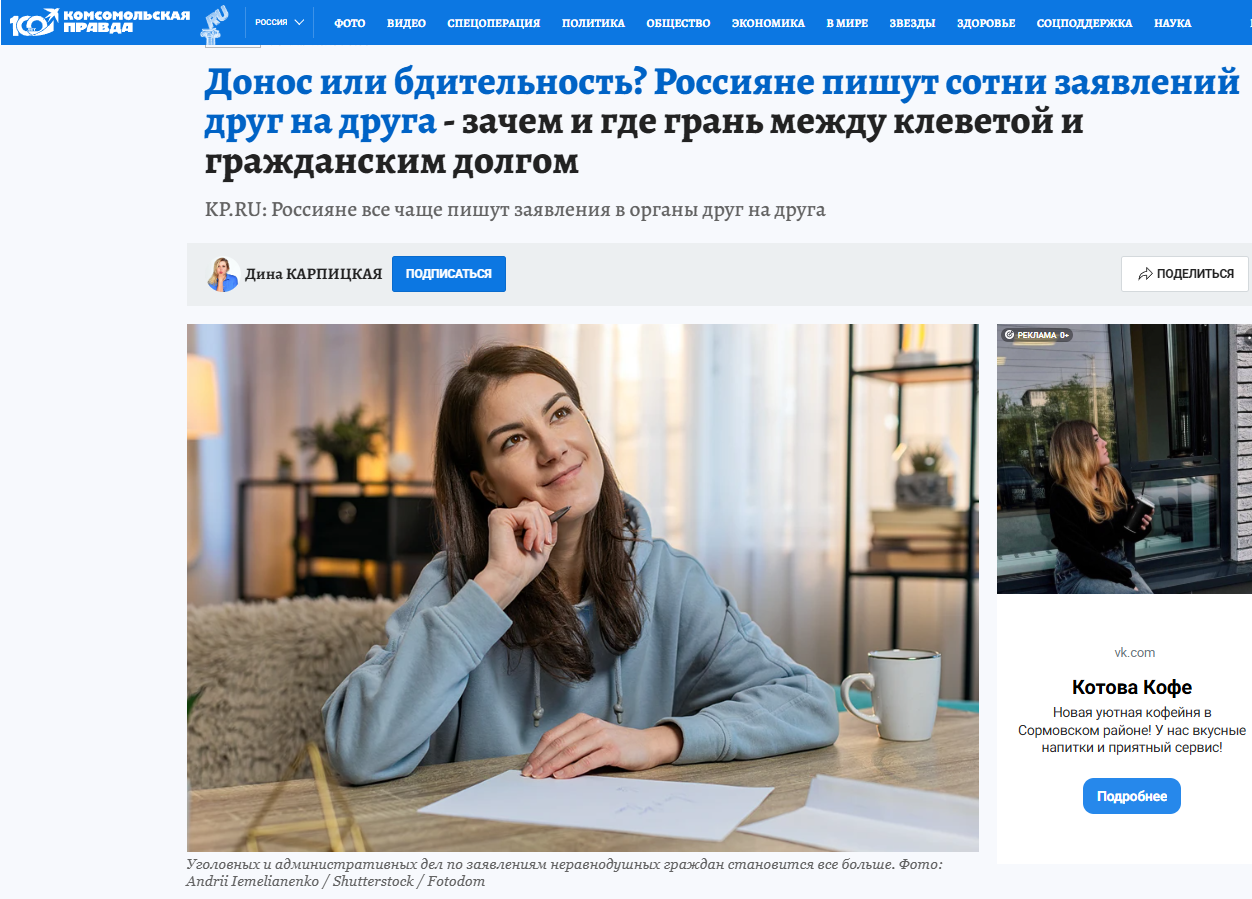
Russians are increasingly writing statements to authorities against each other, and “the line between defending the Fatherland and a witch hunt is becoming thinner,” according to a Komsomolskaya Pravda article published on Monday. Sometimes, says the KP text, “under the guise of civic activity, petty vindictiveness, a desire to simply ‘get on your nerves’ and paranoia flourish.”
Details. A publication entitled “Denunciation or Vigilance? “Russians write hundreds of statements against each other - why and where is the line between slander and civic duty,” wrote the publication’s special correspondent Dina Karpitskaya.
- ️ With reference to “official statistics”, without naming numbers, Karpitskaya writes that there are more and more criminal and administrative cases based on statements from “concerned citizens”. At the same time, the publication provides data on complaints to Roskomnadzor: over the past year, their number almost tripled - from 86 thousand in 2024 to almost 252 thousand in 2025.
- ️ Further, the author writes about cases where a Russian citizen was arrested for 14 days following a denunciation for viewing “pictures discrediting the army” in the Moscow metro, and the family of a Moscow fifth-grader was registered with the guardianship authorities at the request of the school principal because of a blue and yellow avatar. “Of course, if there is a pedophile walking on the Internet or on the street, the sooner they find him, the better. But it happens that vigilance reaches the point of absurdity,” writes Karpitskaya and lists several more examples of denunciations: an accusation of “discrediting the army” against military surgeon and “Man Z” award winner Yuri Evich because of the phrase about “insufficient combat training” of the Russian military, complaints about “LGBT propaganda” because of the color of benches near a kindergarten in Essentuki and a denunciation by a St. Petersburg resident about neighbor because of the yellow and blue balls on the balcony.
- ️ Karpitskaya calls Ekaterinburg resident Ekaterina Gerlach and St. Petersburg resident Timur Bulatov outstanding representatives of the “army of those who care.” The first, a former investigator of the Investigative Committee, wrote two complaints against the singer Yaroslav Dronov (Shaman) - because of a non-Russian pseudonym and “sexual connotations” in a video filmed on Lake Baikal (the singer licked ice) and in concert performances with pushing a microphone into his pants, as well as against TV presenter Vladimir Solovyov - because of insults addressed to blogger Victoria Boni.
- ️ Bulatov is known for denouncing the artist Yulia Tsvetkova, who was tried on charges of distributing pornography due to drawings of female genital organs, and Arkhangelsk student Olesya Krivtsova, who was accused of “discrediting the army” because of anti-war leaflets and reposts on Instagram. Bulatov told KP that he is a “freelance employee” of the authorities.
- ️ Further, the material talks about advertisements offering help with sending complaints for money. Karpitskaya tried to write a complaint, and she was offered to “properly check” the social networks of the person she was complaining about, and for 10 thousand rubles make her “run around police stations and authorities.”
- ️ “Now the time for these scoundrels has come,” said member of the Public Chamber Ilya Melnikov. He expressed hope that the Supreme Court will pay attention to situations where Russians are fined for old posts on blocked resources.
- ️ In conclusion, Karpitskaya writes that “a complaint becomes a universal weapon”: “One sincerely saves the country from subversive content. Another is fighting for justice before housing and communal services and officials. The third is simply taking revenge on his former boss, using the law as a cudgel. And the fourth sees the enemy in colored shops and the wrong avatar.”
- ️ Karpitskaya notes that “the system does not always distinguish a real threat from a yellow bow against the backdrop of blue curtains,” and “we know how to plant a spike.”
Context. In April, the head of the presidential department for public projects, Sergei Novikov, said that “society is tired of prohibitive rhetoric.” A week later, Vladimir Putin called on deputies and senators “not to get hung up” on prohibitions and punishments.
- ️ Putin said that he reads Komsomolskaya Pravda and called it his “favorite” publication .