
Translated material
"Put the stinking little Ukrainian away." Ukrainian Dmitry Balog received 25 years for arson - he himself said that all the sabotage in Domodedovo was blamed on him
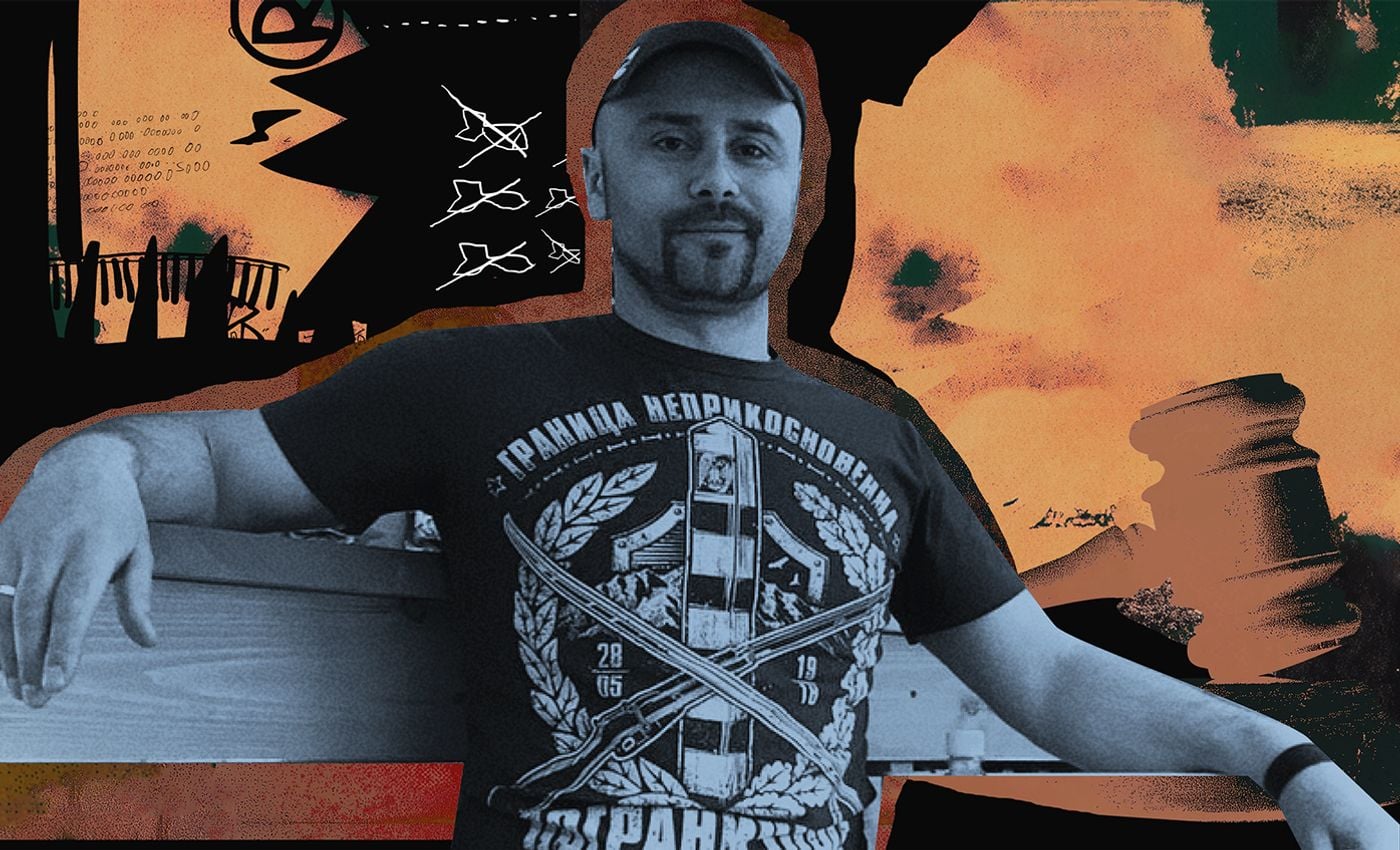
The 2nd Western District Military Court sentenced 39-year-old native of Ukraine Dmitry Balog to 25 years in prison. Since 2014, he lived in Magadan, received Russian citizenship and got married. In 2022, Balog moved to Domodedovo with his wife and little daughter. When two years later, a car with the letter Z on the window burned down near their home, the security forces blamed Balogh. After his arrest, he confessed not only to this arson, but also to several acts of sabotage that had occurred since the beginning of the war in the vicinity of Domodedovo. Almost six months later, when he had a lawyer by agreement, the Ukrainian refused to testify and reported torture. Mediazona tells how Balog tried to defend himself in court and prove that he became a target of the security forces only because he was Ukrainian.
“Who needs you anyway, tell me, Balog? Why would they even do this? Well, for what? - interrupts the judge of the 2nd Western District Military Court, when the accused - Ukrainian Dmitry Balog - again begins to talk about torture after detention.
At the debate on May 5, during which the dispute broke out, a 39-year-old native of the Kherson region, accused of sabotage on the instructions of LSR, brought a thick folder of papers listing all the violations in the case and violence on the part of the security forces. According to him, FSB officers beat him, gave him electric shocks, and threatened his relatives, including those living in Ukraine. The judge insists that there was no need for the security forces to continue to put pressure on Balogh, since he confessed to everything immediately after his arrest.
- What is the logic, why use violence against you, threaten you, if you have already given a confession? - he is perplexed.
- So that I don't deny it? - suggests Balogh.
- For what? To what? Well, you deny, and then what? Your right! What does this affect?
- Well, it was! I don't have an answer!
- I ask what this affects. Do you understand the question? If you have given confessions, then you confirm them. Why do they keep threatening you and threatening you, using violence, promising to use violence against your relatives who are in Ukraine, and so on?! They say they will plant drugs? Do you even understand what statements you are making? Not just about excess, but about serious crimes, serious crimes!
- Of course, your honor! Because all this really happened to me!
The judge recalls that Balogh’s wife did not say anything about the threats during interrogation. He retorts: she was also intimidated, so in her testimony there is “a completely different reality.”
The judge then listed four lawyers who represented Balogh during the investigation until he found a defense attorney. The defendant claims that they all helped the prosecution, and he himself even complained about them to the Bar Association of the Moscow Region, but they found no violations in their work.
— Is the Chamber also in cahoots? - the judge laughs.
- Nobody wants to figure it out. Nobody is interested in this.
— So, by your logic, the lawyers are interested?
- Well, yes, lock up the stinking little Ukrainian, as they like to say...
- Who, lawyers?
- Yes, including lawyers, of course! And no matter where I write, no one wants to do anything.
Balogh is accused of participation in sabotage and terrorist communities, participation in a terrorist organization, terrorist attacks, sabotage and treason.
During the debate, the prosecutor requested 27.5 years in prison for the Ukrainian.
Balogh himself, who was initially arrested on a minor charge of destruction of property - for setting fire to a KIA Cerato with the letter Z on the rear window - does not admit guilt to any of the episodes. He believes that the investigator and operatives simply decided to blame him for all the sabotage that occurred in Domodedovo over a couple of years.
Detention and torture
Dmitry Balog moved to Russia from Ukraine in 2014; he has a daughter from his first marriage in Odessa. For the first few years he lived and worked in Magadan, where he met his future wife, and the couple had a child. In 2022, the family moved to Domodedovo, where Balog first rented a small draft beer store, and then got a job as a driver and delivered employees of a local enterprise to their homes, his brother Nikolai told Mediazona.
Balogh was detained in his apartment on February 9, 2024. The day before, a KIA Cerato car burned down near his house. The car belonged to Dmitry Chervyakov, who, together with his two brothers, is fighting against Ukraine.
Already on February 11, Balogh gave a confession. In them, he confessed to setting fire not only to Chervyakov’s car, but also to relay cabinets, a transformer on a cell phone tower, and four Ministry of Internal Affairs buses in a departmental parking lot. Balog decided to renounce this testimony and talk about torture only on July 31.
By that time, he actually had four assigned lawyers. Until the defender Liliana Akivis-Shaumyan concluded an agreement with the Ukrainian, Balog’s relatives did not even know where he was. His wife only informed Dmitry’s brother that he was detained, but alive and well, and then stopped communicating with both relatives and her husband.
Balogh himself said that a cellmate helped him hire a lawyer, who was inspired by his story and paid for his lawyer himself.
On July 31, 2024, together with Akivis-Shaumyan, Balog told the investigator about the torture. After the arrest, the man said, he was taken to the Domodedovo Ministry of Internal Affairs department, where an unknown FSB officer beat and strangled him. According to Balog, they tied his hands behind his back, unclenched his palms and rubbed some objects on them.
“An employee sat on my head about three times, the last time they treated my hand with some kind of burning liquid substance,” Balogh said. “On the same day, they inserted a cotton swab into my mouth and checked my face for traces of hair burning. He threatened my 16-year-old daughter, living in Odessa, with rape, violence against my mother, living in the Nikolaev region.”
He later added that the security forces also threatened his current family: they promised to plant drugs on his wife and send his daughter to an orphanage. Balog asked to take them under state protection.
The day after the arrest, the torture continued. The man was taken into an office where two employees of the Moscow FSB Directorate were waiting for him. One of them, Balog claims, hit him in the ear and on the back of the head with his palm, simultaneously striking him in the groin with a stun gun.
Only after this was Balogh sent to a temporary detention facility. There he was examined by doctors, but no injuries or injuries were recorded, and Balog himself was afraid to talk about the torture. Lawyer Akivis-Shaumyan, in a conversation with Mediazona, noted that the results of the medical examination after the Ukrainian was sent to the pre-trial detention center are unknown, but she believes that the injuries were not revealed even then.
On April 3, FSB officers escorted Balog to the Meshchansky Court to extend his arrest; According to the man, they put a bag over his head, taped it to his knees, and beat him all the way. After this trip, he decided not to talk about the torture and obediently confirmed his guilt at every interrogation and when checking testimony on the spot - this is what later caused the judge’s indignation.
Balog himself explained his long silence by the fact that in the Kashira pre-trial detention center, complaints from prisoners often resulted in beatings and punishment cells for them. In addition, the Ukrainian said, the FSB officers who beat him came to him several times in the detention center and to extend his arrest to demonstrate that he was still in danger.
Confession and evidence
According to Balogh, immediately after his arrest he wrote his confession under the dictation of the security forces who beat him, who reeked of alcohol. The Ukrainian says that they did not allow him to eat and forced him to memorize the version of events invented by the FSB officers.
During subsequent interrogations, the investigator—Balog is sure that he knew about the torture—added more and more new details to the protocols, and the Ukrainian agreed with everything.
Judging by the speech of the prosecutor in the debate, it is on this testimony that the entire accusation is based. The state prosecutor noted that neither the defendant nor his lawyers had any comments during the investigation. Nevertheless, the Ukrainian’s statements about torture were later checked, but the Investigative Committee refused to open a case.
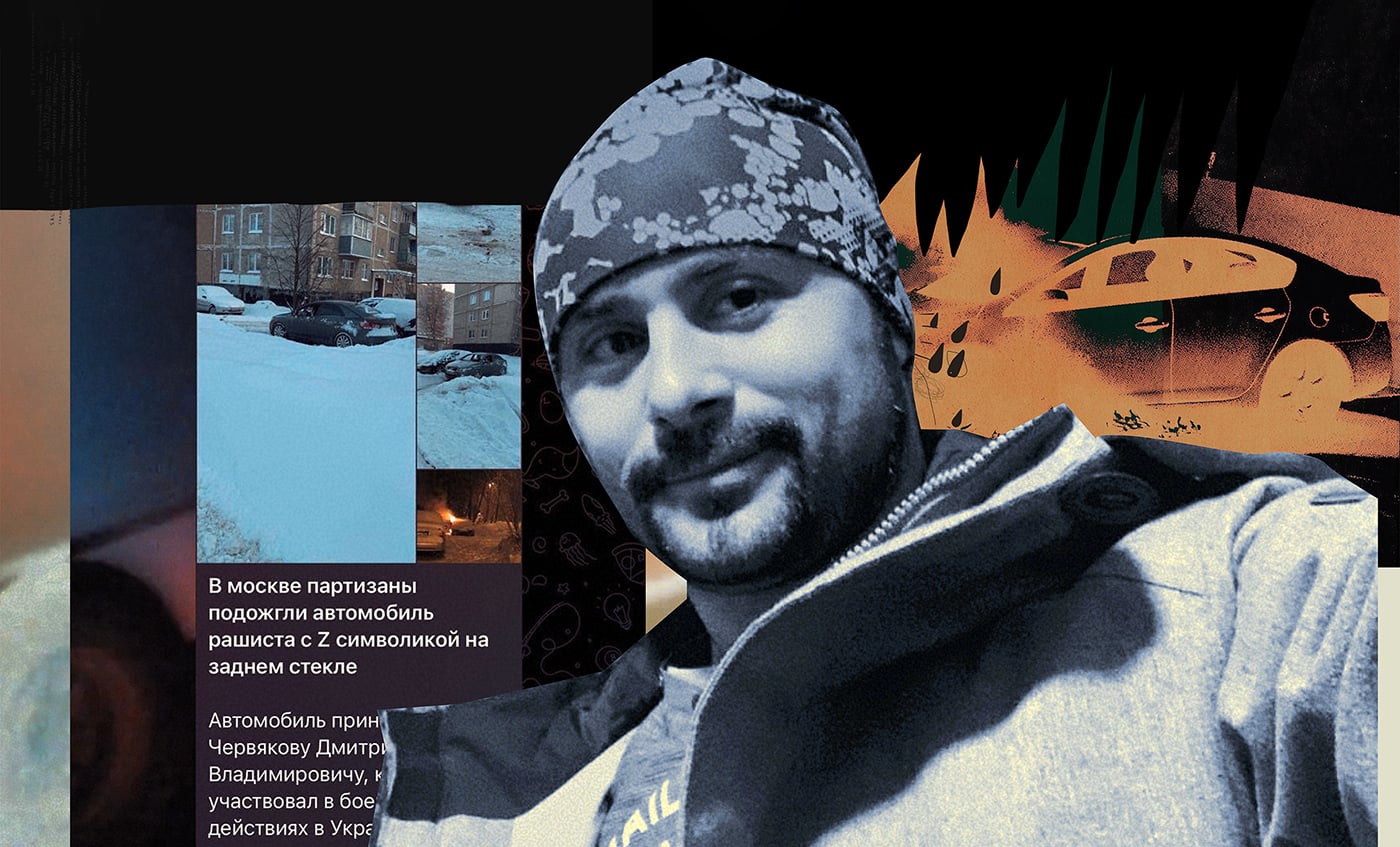
Illustration: Mila Grabowski / Mediazona
In addition to confessions and videos from investigative experiments, the prosecution also referred to material evidence found in Balogh’s apartment. Among them, for example, are “pyrotechnic products” and “firecrackers” with a “terminal” attached to it. At the same time, the experts themselves admitted that the pyrotechnics were household.
The prosecutor mentioned this only in passing, but paid great attention to the messages and files that, according to the prosecution, were found on Balogh’s iPhone and MacBook.
So, on the laptop, operatives found a questionnaire from the website of the Freedom of Russia legion. According to investigators, the defendant filled it out and for some reason kept the document for himself. Balogh in his speech pointed out the absurdity of such actions.
“What you fill out on the site stays on the site. Why keep the form on your computer if you filled it out on the website? I don’t understand what logic the employees adhered to when they attributed this profile to me on a computer taken from nowhere,” he said.
Balogh insists that the security forces also fabricated his telegram and email correspondence: her address, according to the Ukrainian, differs from his real one by one character. The prosecutor read these correspondences in full.
The picture from these messages is as follows: Balog lived in Magadan, but wanted to help his native country. Deciding that there were no suitable targets for sabotage in such a distant region, he moved to Domodedovo.
Balog began communicating with a representative of the “Freedom of Russia” legion named Ruslan. Judging by the correspondence, the Ukrainian himself came up with actions, for example, setting fire to relay cabinets or transformers, and Ruslan coordinated them. Balog sent video reports to him.
However, the shares took a lot of money and time. Ruslan, as follows from the case materials, only covered the preparation costs: he transferred 20-30 thousand rubles, and then after repeated reminders. Then Balog began looking for money for new sabotage from other Ukrainian projects.
Thus, the prosecutor read a letter on his behalf to the ARMY SOS organization: “I am already cooperating with the legion, but there are problems with financing. Plus, I do not support some of the tasks that the curator sets for me. They are directed against people, and I want to fight the system and the army. I have courage and potential, but I do not have basic weapons to carry out combat missions. Not the most productive, convenient and safe options for fighting the regime [suggested by the curator]. Please help me make at least some contribution to stop this madness.”
According to the prosecution, Balog sent a similar letter to the Ukrainian blogger “Apostle,” who pays the Russians for helping the Armed Forces of Ukraine: “Hello, if I find more interesting objects, can you help financially? I need a lot of things to prepare, then I’ll share a video with the results.”
Both of these requests, as stated in the case materials, remained unanswered.
Several long letters were addressed to the former adviser to the office of the President of Ukraine, Alexei Arestovich. In them, the author talked about his sabotage and complained that he had accumulated more than three million rubles in debt because he abandoned work for the sake of arson.
“Now the banks are starting to get angry, courts and scandals at home will soon begin. With the legion and similar matters, I am on pause; we need to have a conversation about debts. Since I watch almost all the videos on YouTube with your participation, I dared to offer you cooperation, if, of course, you have the opportunity,” one of the letters said.
Court and final word
The case against Balogh began to be considered by the 2nd Western District Military Court in Moscow in December last year. During the trial, the defendant was again represented by an appointed lawyer.
Balogh insists that all the evidence against him is falsified, and the prosecution’s version, in principle, contradicts his beliefs.
At the debate, he said that back in 2006, the Ukrainian Border Service terminated his contract due to failure to comply with orders. Since then, Balogh said, he has not trusted the military. The political course of Ukraine also did not suit him, so he left the country - and he would never risk his life for an ideology alien to him. “The investigator hid this piquant moment in the indictment,” Balogh said.
He again recalled that he gave a confession only because of the “wave of sadism and nationalism” of the security forces that hit him.
“Having realized the level of their hysteria and impunity, fearing for my family and my life, I realized that the only right decision was to agree to self-incrimination and fulfill all the conditions of the criminals in uniform. Taking dictation until late at night, I wrote their crime scenarios and spectacular confessions, spoke the memorized text into the phone camera,” he explained in the debate.
Balog is sure that FSB operatives detained him only because of his Ukrainian passport, when they were looking for the arsonist of a car with the letter Z. The security forces, in his opinion, expected to find something prohibited during the search, and when they failed, they planted Ukrainian Armed Forces chevrons in his working Gazelle.
However, these chevrons were not included in the indictment. But Balog is sure that it was they who became the pretext for further verification, after which they decided to “pin” all the unsolved sabotage in the Domodedovo District on him.
The legality of research into his technique also raises questions, the man emphasized. According to him, although the search reports say that he voluntarily gave up the passwords for his phone and laptop, in fact he was forced to do so under torture. This means that correspondence, photographs of crime scenes and the questionnaire of the Freedom of Russia Legion could be uploaded there after the seizure - at a time when it was convenient for the investigation.
He also noted that the case materials do not indicate the serial numbers of the two iPhones and the laptop, so it is unclear whether this is really his equipment.
“One document states that the phone was seized from my home, the other states that it was seized during a personal search. This phone has not been officially discovered either here or there. In a word, it's a disgrace. I am ashamed of such sloppiness in falsification. And the worst thing is that such a mess was allowed to go to court by the supervisory authority, instead of prosecuting employees for official crimes,” Balog explained in the debate.
Finally, according to the man, even the description of his movements during the arson looks implausible. He claims that on May 26, 2022, when the relay cabinets were set on fire, he could not cover 47 kilometers in a few morning hours, although investigators, when describing Balogh’s route, refer to the location of his mobile phone.
He also mentioned many other minor inconsistencies, such as the description of the item used to break the glass at KIA : the materials first mentioned a “red crowbar,” then a “crowbar,” then a “crowbar.” As a result, this item became “unidentified” altogether.
“The investigator could not completely get rid of the interdependencies of the plot conjecture, so he had to supplement the event vacuum with a slight flight of fancy,” said Balogh.
In his speech, he several times called the security forces “criminals in uniform,” for which he received warnings from the judge.
To summarize, Balogh asked the court to acquit him: “The search yielded nothing, no traces of open fire were found on my face, and the officers, having a personal hostility towards immigrants from Ukraine, excited by nationalism and strong alcohol, without legal evidence, extracted testimony from me by torture.”
After this, the prosecutor, in his response, asked the court to take into account the aggravating circumstance when sentencing: political hatred.
On May 19, Dmitry Balog made his final speech. He said that the criminal case helped him get rid of “fake friends” who cut him out of life, “when faced with the nationalist speculation of the prosecution.” In his speech, he called his wife “ex.”
Balogh said that in prison he “took a break from the daily rush” and rethought his life, and the “cleansing silence of the punishment cell” helped him understand who he was and what he lived for.
“I was like a creature overgrown with stalactites of accumulated problems, illnesses, complexes and moral traumas, rooted far back in childhood. The harsh reception, torture, moral destruction was like a running blow against a wall, thanks to which all the growths on me shattered into pieces - and the understanding awakened in me that I need to live not in spite of, but to create something new,” the defendant explained. He named the transition to a raw food diet as one of the manifestations of his transformation.
Balog refrained from assessing his innocence, but compared the work of the prosecution to the work of a bad employee of the document management department in a private company, who would be chased away for “such a mess with a tattered broom.”
“For me this is not a punishment, for me it is an opportunity to develop, since punishing me for other people’s actions is ridiculous, and I am ready for such fun. In any case, I will live to see liberation, or more precisely, until the liberation of my body, since it was not possible and will not be possible to subjugate my mind. And I live with gratitude for everything, which is what I wish for everyone,” he ended his speech.
Three hours later, the judge sentenced Balogh to 25 years in prison. He will have to spend the first 5 years in prison. The court also satisfied the claim of the Ministry of Internal Affairs for 5,120,939 rubles.
Editors: Maria Klimova, Anna Pavlova