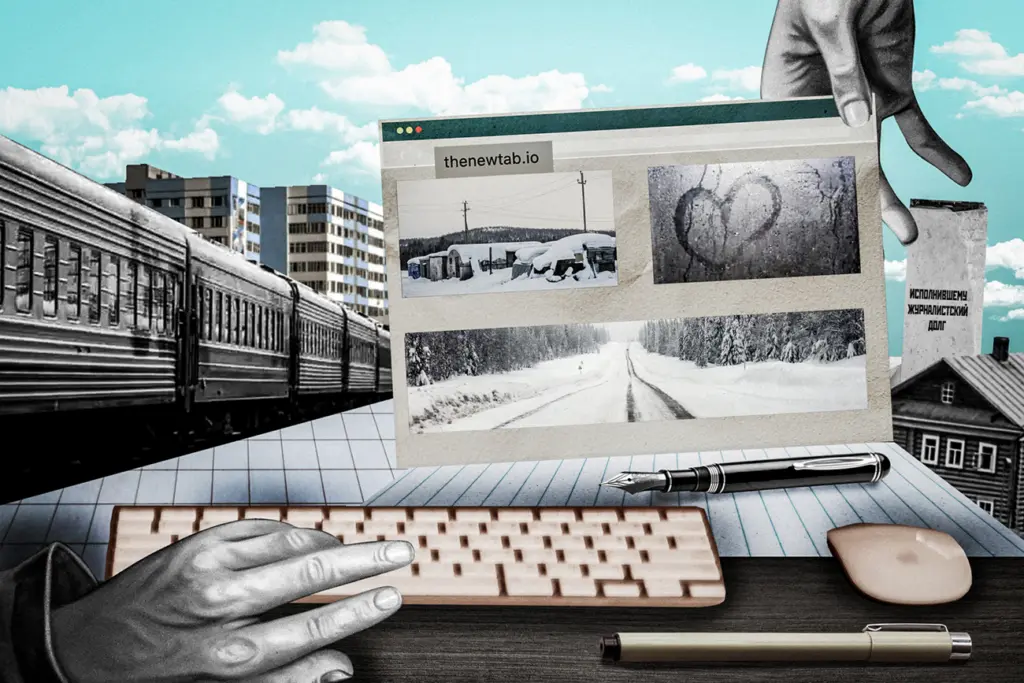
Mikhail Danilovich - about why he left Russia and how the “New Tab” appeared
18+ This material (information) was produced, distributed and (or) sent by a foreign agent Media project “New Tab” or concerns the activities of a foreign agent Media project “New Tab” Author Mikhail Danilovich May 20, 2026 diaries read: 6 min.
Packing things, early flight, crossing the border - just yesterday I, Mikhail Danilovich, was a freelance journalist from Perm who went on business trips around the country for my favorite Russian media. And suddenly I’m leaving for nowhere, getting ready to live in a tent, and all I have is my love for journalism. Thanks to her, luck and the same people in love with the profession, “New Tab” appeared - the Russian The New Yorker or the Russian “Netflix” in the texts, as we call it. Recently, colleagues at the editorial office asked me what I would have done if I had not left the country - so this column appeared on the fourth anniversary of the New Tab.
In the “ Diaries ” section we publish author’s columns in which journalists share their own experiences. These are personal stories in which the nerve of time is felt. The time in which we all live now.
I was in Russia for the last time in March 2022. Everything happened quickly. So I’m buying a plane ticket leaving in a few hours. Now I’m deciding what to put in a small bag. So, flying over my native Perm, I look out the window and realize that I’m leaving for a long time. I don’t know yet that maybe forever.
When I cross the border at sunset, I try to look only ahead. For good luck, everything goes well on both sides of the border. This is how I lived for the last four years: I walked only forward, even if I didn’t always understand where exactly, because there was simply no turning back. Either do it, or you will never do it.
And now I decided to look back and imagine what I would have done if I had stayed at home.
Just like a regional journalist, I would continue to write for various media if they continued to publish my texts. For example, for “People of Baikal”. Six months before the war, they published my report about the heads of villages in Siberia, who in past lives were a paramedic, a primary school teacher and a pensioner.
I always really liked and still like the storytelling in People of Baikal. I like their versatility: these are stories about specific regions, but in fact they are about people, so their texts are read all over Russia. I like the attention to detail, the description of scenes - take it and use it as a script for a movie.
Subscribe to the New Tab channel in Telegram. There we talk about how people, animals, and plants live in the regions of Russia
Working with “People of Baikal” and with other media, at some point I came up with a triad of components of a good text: the essence is to “touch”, “smell”, see what is happening; sharpness - so that there is some kind of breakdown, an unexpected turn; psychologism - so that the story is about a person, his secrets, strengths, weaknesses and manifestations in unusual situations. I also liked to think that a journalist is a social monk, that is, no one knows about his preferences, so he can talk to anyone in order to absorb and, like a mirror, reflect the ambiguity and complexity of human destinies. No activism.
I should probably write to “ Layout ”: I’m attracted by their clarity of presentation and their style in general. In general, I would try to go to editorial offices, and I would also start a pseudonym. Although he probably would not have solved the problems that arose for everyone who, after the start of the war, remained faithful to journalism and at the same time remained in Russia.
Even when I lived in Perm, it was difficult to explain to my interlocutor for which publication the material was being prepared. I'm a freelancer, so I usually didn't know where the publication would be, and people wanted me to name a specific media. It's a million times more difficult for authors on earth now. Both journalists and their interlocutors face more risks and more fear. And yes, my strictness about the fact that “I warned you that I turned on the recorder, which means I can use all your words” would have been shaken.
Multiply this by the paranoia that you live with every day if you want to remain in independent journalism in Russia. Passwords on all devices, VPN, and also the clock on the wall should always work so that you can record at what minute and what the police do if they come with a search. I lived with this paranoia even before leaving the country, and now I would definitely have more of it. When we discussed this column in the editorial office, my colleagues jokingly suggested what I would do if I stayed in Russia - I would write for Vorstka and drink. Well, yes, that's pretty much it.
Besides field work, I had another passion. The team of Perm freelancers “ The Fourth Sector ”, where Nastya Sechina invited me, and my website “Docdrama”, where I and other journalists analyzed cool texts. I was slowly approaching a project that would accumulate both freelance authors and cool stories. But I had no idea how it would work.
If I had stayed in Russia, I probably wouldn’t have understood it. Instead, I would write texts - if I could, taking into account the realities.
If I had stayed in Russia, there would have been no New Tab . And then the report from Kharp , where Alexei Navalny died, would not have come out - a leisurely narrative from a sleepy town near the place where history is being made. Kharp, with the eloquent remarks of its inhabitants and its unshakable everyday life, is a reflection of all of Russia.
There would be no report from a train that, in addition to ordinary passengers, carries Russian soldiers to and from war. Throughout this entire text, you, along with its characters, feel: death is nearby. And you look at everything through her prism - at yourself, at love, at what you ended up on this train for. It’s not easy to answer yourself, which is why the characters in the text drink a lot.
Follow New Tab on X (Twitter). There we write about how the regions of Russia live. We're still mumbling and swearing
If I had stayed in Russia, there would not have been dozens of aspiring authors who published their longreads with us. There would be no partner editorial offices that publish our joint texts.
Ebanina and selfhood, self-acceptance, a window to Russia and a mirror - when everything collapses, we try to tell fascinating stories and do it with an open mind. We are like a storyteller who stands on ice floes floating in different directions. Like the musicians on the Titanic: no matter what happens, their task is not to save, but to play. So that people in Russia do not feel lonely and preserve themselves until better times.
Maybe if I started saving someone instead, there would be more benefit. But then the selection of bright and honest stories about real life in the regions of Russia, which can be read from us and our colleagues, would definitely be poorer.
Mikhail Danilovich - about why he left Russia and how the “New Tab” appeared • Novaia vkladka • RIMA — Russian Independent Media Archive

 Subscribe to the New Tab channel in Telegram. There we talk about how people, animals, and plants live in the regions of Russia