
Translated material
Will there be a banking crisis and freezing of deposits in Russia?
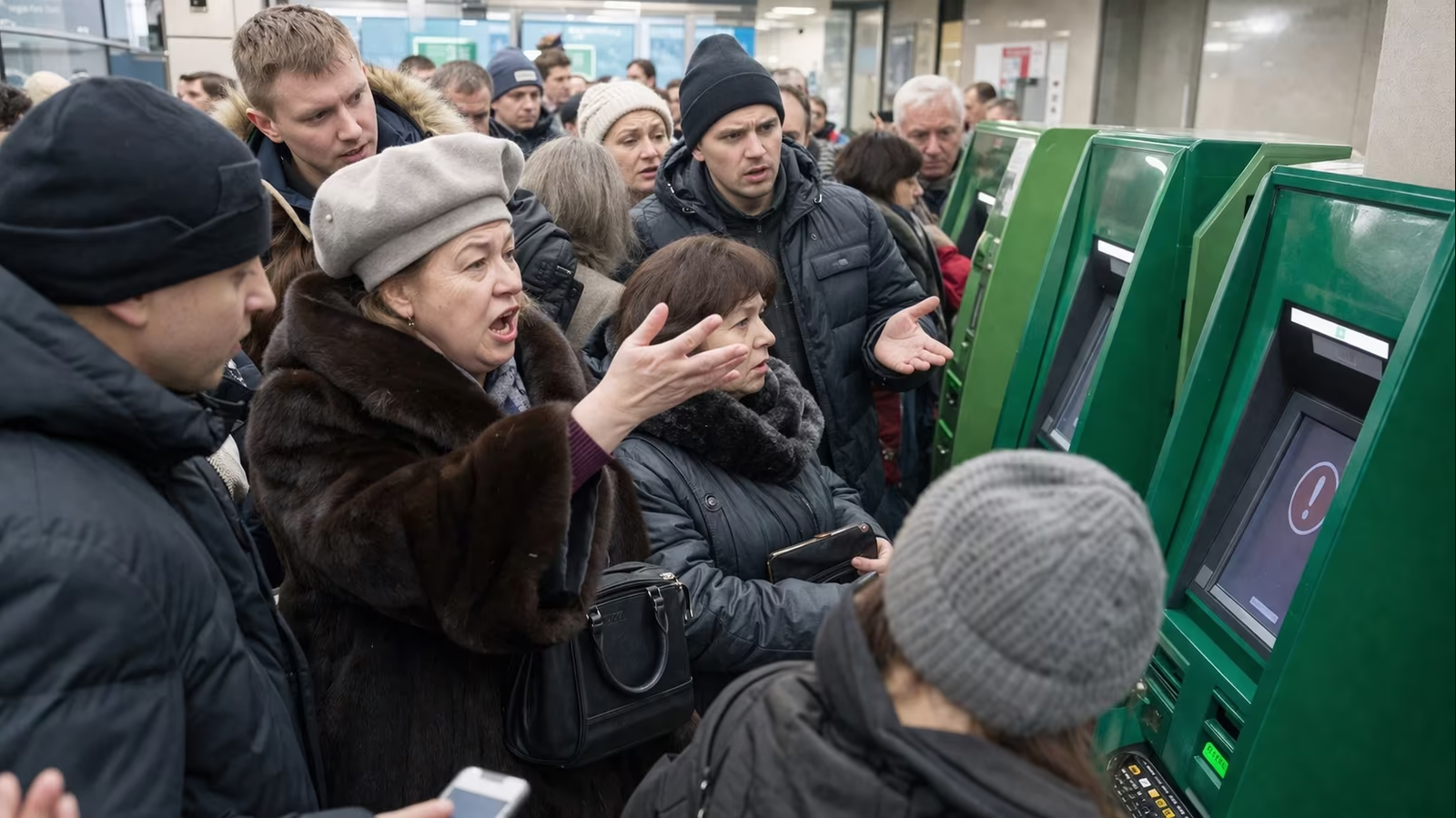
Horror stories about freezing household deposits may come true this year
Since the beginning of 2026, wave after wave of rumors about an impending banking crisis and the freezing of deposits have plagued Russia. And since the end of April, this topic has become one of the most discussed and exciting for Russians. “The Devil” figured out what was happening with the banking system and came to the conclusion that there is no reason for panic, but they may very well appear.At the end of April , supposedly leaked “Central Bank documents” about the impending freeze of deposits appeared in the public domain . Obviously, the fake documents got into people’s spirits very well and generated, if not panic, then a very high level of agitation.
They said that the Central Bank was going to limit the ability to withdraw cash to 150 thousand rubles per month, and turn deposits over 2.8 million rubles into “irrevocable savings certificates.” President Putin spoke about these certificates in February 2024 during his address to the Federal Assembly as an instrument of increased profitability and security. The figure of 2.8 million rubles also appeared there, but as a state-guaranteed deposit insurance limit.
This stuffing was superimposed on the speech of the Minister of Finance of the Russian Federation Anton Siluanov, who told the young participants of the marathon “Knowledge. First” basics of financial literacy and called for “not keeping money under your pillow”, but investing savings in financial instruments.
Financial bloggers took these words as the Ministry of Finance’s desire to prevent people from withdrawing money from their accounts at all costs, and therefore as an additional argument in favor of the imminent freezing of household deposits.
And as soon as this wave of popular panic was extinguished - everyone who could spoke about the absence of plans to freeze deposits - a new topic appeared, related to the crisis of the banking system.
A report from an organization with the unpronounceable abbreviation TsMAKP has been released , which states that a banking crisis may occur in Russia before October 2026. Moreover, a careful reading of the report and its charts suggests that the crisis is already underway, and in the coming months it could develop into a truly serious problem.
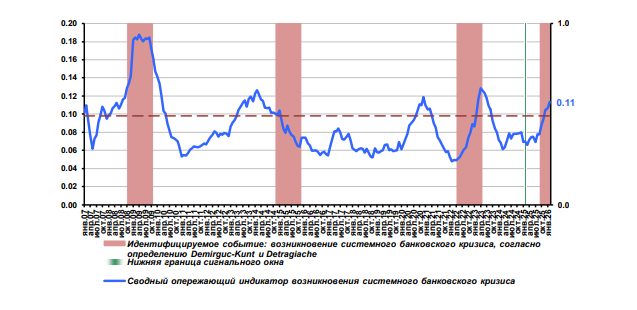
It is important to understand that TsMAKP - the Center for Macroeconomic Analysis and Short-Term Forecasting - is an organization very close to the government, and it is headed by the younger brother of the current Minister of Defense Dmitry Belousov.
The reaction of microbloggers to this report was predictably alarmist: “we said that a banking crisis is coming, your money will be lost, your deposits will be frozen, everything will become worthless, and ATMs will have to be stormed.”
However, serious analysts saw in it a warning that hides serious, but not at all critical, problems. And the Russian banking system did not cope with such problems.
However, she coped in a completely different situation and in a different Russia.
The main problem of Russian banks
The share of bad loans - overdue by more than 90 days - has increased - it has already exceeded the dangerous value of 10% of all loans issued and continues to grow. This alone can already be considered a completed banking crisis.
It is significant that in a similar report six months ago it was 7% and this was already perceived as a threat.
Why is the share of bad loans growing so rapidly?
Firstly, changes in tax conditions, as well as an increase in VAT, led to the fact that many companies were simply unable to service loans. The situation is especially dramatic for small and medium-sized businesses, where overdue loans have increased to 19% of the total lending volume.
Secondly, the share of non-repayment of consumer loans has increased to 13% - in mid-2025 it was 10.5% . And these figures clearly show that not all groups of the Russian population are beneficiaries of the economy of military well-being.
And finally, the number of mortgage defaulters is growing rapidly: 1.7% at the beginning of 2026, against 1% at the beginning of 2025 and 0.7% at the beginning of 2024. Central Bank experts blame this growth on loans issued under the massive “preferential mortgage” in the second half of 2023 and in 2024.
Why you shouldn't panic about the banking crisis
“The banking crisis continues to occur in a latent form - due to the masking of deteriorating asset quality by the restructuring of non-performing loans, as well as the dominance of state-owned credit institutions,” the report explains why even the presence of such an important crisis indicator as a high percentage of bad assets should not be taken dramatically.
There is another important factor that works to stabilize the banking system and neutralize the growth of problem loans - a very high level of loan coverage by household deposits.
Loans issued by banks are only 90% of the population’s money, which is in banks at interest. That is, even if all these 10% of bad loans go to a net loss, the overall balance will converge.
The population's money is the main stabilizing factor of the banking system. Or destabilizing...
From the above it follows: household deposits are now the main, and perhaps the only factor that keeps the banking system from a serious crisis. Even the authors of the report, when they write about the importance of “dominance of state-owned credit institutions,” emphasize that this leads to “maintaining confidence on the part of clients and depositors, preventing the occurrence of banking panic.”
However, if you look at the situation from the perspective of these deposits, it does not look so reliable.
“In February 2025, the index of systemic risks of “flight of depositors” signaled a high probability of a crisis event occurring,” write the authors of the report. In 2025, there was no “flight” - the volume of funds in household accounts and deposits even increased by 15%. However, this growth occurred solely due to the capitalization of interest accrued on deposits that were already in banks. There was no influx of new money in 2025.
During this time, the discount rate, and subsequently the deposit rates, fell noticeably. In January 2025, money could be deposited (for a period of 3 months to a year) at 20% per annum, and now - at a maximum of 14% and then for 3-5 months.
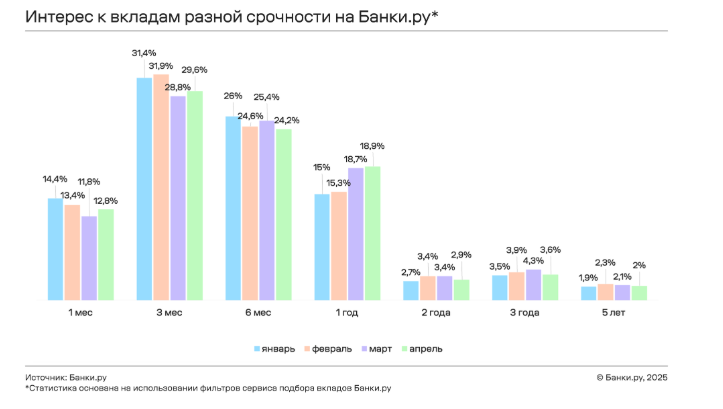
The fact that the highest interest rates on deposits are on short-term deposits aggravates the situation of instability. Every 3 months, people recalculate their benefits and decide whether to renew the deposit or not.
Moreover, the amount of cash in the economy has increased sharply in recent months. That is, people began to actively withdraw money from bank accounts and keep it “under their pillow.” And there are objective reasons for this.
As a result of new taxes, including the emergence of a tax on acquiring, many small and medium-sized businesses were forced to return to cash trading.
In addition, perhaps the main factor was the regular shutdown of the mobile Internet and the transition of many regions to “white lists.” The FSB probably had important government reasons not to include, for example, Sberbank in this list, but people need to pay in stores somehow and they chose the old and reliable method - cash.
In April 2026, the volume of cash increased by 607.3 billion rubles - if you do not take the traditional December peaks in demand for cash, this is a record value, second only to February and September 2022.
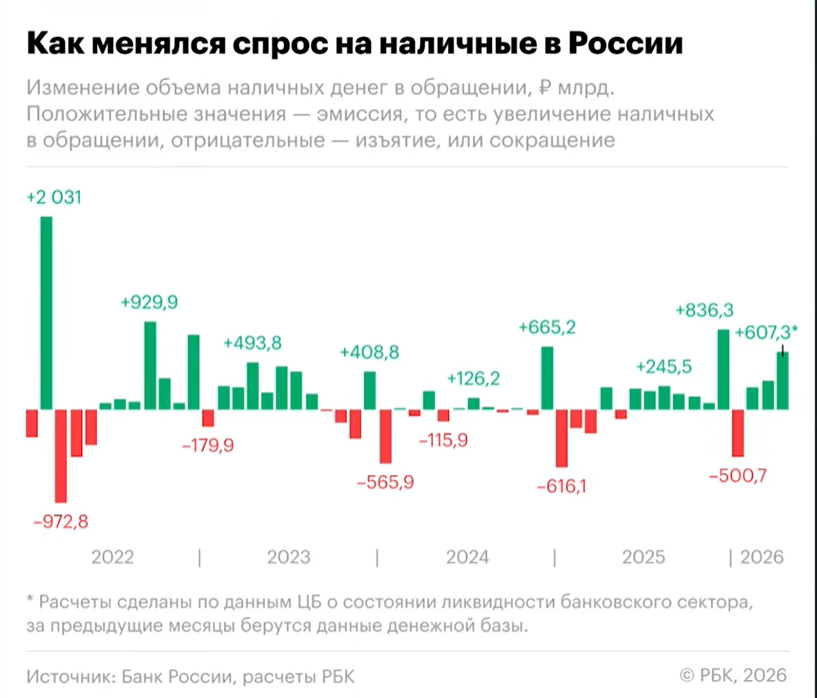
And during the holidays from May 1 to May 10, the increase in cash in the hands of Russians amounted to 210 billion rubles. A year ago, during the same period, 5 times less was withdrawn - 40 billion rubles.
How Russia's enemies can drown the banking system
The high degree of dependence of the banking system on household deposits is its main potential vulnerability. It is logical that Russia’s enemies need to hit this point and in every possible way incite panic and create a situation of fundamental mistrust of the population.
That's what they do.
And we are not talking about representatives of organizations recognized on the territory of the Russian Federation as undesirable, extremist and even terrorist. For the most part, they reassure and give extremely balanced, professional comments.
Dmitry Kolezev, included in the register of extremists and terrorists, analyzing the TsMAKP report, calmly explains that there is no reason to panic. Alexander Kolyandr, an employee of the Carnegie Berlin Center, an undesirable organization in Russia, also sees no reason to panic and convincingly argues that there is no need to get carried away by all sorts of horror stories.
It is not they who create panic among the population, but completely different figures. Freezing deposits is a simple solution to the problem of stability of the banking system. Simple, but very dangerous. Freezing deposits is the surest way to turn any banking crisis into a disaster and cause a critical level of irritation of the population with the actions of the authorities.
“It’s probably hard to come up with more nonsense than the idea of freezing deposits. Well, in a professional environment, these scenarios are not discussed at all, because they are completely meaningless,” says Elvira Nabiullina.
But professionals also spoke about blocking the mobile Internet and about the all-out fight against Telegram. And this did not stop the people who actually determine policy in Russia from doing all this. Even the opinion of the SVO participants, who lost an established communication system due to the blocking of Telegram, did not become an argument for them.
People may be ready to adapt to any game that the authorities throw at them, but this does not mean that they trust it - on the contrary, in recent years they have been taught to expect the worst for them from the authorities.
How can they adapt to a situation where there is a threat to their money on deposit? Withdraw money from accounts, hide it “under your pillow” or transfer it into dollars while the ruble exchange rate is high.