
Translated material
God's judgment. How the Russian Orthodox Church deals with dissenting priests
In the book “The Church Hitchhiker” by priest Alexei Uminsky and journalist Ksenia Luchenko , published in April 2026 by Vidim books , the dismissal of a priest, a ban on ministry, and defrocking are presented as complete arbitrariness. There is no preliminary investigation, there is no time to familiarize yourself with the accusation - the priest simply receives a notice signed by the chairman of the church court, where the motivational part is missing, and the operative part states that the priest has been defrocked. That is, he is no longer a priest and cannot serve the liturgy, confess, give communion, baptize, marry, and so on - in a word, he is no longer the same person he was all his life.
“Sistema” found out how the church court is structured in Russia, how the investigation is conducted, who the judges are, who wrote and who interprets the laws, and, finally, whether priests can avoid judicial arbitrariness.
The public initiative Christians Against War already counts at least 47 priests and deacons of the Russian Orthodox Church who have been subjected to various repressions, from a ban in ministry to defrocking, for anti-war views and refusal to read the Prayer for Holy Russia , that is, the prayer prescribed by Patriarch Kirill, where the priest informs the Lord that “for the sake of battle, those who want to take up arms against Holy Russia”, and asks the Lord “by the power of Your victory.”
Priests from Vladivostok to Vilnius are being defrocked. Father Alexey Uminsky tells Sistema that he regularly, every week, receives confused letters from former colleagues from all over the country - Orthodox priests consider it impossible for themselves to pray for the war, but they are afraid of denunciations and church court.
Telephone law
Priest Alexey Uminsky tells Sistema that the ban on serving at Christmas 2024 and subsequent defrocking did not happen to him according to a previously known procedure, but through phone calls and almost informal meetings. Protopresbyter Vladimir Divakov , dean of the Central District of Moscow and secretary of the Moscow Diocesan Council of the Russian Orthodox Church, called and said that the next day he was waiting for Father Alexei at his Church of the Great Ascension on Nikitskaya to give him the decree. He did not say which decree exactly.
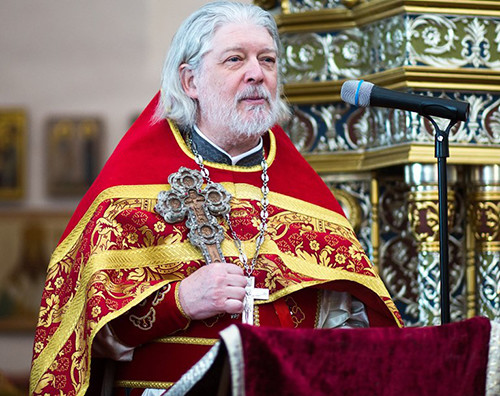
Divakov, one of the oldest Moscow priests, the rector of the famous “church where Pushkin was married,” according to three Sistema interlocutors close to the patriarchy, is nicknamed “Koshchey the Immortal” among the clergy, since he has been the rector of the Church of the Great Ascension since 1990. Explaining the term “dean,” two of Sistema’s interlocutors close to the leadership of the Russian Orthodox Church (on condition of anonymity because their careers are connected with the Moscow Patriarchate) use the criminal term “overseer”—one who looks after the Orthodox parishes of the Central District of Moscow.
Supervising all the parishes of the Central District of Moscow, Divakov, it must be said, apparently did not acquire any special “stone chambers” from these “works of the righteous.” The well-being of a successful manager, but not of a rich man. Sistema discovered that he owned a small apartment in Moscow and a 2008 Toyota Camry Sistema cannot unequivocally state that Divakov or persons associated with him do not have other expensive property or large savings. . But there is a long list of symbolic attributes of a high position in the Church: regular concelebration with the patriarch on holidays in the Cathedral of Christ the Savior, the rank of protopresbyter, an impressive list of church awards : the patriarchal memorial cross with decorations, the Order of St. Seraphim of Sarov, the Order of Sergius of Radonezh, the Order of Prince Vladimir...
About church awards, Sergei Chapnin, director of communications at the Center for Orthodox Studies at Fordham University (USA), tells Sistema that in the Orthodox community they are usually taken very seriously. They are reverently put on on special occasions, and they keep track of who was awarded what orders and at the right time. And FSB officers, according to Chapnin, even believe that church awards in the event of death in the line of duty guarantee security forces a funeral service in the Cathedral of Christ the Savior. How such a funeral service affects the afterlife is unknown, but this opportunity is usually appreciated.
Uminsky tells Sistema that on January 5, 2024, at noon, in the Church of the Great Ascension, Divakov handed him a decree banning him from serving, saying that Fr. Alexey must immediately appear before the disciplinary commission in the Church of the Archangel Michael on Pirogovskaya Street, and on his own behalf he added that he sympathizes with Father Alexey very much. Divakov did not respond to Sistema’s request for comment.
Less than an hour later, the disciplinary commission asked Uminsky several questions about why he did not read the “Prayer for the Victory of Holy Rus',” and, having received the answer “I don’t know what Holy Rus' is,” announced to the priest that he was prohibited from serving and demanded that he immediately remove the pectoral cross.
Uminsky did not know any of the four members of the disciplinary commission personally, and they, as the priest tells Sistema, did not introduce themselves. Judging by the composition of the disciplinary commission indicated on the Patriarchate website, talking to Fr. Alexei in the Church of the Archangel Michael was to be Archpriest Nikolai Inozemtsev (chairman of the commission, rector of the Kazan Cathedral on Red Square, a small church near the Historical Museum), Archpriest Alexander Farkovets (deputy chairman), Priest Alexy Dyachenko, Archpriest Anatoly Alefirov , Archpriest Andrey Shumilov . Which of the five was absent from the meeting, Fr. Alexey Uminsky doesn’t know.
About the chairman of the disciplinary commission Nikolai Inozemtsev, it should only be noted that “System” did not find any wealth from him either Sistema cannot unequivocally state that Inozemtsev or persons associated with him do not have other expensive property or large savings : a ninety-meter apartment in a new building on Partizanskaya Street in Moscow, a parking space, a Lada, a Hyundai Terracan and a Kia Sorento company car. In addition to the rector’s salary, perhaps there is some other income at the Nikolo-Ugresh Theological Seminary - welfare at the level of a university professor, no more. Sergei Chapnin believes that Inozemtsev removes priestly crosses from his colleagues out of obedience, out of an unmistakable sense of subordination and discipline, which is the only thing needed to be included in the modern hierarchy of the Russian Orthodox Church. Inozemtsev did not respond to Sistema’s request for comment.
Soon after the ban on ministry, Father Alexei Uminsky received a call from the acting dean of the Epiphany district, which includes the Church of the Holy Trinity in Khokhly, where Uminsky served. Name was acting dean's father Maxim. Uminsky tells Sistema that personally with Fr. I didn’t know Maxim and didn’t even know his last name. Apparently, it was Archpriest Maxim Baturin , indeed acting at that time. dean . He said that a new rector, Fr. Andrei Tkachev , known in Orthodox circles for strongly supporting a full-scale invasion of Ukraine by Russian troops.
Immediately after Christmas, Alexei Uminsky was repeatedly summoned by phone and email to the church court, which was supposed to consider the issue of depriving Fr. Alexei of the priesthood. Unlike a disciplinary commission, which can only remove a priest and only temporarily, a court can deprive him of the priestly profession itself (in secular terms) - and forever.
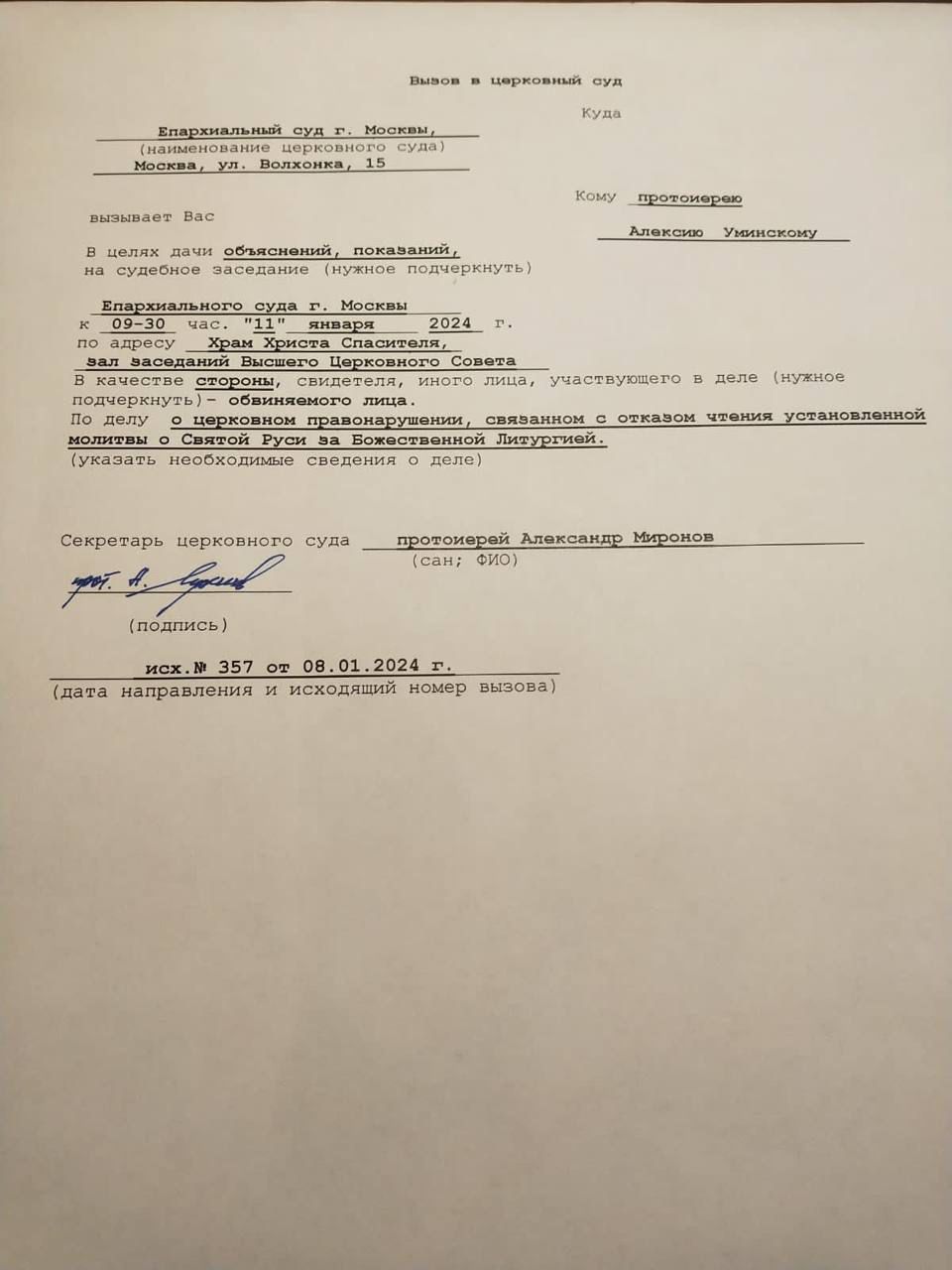
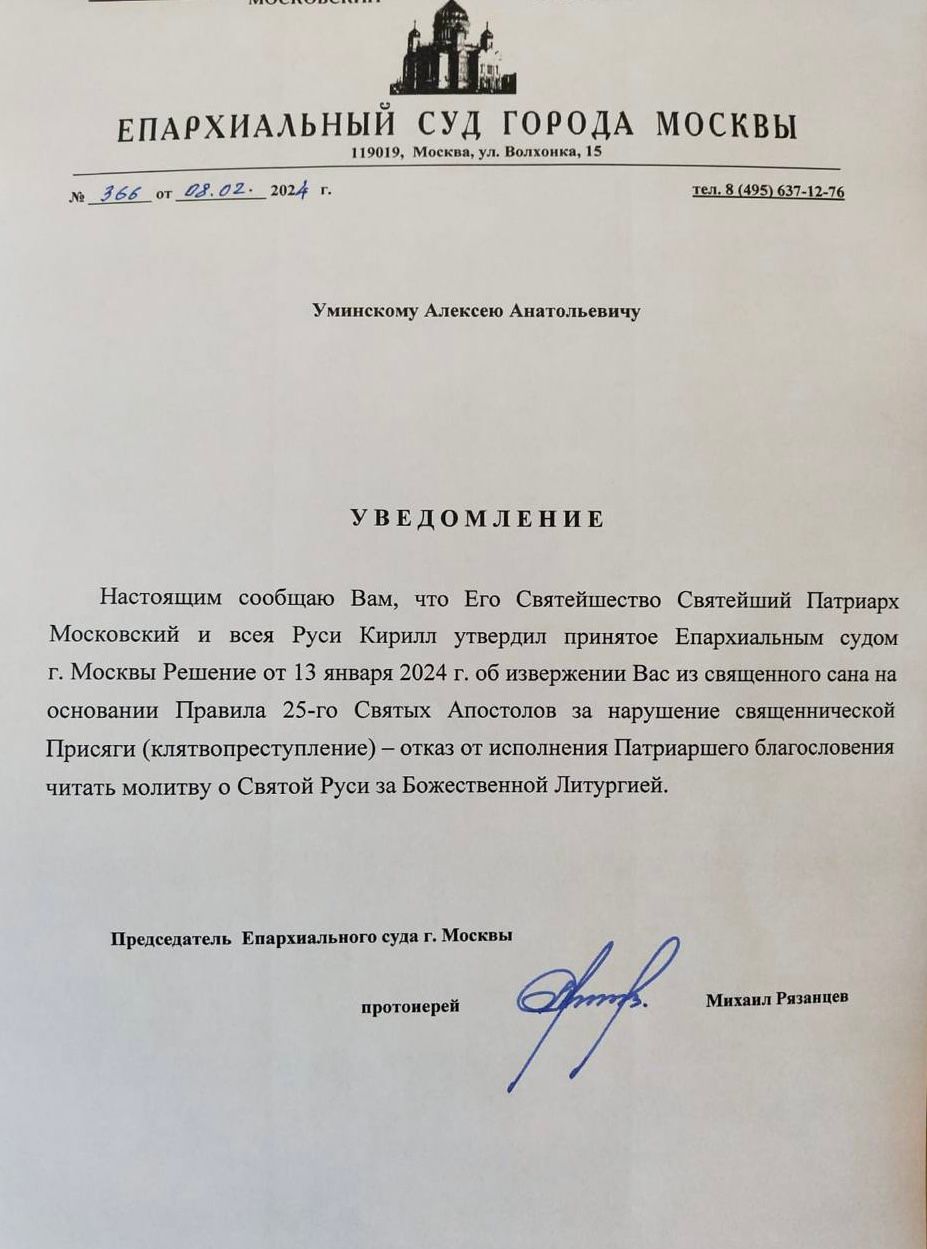
A certain priest he knew (Uminsky tells Sistema) warned him that immediately after the church trial his arrest was being prepared - this time by the secular authorities. Alexey Uminsky did not appear at the trial and left Russia. I received the notification only by email: “His Holiness the Patriarch of Moscow and All Rus' Kirill approved the decision taken by the Diocesan Court of Moscow on January 13, 2024 to depose you from the priesthood on the basis of the Rule of the 25th Holy Apostles for violating the priestly oath (oathbreaking) - refusal to fulfill the Patriarchal blessing to read the prayer for Holy Rus' for the Divine liturgy."
The notice was signed by the chairman of the Diocesan Court of Moscow, Archpriest Mikhail Ryazantsev. In addition to the chairman, members of the court were to take part in the meeting: Archpriest Vladislav Tsypin (deputy chairman), Archpriest Alexy Kruglik (secretary), Archpriests Alexander Dasaev and Vladimir Chuvikin .
Canon law
Theoretically, Sergei Chapnin explains to Sistema, the disciplinary commission was supposed to perform the function of an investigation for the church court - to talk with parishioners, interview Uminsky himself, and establish the fact of “perjury.” None of this, apparently, was done; in any case, three parishioners of Trinity in Khokhly, with whom Sistema spoke, had not heard of any inspectors coming to their church. In fact, Uminsky actually denounced himself, publicly broadcasting on the YouTube channel “Living Nail, ” advising Christians to look for priests “who pray more for peace than for victory.” There was no direct confession “I don’t say a prayer for Holy Rus'” on air. This confession, Uminsky tells Sistema, was made by the priest himself at a meeting of the disciplinary commission; it probably served as the basis for Uminsky’s ban from ministry and defrocking.
Deacon Andrei Kuraev , who was expelled back in 2020 for “blasphemy against the church” and “publication of information of a slanderous nature,” that is, criticism of church hierarchs, wrote an eight-hundred-page book about the church court, “Paradoxes of Church Law.” Her brief conclusions about. Andrei formulates this to Sistema: "The church court is a kind of novelty in the life of the Russian Orthodox Church. In the 19th century, church courts worked normally, but the Soviet government killed this tradition. Formally, the court was restored in 2004, but actually began to work under Gundyaev [Patriarch Kirill]. Gundyaev drew up the rules of church courts on his knees, because it is not always convenient for him to deal with objectionable priests with his own hands. For this we need a church court.”
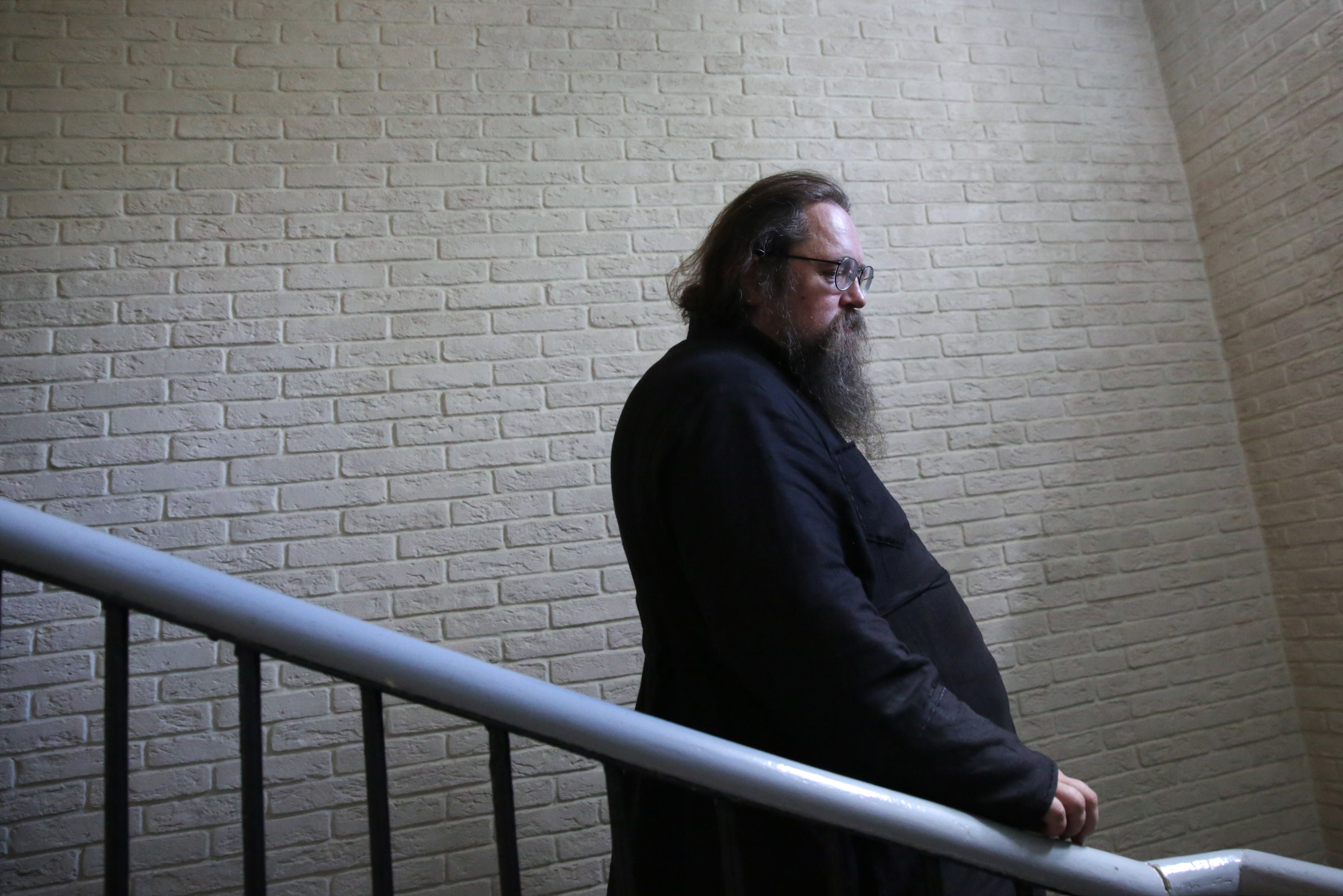
Kuraev tells Sistema that today in the Russian Orthodox Church there is no hint of a separation of different branches of government. The judiciary is not separate from the executive. The composition of the diocesan court is appointed by decree of the ruling bishop. Judges do not receive a salary, they continue to serve in ordinary parishes, that is, they are entirely dependent on the bishop, he is their employer. The court accepts cases only on the written order of the bishop and does not have any initiative of its own. The court's verdict is presented to the bishop and does not enter into force without his approval.
“The work of the court,” continues Kuraev, “does not provide for the presence of defenders. When you ask: “Can I come with a lawyer?”, they answer: “No, this is a closed meeting.” Which contradicts tradition, in the Byzantine Empire such defenders were provided, their entire staff was supported by the patriarchy.”
It also follows from Kuraev’s explanations that it is prohibited to keep any kind of records in the church court. The only meeting of the church court, says Kuraev, which was conducted via zoom and could theoretically be recorded, remains the trial of Fr. Dmitry Ostanin, rector of the Epiphany Church in Bergen, Norway. This priest was banned from ministry for supporting Ukraine. Ostanin answered the court remotely, but Kuraev does not know whether the recording of the meeting has been preserved.
The prosecutor and the judge are the same person. The accusation is brought by the same person who makes the verdict
"There is no procedural code at all," Kuraev continues, "the requirements for the court are not described anywhere. If, for example, witnesses can be called in a case, no one knows how to call them, who will pay for their travel, and so on. The prosecutor and the judge are one and the same person. The accusation is brought by the same person who makes the verdict. The defendant is not allowed to familiarize himself with the court records. The person summoned to court is not informed of the subject of the accusation. You have to come and you will be stunned on the spot. There are no attempts at pre-trial reconciliation. In my case, the patriarch allowed me to appeal, but the court did not record its reaction to the arguments of the accused. I, for example, was accused [by the same Moscow diocesan court], in particular, of slandering the Gomel bishop, accusing him of sex. harassment of a seminarian. At the trial, he asked that the testimony of this seminarian be included in the case, who was ready to appear in court and testify, but received the answer “No, it’s not necessary.” He put the papers on the judges’ table, but the judges didn’t even touch them, as if it were a bomb.” It is not possible to confirm this story by Kuraev; Sistema sent relevant questions to all members of the diocesan court, but received no answers.
Kuraev tells Sistema that the verdict, at least in his case, was written in advance, even before the start of the hearing.
"The trial lasted two hours," says Kuraev, "then they asked me to leave so that the judges could make a decision, and ten minutes later they called me in to sign that I had read the verdict. This time would not have been enough even to simply type the text."
Apostolic Rules
Sergei Chapnin explains to Sistema that one cannot simply equate church rules with secular ones; it is incorrect to assume that a ban on ministry is dismissal, and removal from the priesthood is lustration. Church rules seem to dominate the laws of the state. A priest, for example, works and receives a salary in his church under an employment contract, but if he is banned from serving or removed from the priesthood, then it is customary to simply write a letter of resignation, and not demand that the Labor Code be observed. According to Chapnin, a civilized state should rather not impose its laws on believers, but rather ensure that the church complies with the canonical rules it has adopted.
And here many questions arise. The canonical basis on which the sentence was passed on Uminsky and many other modern Orthodox priests, “Apostolic Canon No. 25, perjury,” from an ecclesiastical legal point of view requires a modern interpretation. Is it a crime to refuse to read a prayer given with the blessing of the Patriarch? Is a blessing a command? Finally, does the church correctly interpret the meaning of the 25th Apostolic Canon: “A bishop, or presbyter, or deacon convicted of fornication, perjury or theft, let him be deposed, but not excommunicated. For Scripture says: Do not take revenge twice for the same thing”? Isn't the point of the rule to avoid punishing the same offense twice? Is the church right, then, that for the same refusal to read the “Prayer for Victory” it first prohibits priests from serving, and then also expels them from the priesthood - that is, what exactly does it punish twice? How can the church canons adopted by the Seven Ecumenical Councils more than a thousand years ago be applied in the modern world? How, for example, should we apply the 45th Apostolic Canon , which prohibits priests from praying with people of other faiths and prescribes excommunication for such joint prayer? Should Archbishop Zosima (Ostapenko) of Elista be deposed for praying with the Dalai Lama in 2004? Should Patriarch Kirill be excommunicated from the church for offering a prayer to the Mother of God together with Pope Francis in Havana in 2016? “Sistema” has not received answers to these questions from the Moscow Patriarchate, and Sergei Chapnin tells “Sistema” that church lawyers themselves do not have a common opinion on these issues.
Andrei Kuraev tells Sistema that the deputy chairman of the Moscow Diocesan Court , teacher of church law at the Moscow Theological Academy, Archpriest Vladislav Tsypin, answered all the students’ questions about how to apply the ancient canons to modern church life: “As the Bishop will bless.”
Keyholder-chairman
Judging by his intonation, Kuraev is even offended by Archpriest Vladislav Tsypin. They are old acquaintances - a professor and a student, long-term colleagues teaching at the academy, housemates, visited each other many times, but as soon as the church proceedings began in Kuraev’s case - not a single phone call, not a single “attempt to whisper” on Tsypin’s part, as Kuraev says. In connection with the trial, Tsypin certainly preferred church obedience to personal relationships.
About the Chairman of the Court, Fr. Mikhail Ryazantsev also has a low opinion of Kuraev. The deacon tells Sistema that Ryazantsev became the keymaster of the Cathedral of Christ the Savior and the chairman of the Moscow Diocesan Court precisely because of his absolute lack of influence, lack of independence, lack of subjectivity in the Russian Orthodox Church. Ключевую роль в суде играет именно Цыпин, а Рязанцев возглавляет суд номинально, потому что естественно, не по писаному какому-то правилу, а по традиции, ключарю, то есть фактическому настоятелю (официально настоятель – сам патриарх) быть и председателем суда.
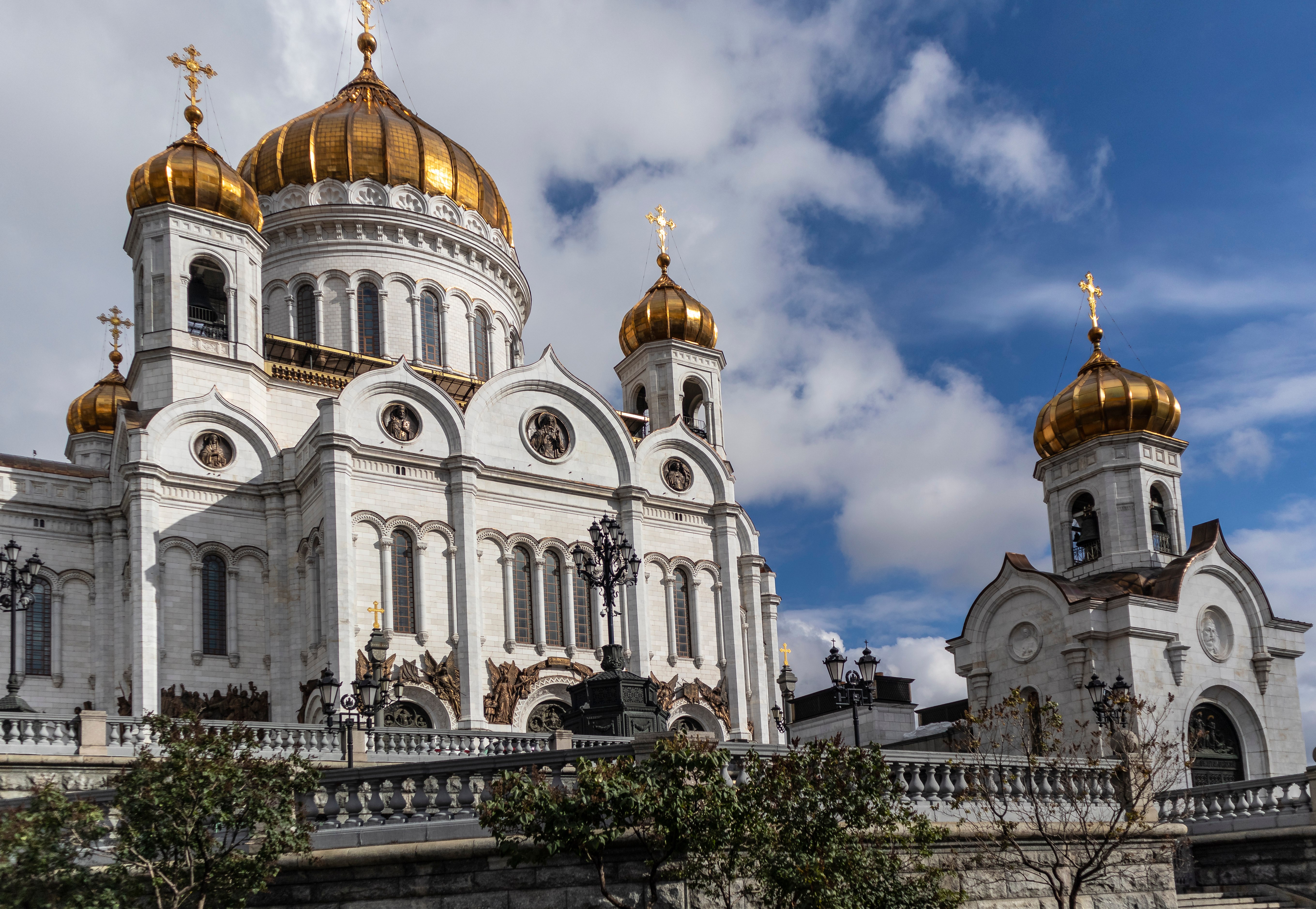
Журналисты неоднократно писали о бизнесе, который построил Фонд храма Христа Спасителя вокруг этого кафедрального собора, который официально принадлежит Москве. Торговые павильоны, подземная парковка, автомойка под названием “Мытный двор”, автосервис, клиентам которого предлагалось, ожидая машину, поклониться мощам святого Николая, когда таковые привезли из Бари в Москву и на Волхонке выстраивалась к мощам многочасовая очередь… А еще аренда помещений. А еще субсидии от правительства Москвы на сотни миллионов рублей.
“Это нормально, что кафедральный собор принадлежит городу, а не церкви, – говорит “Системе” Кураев. – В царской России тоже так было. Церковь разорилась бы, если бы большие соборы передали ей на баланс”.
Возглавляют Фонд храма Христа Спасителя со стороны Москвы непубличный управленец Игорь Ковалев , а со стороны церкви о. Михаил Рязанцев. “Системе” не удалось найти "Система" не может однозначно утверждать, что у Рязанцева или связанных с ним лиц нет другой дорогостоящей собственности или крупных сбережений сколько-нибудь экстраординарных доходов Рязанцева от этого миллиардного бизнеса. Маленькая квартира в Крылатском и FIАТ 500 – благополучие, но не богатство. Зато серьезный список церковных и государственных наград . А еще та особая влиятельность, прямой доступ к сильным мира, который дает положение фактического настоятеля главного храма страны. “До какого-нибудь важного московского или федерального чиновника так просто не доберешься, – поясняет “Системе” Сергей Чапнин. – А после праздника какого-нибудь или отпевания можно подойти и неформально решить любой вопрос”.
Чапнин и Кураев в разговорах с “Системой”, независимо друг от друга и в разное время, утверждают, что председатель епархиального суда, как правило, очень дорожит своей должностью, и потому судебные решения выносит в полном соответствии с желаниями церковного начальства. Это касается не только Москвы, но и любой другой епархии, Литвы, например, где митрополит Виленский Иннокентий одним днем (29 июня 2022) исторг из сана сразу четверых видных православных священников – они выступали против войны, и митрополит не осмелился позволить в своей епархии такую, с точки зрения Москвы, фронду. Рязанцев не ответил на запрос "Системы".
Трусливый человек
Дьякон Андрей Кураев рассказывает “Системе”, что в зарубежных епархиях Русская православная церковь вообще-то старается вести себя мягко, закрывать глаза на антивоенные высказывания клириков, не очень настаивать на чтении “Молитвы о победе”, идти на компромиссы с местными властями, чтобы не потерять прихожан. Так произошло, например, в Латвии: в 2022 году Сейм объявил Латвийскую православную церковь отдельной от РПЦ, Собор Латвийской церкви внес изменения в устав, но Москва канонически никак не отреагировала, не анафематствовала латвийских “раскольников”, но и не признала латвийской автокефалии, только выразила понимание сложной политической ситуации и призвала верующих “хранить единство”. Юридически Латвийская церковь остается частью Русской церкви, правительство Латвии этого не признает. “Спустили дело на тормозах, – говорит “Системе” Чапнин, – подвесили до лучших времен”.
Иначе было в Литве. Лишенный в 2022 году сана священник Владимир Селявко рассказывает “Системе”, что в правление митрополита Хризостома (Мартишкина), вплоть до смерти его в 2010 году, жизнь Литовской православной церкви была практически независимой от Москвы. Наследовавший Хризостому митрополит Иннокентий (Васильев), возглавляющий епархию до сих пор, тоже имеет репутацию человека либерального, но времена меняются.
Больше всего он боится начальства
“Он мягкий человек, не кровожадный, – говорит об Иннокентии о. Владимир Селявко, работавший секретарем этого митрополита больше семи лет. – Но трусливый. Он боится всего. Боится пойти к врачу. Боится ездить по узким дорогам, всегда просит везти его по большой магистрали. А больше всего он боится начальства”.
Подтверждения или опровержения этих сведений “Система” не смогла получить от пресс-службы Виленской епархии РПЦ.
После начала полномасштабного вторжения российских войск в Украину многие литовские священники выступали против войны. Митрополичий канцлер (так в Литве называют викария, секретаря епархии), Виленский благочинный и настоятель Кафедрального Пречистенского собора Виталий Моцкус прямо высказывался против войны на литовском языке и для литовских СМИ. По словам о. Владимира Селявко, выступление Моцкуса “Православные Литвы осуждают действия России по вторжению в Украину” было опубликована даже на сайте Виленской епархии, сейчас эта страница удалена. Священники, сослужившие о. Виталию в Кафедральном соборе, в том числе Владимир Селявко, тоже не скрывали своей антивоенной позиции в разговорах с журналистами .
Владимир Селявко рассказывает “Системе”, что митрополит Иннокентий пытался искать компромисс и 17-го марта 2022 года даже собрал некий совет, долженствовавший примирить антивоенную позицию литовских священников с провоенной позицией Московской патриархии. По результатам совета выступил с знаменитым заявлением : “Позиция Православной Церкви в Литве неизменна – мы решительно осуждаем войну России против Украины и молим Бога о ее скорейшем прекращении… У нас c Патриархом Кириллом разные политические взгляды и восприятие текущих событий. Его политические высказывания по поводу войны в Украине – это его личное мнение. Мы в Литве с этим не согласны”.
Но уже 14-го апреля 2022 Иннокентий снял Виталия Моцкуса с должностей канцлера, благочинного и настоятеля Пречистенского собора и назначил на все эти должности, а заодно и на должность председателя церковного суда епископа Тракайского Амвросия (Федуковича). Вскоре бывший канцлер Моцкус был лишен сана, а вместе с ним извергнуты из сана были и сослужившие ему в Пречистенском соборе священники.
Про Амвросия о. Владимир Селявко рассказывает, что в начале полномасштабной войны тот приглашал его для беседы. Тогда о. Владимир видел на столе у епископа случайно или нарочно оставленные на виду распечатки антивоенных высказываний канцлера Моцкуса и самого Селявко. Отец Владимир полагает, что это именно епископ Амвросий послал в Москву материалы, свидетельствующие об антивоенных настроениях литовских священников, то есть доносчик был одновременно и судьей. Потом из Московской патриархии последовал звонок Митрополиту Иннокентию, недавно еще осуждавшему войну. Иннокентий испугался и уволил Моцкуса, а вскоре запретил в служении и лишил сана его и его сослуживцев-единомышленников Виталия Даупараса, Георгия Ананьева, Гинтараса Сунгайлу, Владимира Селявко.
“Системе” не удалось независимо подтвердить этот рассказ о. Владимира Селявко, представители Виленской епархии РПЦ не ответили на вопросы “Системы”.
Апелляция в Стамбул
Основной корпус церковных законов относится к эпохе Вселенских соборов, то есть к эпохе с IV по IX век
Директор по коммуникациям Центра православных исследований Фордэмского университета Сергей Чапнин поясняет “Системе”: “До революции 1917 года в России церковный суд был и были очень серьезные церковные юристы. В западный странах все это время церковное право продолжало существовать и развивалось. Можно учиться, например, в католических университетах на юридическом и специализироваться именно в каноническом праве. Ничего подобного в советской России не было и в постсоветской России нет. Это значит, что есть проблема толкования правовых, церковно-канонических норм. Это большая проблема, потому что основной корпус церковных законов относится к эпохе Вселенских соборов, то есть к эпохе с IV по IX век. Все было другое, поэтому творческая задача современных церковных юристов – применить канонические нормы к современной жизни”.
По словам Чапнина, в отличие от Греции, например, где церковно-юридическая традиция не прерывалась и школа канонического права существует, в России каноническое право можно назвать суррогатным: толкователи апостольских правил действуют по принципу “чего изволите”. Если епископу нужно осудить кого-то, задача специалиста по каноническому – найти каноническую норму, которая оправдывала бы принятое епископом решение.
“Уже в 90-е годы, – говорит Чапнин, – мы вели разговоры о том, что нам нужно возрождать церковный суд как институт. Еще до Кирилла было принято Положение о церковном суде . Во-первых, согласно этому положению, есть епархиальный суд, священники, которых назначает епископ. Во-вторых, Высший церковный суд, епископы, которых выбирает Архиерейский собор, к высшему суду можно апеллировать, если не согласен с решением епархиального суда. А решения Высшего суда можно оспорить на Архиерейском соборе, собор епископов выступает как высший судебный орган”.
Практика, однако, показала, что ни к Высшему церковному суду, ни к Архиерейскому собору никто из лишенных сана священников, с которыми поговорила “Система”, не обращался. Обращаются сразу к Вселенскому патриарху Варфоломею.
“Действительно, – говорит “Системе” Чапнин, – сохраняется закрепленная в канонах средневековая норма права, что если священник не согласен с решением суда своей поместной церкви, он может апеллировать к суду Вселенского, то есть Константинопольского патриарха. Это высшая судебная инстанция в мировом православии.
Долгое время казалось, что это мертвая норма. В отношении Русской православной церкви она столетиями не использовалась. И вдруг, начиная с кейса отца Ивана Коваля, эта норма ожила. Греки посчитали возможным восстанавливать в сане священников, исторгнутых Русской церковью. У антивоенного священства и священников, лишенных сана в результате интриг в РПЦ появилась возможность быть восстановленными в сане”.
При этом неправильно думать, будто восстановление исторгнутого священника в сане может быть автоматической или хотя бы простой процедурой. И в Московской патриархии это, похоже, хорошо понимают.
Дьякон Андрей Кураев рассказывает “Системе”, что его исторжение из сана еще до полномасштабной войны в Украине было обставлено патриархом как юридический тупик. В 2020 году патриарх утвердил исторжение, но немедленно наложил на это решение мораторий . Кураев полагает, что это парадоксальное решение принято было именно для того, чтобы дьякон не имел юридических оснований апеллировать к Константинопольскому патриарху. В этом подвешенном состоянии Кураев прожил два года, до тех пор, пока началась полномасштабная война, исторгать священников из сана стали десятками и кейс Кураева перестал быть уникальным.
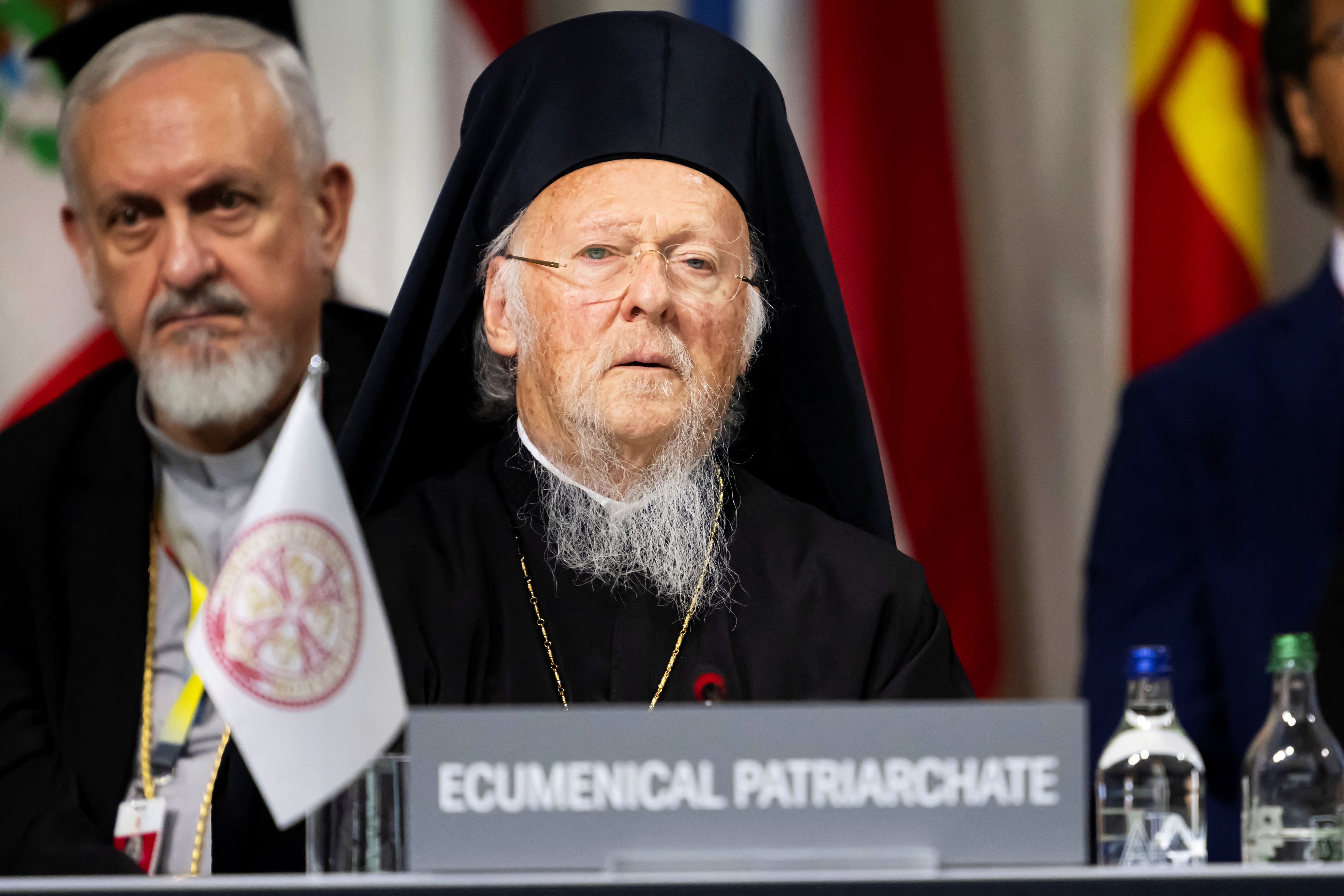
Отец Алексей Уминский тоже рассказывает “Системе”, что его апелляция к Вселенскому патриарху, восстановление в сане и поиск для него нового места служения уже в качестве священника Константинопольского патриархата потребовали больше года. Простой процедуры нет, понадобились личные связи, помощь коллег из Франции и Бельгии, личная встреча с патриархом Варфоломеем, поиск прихода, который готов принять восстановленного в сане священника – и только потом восстановление.
Отец Владимир Селявко говорит, что восстановлению в сане литовских священников очень помогли вмешательство премьер-министра страны Ингриды Шимоните и визит патриарха Варфоломея в Литву. Эти события, впрочем, не отменили значительную бюрократическую волокиту и необходимость перевести все документы священников с русского и литовского языков на английский.
В последнее время, говорит “Системе” московский клирик, пожелавший (из страха лишиться сана) остаться неизвестным, “в патриархии сообразили, что надо только запрещать священников в служении, но не лишать сана, чтобы они не могли апеллировать к Вселенскому патриарху”. По крайней мере один такой случай юридической безвыходности действительно известен – кейс отца Константина Кокоры, который эмигрировал во Францию, но служить там не может, потому что не исторгнут из сана в Москве, а только запрещен в служении.
Ссылка и развод
Для десятков антивоенно настроенных священников исторжение из сана и последующее восстановление в сане не является просто неприятной бюрократической процедурой, какой для мирянина была бы потеря работы и поиск новой. Лишение сана для священника – это даже не просто запрет на профессию. Отец Владимир Селявко говорит “Системе”, что это похоже на ссылку в далекую и не обжитую страну, да еще и одновременно развод с потерей прав на детей – мгновенное и радикальное изменение всего жизненного уклада.
“Наверное, я и правда был плохим диаконом,” – говорит “Системе” о. Андрей Кураев, и в словах его слышится глубокая горечь.
Отец Алексей Уминский описывает расставание с паствой, с прихожанами церкви Троицы в Хохлах как расставание с семьей. Константинопольский патриархат восстановил о. Алексея в сане, определил ему место служения – церковь Знамения Божьей Матери в Париже, даже предоставил небольшую квартиру над церковью. Но не платит зарплаты. На жизнь священнику приходится зарабатывать лекциями и проповедями в социальных сетях.
Чувство такое, как будто идешь, сам, своими ногами в операционную, где тебе ампутируют что-то
А о. Владимир Селявко говорит: “Я сам на это пошел. Моя совесть заставляла меня пойти на это. Но чувство такое, как будто идешь, сам, своими ногами в операционную, где тебе ампутируют что-то. Проснешься уже другим человеком. Я ведь из очень консервативной семьи, такие литовские амиши , только православные. Я с детства мечтал быть священником, с шести лет. Есть сотни людей, которых я крестил, женил, родителей отпевал, а теперь они не здороваются, переходят на другую сторону улицы при встрече. Я буквально потерял близких: дядя священник со мной больше не общается, один из братьев не общается, тесть-священник. Я не могу спокойно приехать к могиле отца, потому что там попаду на территорию общины, которая меня не принимает больше”.
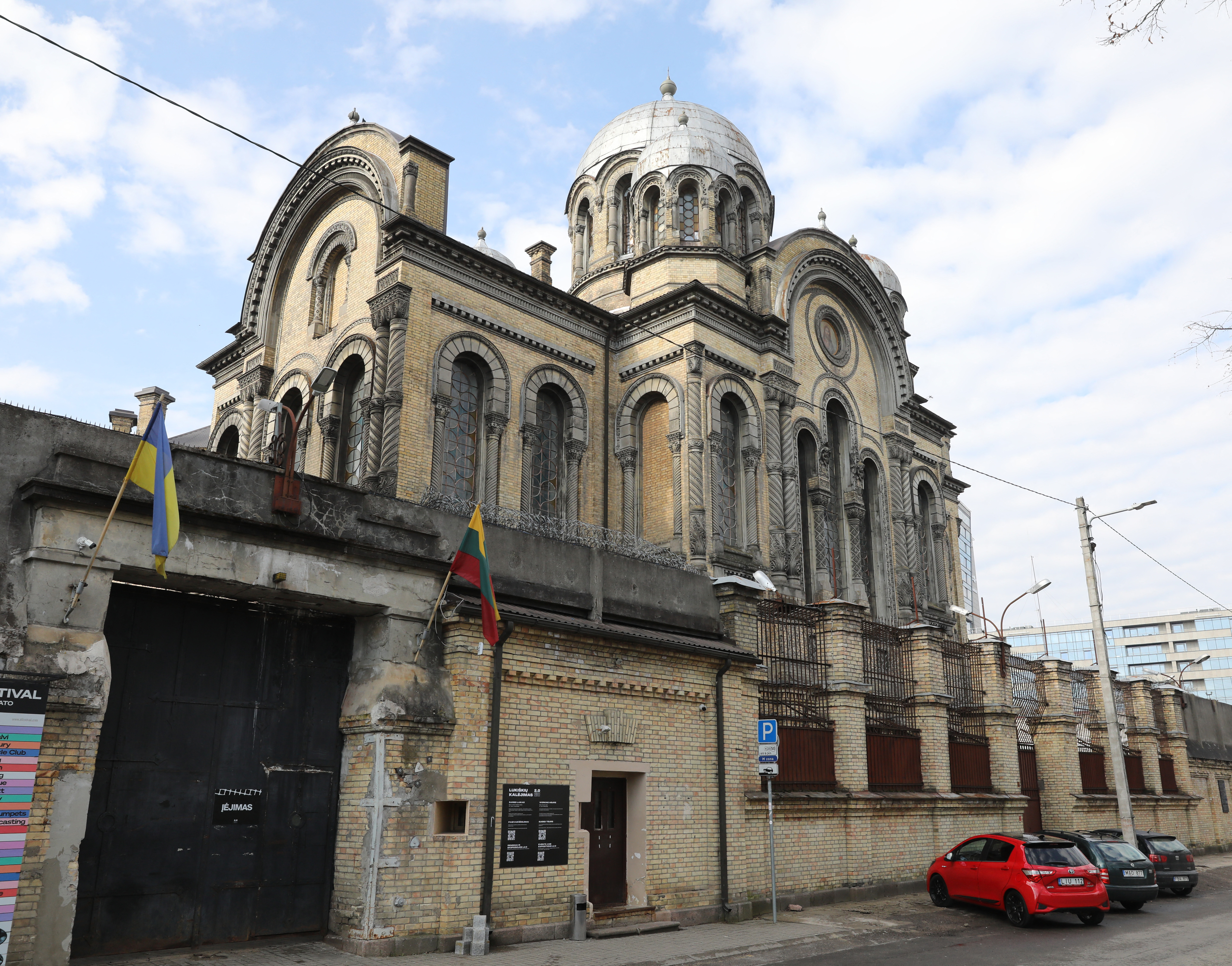
В качестве константинопольского священника о. Владимир служит в церкви, которая еще в советское время переделана была в концертный зал. Иконостаса там нет, но есть эстрада. Каждое воскресенье утром, о. Владимир достает из кладовки раскладной аналой, пару пюпитров для икон и поставцы для свечей. После службы убирает все это свое “церковное убранство” обратно в каптерку. Строительство церкви литовского экзархата константинопольской церкви в Вильнюсе только еще обсуждается с властями.
После многотысячной паствы Кафедрального собора, теперь на службы к о. Владимиру приходят два десятка человек. И священник радуется когда его паства растет хоть бы и на одного человека.
 Caucasus.Realities application for your smartphone Install
  Caucasus.Realities on Telegram Read