
Translated material
Why should you read The Book of Passages?
About Walter Benjamin's main unfinished work
Walter Benjamin's "Passages" has been called an anthology of the culture and everyday life of Paris in the mid-19th century - in any case, the genre nature of this book is not easy to determine. The author worked on it for many years until his death - and left it unfinished. Perhaps, Ivan Davydov believes, this is because life itself, which Benjamin tried to describe in its entirety, is incomplete.
All of us, since February 24, 2022, have found ourselves in the face of advancing barbarity, violence and lies. In this situation, it is extremely important to preserve at least the remnants of culture and support the values of humanism - including for the sake of the future of Russia. Therefore, the editors of Gorky will continue to talk about books, reminding our readers that there is still a place for thought and fiction in the world.
Walter Benjamin. Book of Passages / Compiled by Rolf Tiedemann. M.: Ad Marginem Press, 2026. Translation from German by Vera Kotelevskaya, translation from French by Sergei Fokin. Content . Fragment
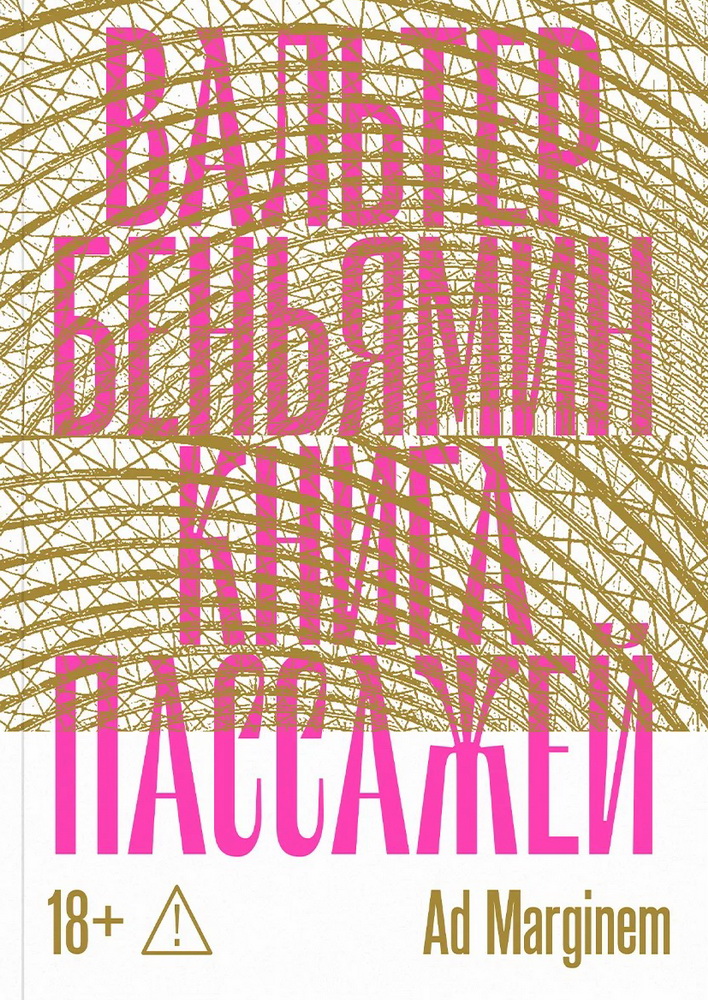
Let's play a game first. Let's pretend that we don't know anything about the author. Haven’t read before either “The Moscow Diary”, or “Berlin Childhood at the Turn of the Century”, or “One-Way Street”, or even “Works of Art in the Age of Its Technical Reproducibility”. By the way, “The Work” appeared just during the work on the book that we are going to talk about. In a sense, as a by-product of this very work. Well, I myself violated the proposed rules: after all, we agreed that we knew nothing about the author.
It is clear, of course, that this is a convention: we have no way to uproot books we have already read from our heads. They remain there, grow, take root, and this process does not depend on us in any way. They can leave, forget themselves, yes, but also only of their own volition. I recently came across a new book by one of my older friends, who is no longer with us. It’s new and old, it came out during the author’s lifetime, but it seemed to me that I had never seen it before. I came across it, bought it, opened it, made my way through the difficult text with painful pleasure - I generally love his books - and only when I got to the middle did I realize that I had already read it before. But for some reason I completely forgot. Why, how, why is he doing this to me? Maybe so that I could experience my pleasure once again. As if for the first time. This is a parting gift. Or, conversely, promising a quick meeting.
Okay, any game is a convention, but I propose to play.
So, a huge volume. Almost a thousand pages. A real monument to the work of translators. And just one glance is enough to understand: this book will require work from you. It takes determination to open. Let's make up our minds.
It all starts with promises. Everything always starts with promises (the girls will confirm). The main text is preceded by something like an outline, and the author promises us the history of Paris as the capital of the 19th century. The plan is detailed, (almost) logical, suggesting a well-structured story, understandable characters. Big names are like nails, nails will be driven into the wall, pictures will be hung on the wall. We will admire the paintings and understand everything. But further... Further - complete chaos. A muddy stream of quotes. The headlines are almost always deceiving. At the very least, they don’t really clarify anything and poorly correlate with the promises with which it all began.
Famous authors - Baudelaire (he seems to be definitely the hero here, and the main one, although this is not a fact). Hugo. Balzac. Forms. Saint-Simon. Marx. A special Marx. The author is clearly trying to make friends with Marx, but he persistently gives us quotes in which Marx is either a poet or a mystic. Some repeat it several times, probably for greater persuasiveness.
And the writers are completely unknown or forgotten, it is possible that they are fictitious. That is, it is impossible - the author sat in libraries for years and read them all, and made his own extracts, but we agreed that we know nothing about the author. Therefore, their existence is questionable for us.
Well, a person - even in the blessed 19th century - could not write that, given their anatomy, it is more convenient for women to walk on four legs rather than two. And that perhaps upright walking first appeared in men. And so they coexisted for some time - a man and his four-legged girlfriend.
I couldn't. However, here is the link - the name, year of publication, even the page. You can check, or you can believe that the author made up everything - the title, the year of publication, and so on.
The author hides behind quotes, only occasionally daring to peek out from behind the cover. However, the style prevails - although his own aphorisms are at least fifty years younger than any of the quotes, they look quite organic among them. There is, however, a whole chapter where the author tries to figure out the method, but it doesn’t make the text any clearer. Rather, it completely confuses everything. Perhaps he is a Marxist. That is, a Freudian. Although, of course not. Kabbalist? Well, just a little bit. Antique dealer But no. The antique dealer is a businessman, and he is a collector. The image of a collector occupies his imagination. He also collects other people's definitions of collecting.
We are in the crowd (and the image of the crowd attracts the author, just like his main character - Baudelaire - or not the main one, or not in the same way, but much more powerfully). We are not reading, we are walking aimlessly through a huge city, which, of course, was at least partly built in accordance with some plan, and Baron Haussmann, naturally, also flashes here. But when you walk aimlessly through a huge city, you don’t think about any plans. You dissolve into chaos. And around - politicians, beggars, writers, prostitutes, stockbrokers, rag dealers, newspaper men, beggars, millionaires, hard workers from the suburbs, artists, society ladies... And flâneurs, idle, that is, revelers, that is, us. We pass by ourselves and can even push with our elbow.
And they all talk. They make endless noise that cancels out the meaning. This noise is life; whether life has meaning is a debatable issue, to put it mildly.
And so on until the last page. We are seen off by students of the Polytechnic School, “youths of pleasures and holidays” from a poem by the poet Barthelemy, now forgotten, like almost everyone else our author quotes. Then there is a row of empty pages - the author was preparing notebooks for new extracts, but did not have time to fill them out. The publishers carefully reproduced the blank pages.
The rest is silence, as one not completely forgotten poet used to say.
That's all. Game over.
Now let's remember some of what we do know about both the author and the book. It was to become his main book. He worked on it for 13 years - from 1927 until his almost death. Voluntary or not entirely voluntary death, it depends on the point of view. Walter Benjamin, in Europe surrendering to the fascists, turned from a flâneur not even into a refugee - into a fugitive, and, realizing that he could not escape, he committed suicide. That is, he still ran away.
He was going to write something elegant and light about the arcades, the covered shopping galleries of Paris that determined the appearance of the city in the 19th century. Work for several weeks - he himself spoke about it in letters to friends (letters to friends are right there, in the attachment, after saying goodbye to the students of the Polytechnic School, we fall not into silence, but into these very letters). It didn’t work out, it was work that ate up the rest of my life and boiled down to an exciting hunt for other people’s quotes for the collector. Blank pages, several unfilled notebooks are direct evidence of this. He had no intention of stopping. He wanted, of course, to write his book, he enthusiastically told his understanding interlocutors - Theodor Adorno, for example, and Gretel, Theodor Adorno's wife - about what it would be like when he wrote it. But, it seems, if I didn’t understand it myself, I felt that it was basically impossible to write it.
From an optional stroll through the arcades - fashionable shops, supple beauties, inevitable flâneurs - to the desire to tell the story of the last century (for Benjamin, the past) through the history of the main city of this century. “New Babylon”, “Babylon of the 19th century” - these broken metaphors, of course, flash through him. The city-universe, the symbol of which was the tower.
So far, in the conversation about the book, which almost entirely consists of quotes, there has not been a single quote. Now is the time. True, Benjamin does not have this quote, but, of course, he knew it perfectly:
“All people on earth had the same language and the same words. Moving from the East, they found a valley in the land of Shinar and settled there. And they said to each other: Let us make bricks and burn them with fire. And they used bricks instead of stones, and asphalt instead of lime. And they said: Let us build ourselves a city and a tower whose height reaches to heaven; and let us make a name for ourselves, so that we are not scattered over the face of all the earth. And Yahweh came down to see the city and the tower that the sons of men were building. And Yahweh said: Behold, there is one people, and they all have one language; This is the first thing they began to do, and they will not lag behind in what they decided to do. Let us go down and confuse their language there, so that one does not understand the speech of the other. And Yahweh scattered them from there over all the earth; and they stopped building the city. Therefore, the name was given to him: Babel, for there Yahweh confused the languages of the whole earth, and from there Yahweh scattered them throughout the whole earth.”
If you write about Babylon—even if it’s new—you’ll definitely have to build a tower. And not Eiffel (Eiffel, of course, sticks out from Benjamin’s text, but that’s not the point). You will have to collect bricks of quotes, but there is enough asphalt on the city streets. We'll have to put them together, regardless of the original plans. Convincing yourself that one day you will complete it. Realizing or feeling that it is impossible to complete it.
This book is not a book. Not a book, but a construction site, with mountains of verbal rubble, with neat slabs of extracts. Whether there is a vengeful God is also a debatable question, but even if He does not exist, He will have enough strength to prevent the tower from being completed to heaven. To unfold world history in such a way that the author has only one way out. Into your own death.
He who builds a tower will fall, as another not entirely forgotten poet said, whom Benjamin does not quote.
A huge volume - a story of failure, and described in advance. In the Bible. The scale of the failure is appropriate. But the author still succeeded in achieving something. There is no tower, but the reader (especially the one who has finished reading) has a complete feeling that he is among people whose languages are mixed. Among the endless, meaningless hum of their conversations.
And it seems that this is the limit of what is possible for the person who took on the project of the Tower of Babel. The tower cannot be seen. The tower can be heard.
To hear this, you should read Walter Benjamin’s “Book of Passages.”
Yes, you know, I would like to write such a book. But in order for it to be published, you must first die...