
Translated material
The Emperor's Silver: How Fake Artifacts were Turned into Multimillion-dollar Assets
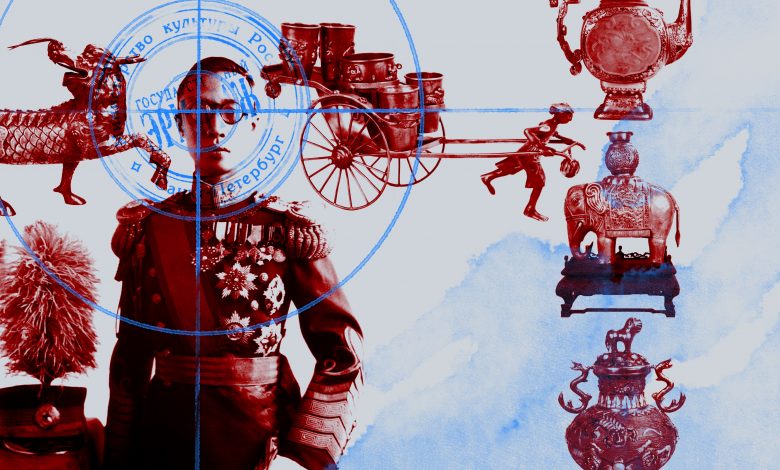
The story of the “treasures of the last Chinese emperor” has been circulating among collectors, art historians and lovers of conspiracy legends for decades. But in recent years it has suddenly become an international story, with anonymous letters, Hermitage documents, Ukrainian intelligence services and estimates worth hundreds of millions of dollars.
Chronicles.Media traced how the myth about Pu Yi's collection became connected to the market for dubious cultural property, false examinations and schemes through which works of art were turned into financial assets.
Sensation from Mariupol
In October 2023, the Spanish newspaper El Mundo published material that looked more like a Hollywood thriller script than a report. It stated that the priceless silver collection of the last Chinese emperor Pu Yi was put up for sale on the darknet. The sellers were people associated with drug cartels. Lot - 117 items; starting price is almost 480 million euros.
The source of origin of the collection was named specifically - Mariupol. According to a Ukrainian official who spoke with El Mundo, it was from there that the relics were taken out during the war and brought to Europe through a chain of intermediaries.
The story looked too good to be true. There are too many coincidences: the emperor, the darknet, underground auctions, criminal intermediaries. This creates the atmosphere of a “big find” that can attract not only the attention of the public, but also the money of potential investors or collectors.
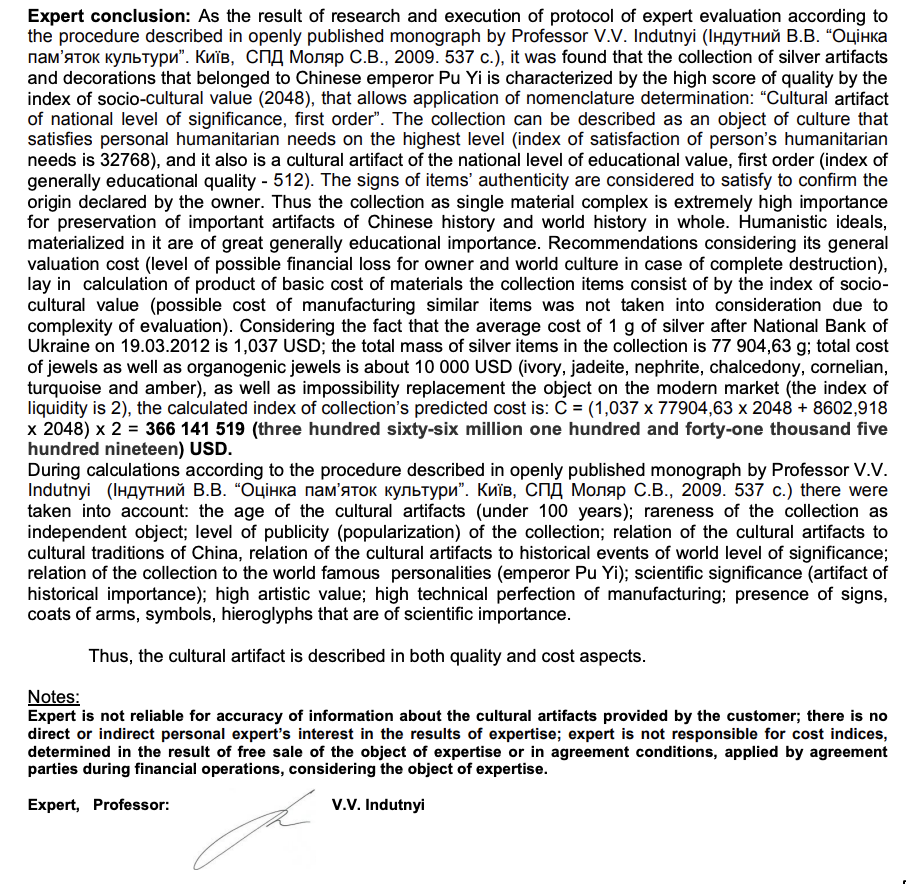
A year later, in 2024, anonymous letters came to the Russian editorial offices of independent media. Their contents almost completely repeated the Spanish publication: the same Pu Yi collection, the same 117 items, the same underground auctions. No names, no addresses, no specific details. But this time the legend had “confirmation”: a document enclosed in the letter with the coat of arms of the State Hermitage. It said the collection of 117 items was valued at $402 million.
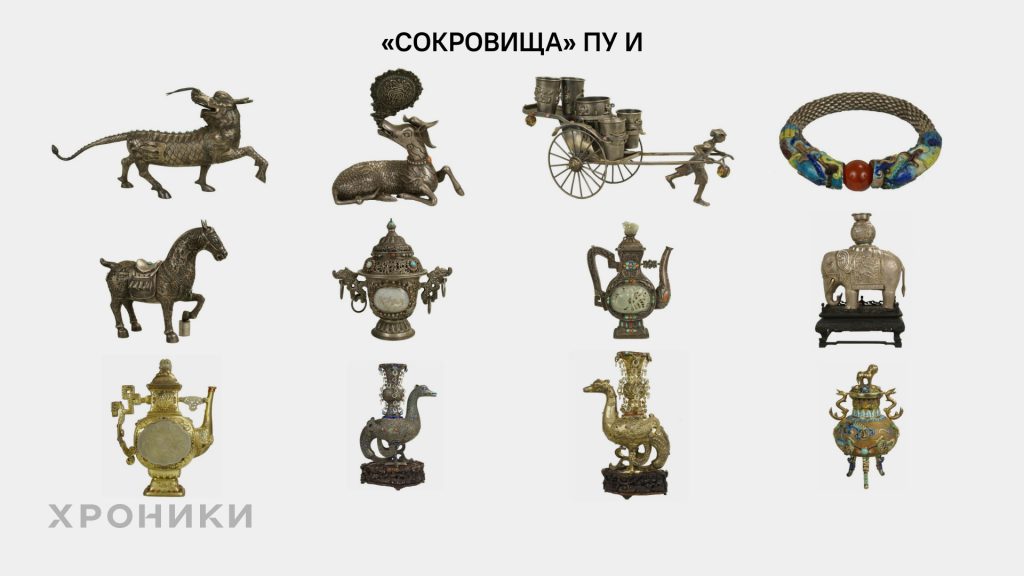
At first glance it looked convincing. The list of things was carefully written out: cups, sabers, jewelry, tabletop items. The document bore the signature of a famous art critic and the seal of the Hermitage.
But it was precisely in such “details” that the problem lay.
- The document did not have a date or registration number - mandatory for any official conclusion of the largest museum in Russia.
- It was signed by a man who had died fourteen years earlier.
- The difference in the estimated amounts - €480 million in Spain and $402 million in anonymous letters - was not explained in any way.
But the main thing was not even the strangeness of the document. Almost immediately it became clear that behind the valuation of the collection was a person who had already appeared in stories involving many times inflated values of art and museum objects—Ukrainian professor Vladimir Indutny.
Haunted Documents
In any story about multimillion-dollar antique transactions, the main argument is not the legend, but the document. It is the stamped and signed paper that turns a dubious collection into a potential asset for banks, insurers and buyers. In the case of the “Pu Yi Treasures,” such a document actually appeared.
An “evaluation document” was attached to the anonymous letters sent to Russian editorial offices, part of which was a letter on State Hermitage letterhead with a detailed description of the collection.
The list was compiled carefully: cups, sabers, jewelry, household items - each with a separate number, a brief description and market value. Under the text of the letter from the State Hermitage was the signature of Evgeniy Iosifovich Lubo-Lesnichenko, one of the largest Soviet and Russian specialists in Oriental art, and the assurance of the scientific secretary of the Hermitage N.P. Lavrova.
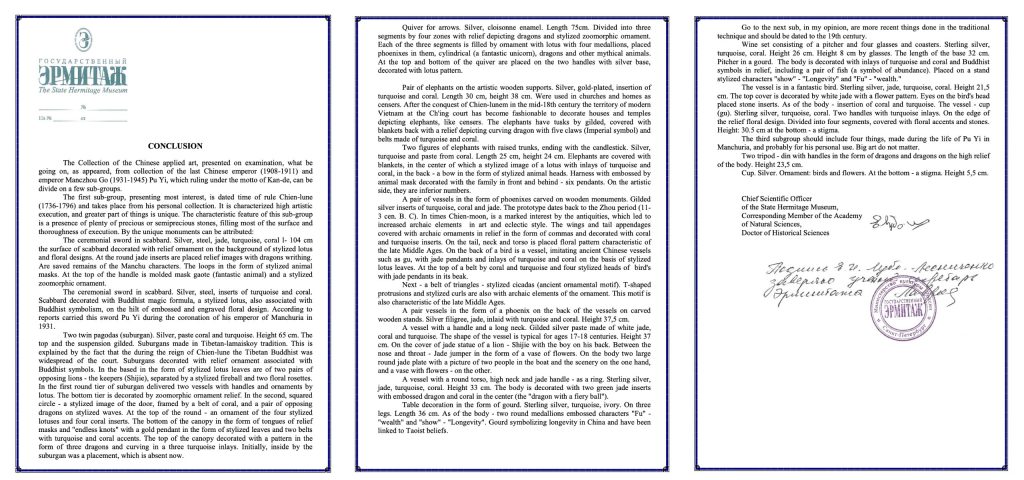
At first glance, everything looked perfect. Such a document can open the door to any bank, insurance or auction house. But upon closer examination, it turned out to be full of inconsistencies.
Evgeniy Lubo-Lesnichenko was truly a world-class authority. His name in art criticism is a guarantee of competence. But he died in 2001. And the document attached to the letter is dated 2015.
The second signature is N.P. Lavrova, scientific secretary of the Hermitage. On paper it looked convincing: name, position, assurance. But the Hermitage press service later confirmed: in 2015 there was no such employee in the museum.
Any official document of the Hermitage has mandatory details: date of preparation, registration number, incoming and outgoing stamp. They weren't here. The paper looked like a copy assembled “museum style”, but devoid of what makes it legally significant.
It was this document, however, that became the basis for the assessment of the “Pu Yi collection” worth hundreds of millions of dollars.
Professor of Questionable Values
Behind the “Hermitage document” with the signature of a dead art critic, another name is unexpectedly discovered - Professor Vladimir Vasilyevich Indutny. It is he who is indicated by the author of the collection’s valuation at $402 million.
The name of Vladimir Indutny has been cropping up for years in stories where works of art and archaeological artifacts suddenly turn into assets worth hundreds of millions of dollars.
Indutny is a geologist by education; in 1993 he defended his doctoral dissertation in geological and mineralogical sciences at the Institute of Mineralogy and Ore Formation in Kyiv. In the 1990s, he headed the State Gemological Center of the Ministry of Finance of Ukraine, where he began to develop his own methods for assessing cultural property and jewelry. For officials and businessmen then it was convenient: an expert with the seal of the Ministry of Finance could justify any cost.
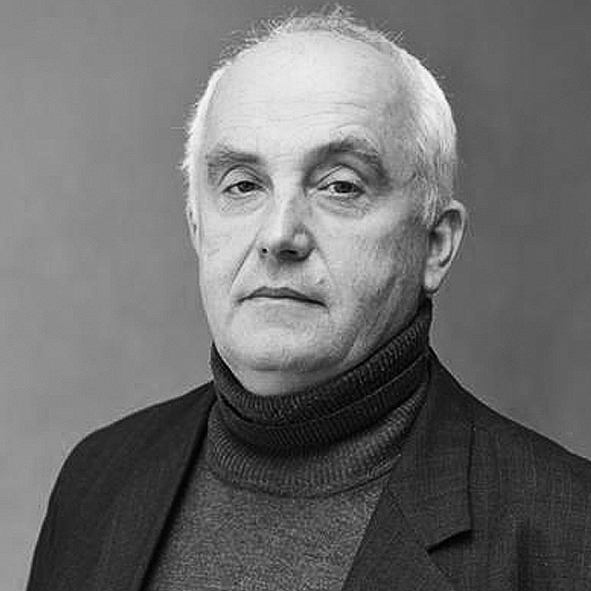
As a result, Indutny turns into a universal “appraiser” - from minerals to paintings and museum artifacts.
Vladimir Indutny is often associated with the private museum "Platar" in Kyiv, which was founded in the 1990s by two Ukrainian entrepreneurs - Sergei Platonov and Sergei Taruta. The name is made up of the first syllables of their last names: PLA-TAR.
The museum was positioned as a unique collection of antiquities, containing more than 10 thousand artifacts - from objects of Tripoli culture and Scythian gold to products of Kievan Rus. But from the very beginning, “Platar” was surrounded by scandals. In 2008, the Polish press accused the museum of organizing an exhibition of artifacts of dubious origin in Warsaw. In 2009–2012, an international dispute flared up: the “Glory of Ukraine” collection went to the United States, and the Ukrainian Ministry of Culture demanded its immediate return, fearing that the exhibits might be lost. Ukrainian archaeologists have publicly stated that many of the Platar items were acquired from black diggers and their authenticity is questionable.
Who was behind the projectSergei Taruta is a businessman and politician, one of the founders of the Industrial Union of Donbass (IUD) corporation, which was one of the largest industrial groups in Ukraine. In 2014, he became the governor of the Donetsk region, and later a people’s deputy. His name is associated not only with business and politics, but also with cultural initiatives, among which the Platar Museum occupies a key place.
Sergei Platonov is a collector and philanthropist who was born in 1946 and died in 2005. It was he who was the ideological inspirer and main “collector” of the museum. Colleagues called him a man who devoted his life to finding and preserving artifacts - often in a semi-legal market.
It was Vladimir Indutny who turned out to be a key figure in the legalization and evaluation of the “Platara” collection. His techniques have been used to certify the value of exhibits, for exhibition catalogs and for insurance appraisals.
In fact, it was he who could turn a dubious find “from the black market” into an “artifact of national significance” with a multi-million dollar price tag. And the signatures of such an expert opened the doors for the museum to international tours and lucrative deals.
Thus, Indutny becomes a key figure in the history of the “Pu Yi treasures”: he not only participated in the assessment of the collection, but also helped create its financial image - a jewel worth hundreds of millions of dollars.
But this was not the first time that his “assessments” became a tool for dubious transactions.
Millions from thin air
In the early 2010s, Indutny found himself at the center of a high-profile scandal with the Tavrika bank. The expert company Art Analytics, which he headed, was supposed to evaluate the collection of contemporary Ukrainian art collected by banker Sergei Tsyupko.
Induty came up with a technique that looked like a mockery of common sense. The cost of the painting was determined... by the area of the canvas. One square decimeter cost a fixed amount, which was “indexed” annually. An artist could be either a genius or an unknown provincial - the formula was the same.
Art critic Konstantin Akinsha calls this technique complete absurdity and madness. According to him, a normal appraiser studies the value of similar objects of art on the market - studies auctions, based on the results of market sales. “This is some kind of self-propelled carriage invented by the Slavic peoples,” he sneers.
In 2011, one square decimeter cost $2.70, in 2012 - already $4.60. So the value of the collection grew to fantastic amounts: first 5.4 billion hryvnia (about $675 million), then 9 billion (about $1.1 billion). These papers went as collateral to Tavrika, and the bank began to issue loans against the “most valuable collection.”
The truth was revealed only in 2014, when an independent examination valued the entire collection at only 16 million hryvnia - less than $2 million. In 2016, the works were sold for approximately this amount, but it was too late: Tavrika collapsed, investors lost money. Indutny, whose signature was on the inflated estimates, was never held accountable.
A few years later, the pattern repeated itself - only this time with archaeology.
In 2013, the Crimean collection of Scythian antiquities went to an exhibition in Europe. After the annexation of Crimea, a protracted legal dispute began over who it belongs to - Ukraine or Russia. As a result, the Amsterdam court sided with Kyiv, and in 2023 the real exhibits returned to the National Museum of the History of Ukraine.
But in parallel, in 2018 , an “alternative version” arose in Spain. Objects very similar to Scythian artifacts were “found” in one of the bank vaults in Madrid. They were valued at €123 million and were going to be used as collateral for a loan. Spanish authorities rushed to announce the “biggest theft of the century.”
But the invited experts quickly established that all the items were fakes. Konstantin Akinsha, who studied this story, noted that this could be seen even from photographs. “These are the crazy fantasies of some Odessa jeweler” - this is how he assessed the quality of the “Scythian gold” lying in a Spanish bank.
The essence of the scheme was simple: legalize the fake through the media and insurers, and then turn it into a financial asset.
The scheme seemed universal: first, a legend was created about the value of the object, then an expert assessment appeared with a multiply inflated value, after which the object of art was turned into a tool for loans, insurance or financial transactions.
It was according to this model that the story of “Pu Yi’s silver” later began to unfold.
In both cases - both with the paintings and with the “Scythian gold” - the handwriting was the same.
- A paper is created: expert opinion, insurance assessment, “scientific methodology”.
- On paper, the artifacts fetch fantastic prices.
- Banks, insurers and the media are involved.
- Loans are taken out for art objects assessed by Indutny.
When “Pu Yi silver” appears in this chain with the fake signature of a dead art critic and a price tag of hundreds of millions, it is no longer a sensation. This is a continuation of the series. Induty used the same technology: a legend, paper and zeros in the “cost” column. But for such a scheme to work, paper alone is not enough. We need a legend to which objects of unclear origin can be attached. In the case of this collection, the “treasures of the last Chinese emperor” became such a legend.
The Legend of Pu Yi Treasure
Stories about the “treasures of Pu Yi” have been circulating for decades. They are overgrown with rumors and conspiracy theories, but they have the same root - the autobiography of the emperor himself, published in the late 1960s under the title “The First Half of My Life.”
In it, Pu Yi describes the path from the throne to the camp: he ascended the throne as a three-year-old child, was overthrown by the revolution in 1912, and later became the puppet ruler of Japanese Manchukuo. In 1945, he was arrested by Soviet troops while attempting to escape to Japan. He spent several years in the USSR, then was extradited to China, where he underwent “re-education”, and eventually worked as a gardener and librarian.
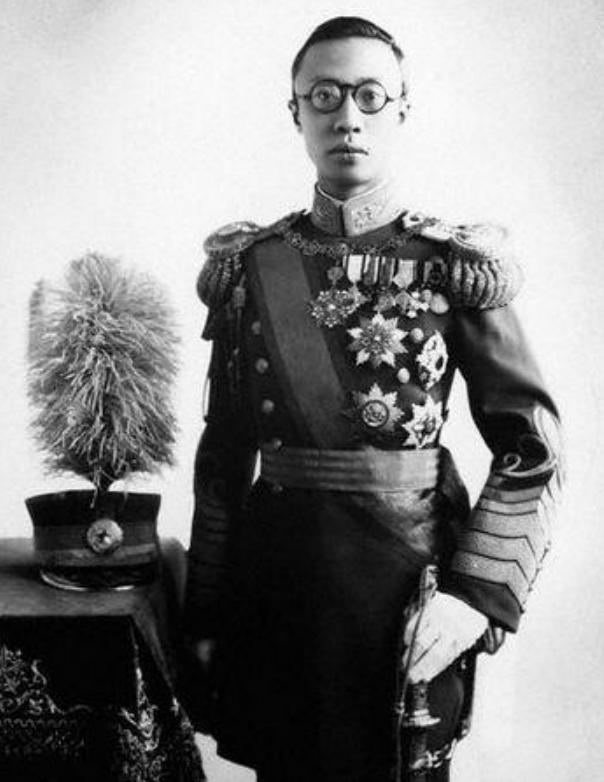
The most enduring version, repeated from article to article, is that Pu Yi was not captured empty-handed. In his luggage he allegedly had suitcases and briefcases with jewelry and silver. Then the plot sounds almost like a fairy tale: the emperor hid some of the things in the camp near Khabarovsk, and years later they ended up in the hands of antiques dealers. Thus, the “lost collection” was gradually “restored” through the efforts of collectors.
This legend regularly appeared in Soviet magazines like Rodina, and in the 21st century it migrated to blogs and pseudo-historical articles. It is precisely its traces that can be seen in the “evaluation document”, which was later attached to the letters to the editor: there things were described as if they really were part of Pu Yi’s personal luggage.
Scientists perceive this story with obvious disbelief. A leading researcher at the Institute of Oriental Studies of the Russian Academy of Sciences, in a conversation with a Chronicle Media correspondent, notes:
“On the one hand, Pu Yi was truly a collector and aesthetic person. He may have been interested in silver, although this is not typical for the Chinese tradition. On the other hand, he was arrested on the plane while trying to escape. It’s unlikely that he carried a collection with him; his luggage was minimal.”
Art critic Konstantin Akinsha expresses himself even harsher:
“Can you imagine the Chinese emperor running around the camp and hiding treasures like a squirrel?”
Both experts agree on the main thing: the story about the “suitcases” is beautiful, but unprovable. It is convenient for those who want to legalize a collection of dubious origin.
One thing is important here: the treasure myth is not just “folklore”. It works as a universal excuse. Any selection of silver objects, any collection without clear provenance, can be “glued” to the name of Pu Yi. The very brand of the last emperor becomes a stamp of authenticity.
This creates an illusion: what we are looking at is not a collection of random artifacts from the 1950s, but “relics of the Qing Dynasty.” And then there is only one step left - to attach the signature of an authoritative expert and name the amount with six zeros.
In 2023, this legend collided with reality, but not in a newspaper publication or in expert papers, but on the Ukrainian-Polish border.
Examination of the myth
In the summer of 2023, the story of the “last emperor’s silver” received a new lease of life. Employees of the Security Service of Ukraine (SBU) and the State Customs Service detained cargo heading to an exhibition in Prague. The invoices read: “museum items.” The declaration is even simpler: “not cultural values.” This formulation exempted the need to obtain permission from the Ministry of Culture.
But the boxes with this cargo contained the same “imperial collection”, which various intermediaries valued at either $400 million or €480 million.
This circumstance destroyed the Mariupol version of the origin: the collection was not in caches taken out of the occupied city, but in the Kiev Platar Museum.
The Platar Museum, associated with politician and businessman Sergei Taruta, insisted : everything is legal. The package of documents included an agreement with the Czech gallery Galerie Gema, the conclusion of the Lviv National Art Gallery named after Boris Voznitsky and certificates from the Ministry of Internal Affairs. The latter argued: the sabers from the collection do not belong to edged weapons and can be freely exported from the country.
The official version looked convincing. But the contrast between the “worthless” artifacts in the customs declaration and the hundreds of millions in the “valuation document” was too stark.
The SBU ordered a re-examination. And it was she who became the turning point of the whole story.
The editors of "Chronicles.Media" were able to familiarize themselves with the results of the examination. Most of the items turned out to be... products of the mid-20th century. Sabers, goblets and decorations were made in the 1950s, often from synthetic materials.
The collection turned out to be heterogeneous: there were objects from mainland China, from Tuva, from Minusinsk, from the Pacific coast. Experts considered only five objects to be cultural values.
The main conclusion was merciless: these things have nothing to do with Emperor Pu Yi and the Qing Dynasty. And the millions in estimates are the result of inflated costs, not real value.
But the main question remains: if Pu Yi’s collection is a myth, then why were documents, articles, rumors and exhibitions created over decades? The answer lies not in museum windows, but in bank safes and the offices of “valuation” experts.
It remains unclear who exactly and for what purpose continued to spread the story about the “Pu Yi collection” after the Ukrainian examination cast doubt on it. It is possible that they tried to use the legend to find buyers, investors or intermediaries outside of Ukraine.
Legend price
The history of “Pu Yi silver” is important not only because Ukrainian expertise has cast doubt on the origin of the collection. It shows how the market for dubious cultural property generally works.
In the post-Soviet space, such schemes have been turning legends, expert opinions and big names into assets worth hundreds of millions of dollars for decades.
In this system, what was most important was not the artifacts themselves, but the documents that confirmed their “value.” They were the ones who opened up access to loans, insurance, exhibitions and potential buyers.
And although Ukrainian expertise has virtually destroyed the myth of the “treasure of the last emperor,” the technology itself, apparently, continues to work today.
Dmitry Sukharev