
Translated material
Rhetorical pump
The weaker the law, the more menacing the speeches against relocants

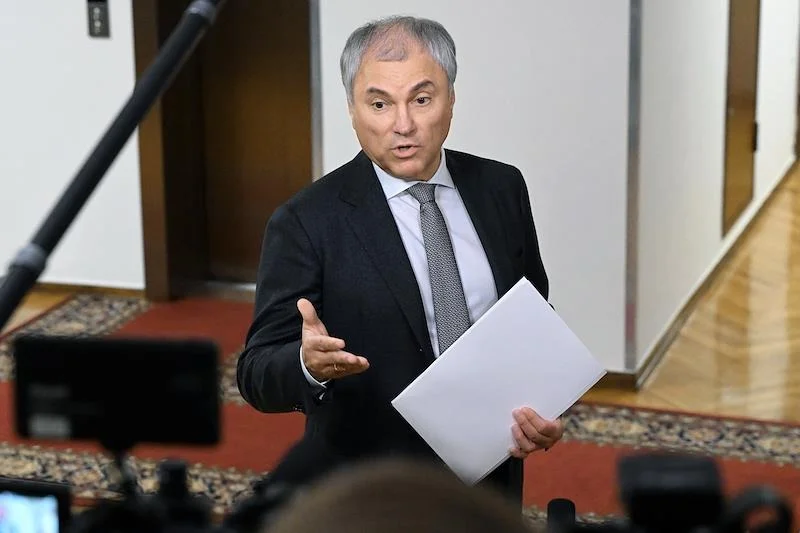
State Duma meeting. Photo: Press service of the State Duma of the Russian Federation / TASS
State Duma Chairman Vyacheslav Volodin did not skimp on terrible words when speaking about the law adopted by the Duma on Tuesday on administrative fines for “scoundrels” who left: “Anyone who gets lost, commits an offense, and then continues to discredit... must understand that he can lose not only his Motherland, but also his property, which he has here thanks to the Motherland, the citizens.”
It is unlikely that Volodin did not read the draft adopted in the second and third readings, and if he did, he did not understand. The newly adopted law deals only with arrest, but not with the seizure of property.
Along with the possibility of seizure of all property, regardless of the size of the fine, the main innovation of this law is the possibility of trial in absentia within the framework of the Code of Administrative Proceedings of the Russian Federation for “actions against the interests of Russia.” Their list has been expanded: along with failure to comply with the legislation on “foreign agents” or participation in the activities of an undesirable organization, a fine can now be imposed, for example, “for abuse of freedom of mass information,” expressed (again, for example) in “dissemination... of information that offends human dignity and public morality, expressing clear disrespect for society...”.
But, firstly, the seizure of property implies a ban only on disposing of it (selling, donating, leasing), but not using it:
Thus, relatives and friends of the relocant who live in it legally cannot be evicted from the apartment; he himself has the right to use the apartment (and car) if he temporarily returns to his homeland.
Secondly, the seizure of property to ensure payment of a fine is in any case a temporary, and ideally, if the courts and bailiffs work as expected, even a short-term measure. The arrest must be lifted after paying a fine, the amount of which rarely exceeds 100 thousand rubles, and in most cases ranges from 5 to 30 thousand rubles. The fine can be paid according to the details specified in the receipt, both by those who are held accountable, and by his representative or any acquaintances.
Such a weak structure must be strengthened by “installing” practices that do not directly follow from the law. First of all, for this, the judges, to whom the relevant materials will be received, will have to, having imposed an arrest, delay the consideration of the case on the merits, and the bailiffs will have to carry out the execution of the penalty by writing it off from the account. In turn, the banks in which the relocant accounts remain will have to be creative in order to prevent them from enforcing the fine.
The Duma is gradually exhausting its imagination on the topic of how else to annoy those who have left. At the legal level, it is difficult to come up with something new, so the emphasis will shift to “installation”. This is why Volodin’s rhetoric is needed:
It is precisely this, and not the law, that judges and other law enforcement officials will focus on when considering cases against “scoundrels.”