Date
Author
Материал Зиновий Зиник Иллюстрации София Хананашвили
Source
Preserved copy
Translated material
Chapter 15. Bone in broth
Any religious cult that borders on idolatry gives rise to its dissidents, dissidents and rebels. In the new parody episode of “The Stolen Handwriting,” the loyalty of our young hero-memoirist Zinik to his spiritual mentor Asarkan is tested in a tense interaction over a plate of broth at Irina Uvarova’s with an experienced student of the wandering philosopher, who is trying to undermine Asarkan’s cult of personality by exposing the fetishism of his old jacket.
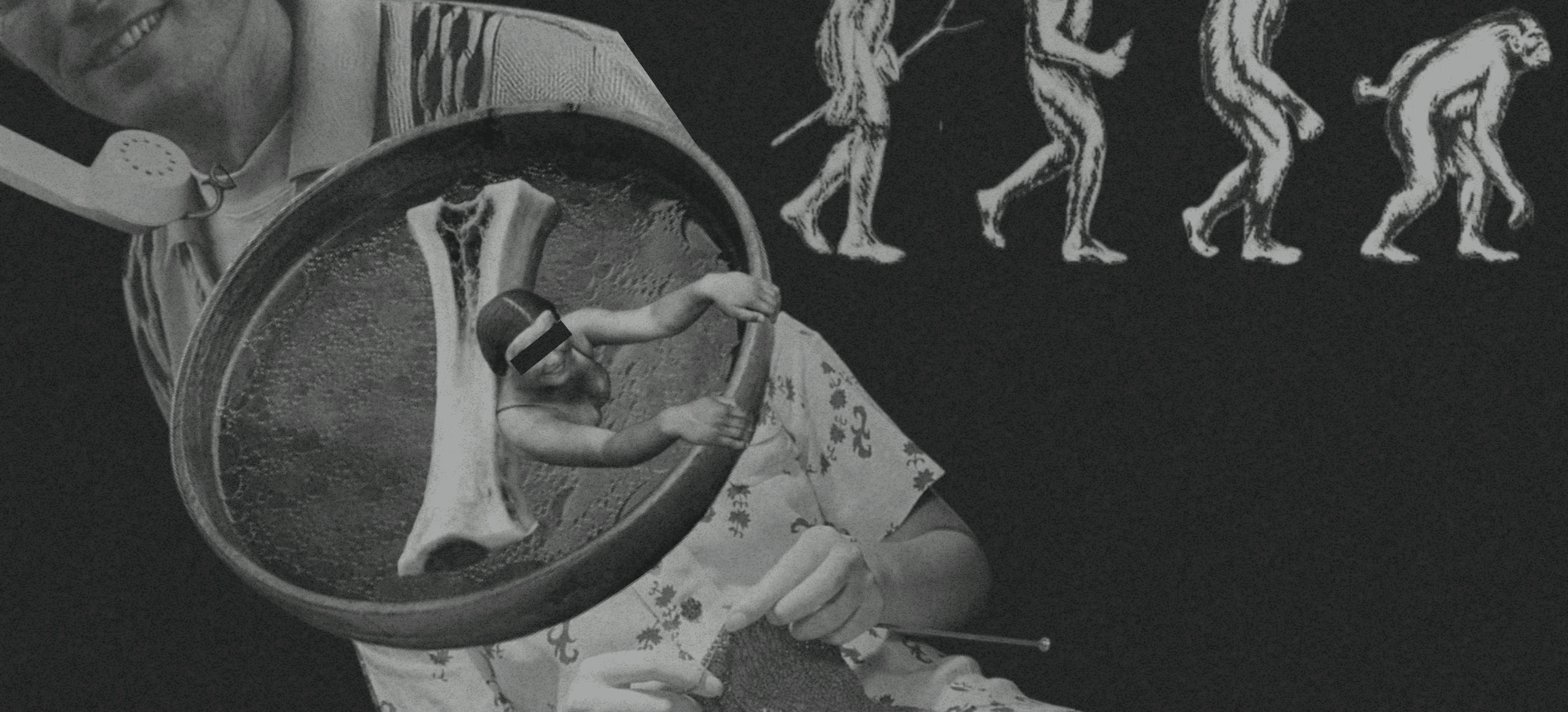
I rose from my chair with an unlit cigarette in my hands. Uvarova also stood up, putting aside her knitting. We moved towards the matchbox in the corridor. At that moment there was a knock on the door, as if warning me not to steal this box of matches. I was dismayed by everything I heard: a great man leaving home, abandoning his loved ones to the mercy of fate, and risky flirting on the part of another great man, while before my eyes there was a scene in the carriage with the intimate diary of a great woman. I was already imagining God knows what. You could write a dissertation on knocking on the door. How to guess who is knocking - a soldier's boot or nervous knuckles? A knock on the door brought me back to harsh reality, like a knock on the door for Macbeth after the murder scene: Uvarova and I were conspirators in exposing the cult of Asarkan. And at the same time - Ulitina. And caught red-handed. What nonsense? Uvarova immediately responded to the knock on the door:
“This is Nevler,” she said. Nevler? And in doubt and in sadness I whispered: “That’s hardly a friend...” Someone croaked: “Nevlermor.” Certainly not Uvarov. This is a joke for Ulitin, invented now. I am sure that he had already made a joke in the same spirit ten years before my meeting with Nevler. A parody of Alik Volpin's parody of Edgar Allan Poe, although I first heard Volpin's recitations much later, in the Aikhenvald family, during the epoch-making concert of Zinovy Voas. I am telling you all this forty years later, and inevitably my current awareness of what lay behind the meeting with Nevler in the past is reflected in the present retelling of these past events. However, the feeling of sadness from the knock on the door arose immediately, just as the feeling that I was in the same intimate compartment of a train to the future with Uvarova immediately disappeared.
“A knock on Nevler’s door is immediately recognized,” said Irina. In the fading beats, she said, pessimism and hopelessness sound. An emanation of sadness penetrates the walls as Nevler approaches. In this knock on the door there is great sadness and the conviction that his expectations will not be met. This knock died away almost immediately. The knocker was convinced that the door would never open when he knocked, that they would not let him in: he was not welcome here. In Nevler's eyes, the world is terrible and nothing good should be expected in this world. Little Sasha and Pashka rushed to the door to answer the knock to check the knocker’s political loyalty. Little Sasha asked Nevler standing outside the door: did he manage to lose his tail? This question sounded like a quote about the lost tail of the donkey Eeyore from Asarkan’s favorite work translated by Zakhoder. Nevler's dull voice answered, not without gloom, that he had no tail. Moreover, as far as he knows, he never had a tail (implying, of course, KGB surveillance). Irina opened the door.
Nevler, the “dead soul” of silk-screen printing, entered the door sadly bowing his eyes down. His coat was covered in wet snow, which the guest threw off in one movement, without shaking, onto the floor and walked into the kitchen. Everything new and unfamiliar, like me, appearing in his life or at other people’s doors, was perceived by Nevler as omens of an impending catastrophe. He passed me, not going around, but as if passing right through me, without touching me (apparently, I stepped aside in time), and sat down on a chair by the window.
"How are you?" Ira asked. “It’s terrible,” Nevler replied, rubbing his hands, “but no one believes me. Everyone thinks I'm something like this. But I don’t at all. I'm dying of hunger." The emphasis was on the word dying. From what? From hunger. That is, the point is not that he is hungry, but that he is dying, and the reason for this is not even hunger, but because there is nothing at all. “I only have meat broth,” said Irina. “Who is Asarkan who doesn’t like? “It’s my pleasure,” Nevler responded melancholy.
“Let's not talk about bones in the broth,” said Irina. Her eye shot towards Nevler - the eye of a large, cautious bird. "And what?" he said, as if answering a question that had not been asked out loud. “Let Zinik listen too: it’s good for him. For the future. And with whom did the tired slave plan his escape? Irina stood at the sink and washed coffee cups. I watched how the muscles of her naked neck tensed under her short haircut. She turned around, throwing a quick, as if testing, glance at me with an ironic smile: they say, dear boy, why are you pretending that you don’t understand what the conversation is about? “I need to have a heart-to-heart talk with your Lena sometime,” Irina said, as if it were a matter of course.
I was speechless.
These frank conversations. My parents never discussed their own relationships with each other. My father knew that my mother was flirting with mutual friends, but he remained silent. They were always talking about something else. But the threat constantly slipped between the lines. Until a scandal arose over the slightest reason because of nonsense. It came down to slaps. And even worse. I was hiding behind the screen next to my cot. The incredible - for me - frankness in communication among Asarkan’s friends was now no less of a shock. As Aikhenwald said on “Sunday” at the Izmailovo menagerie: it is assumed that everyone already knows everything, and if they don’t know, then they will be informed during interrogations by the security authorities, because everything, of course, is taken into account, everything is written down. Or was all this frankly said by Irina in front of me, so that I would convey it to the right place - that is, to Asarkan? These are all metaphors, of course. You had a different hypothesis. This inability to hide anything from each other was not just a protest against bourgeois hypocrisy, but an impulse of self-exposure. The desire to be naked, Dostoevsky would say.
We sat in silence. Silently, because a plate of broth was placed in front of Nevler. He ate the broth. I decided to avoid the broth just in case: after my experiment with the Turkish woman, I was afraid that some absurdity would also happen with the broth: I would certainly do something wrong with the soup spoon, or, God forbid, I would end up with a huge bone in my plate and it would be unclear what to do with it? I sat down next to the table on a couch covered with colorful homespun rags (undoubtedly a museum rarity), under a shelf with decorative art. Sometimes Nevler took his eyes off the plate of soup and looked, squinting, at me. This is how they look at an unfinished canvas. They are looking closely at where to make an additional smear. In his eyes I was obviously a heartbreaking sight.
He began to tear off pieces of bread and throw them into the broth, and when they became soggy, Nevler picked them up with a spoon to put them in his mouth. They, swollen, floated in the broth, like the huge dumplings that Grandma Bertha fed me. “I love dumpling broth,” he said, as if answering my unasked question. Most likely, in his childhood he had the same grandmother Bertha with the same dumplings in the broth. “Do you like dumplings?” I said nothing because I didn't like the dumpling broth. But I ate them because I loved Grandma Bertha. Taking his eyes off the plate, Nevler finally looked at me directly, without squinting evasively. He looked sadly.
“I never trusted smiling, naive faces like Oliver Twist,” he said sadly and doomedly. “The old rogue was right: the perfect face for a pickpocket. Behind such a smile of naivety, I imagine the grin of a future monster. Do you have natural curls? Or is it a wig? he asked. I said that I just haven’t had my hair cut for a long time. “And the eyes - I can’t figure out - are they blue or green?” And suddenly, without transition: “Are you a Jew?” I decided not to answer this question. “So he’s a Jew,” stated Nevler. “I myself don’t mind being included in this tribe. But Asarkan considers himself one of the rootless cosmopolitans. Has he introduced you to Weyland yet? This one is also a rootless cosmopolitan.”
And Nevler, forgetting about the broth, began to talk about the exotic characters in Asarkan’s life, as if this was not life, but a circus. Weiland, he said, is half American Negro - on his father's side, and on his mother's side - a Jew, a street hooligan from Kamergersky Lane, where he was born. That’s exactly what was written in the passport: Negro-Jew. Weiland plays the guitar and wants to perform songs of American blacks, as if his paternal ancestors from the slaveholding South. For this purpose, Sasha Kurepov, who speaks all the languages of the world, teaches Weiland supposedly English. Abracadabra, but with a perfect accent. I said that I had already been present at the demonstration of Kurepov’s multilingualism during Asarkan’s walks from Pushkinskaya Square to the Central Telegraph. “Victor Joels said that you perform in the genre of guitar romance?” Nevler popped another homemade dumpling into his mouth and unexpectedly winked at me conspiratorially: “You could sing a duet with Weiland - give a joint concert at the Artistic cafe. Asarkan the impresario will sell tickets at the entrance together with the doorman Kolya. It will be a heartbreaking sight." There was an inexpressible sadness in Nevler’s eyes. “Joels said that you are studying mathematics at the university? Why do you need to strum your guitar at different feasts in the nightmare of our lives, when the music of the spheres and the symphony of mathematical formulas are available to you? Follow this heavenly music and the entire musical staff of the Universe will open before your eyes!”
Before my eyes, Ira Uvarova changed her position. She sat with her legs crossed. Legs crossed, arms crossed with knitting needles cutting into red sweater. Without looking up from her knitting, she changed legs. Foot on foot again, but in a different order - with the elegance of one-sided surfaces along which my eye traveled without noticing boundaries. I wanted to embrace this surface not only visually. I took a deep breath. The sound came back on. Nevler’s voice reached me: “... the magic of mathematical formulas, Pythagorean numbers, Leibniz monads, infinite fractions, higher mathematics!”
“I don’t understand anything about numbers. I studied the properties of geometric shapes that are preserved under any transformation without breaks or gluing.” No tears or splices? Nevler fell silent and looked at me sadly and suspiciously. “For example, one-sided surfaces, like a Möbius strip,” I explained, looking at Ira Uvarova. Her eyes were drawn into the red sweater. I watched the crease that appeared on the leather skirt where the legs crossed. The leather skirt hugged the hips without tears or seams. “I loved topology in pictures, but as soon as they started using formulas with numbers, and algebra began instead of pictures, I stopped understanding anything.” I don’t know what Nevler understood, but he said:
“In addition to algebra, there is also harmony, divine logic. Do you know Volpin?”
“Volpin is metamathematics.”
“So you had nothing to do with Volpin? What kind of mathematician are you then, you are a one-sided surface! Do you know his memo: how to behave during interrogation?” I admitted that I haven’t been called anywhere yet. Now, recalling the exchange of remarks with Uvarova and Nevler, I am amazed at how readily I accepted the status of being interrogated. It was an interrogation. And I didn't mind. I didn’t say: go to hell, it’s none of your business, I won’t answer! I came up with answers. Moreover, I wanted to please the investigator - he was deciding whether I should describe the atmosphere at the department of topology, where graduate student Golo took my test, riding with me on a boat on the lake in the park of culture and recreation. Graduate student Golo already knew then that I did not understand anything - neither the algebra of one-sided surfaces, nor the harmony of multidimensional spheres. But on the other hand, I could present to Golo the rudimentary ideas of what eventually came to be called Sots Art, and I could share with him my first acquaintance with the art of postcard collage. He could talk about the absence of boundaries between the stage and the hall in Pirandello’s dramaturgy and about Bakhtin’s concept of carnivalism. Now I understand that it was an amazing era: Moscow State University mathematicians imagined that they were not in Soviet Moscow, but in Oxford or Cambridge - among the elite. My involvement in the world of art in the realm of algebra and harmony was more important for my scientific supervisors than any exams and tests. The boat was sailing, and my supervisor was at the oars. I was told which number to put where in the theorem about the multidimensional sphere, and the test was passed. That's how I got my diploma.
I didn’t understand what exam I was taking Nevler - yes, he was seven years older, and when you’re nineteen it’s like seventy. It’s like I’m a first-grader answering test questions from the school authorities. I don’t really understand why I was ready to report and apologize for my wrong steps in life, as if he were the head teacher of the school where they were going to kick me out because I threw a sippy cup inkwell at the chemistry teacher (that happened). Nevler examined me almost medically, kept me under observation, and compared me in his mind with previous excesses. There was a strange counterpoint between his rhythm of speech, quite fast, almost without pauses, like Asarkan’s, and his gestures - demonstratively slow, when every movement seemed to be planned in advance. He had the role of an observer - no: a contemplator, recording in his mind everything that appears before his gaze, but keeping his opinions to himself. It was like I was in front of a camera in a fashion studio and I wanted to please the photographer. I think this is the essence of the tragedy of my life: I want to please everyone - especially those who clearly do not like me. I read in memoirs about Mayakovsky, it seems that Lilya Brik said about his hobbies: he especially passionately sought the love of precisely those women to whom he was completely indifferent. But I’m not Mayakovsky, am I?
I wanted to light my cigarette, half crumpled in my fingers, and looked for matches with my eyes. Nevler put down the spoon, took a lighter out of his pocket and lit it, reaching across the table, under my nose. I pulled away in fear. It was a huge, military-looking lighter, similar to a gas burner. But I didn't know where to throw the ashes. He reached for the vase on the table next to the ottoman. Irina with a quick gesture snatched the vase from under my cigarette. “This is an Etruscan bowl from the bottom of the Black Sea - a gift from Feodosian fishermen,” she said, putting the bowl away from me. She offered me her ashtray made of plastiglas with pockmarks from the cigarette butts that had once been extinguished in it. “Be careful with the cigarette on this couch,” she said, “Asarkan once dropped a burning cigarette into the gap between the backrest, and we had to turn this couch upside down with its legs to remove this smoking object between the decorative pillows. Thank God I noticed it in time. It could have ended badly. And Asarkan - what! To the grief of all the bourgeoisie, we will fan the world fire.”
“You notice, Irina: Zinik shakes off the ashes, like Asarkan,” Nevler said, as if I was not in the room, while carefully observing the movement of my hand with the cigarette. “Asarkan’s gestures, and intonations, are essentially the same as Ulitin’s. Or is this Ulitin’s parody of Asarkan’s gestures and intonations? Give me some broth,” and Nevler handed him the plate. Irina put her knitting needles aside and armed herself with a ladle.
“You got a big bone. Do you mind? she placed the plate in front of Nevler and returned to her knitting.
“This is cultural Bolshevism,” said Nevler, stirring the broth with a spoon. “If you listen to Ulitin, words, gestures, it’s all public property, they fly in the air, around cafe tables, like balloons at a demonstration. We catch them like butterflies with a net on the common lawn.”
“My books don’t fly through the air,” said Irina. “For these new Bolsheviks, not only words, but also other people’s books are public property. If such an anarcho-communist likes a book, he takes it off the shelf, takes it away and never returns it.” I covered Dostoevsky’s “The Teenager” on my lap with my sleeve.
“Why be surprised?” Nevler said. “Asarkan himself cuts old books into postcards. Especially beautiful books. Old and new. He sees beautiful printing - and immediately has to ruin it: with newspaper inserts, comments in the margins, or right under the scissors - on postcards! This is not a collage or pastiche. This is vandalism."
“Asarkan not long ago brought me to the house of Moscow vandals. Another family of his benefactors and philanthropists collect icons and travel abroad,” said Irina. “I was seated in the supposedly most honorable place at the table. It turned out to be an uncomfortable place, hard. And it's cold ass. This chair is made of forged metal, made of openwork filigree cast iron. I took a closer look: this is clearly a ritual chair - Estonians place them on graves. For meditation. And they put me on this grave, so to speak. There are dead faces at the table. And Asarkan reads his sermons. I never went to that house again.”
“This is vandalism,” Nevler said. “These vandals need to bring everything high down to themselves. I'm going to write an essay about Soviet vandalism called "The Culture of Rudeness."
“This is not even vandalism - this is looting!” Uvarova said. She concentrated on her knitting for a moment: she picked up a loop that had slipped off with her knitting needle. “At Asarkan’s request, I recommended Kurepov for the role of a footman in a play based on Bulgakov’s Moliere. After the performance, this polite young man with a steely, insolent gaze appears at my door. A dish comes out from under the floor somewhere. Porcelain with silver inlay. As a gift to me, you see. As a sign of gratitude, supposedly for the years of our friendship. Friendship? I suspect he was paying for a favor, like a box of chocolates for a local doctor. I looked carefully at this dish and realized that it was a ritual utensil: from the Jewish Sabbath, judging by the ornament, either for washing hands or for matzah. The subject, in short, is consecrated. Sacral. I asked where I got it. He began to spew some nonsense about a warehouse of forgotten things, about almost a landfill, where there were various old things. If, he says, the dish doesn’t suit me, he can find me a wonderful samovar, also with inlay.”
I guessed where this dish with inlay came from. Obviously from the shop of Georgy Ivanovich Moreno. Or maybe he picked up this item in a house where someone’s Jewish grandmother died and the heirs are getting rid of all the “junk.” The moment came when I had something to say about dishes and samovars, exchange my experience of communicating with a junk dealer from the Tishinsky market, boldly and authoritatively insert my deep thought into the Socratic dialogue between Uvarova and Nevler:
“The progressive intelligentsia once threw samovars and all their old stuff into the trash. Now give them everything ancient, Slavic, ritual and church. Spinning wheels, icons and all kinds of bronze - palekhs, candlesticks, mortars and pestles, samovars,” I said, trying to sound ironic, like Asarkan.
“Did Asarkan say that?” Nevler asked after listening to my maxim.
“No, this is the thought of a junk dealer at the Tishinsky market.” I let it slip. I had to mention the visit to the antiquities shop with Asarkan on the way from Pushkin Square to Yoels.
“So Asarkan is now wandering around the shops of the junk dealers? What is he looking for there? A mortar and pestle?
“No, he wanted to get rid of the bear coat that Joels gave him. Ulitin claims that it could have been a fur coat donated by American Jews to Stalin through Mikhoels.”
“Have you measured it?”
"Yes. It's very difficult to wear. Perhaps Mikhoels was killed wearing this fur coat.”
“How much did you get? Not for the murder of Mikhoels, but for his fur coat?”
“Old clothes don’t work these days,” I quoted the junk dealer Moreno. Nowadays, junk dealers work mainly for foreign tourists, I explained with professional aplomb to Nevler and Uvarova. Yves Montand bought women's underpants, but now the clothes don't work, even exotic ones. Like a bear's coat. Bronze is coming now.
“When we needed bronze balls for props, we didn’t go to the junk dealer: Novatsky and I were plotting how to cut off the bronze balls from Yuri Dolgorukov.”
“At his horse,” Nevler clarified (once again). “Not from Dolgorukov, but from his horse.”
“I’m sure that junk dealers would immediately buy these bronze eggs from you.” Heavy bronze sells easily, I explained, mimicking the intonation of a junk dealer. The copper basins walk more slowly, almost at a pace, but they also walk. And the outerwear hangs and doesn’t go anywhere.
“So now, having abandoned mathematics, you are at the beck and call of a junk dealer? Old clothes don’t suit us these days.” Nevler, distracted from the dumplings, glances at me. His forehead, flattened between his short haircut and bushy eyebrows, narrowed even further into wrinkles as if of offended surprise. The eyes periodically peeked out from under the eyebrows, only to drown again in deep and inexpressible sadness. “Why aren’t you wearing Asarkan’s jacket? The first thing all college students wear is his jacket. Have you tried it on?
“Which jacket?” At first I didn’t understand what kind of jacket we were talking about. I always saw Asarkan in the same jacket. And if he filmed it, it was only in an overheated Moscow apartment, like the day Yoels was conceived.
“A gray jacket, similar to tweed, a gift from Joels,” Nevler specified. “From Asarkan’s wardrobe, on his hanger next to his bookshelf.” The word “wardrobe” rhymed with the word coffin. To call a nail in the wall near the door of a den on Khitrovka a hanger and a wardrobe was a strong hyperbole. I realized which jacket was meant and said that I had actually tried it on. But the jacket was covered in dust. I tried to shake it, raised dust, sneezed, and destroyed Asarkan’s postcard collage on the table nearby. Asarkan stopped me in this destructive gesture. He said that it is wrong to fight dust - no matter how much it is wiped or shaken out, it appears again. Dust has a tendency to grow. Asarkan, according to him, is against aggression of any kind: let the dust grow as it wants. “Asarkan wanted to give me this jacket for temporary use,” I said, realizing what was going on.
“To do this, of course, we need to get Asarkan for temporary use. Not everyone succeeds,” said Uvarova.
“But the jacket was too small for me.”
“You are not much taller than Asarkan. I mean, height. But this jacket also turned out to be too small for Asarkan. I was ready to redo it. The art of cutting and sewing promises us new success,” said Irina.
“This art does not promise anyone any new success,” Nevler noted gloomily. “The idea of perpetual redesigning is linked to the general obsession with second-hand items under Soviet rule,” he said. The constant shortage of consumer goods leads to the fact that things from childhood are bought for growth. Sister's school uniform. Older brother's worn-out shoes. Things are passed from grandfather to grandson, and when the grandfather falls into childhood, he receives back his grandson's worn things. Nothing is thrown away. Everything is being refaced. Takes on a different face.
“Like in Asarkan’s homemade postcards?” I said. Irina looked at the teenager with a different look. This teenager should not be underestimated, Nevler probably sadly decided.
“The jacket was clearly not the right size for Asarkan. But it was forbidden to even touch him,” Irina continued. “At one time, Asarkan even walked around Moscow salons in it.”
“Precisely because he looked like a fool,” said Nevler. “Asarkan wants to look even more pathetic, even more of a victim. After all, this is his conscious calculation: to look so that those around him will immediately feel guilty. Especially among his teenage pupils: you immediately want to give all of yourself to the task of saving your mentor.” Asarkan himself quickly got tired of this masquerade and the jacket, like some kind of sacred relic, migrated to the shoulders of his students, Nevler said. “So, by the way, lovers tend to exchange clothes with each other - each of us wanted to put on something tangible that was physically connected with Asarkan. All fans imitate their idol's dressing style. And Asarkan knows this and therefore immediately invites everyone to try on his jacket. Each of us tried to try it on ourselves as a kind of cassock, a priest's robe. This jacket has turned in our eyes - I do not exclude myself - into a kind of shroud of our savior. This mantle, this robe made of Polish tweed became the vestment of sufferers and victims, lonely monks in a world of vulgarity and falsehood. Even Tolya Makarov bought himself a similar jacket in Paris. Since Asarkan became a columnist for “The Week,” he has surrounded himself with a round dance of mysterious characters. Zinik, I would stay away from some of them.”
“Maybe it’s not worth it, Leonid, to paint everyone with the same brush?” Irina said, digging her knitting needles into an unknitted red sweater.
“And yet, even in any of the noblest subspecies - say, Janik’s Izmailovo menagerie on Sundays - there is something in common, something inherited from the original, from Asarkan: the sperm of his thinking, I would call it, like a kind of biological breed,” said Nevler. “I look for logic in cultural phenomena. So, the jacket is like a label, a price tag, a mark of this breed of Asarkan individuals.”
“Where did this jacket come from? Does anyone know where Joels bought it? Irina asked.
“This is a great secret,” said Nevler and swallowed the last dumpling. “Probably couldn’t have happened without your junk dealer, Zinik. When clothes were still in fashion. The degradation of those who wore this jacket has been evident for a long time. Nobody remembers Slavka Repnikov now. Repnikov was the first to show off in this jacket. He also studied foreign languages, had an affair with an American student - she walked on a wire, demonstrating American refrigerators to the Soviet population and Repnikov personally at an exhibition in Sokolniki. He began to mingle with foreigners, cheated on hundreds in Beijing, and read James Joyce. What did you finish with? He's in prison on an espionage case. What foreign language did he learn? Thieves' jargon in the camps! Then Kurepov began to wear this jacket, Nevler continued. “Where will this drama student end up? He becomes disillusioned with the Stanislavsky school, marries a French tourist and plays the role of a footman at the Comedie Française theater. And then he will disappear behind the scenes of eternity. I saw Weiland in this jacket too. He already periodically sits in jail and the sobering-up station. How will Weiland end up pretending to be an American pop star in the Moscow gateways? He will have a dozen wives, two dozen illegitimate children and a whole warehouse of empty vodka bottles. Or maybe they will all meet Repnikov when they themselves get to the camp. It will end very badly. But no one believes me. The cheerfulness of Kurepov, speaking nonsense in every conceivable language of the world, is a heartbreaking sight for me. I believe life is a tragedy and our days are filled with unspeakable sadness. My existential secret is that I don’t make a secret of it, I openly admit: there is no happiness in the world, but there is peace and will. However, sometimes it seems to me that there is no will either, and peace cannot be found even in the next world. What is there? Awareness of this sad truth. It's better to be prepared for the worst. I do not hide this truth from myself or others. Unlike some, I live in a state of permanent sadness. Optimistic hopes are alien to me. It's better to be disappointed than fooled. That's what I wanted to say in a nutshell."
“Lyonik, aren’t you exaggerating the role of the jacket in the development of human character?”
“No, Ir, my dear, look, think about it: you shouldn’t treat this phenomenon so frivolously. You and I are the last formalists. We are members of the editorial board of Decorative Arts. Decorative, you know? Form determines consciousness. We are talking about the secondary nature of someone’s personality, hiding behind someone else’s clothes. Someone else's skin, cassock, shroud. Asarkan himself will tell you the same thing. He is a fan of Mikhail Chekhov. What does this opponent of the Stanislavsky school, where, by the way, Kurepov studies, tell us? Mikhail Chekhov believed that the inner world of a hero can only be understood through external circumstances and attributes associated with this character, with his external appearance. Asarkan passes on the jacket, the outer shell, as an inheritance to his ward, right? But what is the effect of this Asarkan shell? This jacket is a metapsychological Trishkin caftan. By imitating Asarkan’s appearance and gestures, a person narrows his inner world. The richer the external gestures, the more sophisticated the vocabulary, the less mental independence, right? This is the transformation of man into a new breed - a mixture of a monkey and a parrot.”
“You're right, Nevler. It is curious that through this imitation, as in a distorting mirror, you immediately distinguish the key features of the original. A complete set of clichéd Asarkan: all of it “in essence”, “in principle”, “in essence”, “in fact”, with ideas, sayings, paradoxes. But it’s like being in a broken record player: the gramophone needle suddenly twitches and jumps from one track to another, and instead of an operatic aria there is some kind of nonsense - made up of the same grunts, grunts and grunts.”
It seemed to me that Nevler glanced in my direction and then exchanged glances with Irina, who also looked at me, as if checking the effect of her own words. Both understood that I understood.
“Exactly right,” Nevler picked up her thought. “But wouldn’t a simpler analogy be appropriate here, Ir? They live as if under the dictation of Asarkan - like a typewriter under the blows of ten fingers according to the blind method. But sometimes the finger moves one letter or accidentally jumps, the rest move after it according to the same system, and the result is complete abracadabra - but according to the method. A doppelgänger is someone who does the same thing, but in the wrong order.”
“A monkey at a typewriter?” Irina grinned.
"Worse. This is some kind of Darwinism in reverse: not the transformation of a monkey into a man, but, on the contrary, the transformation of a man into a monkey. But perhaps this new species is not the ancestor of the orangutan at all. No. Something different. We know that a person can become brutal. For example, he gets drunk on vodka and turns into a beast. This is understandable. I see the emergence in the future of a completely new biological species. Maybe not even human, but superhuman - some kind of mechanical-electronic apparatus, a colossus with lenses and lenses instead of eyes, with levers and claws under the skin instead of hands. A living bodily robot, seemingly human. This creature will produce a superficial impression of a symbiosis of Asarkan, Ulitin and Aikhenvald in its manners, in its speech, lifestyle and gestures. But the main purpose of the appearance of this monster into the light of day is the destruction of his teachers!
There was silence. I looked at my hands, clutching Dostoevsky’s “Teenager”: as if in a dream, in reality I imagined how my fingers turned into metal claws, no, into jointed detectors, growing cable tentacles from the steel sleeves of a cybernetic robot; I felt my face shrink into the hairy, toothy muzzle of an orangutan, and my throat was covered with green parrot feathers.
“Nevler, you are our Cassandra!” Irina said after a pause. “You forgot about the broth. It’s going to get completely cold.” Nevler carefully fished out a large bone from the remains of the broth and began to gnaw and suck it, sucking out the “rogue” - the bone marrow - with a whistle and gurgle.
“The swindler is the most tender, Ira, the most tender! The most delicious thing is always hidden inside the bone, like the subtext in the style of the iceberg, which Hemingway taught us,” Nevler finally put the bone down. "Nice bone! I haven’t tasted such a bone for a long time,” he sighed and wiped his lips with the back of his hand. “You know, Irina, how keenly I perceive the ugly sides of our reality. Everything seems terrible. Absolutely everything - houses, people, ideas, heaven. Then you wake up, eat some bone broth and think: maybe it’s not so terrible?”
“When are they going to take me home?” Little Sasha asked a rhetorical question (apparently not for the first time), entering the kitchen. And she left melancholy. It was about three o'clock. While I was saying goodbye to Uvarova and putting on my coat, Nevler was talking on the phone next to me: “Pavel, I won’t be able to go to the cafe today. I'm at Uvarova's. Well, yes. And then Zinik. Yes, he’s cute.” Without letting go of the telephone receiver, Nevler looked at me and suddenly smiled. I shuddered.
This smile transformed him beyond recognition. This was a different person, mentally open and understanding everything, who had nothing to do with the ominous prophecies of Cassandra with the bouillon bone. I think smiling is an amazing phenomenon. A person can be all graciousness and goodwill with a pat on the back. But as soon as such an interlocutor smiles, you understand: it’s not a smile, but a knife—they’ll cut you down at the first opportunity. A person can express a lot of the deepest ideas and theories, but as soon as he breaks into a smile, you see: he’s a fool and a simpleton! A smile radically changes your impression of a person; a smile transforms a person in your eyes. A smile is like the transformation, according to Darwin, from ape to man. Nevler seemed gloomy and irritable to me, an aggressive rude person throughout the conversation. I didn't realize that we can perceive sadness and sadness as hostility and contempt.
You ask how I still, forty years later, remember these endless conversations in the houses and kitchens of Moscow? But my memory is not a transcript. I will not reproduce everything that was literally said that day at Uvarova’s.
I created for myself in my memory a certain image of my interlocutors trying to undermine the ideal image of Asarkan in my eyes. I remembered only those words and intonations that corresponded to my fantasies about these people at that moment - and about their attitude towards me. I suspected that they suspected me of false loyalty to the circle of Asarkan, Ulitin, Aikhenvald. Therefore, when I try to retell to you now the entire conversation with Nevler and Uvarova that morning, it turns out that I am recreating the transcript of the interrogation. In fact, I eliminated in my memory everything that interfered with this particular impression of mine about them and their words that day. I created a fiction. I selected and laid out in a certain order, in montage and collage, those remarks that developed precisely this line of their imaginary relationship with Asarkan. And therefore, I remembered only those remarks from Nevler that did not contradict my image of a person settling scores with my main character. I remembered those trains of his thoughts that seemed to reduce the ideal image of Asarkan and Ulitin in my eyes. I suspected them of blasphemy, when in fact it was on their part a heretical desire for freedom from tyrannical theology, a rebellion against the idols, totems and taboos they had created. He and Uvarova tried to find out the dialectics - the causes and consequences - of Asarkan’s unpredictability, his secret director’s techniques in the play of life. They perhaps hoped that they could get from me some unusual view of Asarkan through the eyes of a convert.
Улыбка Невлера перед дверью изменила всё.
Всего этого я тогда ещё не понимал. Я лишь нервно улыбнулся Невлеру в ответ и стал засовывать Достоевского в кожаный ранец эпохи Второй мировой (подарок моего отца-артиллериста), заодно, почти машинально, подцепив коробок спичек на столике у дверей. Распрощался и вышел вон.
Было ещё светло. Снег, успокоившись, лежал, прилежно скрыв всю подноготную московской жизни. Это был чистый день. Я вдохнул чистый воздух, как будто вышел из тюрьмы. Мне было весело. Память о мрачных пророчествах, которые я только что выслушивал, как будто стерлась, как магнитофонная лента. Мне страшно захотелось с тобой увидеться и восстановить в подробностях всё, всё, всё.
Из папки с документами
Открытка Асаркана, полученная через сутки после моего визита к Уваровой:
Не случайно Гнездниковский переулок был выбран М. A. Булгаковым в качестве места для первой встречи Мастера и Маргариты. Именно здесь сам писатель познакомился со своей третьей женой Еленой Сергеевной Шиловской (1893–1970) весной 1929 г. в доме братьев-художников Моисеенко (Большой Гнездниковский переулок Nº 10, кв. 527). В том же здании, Доме Нирнзее, была также московская редакция берлинского журнала «Накануне», который опубликовал работу Булгакова за границей.
Упоминание здесь журнала «Накануне» с публикациями за границей — явный намёк на судебный процесс Синявского и Даниэля. Именно с этого Дома Нирнзее свисает сосулька, убившая любовницу героя повести «Гололедица» Андрея Синявского. Учитывая тот факт, что Ирина Уварова в конце концов стала женой Юлия Даниэля, можно считать эту открытку Асаркана своего рода пророчеством.
To be continued. Предыдущие эпизоды романа — здесь .