
Translated material
A very quiet “Hurray!”
Russian hockey will be returned in parts and for a long time, making a decision on admission to each tournament separately

Channel One Hockey Cup: Russia - Belarus - 3:1. Photo: Kirill Kukhmar / TASS
After the independent disciplinary council of the International Hockey Federation (IIHF) annulled the decision of the main organization to exclude Russia and Belarus from the 2026/27 season, if not euphoria, then something close to it began in the country: “They themselves admitted that there were no grounds for exclusion! Now they must return it immediately!” They are already figuring out which competitions will open first, and options for the composition of the Russian national team for the 2027 World Cup in Germany are already being discussed. And this despite the fact that the disciplinary council, which followed the principle contrary to the position of the IIHF, warned that it did not take sides, there is no talk about the return of disgraced teams, and the annulment does not change anything in the existing system.
Simply the formulation of the refusal “for security reasons” and “organizational impossibility of holding tournaments with the participation of the national teams of Russia and Belarus,” which the IIHF Council habitually operates on the appeal of the Russian Hockey Federation, was considered meaningfully for the first time. According to the verdict of the meticulous members of the disciplinary council, “the safety risk assessment reports provided by the IIHF are not exhaustive and contain only general provisions.” There were not enough “arguments” to substantiate the fact that Russia’s return next season was impossible - as a result, the “case” was sent for re-examination by the IIHF council or congress.
There is progress, but a breakthrough is far away, if it is even possible in the near future - the path to return is not a rough road, but an obstacle course of varying levels of difficulty, old and new.
The Russian side, represented by the Ministry of Sports and the Russian Hockey Federation, initiated and thoroughly invested in the search for legal clues to find and expand a gap in the tough position of the IIHF, one of the most stubborn international sports federations, which rejected any arguments in favor of the return of Russian hockey. Justifications such as “without Russia, hockey is incomplete”, references to the glorious, primarily Soviet, history and the invaluable contribution of domestic hockey to the development of the most popular game, juggling with the names of famous and legendary players, calculations of sociological surveys about the decline in interest in international tournaments, in which Russia has not been present for the fifth year, did not impress the main international hockey body with the word “at all”. Relaxations from other federations were not an example for the IIHF; the December recommendations of the International Olympic Committee to allow young Russians and Belarusians to compete in individual and team events with the flag and anthem were ignored.
The toughness and unshakability of the IIHF’s position towards Russia and Belarus is determined by the leading European national federations. In the formulation “for security reasons”, adopted more than four years ago, no one saw anything vulnerable - they say, everyone understands why Russia found itself under sanctions, but political correctness required a justification as far removed from politics as possible, which was done without a detailed explanation of what these security threats were for the participants, as well as for the organization and conduct of competitions.
And when the FHR, after the decision of the IIHF council on January 21, according to the regulations, filed a complaint specifically with the disciplinary council, it was forced to consider in detail the reason for the next refusal, which followed every year. It turned out that if we consider the issue exclusively from a legal perspective, there is nothing behind the general words, which is what the Russian side caught the IIHF - I believe, not without the help of strong Swiss lawyers who have been painstakingly looking for and sometimes finding weak points in the actions of international hockey bosses for more than a year.
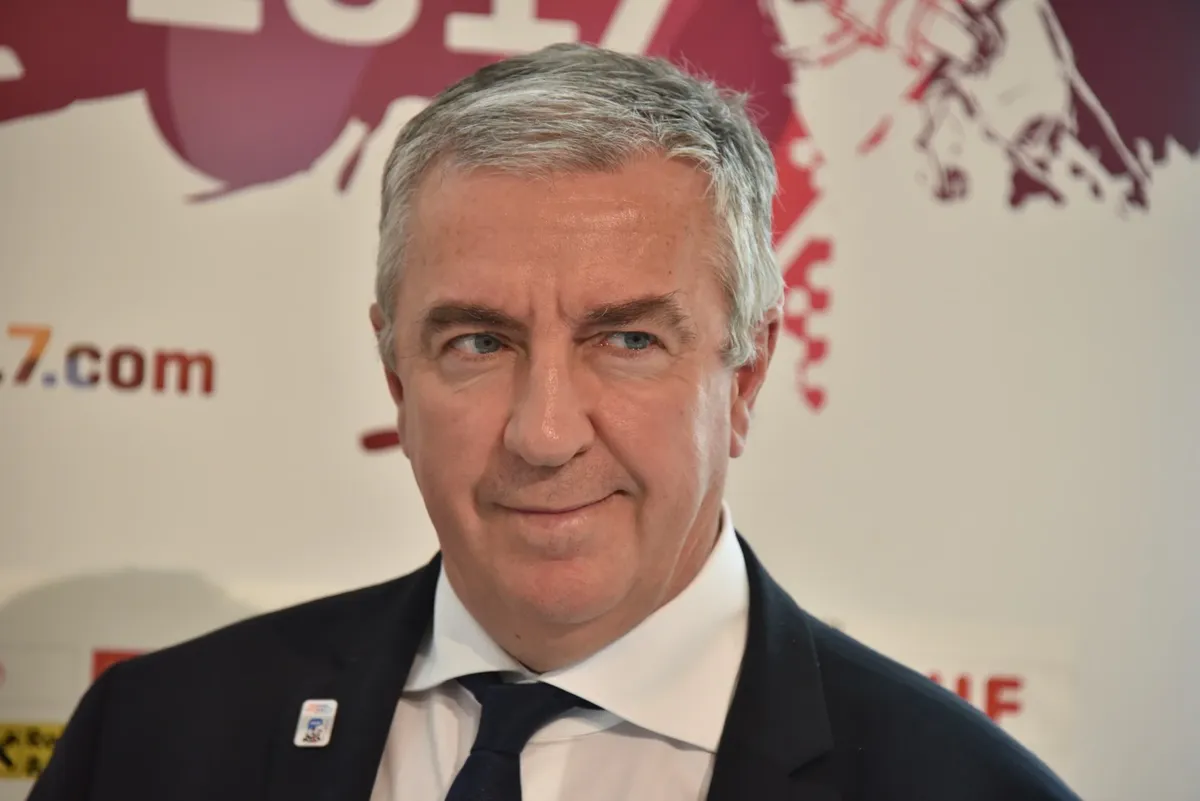
The timing of the appeal was chosen very precisely - in March it became known that the organization’s president, Luc Tardif, who is not considered a supporter of Russia’s return, was resigning in the fall, and the American-Iranian conflict and its echo definitely forced some of the decision-makers to look at the main European conflict a little differently. The IIHF was not ready to provide a reasoned response to the Russian side’s claims in the language of a legal document.
In fact, in order to give the wording “for security reasons” the proper weight, a decoding with very specific examples was required: what the risks are, where, from, when and where to expect threats. Either these could be clashes between fans who are initially and regardless of the sporting event opposed to each other, or these are incidents that can occur right during competitions with the participation of athletes from opposing camps, especially dangerous in contact team sports, or this is a very specific prospect of violating the integrity of the competition due to the refusal of one or more teams to compete with a known opponent...
The fears are not unfounded, but so far only theoretically, because even the simplest threat in the form of a boycott, even if it was realized, was not in title events and only a few times, in team events only once - by the failure of the Ukrainian women's water polo team to show up for the World League match for seventh place with the Russian national team that had recently been admitted to the competition. As a rule, Ukraine protests against any relaxation in the area of admission of Russians and Belarusians and receives support from European countries, but only in the form of warnings about possible non-participation in a particular tournament.
Having analyzed its relative failure, the IIHF may not “strengthen” the refusal formula and try to immediately take revenge in the legal field, but will transfer the resolution of the issue into a long-term tedious process called “neither refuse nor allow.” The IIHF Council, within the framework of the organization’s congress during the 2027 World Championship, has already made an interim decision: it will comprehensively consider the issue from the angle of the operational and sports components and make a decision on the admission or non-admission of Russian teams “separately for each tournament.”
This means that they will most likely start with youth and junior tournaments (Belarusians, by the way, have already been allowed to participate in the 2027 Junior World Championships, which can really be considered a breakthrough) - as a test to clearly check what is possible and what is not.
To assume that the IIHF will go all out in order to lay out the carpet for the Russian national team for a speedy return is more than naive - most likely, it will not be in a hurry. And it is very likely that as the process progresses, more and more specific obstacles will be discovered and arise - and at least in the form of a number of countries refusing to simply issue visas to Russian athletes, and especially fans. And then the IIHF will only have to either throw up its hands or transfer the tournament to another country, which implies that when organizing any competition it is necessary to have a plan “B” with additional costs and logistical problems. As for visits of national teams or clubs to our country, especially the holding of major tournaments in Russia, a refusal with the wording “for security reasons” can hardly be disputed - these are the realities.
...For optimists who already see the Russian national team in Dusseldorf or Mannheim next May, I suggest you think about how this can be done, taking into account the fact that for the first time in 20 years the Ukrainian national team will compete in the elite division, which, along with Kazakhstan, replaces the losers of the 2026 championship, Great Britain and Italy. The Russian national team has not virtually left the top echelon all these years, has a guaranteed right to return as soon as it receives permission, but how exactly can it be returned in almost the shortest possible time and to someone else’s living place - for example, to the place of the same Ukrainian national team, which rightfully won a promotion? And how to solve a bunch of other problems that will fall on the heads of the owners and organizers if, within the framework of one tournament, they have to deal with national teams of countries that are in a situation of tough military confrontation? They, of course, can be separated into different groups and cities, but I’m afraid that at the moment, taking into account all the input, even the best minds of humanity will not be able to technically solve such a problem to everyone’s satisfaction.
It will almost certainly not be possible to return quickly and “fairly” by May next year. Conversations about sports outside of politics, assurances that athletes are not responsible for the actions of the state, have meaning in some ideal world, which we have never had on our planet and never will have.
If we draw analogies with a hockey match, then the process of a full-scale return of Russians to the international hockey family is somewhere in the middle of the first period. There are still two and a half ahead, and overtime and shootouts are possible. It’s just a pity that the generation following super-veterans Alexander Ovechkin and Evgeni Malkin has reached veteran age and is about to begin to fade from the stage, having never played for the national team in recent years.
But this, of course, is not even the biggest problem.