
Translated material
Burka on the rock scene. Five women's voices against forced marriages, bans and silence
Shura Radina
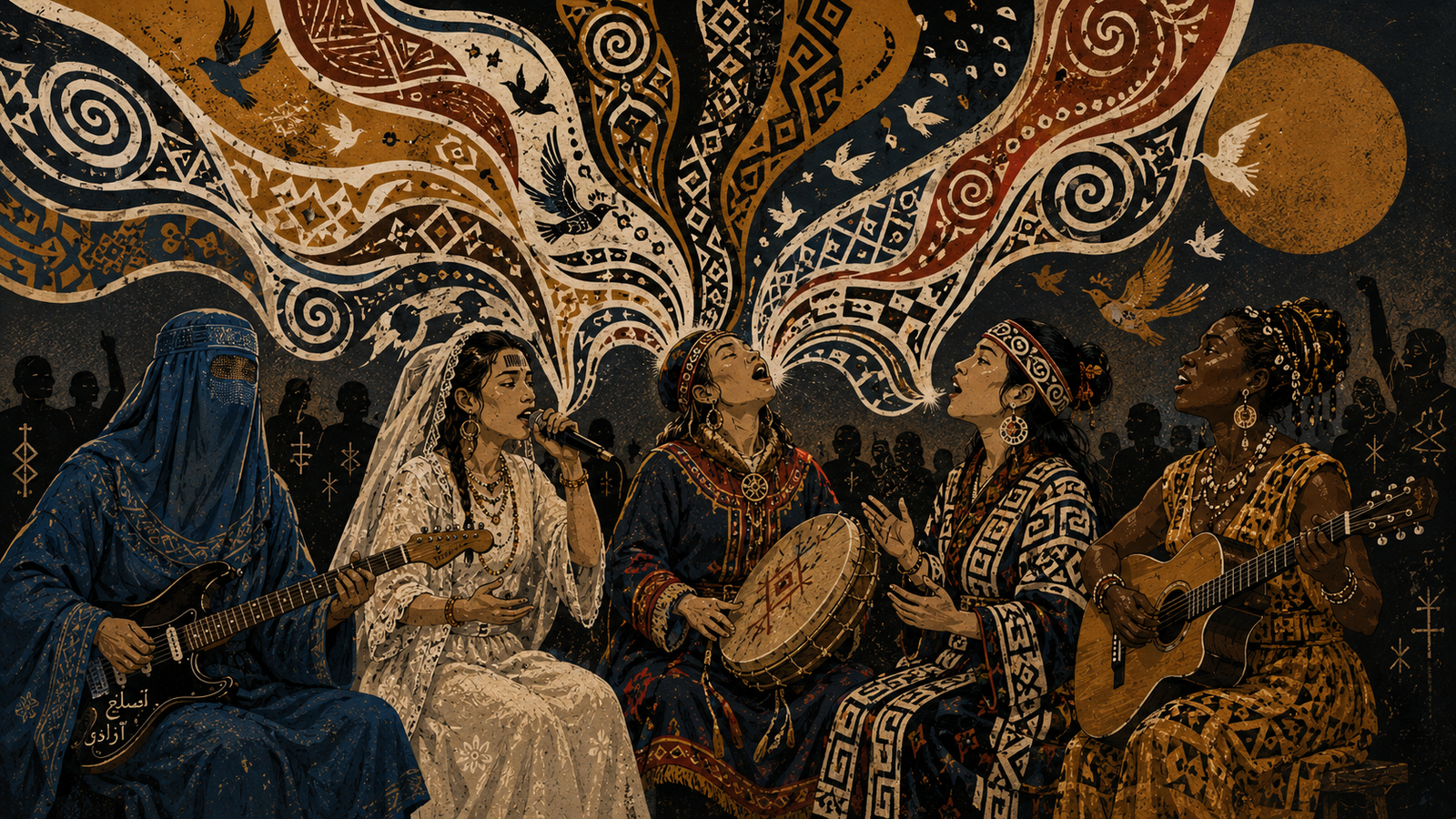
A good girl should be silent. But Sonita Alizadeh put on a wedding dress, drew a barcode on her forehead and recorded a rap about girls who are sold into marriage like commodities. Burka Band took to the stage in blue burkas: not out of obedience, but so that they would not be killed after the concert. Marie Boine sang a yoik, which in a religious family was considered a diabolical activity. The Ainu group Marewrew has brought back to the stage choral songs in a language that Japan has been pushing out of schools for decades.
Journalist Shura Radina profiles five women's groups from Afghanistan, Japan, Norway and Benin who turned music into a form of resistance and challenged enslaving and unjust traditions - despite fear and inhibitions.
Marewrew. Ainu butterflies
“Butterfly” is how the word Marewrew is translated from the Ainu language of Hokkaido.
Marewrew, have been performing since 2005 with Ainu songs “upopo”.
On the northern and largest island of Japan live a people whom Japan has long tried not to notice. The Ainu are "people" (ainu: "noble man", kur: "man"), one of the oldest peoples of the Japanese archipelago: their presence in Hokkaido dates back to the Jomon period, thirteen thousand years BC. Over the centuries, the Japanese imposed taxes that the Ainu by definition could not pay (rice, which they did not grow), destroyed the hunting and gathering way of life, and during the Meiji period, from 1868, began systematic assimilation, to the point that forced intermarriage with Ainu women was perceived as a tool for the literal dissolution of the people into the Japanese gene pool. By the middle of the 20th century, the word “endangered” had become a journalistic cliche. The turning point began in the 1970s–90s: the Ainu entered the international arena, participated in the UN working group on indigenous peoples, sought a revision of ILO conventions, and in 1992 the head of the Hokkaido Ainu Association spoke for the first time at the UN General Assembly, and in 2008 the Japanese government officially recognized the Ainu as an indigenous people.
Marewrew emerged in defiance of the “extinction” narrative. Four women from Hokkaido, singers Rekpo, Hisae, Mayunkiki and RimRim (member of the group until 2022), have taken on the task of reviving the genre of upopo - traditional Ainu songs sung in a choir, in a circle of singing, with voices intertwining and creating something akin to trance. The participants themselves say that they are preserving the disappearing Ainu culture.
Living according to the traditional Ainu way of life is now very difficult,
- Hisae says . She runs a small Ainu museum, where she shovels snow and cleans the halls herself, and also supports traditional art.
The names of the participants are small manifestos in themselves. Rekpo took the Ainu name when she realized that she wanted to sing all her life: “reku” is the throat, “po” is something like “child”, and in general the word refers to bird singing. Mayunkiki made the name from the sound of her Japanese name Mai, a metallic jingle, and added “kick” because she wanted no one else to be called that. But behind the beauty of the names there is a question of ethnic identity, which each of them solved in their own way. Here Rekpo recalls how for a long time she could not sing Ainu songs with complete openness, as if something was holding her back and not allowing her to open up on stage, perhaps some shame or a reminder of the unstable position of her people. The turning point was contact with the indigenous people of Taiwan when she saw that they were singing confidently and openly, without apologizing for their status.
In Japan, many people do not even know who the Ainu are. And seeing people who are proud and open about who they are has been a huge inspiration to me. After that, I told myself: I need to behave with dignity.
Singer Kawamura Hisae says that she focuses on old recordings:
It's not necessarily a beautiful voice, but I find it incredibly attractive.
We are always on a very fine line; we cannot say that this is a tradition, but we cannot say that this is not a tradition. This space is Marewrew,
— shares Rekpo. Marewrew tour all over the world: Taiwan, Australia, Germany, USA. In 2020, their songs were featured in the Netflix series Juon: Origins. In 2024, the collection "Ukouk" was released - a twelve-year archive of recordings, from boat songs to bear ceremonies. But the participants themselves emphasize : popularity is not an end in itself.
For those who got to know us and were inspired by us, I want them to delve into their own [culture]. It doesn’t matter what country, what region: there is no place where there is no culture. And it is not that only one culture is beautiful. To say that only one thing is beautiful very easily gives rise to prejudices and misconceptions. Since you have met us, let this be a reason to think: what about others?
Burka Band. Feminist punk from Afghanistan
Afghanistan's first female rock band, performing anonymously since 2002.
In October 2002, the Goethe Institute organized a music workshop in Kabul, the first since the fall of the Taliban regime. A German drummer gave lessons at a state music school. One young woman, believed to be named Nargiz (participants remain anonymous for security reasons), was so inspired that she immediately began learning to play. Two more girls joined her, and Burka Band was born.
They put on blue burqas, which became several symbols at the same time: on the one hand, protection in a country where female musicians risked their lives, on the other, ridicule, because it was the blue “shuffle” burqa that Afghan women were forced to wear under the Taliban. By wearing it on stage, the girls symbolically expressed their protest against conservative groups and the remnants of the Taliban regime.
Of course, singing in burkas was a joke, but at the same time it was necessary to wear them. If people in Afghanistan knew who was part of the burqa singing group, we could be attacked or killed, because there are still a lot of religious fanatics here,
- said a group member.
The debut single “Burka Blue” was recorded directly at that workshop in 2002, the album was released in 2003 on the German label Ata Tak. Musically, it was straightforward indie rock, cheap guitars and simple rhythms.
You give me all your love
You give me all your kisses
And then you touch my burqa
And you don’t know who’s underneath it!
The group toured Europe, performed in Germany, and gained fame on the continent in the mid-2000s. In 2021, with the return of the Taliban to power, the group ceased to exist.
There were unconfirmed reports that the lead singer had left for Pakistan. What happened to the rest of the participants is unknown. But recently their lyrics have become relevant due to the ban on women's education and conversations in public places:
Now freedom is over.
My prison is my room.
My life is a computer
And there's nothing more to do.
Sonita Alizadeh. Afghan rap about forced marriage
She announced her refusal to get married through music and has been performing since 2014.
Sonita Alizadeh was born in 1996 in Herat, during the last year of the first Taliban rule. Her childhood was marked by escape; the family walked hundreds of kilometers through the mountains to Iran. In Tehran, Sonita could not go to school; Afghan children without documents were not allowed there. Signs “No Afghans allowed” stood at the gates of secondary schools. She learned to read and write at an NGO for refugees. It was there that I discovered poetry. And then I heard Eminem.
I finally figured out how to tell my sisters' stories so that people would listen,
- she will say later. At the age of ten she was almost sold into marriage; the family changed their mind only because they urgently had to flee. At sixteen, the marriage story repeated itself, the mother called and said that she had found a groom, her brother needed money for his own bride price.
I cry out on behalf of a woman who has been silenced her entire life.
I scream on behalf of a body broken under other people's price tags.
Iranian documentarian Rokhsare Gaemagami gave her mother two thousand dollars in exchange for six months of freedom for Sonita. During these six months, Sonita wrote and recorded “Brides for Sale.” In the video, she appears in a wedding dress, with bruises on her face and a bar code on her forehead. She raps about girls being sold into marriage as commodities by their families. The video was released on YouTube in 2014 and gained millions of views within a few weeks. World media, from CNN to The Guardian, wrote about a refugee girl who saved herself from child marriage by rapping. After this, the NGO Strongheart Group offered her a scholarship to a school in the American state of Utah. The family eventually retreated, and Sonita left to study. In America, she combined music and study, and later entered Bard College in New York to major in human rights and international relations. In 2015, the BBC included her in the list of the hundred most influential women in the world, and Foreign Policy magazine named her one of the leading thinkers of the year.
After the return of the Taliban in 2021, she said :
It breaks my heart that the monsters from my story are back in power. But I want them to know that in all this darkness, Afghan women and girls will not give up.
Star Feminine Band. Glastonbury Stars
Girls from northern Benin who have been producing anthems for women since 2016.
André Balagemont, a music teacher and father of two of the seven participants, opened a girls-only music school in Natitingou, a conservative town in northern Benin. The idea seemed strange even to the neighbors: women here are usually seen as backing vocalists or dancers, and not as those who hold a guitar or sit behind the drums. There are currently seven people in the group ranging from 12 to 19 years old. Marguerite, Julien, Benny, Sandrine, Anne, Yurris and Grasse sing in French, Bariba, Fongbe, Vaama, Pel and Ditammari - such a number of languages is due to the desire to “reach” every village.
We want the world to know that women have rights that must be respected,
- says Sandrine.
Their repertoire includes songs about female circumcision, forced marriage, and the right to education. The debut album of 2020 was released on the French label Born Bad Records. The group performed at Glastonbury and Roskilde - the largest rock festivals in the world. In 2023, UNICEF named them “Young Champions” for their human rights activism.
Marie Boine. The devil's work yoik
Sami voice from a religious family, performing since 1989
Marie Boine grew up in the village of Gamehisnjarga in Finnmark, in the far north of Norway, in the heart of Sápmi, the Sami land. The first music she heard in her life were religious hymns: her family was strictly Laestadian, there were no records or television in the house. The radio was only allowed to be listened to on three occasions: news, weather forecast and Sunday church service. But when the parents left, the children turned the tuning knob and found jazz, rock, music from all over the world. Singing joik, a traditional Sami vocal improvisation, was prohibited and was considered the devil's work. Speaking Sami was also not encouraged: Norway had been pursuing a policy of “Norwegization” for decades, so Marie Boine grew up ashamed of who she was.
When I started, I was an angry young woman. And she had every right to do so,
- she will say later. At first she sang in Norwegian and English. Then she returned to Sami, “ a good language for singing, so rich for the voice,” and Yoik.
The breakthrough album “Gula Gula” was released in 1989, its title translates as “Hear the voices of the foremothers.” Marie channeled her personal and political rage into music that intertwined Sami joik with jazz, rock and folk. The album made her a star first in Norway.
I was never a political activist to begin with, music just gave me a profile and a platform and I used it. By telling my personal story as a Sami, I feel like I am sharing part of the history of my people.
The following decades were a continuous work at the intersection of art and activism. She collaborated with Jan Garbarek, Peter Gabriel, Bugge Wesseltoft. She wrote music for the film “Kautokein Uprising” about the Sami riot of 1852. She received four Spellemanprisen - a Norwegian Grammy, a Nordic Council Award, and in 2009 was elevated to a knighthood of the Order of St. Olav, first class. In 2024, Alva was released in an attempt to come to terms with her own demons, returning to what she had once left behind: a strict religious childhood and shame.
My hope and my dream above all is that we, the indigenous peoples of the world, who have inherited this wisdom from our ancestors, can preserve our spiritual connection with nature and pass it on to the rest of the world,
— the singer tells Norway Today.
Different voices, but one song
All five stories are about different continents and cultures, but they are united by a common “silence”: an Ainu woman who should be ashamed of her language; an Afghan woman whose body is valued in dollars; a Sami girl who was told that her song was the devil's work and a girl from Benin who was given a place in the background. Music dies not only from disasters, it dies from prohibitions and shame, from “no entry” signs and from the belief that some voices are better off silent. The activism of women who decided to fight for their rights makes songs break through to the masses and convey liberating messages. And as long as there are those who sing, it means that music is not dead yet.